Kosovo, Serbia Experts Duel over Trepca Mine

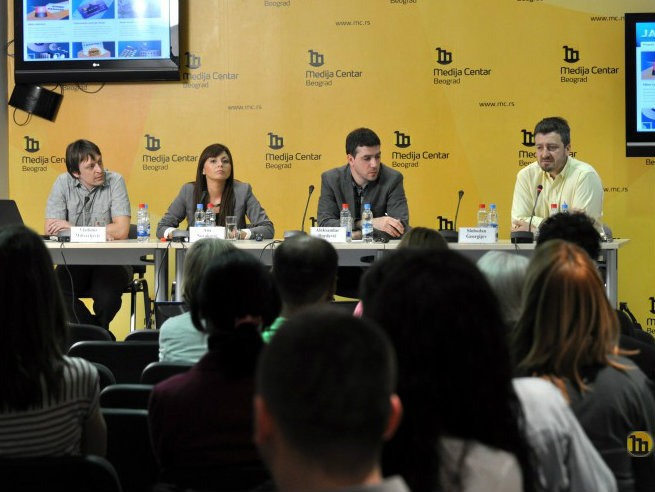
Economists from Kosovo and Serbia debate the future of the disputed Trepca mine complex, in the new episode of the TV debate series “Tema”, produced by Internews Kosovo and BIRN.

Two economists from Kosovo and two from Serbia debated the economic potential of the disputed Trepca mining complex, which according to estimates could be exploited profitably for decades to come.

Panelists agreed that only dialogue can resolve the differences between Serbia and Kosovo over the half-defunct mine and restore production.

Radoman Rabrenovic, director of the Institute of Geology of Serbia, said the reserves of metal resources in Kosovo merit particular attention.

However, according to Rabrenovic, many political questions currently impede the revitalization of Trepca.

Trepca today shares the same fate as the nearby divided town of Mitrovica. In the south, the socially owned enterprise is managed by the authorities of Kosovo.

Assets in the north are managed by an administration installed by the government of Serbia.

The ethnic Albanian former director of Trepca, Nazmi Mikullovci, said that it would take less than 200 million euro to revitalize the company that he managed back in the 1980s.

“To produce metal, Trepca needs 174 million euro, according to a study we conducted in 2005. But the problem is not with money but rather the administrative division between the south and north,” he said.

“We need to overcome this this division and have Trepca function as one entirety; the investment funds are the least of problems,” he added.

 The Trepca complex comprises an 80km-long and 30km-wide network of dozens of active and inactive mines, which are estimated to hold at least 50 million tons of exploitable ore.

Both sides agree that the revival of this industrial behemoth would benefit both economies, regardless of how the current political and administrative problems are resolved.

The deputy president of the Chamber of Commerce of Serbia, Mihajlo Vesovic, said the risk of inappropriate and irrational exploitation of the resources should unite the interests of both Serbia and Kosovo.

According to him, low production levels in the company caused more trouble to Serbia than to Kosovo, as Serbian industry relied heavily on metals produced in Trepca.

Vesovic said the demand for lead and zinc, the two main ores in Trepca, was much greater in Serbia than in Kosovo.

The President of the Chamber of Commerce of Kosovo, Safet Gerxhaliu, said the impact of revitalization would be felt more in Kosovo than Serbia, as it would create at least 10,000 new jobs and exports worth around 300-500 million euro per year.

“In addition to 10,000 new jobs as a direct effect, there would be indirect employment as well, generating roughly over 20,000 jobs. This would have a very positive effect over the next 10-20 years in Kosovo,” he added.

The programme also discussed the economic interdependence between Kosovo and Serbia, where the two chambers of commerce challenged each other on the obstacles facing businessmen in the two countries.

Tema is produced by Internews Kosova in partnership with BIRN in Kosovo and Serbia and supported by the United Kingdom’s Foreign and Commonwealth Office.

The episode will be aired this Saturday, May 25, 2013, at 7pm on TV PINK 2.
BIRN Serbia Journalist Wins Investigative Journalism Award

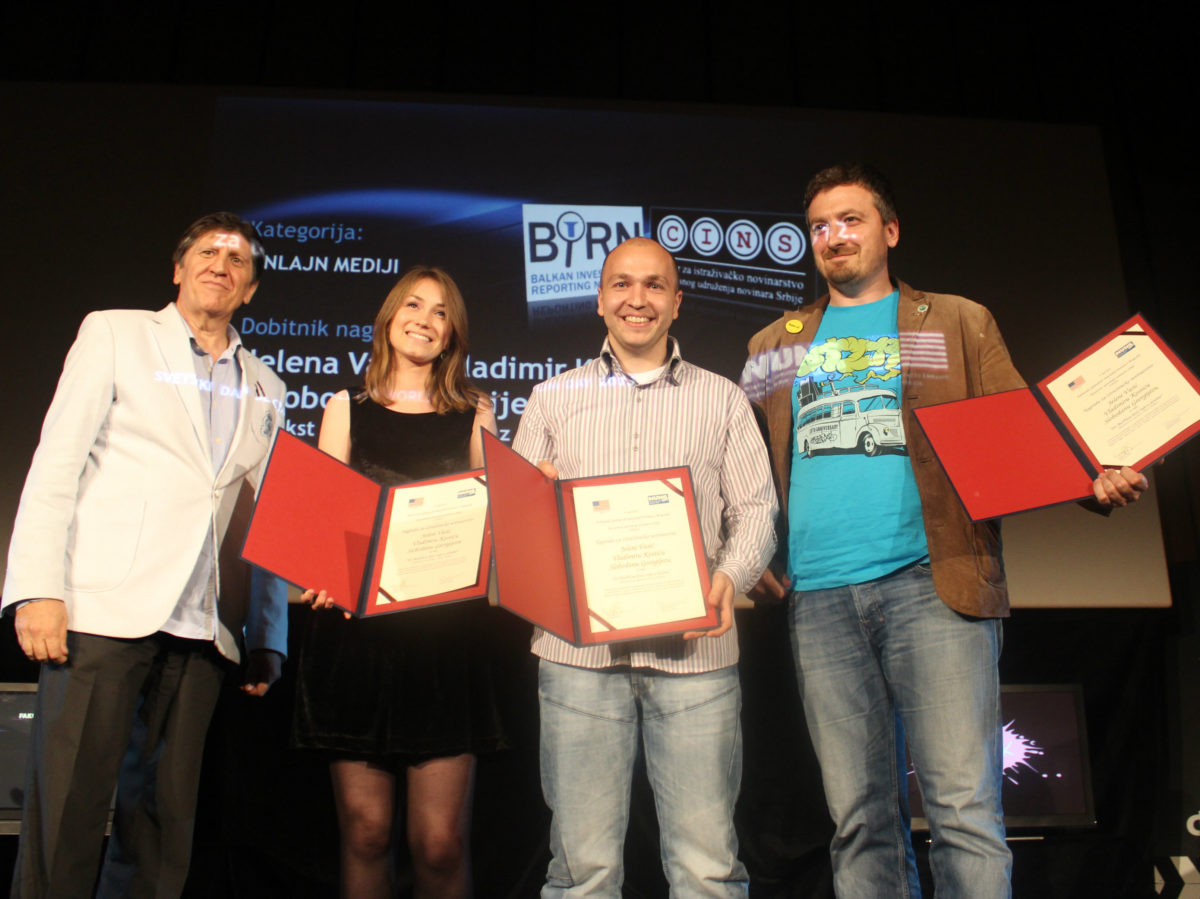
BIRN Serbia journalist Slobodan Georgiev has won the 2013 National Investigative Journalism Award, a prize given by the Independent Association of Journalists in Serbia.

NUNS investigative award

Georgiev, together with Jelena Vasic and Vladimir Kostic from the Centre for Investigative Journalism in Serbia, won in the online media category with their investigation into irregularities in Belgrade’s BusPlus system.

The award in the print media category was given to Sandra Petrusic for her series of articles entitled ‘Hospital Files – Money for Decay’, which was published in the weekly NIN.

In the electronic media category, the award went to Dragan Stankovic and Zorana Jovicic from RTV Belle Amie for their story ‘How 19 Million Was Spent on Konsantin’.

Two more BIRN Serbia journalists, Aleksandar Djordjevic and Ana Novakovic, were nominated in the online media category for their series of articles about Belgrade’s expenditure on promotion. 

Aleksandar Djordjevic was also nominated in this category for his story ‘The Electric Power Industry of Serbia Sends Incorrect Bills’.

The members of the jury were Brankica Stankovic, Milorad Ivanovic, Sasa Lekovic and Branko Cecen.

Each award is accompanied by a prize of 1,200 dollars, and this year 51 journalists entered the competition, submitting 101 articles or contributions.

The annual awards are organised by the Independent Association of Journalists in Serbia and supported by the US Embassy in Belgrade.

BIRN Serbia Stages Javno Database Conference

BIRN Serbia, part of the Balkan Investigative Reporting Network, held a conference on April 26 to discuss its portal Javno.rs, an open and fully searchable database containing thousands of documents on public expenditure (see http://javno.skockajtebudzet.rs/index.php).

BIRN Serbia stages Javno

The speakers at the conference were BIRN Serbia journalists Slobodan Georgiev, Ana Novakovic and Aleksandar Djordjevic, and database programme creator Vladimir Milisavljevic. More than 30 media and NGO representatives took part in the conference.

Georgiev said that the database, which the BIRN team has been compiling since 2010, is primarily meant for journalists and researchers as well as interested citizens. The aim of the website is to make information about the spending of public funds easily accessible to the wider public.

“The databases that have been created will be supplemented every year while new ones will be developed. Soon we will launch two more interesting databases, one containing information on how public health facilities and pharmacies spent funds on different medicines procurement, and the other one containing information on all Vuk Jeremic’s travel expenditures while he was minister of foreign affairs,” said Georgiev.

Novakovic said that all the information contained in the databases was based on requests for access to information of public importance and that it took up to six months to collect all the answers for some of the databases.

“Out of 180 requests sent, 66 were sent to local governments, 60 to ministries of the Republic of Serbia, 45 requests were sent to various public companies and around ten requests were sent to different state institutions such as Public Procurement Office, the Treasury, Serbia’s Investment and Export Promotion Agency and others,” said Novakovic.

Djordjevic described how journalists and researchers can use the information from the database to create new investigative stories.

“These databases are good starting point for further research because you are already given the basic information. This is important because when you want to make a good story, the biggest challenge that you are facing is choosing the right topic,” said Djordjevic.

The idea for Javno came from BIRN but our many partners helped to implement it: from the British Embassy in Belgrade to IREX.

BIRN Serbia journalists shortlisted for investigative journalism award

BIRN Serbia journalists Aleksandar Djordjevic, Ana Novakovic and Slobodan Georgiev have been named as finalists for the National Investigative Journalism Award 2013 by the Independent Association of Journalists in Serbia.

Djordjevic and Novakovic were selected for their series of articles about how much money Belgrade public companies have spent on marketing and advertising since 2008. All these stories can be found at http://www.skockajtebudzet.rs/rs/page/analize.

Djordjevic was also nominated for his investigation into the way that the Electric Power Industry of Serbia sends incorrectly calculated bills to two million consumers every month. His research attracted a lot of attention and a large number of media outlets republished the story. The entire article can be found at http://www.skockajtebudzet.rs/rs/clanak/eps-salje-neispravne-racune.

Georgiev, together with Jelena Vasic and Vladimir Kostic from the Centre for Investigative Journalism in Serbia, were nominated for their investigation into irregularities in the BusPlus system. The story is at http://www.skockajtebudzet.rs/rs/clanak/do-busplusa-kroz-rupe-u-sistemu.

Nominated in the same category are two journalists from the Centre for Investigative Journalism in Serbia for their series of reports about narcotics cartel bosses – editor Stevan Dojcinovic, a Balkan Fellowship for Journalistic Excellence alumnus, and Bojana Jovanovic – plus Marija Magdalena Idei Trifunovic from the website Istinomer.

The Investigative Journalism Award is organised by the Independent Association of Journalists in Serbia and is supported by the US Embassy in Belgrade. The winners will be announced on Media Freedom Day on May 3.

Southern Serbian Cities and Municipalities Join ‘Europe – That Is You’ Campaign

Representatives of the Delegation of the European Union’s delegation to Serbia, the Serbian government office and EU’s PROGRESS European Partnership with Municipalities Programme sent out a message to mayors and heads of municipalities in south and south-west Serbia, saying that the amount of donations they will get in the coming period depends on their abilities and competence, which is why it is necessary to strengthen the capacities of the local administrations so they can respond to the challenges of EU integration in the best possible way.

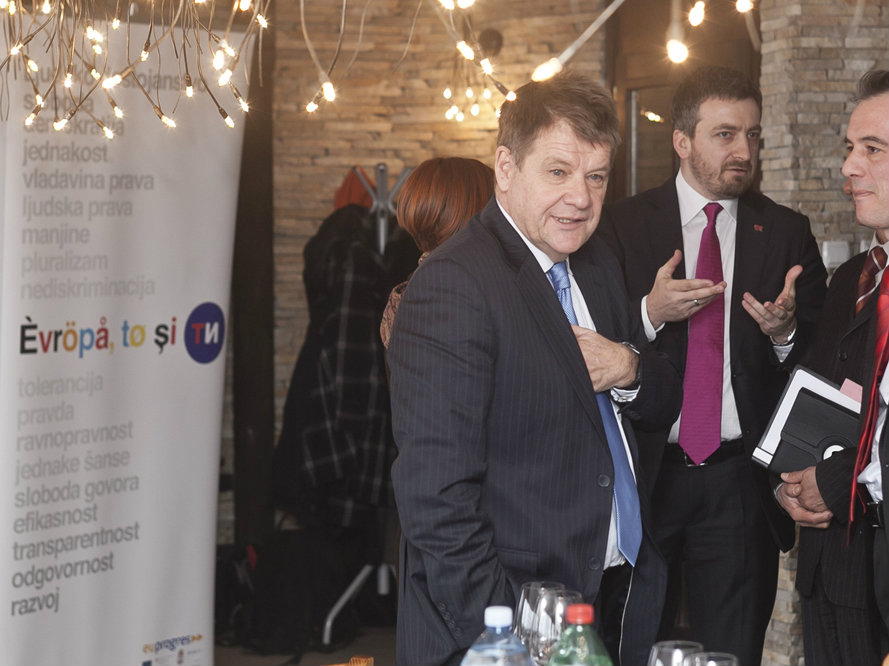
A working lunch took place on March 22 in Topola in Serbia to mark the beginning of the ‘Europe – That Is You’ campaign. In attendance were mayors and heads of 25 cities and municipalities in south and south-west Serbia, from the Pcinja, Jablanica, Toplica, Zlatibor and Raska districts, and they all voiced their readiness to support the activities aimed at bringing Europe closer to the local communities that they represent.

The deputy head of the EU delegation to Serbia Adriano Martins confirmed the European Union’s resolve to give Serbia strong support on its path towards European integration and said that the coming period will be marked by an even more intense cooperation on initiatives coming from underdeveloped or insufficiently developed regions.

“EU funds are open to all projects whose foundation is the development of your communities, inter-municipal cooperation or the strengthening of cross-border initiatives. We will be together on this job and all EU institutions that have their representatives in Serbia will stand at your disposal. However, you are the bearers of these projects and initiatives,” said Martins.

EU PROGRESS manager Graeme Tyndall commented on the results jointly achieved by his team and the local administrations by implementing dozens of projects and stressed that south and south-west Serbia have the capacity to respond to the challenges that the next phase of EU integration will bring.

“If over the past three years we have helped you get some important things started in your local communities then our mission has been fulfilled. However, what is crucial is the depoliticisation of development. The important thing is not that the local president launched a project but for that project to be in the benefit of all members of a community and for it to be successfully completed,” said Tyndall.

European Integration Office director Milan Pajevic spoke about the importance of cooperation between local government units and state institutions. He explained his institution’s role in the system of allocating donor assistance and voiced readiness to assist, with his team, local administrations in improving ways of accessing European funds.

“It is important that we understand each other well and that we know what our goals are. I believe that this campaign will help us get there. The European Union’s support is already noticeable in local communities and we will make efforts to ensure that this also continues to be the case in the coming period,” said Pajevic.

Representatives of the cities and municipalities spoke during the working lunch and had many comments on the cooperation established so far with the EU, the EU Integration Office and the EU PROGRESS Program.

The overall conclusion was that the projects funded by the European Union, the Swiss government and the Republic of Serbia through the programme have produced results which have given the people in local communities a new energy, improved their living conditions and equipped the local administration with new strength to work even more decisively on developing these cities and municipalities.

„You helped us obtain funds so we could improve our people’s quality of life and, by doing so, you made our work easier,” said Jovan Corbic, the president of the Municipality of Raska.

“It is our job to set up a good team, a team skilled in producing developmental projects. Only then can we say that we have been successful in our work,” added Semsudin Kucevic, the head of the Municipality of Tutin.

BIRN Serbia Launches Website “JAVNO”

The Balkan Investigative Reporting Network (BIRN Serbia) launched a portal called Javno.rs, an open and fully searchable database containing thousands of documents on public expenditure, on March 28. The link for the site is http://javno.skockajtebudzet.rs/index.php.

The database that the BIRN team has been compiling since 2010 is primarily meant for journalists and researchers as well as for all interested citizens. The aim of the Javno.rs  website is to make information about the spending of public funds easily accessible to the wider public.

Javno is devised as a constantly growing resource that is regularly updated. The databases that have been created will be supplemented every year while new ones will be developed, covering fields of interest that we assess as murky areas of public expenditure or as potential generators of corruption in Serbia.

The website currently contains six databases:

1. Discretionary expenditures of the Serbian government, containing information on how the ministries spent public funds on budget lines 423 and 424 Specialised services and Contracted services for 2010 and 2011.

2. Public funds and the media, containing information on how local government bodies financed the media, what particular content they financed, what was the scope of this financing and what criteria were applied during the process.

3. Belgrade promotional costs, a database of the expenditures of the City of Belgrade Administration and city public companies on hiring PR agencies and on promotion.

4. One hundred biggest public procurements, a database of the 100 biggest procurements in the past ten years.

5. Investments for investors, a database on the programme for attracting direct investments to the Serbian state and the employment of new workers over the past seven years

6. 2012 elections, a database of all candidates who participated in the Serbian parliamentary elections in 2012.

The idea for Javno came from BIRN but our many partners helped to implement it: from the British Embassy in Belgrade to IREX.

BIRN and Transparency Serbia hold debate on tackling corruption

As a part of the ‘Monitoring Policies of the Government of Serbia’ project, a conference on systematic approaches to fighting corruption was organised by BIRN Serbia in cooperation with Transparency Serbia on March 20.

BIRN Serbia debate on corruption

The key panelists were Michael Davenport, the United Kingdom’s ambassador to Serbia, Louis Laurent Stokvis, the Netherlands’ ambassador to Serbia, Rodoljub Sabic, the Commissioner for Information of Public Importance, Tatjana Babic, the director of the Anti-Corruption Agency, Radoslav Sretenovic, president of the State Audit Institution, Radomir Ilic, special advisor at the justice ministry and representatives of other independent bodies. More than 50 state, NGO and media delegates took part in the debate.

Michael Davenport said that Serbia, with a corruption perception index of 39, is in 80th place out of 186 countries and is recognised as a highly corrupt country.

He emphasised the importance of independent bodies such as the commissioner, the ombudsman, the Anti-Corruption Agency and the State Audit Institution in the construction of high-quality anti-corruption mechanisms.

“All these bodies submit to the parliament their annual reports in which they indicate the identified problems and recommend how to resolve them. In that way they are helping parliament to fulfill one of its main roles, which is the control of the executive branch, and enable better public insight into the work of independent bodies,” said Davenport.

Louis Laurent Stokvis said that parliament has a key role to play in the fight against systemic corruption. He stressed that no country can be satisfied with a high corruption index, especially Serbia, which aspires to join the EU.

“The government and parliament can work together to eradicate corruption and it is necessary to create a practical structure for the systematic fight against corruption,” said Stokvis.

Rodoljub Sabic pointed out that it is a serious problem for democratic society if Serbia does not implement the conclusions made by parliament.

“After parliament has considered the reports of independent institutions and reached a conclusion about them, they become official. It is necessary to have a mechanism to implement these conclusions in practice,” said Sabic.

Radoslav Sretenovic, president of the State Audit Institution, said that the most frequent problems arise during the implementation of the law on public procurement. Sretenovic also emphasised that the authorities do not use the right to list public officials’ financial and non-financial assets.

Ana Jerosimic, a representative of the Anti-Corruption Agency, announced changes in the national anti-corruption strategy reporting process, the extension of the agency’s rights in the fields of supervision of the implementation of the strategy and more accountability for non-compliance with the strategy.

“The new strategy provides that the duty bearers submit to the Agency semi-annual and annual reports, as well as evidence of activities carried out. If the agency is in doubt whether something is done, it will have the right to seek additional verbal explanations,” said Jerosimic.

The conference was the third in a series of public debates addressing topics like corruption, health, education and the economy. The debates are part of the BIRN Serbia’s project to monitor election campaign promises.

The conference was organised with the support of the embassies of the United Kingdom and the Netherlands to Serbia.

BIRN Serbia begins journalism training within EU PROGRES programme

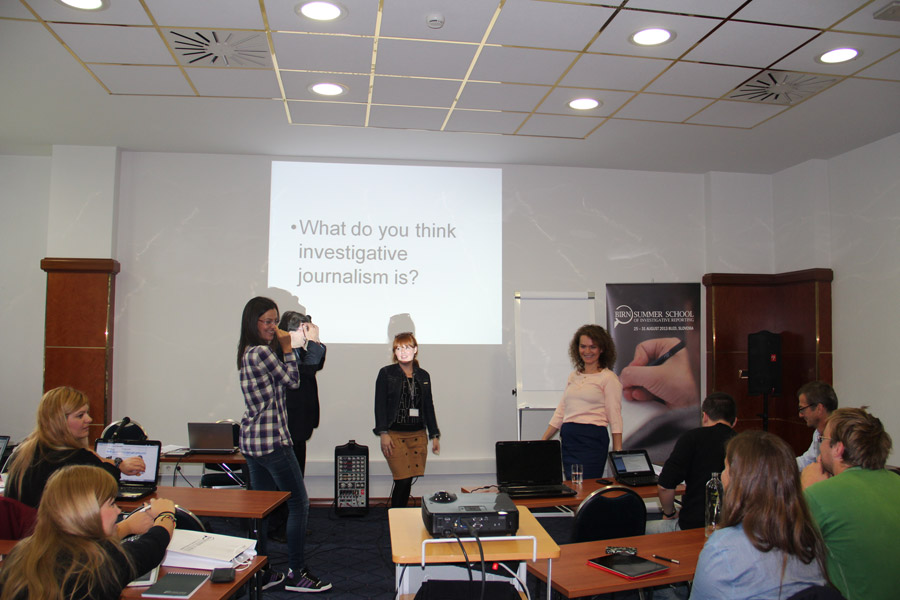
The first training session for journalists and editors organised by BIRN Serbia as part of the project ‘Europe, It’s You’ was held in Leskovac in southern Serbia from March 15-17. The training sessions are part of The European Partnership with Municipalities – EU PROGRES across south and southwest Serbia.

PROGRESS training

The participants included 13 journalists and editors from eight municipalities and cities from this region.

The trainers and speakers were representatives of the EU PROGRES Programme, an expert from the Serbian government’s office for EU integration (SEIO), Zoran Sretic, and an assistant from Belgrade University’s political science faculty, Aleksandra Krstic. 

Sretic explained the details of Serbia’s progress towards joining the European Union, particularly the Interim Trade Agreement and the Stabilisation and Association Agreement.

The participants were mostly interested in finding out how these agreements will affect their own communities.

Serbian and European media coverage of the EU was the main topic of Krstic’s presentation. She explained in detail what kind of tools and information that could be useful for journalists are to be found on EU institutional web pages.

The next training will be organised from March 29-31 and involve a new group of participants. 

BIRN Serbia holds public debate on health in Serbia

BIRN Serbia organised a panel discussion in Belgrade on March 13 about introducing a better system of protection of patients’ rights as a part of its ‘Monitoring Policies of the Government of Serbia’ project in the fields of the economy, health, education and the fight against corruption. 

Tanja Maksic, project coordinator at BIRN Serbia, said that the results of the project’s monitoring showed that the election campaign promises that have been fulfilled so far are those relate to healthcare availability, expanding the list of free medicines and financial support to pregnant women.

“When it comes to the law on the protection of patients’ rights, it was not explicitly announced during the election campaign, but it was mentioned in the prime minister’s speeches. Also, I want to remind you that Serbia is the only country in the region that has not adopted this law,” said Maksic.

She added that the draft law on the issue defines in detail the rights of patients, but not their protection or any potential sanctions against those who violate them.

“The draft law on the protection of patients’ rights will be available to the government of Serbia by the end of March or early in April, while the law should be adopted by parliament during the spring session,” said Perisa Simonovic, state secretary at the health ministry.

Radmila Ivanek, special adviser to the health minister, said that several months of public debate had helped to improve the text of the legislation.

“In addition to the existing 11 rights, eight new rights are incorporated in the new law. Among them are the right to preventative measures, the right to quality health services, the right to a second opinion, the right to patient safety, and the rights of children in hospitals,” said Ivanek.

The topic of the patients’ rights protector and its relocation to local government under the new legislation caused most debate during the panel discussion. The law says the position will be relocated from healthcare facilities to local municipalities and that its name will be changed to patients’ rights advisor.

The Serbian ombudsman’s office, which supports the adoption of the law, pointed out some of the problems surrounding the current situation.

“The problem was that the protector, while working in health institutions, was also performing a numerous of other legal issues, therefore it’s important that this will be someone whose main activity will be protection of patients’ rights. It is also important to regulate the whole procedure, because in practice we were faced with situations in which its role was limited to forward complaints and responses among patients and doctors,” said Gordana Stevanovic, a representative of the ombudsman’s office.

But Marina Mijatovic, director of the NGO Legal Scanner, disagreed with the new name because the role of the position is not just to advise patients but to protect their rights as well.

The panel discussion was part of a project entitled Development of Mechanisms for Monitoring and Measurement of Government Policy, conducted under the auspices of the British Embassy in Belgrade.

BIRN Serbia Conducts Debate on Education in Serbia

Public discussion about education in Serbia is currently limited and the impact of educational policies is not matching up to expectations, it was concluded at a debate dealing with education policy organised by BIRN Serbia on February 27.

BIRN Serbia debate on education

“Nobody expected a breakneck shift in the field of education from the new government, but it feels that the issue remains on the fringes – there is a mismatch between expectations and the way in which this very important subject is treated in public,” said Dragana Zarkovic-Obradovic, the director of BIRN Serbia, during the debate entitled ‘How to Write Education in Serbian’.

Vlasta Matejic, one of the creators of the strategy which ensures that the state allocates 4.5 per cent of its budget to education, said it was “untrue that the Serbs are an educated nation” – a fact which is one of Serbian society’s biggest contemporary problems, he said.

According to Matejic, the development of education in Serbia depends on the courage of the state: “If we are bold enough, we will have better education, but if we allow politics to mix with education, we will have education as usual, and that’s not good,” he said, adding that the ultimate outcome is likely to fall somewhere between these extremes.

Matejic warned that there are many illiterate people in Serbia, and that “academic people do not even read their own works, nor [their] publications”.

Radivoje Mitrovic, state secretary at Serbia’s education ministry, said that education is not just a matter for the ministry and the state, but for all – from nurseries to universities, from pupils, students and parents to the economy and local governments.

Mitrovic said that it is very important that education is seen as an opportunity and a tool to overcome the current crisis.

A survey conducted by BIRN Serbia showed that education was very little represented as an issue in last year’s election campaign; it was mostly raised by the Serbian Socialist Party but absolutely sidelined by the Serbian Progressive Party and United Regions of Serbia coalition.

The panel discussion was part of a project entitled Development of Mechanisms for Monitoring and Measurement of Government Policy conducted under the auspices of the British Embassy in Belgrade.