BIRN Serbia launches research on media financing

BIRN Serbia has begun a new project to research current practices in media financing, which will result in the development of best-practice recommendations as well as proposals for the monitoring and evaluation of future practice in the area.

The overall aim of the project is to protect the public interest through the provision of independent and quality media production and more transparent public spending.

According to government-adopted Media Strategy and the new Draft Law on Public Information and Media, public funds should be allocated to the media outlets only through open-call procedures. Currently, the majority of funds for media are allocated directly, while a smaller portion are allocated based on open calls for projects and through tenders.

The project strategy is intended to develop a non-discriminatory, consistent and transparent system of financing media production in order to enable citizens to exercise their right to complete, timely and objective information.

Within the project, BIRN will analyse the existing practice of financing, develop proposals for future practice and organise a series of round table discussions in five cities.

The project research will start by December 2013 and will last until October 2014.

This research is part of BIRN’s ‘Enhancing media independence through development of sustainable and competitive financing model’ project, conducted under the auspices of the Embassy of the Netherlands in Belgrade.

BIRN Serbia holds debate on EU’s 2013 progress report

BIRN Serbia held a debate on Tuesday about whether the government has been successful and efficient in implementing reforms in the context of European Commission’s recently-published 2013 report on Serbia’s progress.

The debate focused on four key areas – the economy, health, education and the fight against corruption – in which BIRN Serbia has been monitoring government policies for the past year and a half.

The speakers were Dragana Zarkovic-Obradovic, director of BIRN Serbia, Jasminka Cekic Markovic, director of the Centre for Education Policies, Predrag Stojicic, director of Serbia on the Move, Kori Udovicki, director of the Centre for Advanced Economic studies and Nemanja Nenadic, programme director for the watchdog organisation Transparency.

More than 40 media, NGO and public administration representatives took part in the conference.

Dragana Zarkovic-Obradovic said that BIRN’s latest research showed that, even though European Commission report was generally considered “historically positive”, the real effects of the government’s reforms only range from semi-successes to failures.

Kori Udovicki stressed that the government’s economic promises were populist and that it is necessary to follow priorities and plan strategically in order to increase productivity.

She said that tightening up financial discipline and the rationalisation of the public sector were the main mechanisms for the recovery of Serbian economy.

Nemanja Nenadic said he believes that the EC report corresponded to real reforms in Serbia, but that it did not cover all the important issues – problems that repeat themselves from year to year, which Serbia has not done enough to solve.

He added that Serbia is entering another pre-election campaign period even though issues that came up during the previous election still haven’t been solved.

All participants in the debate agreed that the EC’s ratings are better than in previous years, but noted that Brussels is never too severe with the authorities.

The debate was part of the BIRN Serbia ‘Accountability Tools for Monitoring Government Performance’ project, which was conducted under the auspices of the British Embassy in Belgrade.

BIRN Serbia publishes ministries’ 2012 discretionary expenditures

BIRN Serbia has published a database of the discretionary expenditures of the country’s ministries for 2012 on its portal Javno.rs.

The database contains information on how the ministries spent public funds on budget lines 423 and 424, contracted services and specialised services for 2010, 2011 and 2012.

The Serbian government has announced savings in the area of goods and services and discretion rights as one of its planned measures for economic recovery. This measure is intended to deliver savings up to four billion dinars for the state budget.

BIRN’s research has shown that the ministries have increased discretionary expenses during the past three years and paid 53.6 billion dinars in total for various contractual and specialised services.

In 2010, ministries spent 2.6 billion dinars on specialised services and11.6 billion dinars on contracted services.

According to data for 2011, the costs of specialised services were reduced and total expenditures of ministries on these were 1.5 billion dinars, while the costs of contracted services increased by five billion dinars compared to the previous year.

The data that BIRN collected for 2012 showed an opposite trend in the spending of public money on these two budget lines. The ministries spent much more money to pay for specialised services, nearly 19 billion dinars, while on contracted services, they spent only 2.1 billion.

All the information contained in this database was based on requests for access to information of public importance and it took up to six months to collect all the answers and two more months to make easily accessible and searchable.

Javno.rs is an open and fully searchable database containing thousands of documents on public expenditure. The databases that have been created will be supplemented every year while new ones will be developed, covering fields of interest that we assess as murky areas of public expenditure or as potential generators of corruption in Serbia.

For which specific services and with which individuals and legal entities ministries closed contracts worth up to tens of millions of deinars, see the website http://javno.skockajtebudzet.rs/index.php.

The idea for Javno came from BIRN but our many partners helped to implement it, from the British Embassy in Belgrade to IREX.

BIRN Serbia Continues Post-Election Monitoring

For the past year and a half, BIRN Serbia has been developing mechanisms for qualitative monitoring of government’s policies, mapping trends and reforms in the four areas which citizens singled out as the most important to their personal and social well-being – the economy, the fight against corruption, health and education. Thanks to the continuation of the project ‘Accountability Tools for Monitoring Government Performance’, supported by the British Embassy in Belgrade, BIRN will carry on its watchdog role for another six months.

The long term goal is to positively influence the creation and implementation of public policies in the four designated fields, through the creation of public demand and the engagement of civil society organisations, experts and public administrations, driven by the monitoring results.

Based on the research conducted during the electoral campaign, BIRN came up with a follow-up project, and since September 2012 has set up unique post-election watchdog mechanism, focused on the fulfilment of electoral promises made by politicians.

This mechanism also contributes to tracking general progress on reforms and enabling debate on policy choices made by the government in the four targeted fields. A monitoring matrix, containing several qualitative indicators, will be soon published online and, along with legislative and budgetary tracking and shadow reporting, presents an important tool for voters to make politicians accountable.

The implementation of this project will provide all interested parties with critical and unbiased insights into the progress of reforms and the quality of public policies in the four designated fields, empowering their meaningful participation in public debate. It will also help intensify public discussion and engage all relevant stakeholders over potentially controversial moves by the government. 

BIRN Serbia Wins Regional Journalism Competition

The South East European Media Observatory, a regional partnership of civil society organisations aimed at enhancing media freedom and influencing reforms, has chosen BIRN Serbia to produce a series of investigative articles related to ‘soft censorship’ in the Serbian media sector.

BIRN Serbia will produce stories which tackle the abuse of public money to exert political influence on the media. The stories will focus on the allocation of public funds in the Serbian media sector as a tool to control media outlets.

The stories will show how the misuse of state funds consequently leads to clientelism and soft censorship and is also a potential source of corruption and legal violations. The core story will be related to the situation in the Serbian media sector, while a regional perspective will be provided through an investigation in Croatia, showing a similar trend.

In the light of the Serbia’s new EU integration developments, BIRN Serbia’s work on the issue is anticipated to be a step towards advocating changes to current poor media practices and the adoption of new, European standards in the sector.

The BIRN Serbia proposal was one of six investigative journalism initiatives to receive support from the South East European Media Observatory grant scheme. The independent jury decided to award one project from Albania, Bosnia and Herzegovina, Croatia and Serbia, and two proposals from Macedonia.

The project will last until December 2013, and it is expected that all the stories will be published both on project web site and BIRN’s own sites (regionally on BalkanInsight.com and locally on Skockajtebudzet.rs).

BIRN Assesses Serbian Government’s First Year

BIRN Serbia has published a report about the government’s progress in fulfilling election promises in four key areas – economy, health, education and the fight against corruption. 

For the past year, BIRN Serbia has been monitoring government policies in the four areas which citizens singled out as the most important to their personal and social well-being.

The monitoring results showed that the government had made limited progress in fulfilling election promises made and that implementation was even slower dynamics politicians planned.

According to BIRN’s report, the least progress was made in the field of education. The most important legislative activity was related to the adoption of the Education Development Strategy in Serbia to 2020, although no action plan was adopted for its implementation.

In the health area, the government should seriously work on establishing  anti-corruption measures, transparency in public procurement, the availability of health protection by clearly defining the status of private practices, and infrastructure improvement.

In this field, campaign promises were partly fulfilled by expanding the number of patients who are eligible for health insurance at the expense of the state and by implementing some measures of population policy. The long-awaited law on the protection of patients’ rights was also adopted.

The Anti-Corruption Strategy is the most important document which was adopted by the government and parliament in the field of the fight against graft, and contains key recommendations for the prevention of corruption and the strengthening of independent control institutions.

Even though the privatisation audit showed government’s determination to fight corruption, work should continue to strengthen institutional mechanisms in order to minimise corruption, which is seen as systemic.

In the economic field, which is the top priority for the public, there was very little progress, even though most of the legislative initiatives in the past year were launched in this area. The government was unable to find an adequate solution to the economic crisis, unemployment is still high and it is necessary to consolidate public finances in order to reduce the budget deficit and public debt.

The report is part of the BIRN Serbia ‘Monitoring Policies of the Government of Serbia’ project, which was conducted under the auspices of the British Embassy in Belgrade.

More information is available at http://www.skockajtebudzet.rs/rs/clanak/godinu-dana-vlade-ne-ispunjenost-obecanja

Annual meeting of BIRN Assembly and Steering Board

BIRN brought together its Steering Board and Assembly members for their annual meeting in Belgrade from July 9-12.

The meeting takes place each year in the Serbian capital to enable Board and Assembly members to discuss BIRN’s ongoing activities and its plans for strategy development.

During the three-day meeting, a new BIRN statute that was presented last year at the Board meeting and an audit of BIRN HUB was endorsed.

Ana Petruseva, one of the founders of the BIRN regional network and BIRN Macedonia, said: “This helps us get clear picture how to proceed with new and ongoing BIRN activities.”

Local BIRN directors presented also all their country activities and strategic and operational issues to the members of the Assembly.

The possibility of opening a BIRN office in Albania was also discussed.

BIRN Steering Board and Assembly Meets in Belgrade

BIRN is holding its annual Steering Board and Assembly meeting from July 9-12 in Belgrade.

The meeting is organised to discuss strategic and operational issues facing BIRN, ongoing programmes and plans for the future. 

The Steering Board is composed of BIRN country directors. Each board member will make a presentation about country specifics and fundraising activities.

The Assembly brings together Tim Judah, author and Balkans correspondent for The Economist, Wolfgang Petritsch, Austria’s permanent representative to the OECD, Steve Crawshaw, international advocacy director at Amnesty International, Stefan Lehne, former Austrian diplomat and visiting scholar at Carnegie Europe in Brussels, and Per Bymon, secretary-general of Swedish Radio and Television’s humanitarian foundation, Radiohjälpen.

University of Pristina honours US and EU envoys

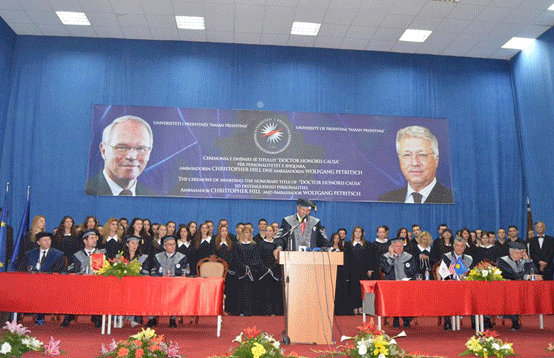
Hasan Pristina University honoured former special envoys Christopher Hill and Wolfgang Petritsch on Wednesday with the title of Doctor Honoris Causa in a ceremony held at the faculty of philology. They were awarded the title for their contribution to the resolution of the Kosovo conflict.

Hill and Petritsch, who worked as the special envoys of the United States and the European Union respectively during attempts to stop the Kosovo conflict in the late 1990s, were honoured for their outstanding contributions to creating conditions for peace, justice, freedom and democracy and increasing opportunities for the development of education, science and academic freedoms in Kosovo.

The rector of Hasan Pristina University, Ibrahim Gashi, opened the ceremony.

“We were lucky to have you and your peoples as our friends during our worst, hardest time,” said Gashi.

Prime Minister Hashim Thaci praised the two former envoys for bringing together the Albanian political spectrum.

“Mr. Hill and Mr. Petritsch stood by Kosovo when Kosovo needed friends the most,” said Thaçi.

The two former envoys also addressed the gathering.

“Kosovo has changed a lot since the time when I was here. You cannot choose your neighbours, but you can live in peace with them,” said Hill.

“The European Union is facing many problems, but Kosovo is moving towards the EU,” said Petritsch.

Petritsch and Hill acted as mediators during the talks between Kosovo Albanians and the Yugoslav authorities at the Rambouillet Conference in 1999 before the NATO bombing campaign ended the conflict.

Petritsch, from Austria, is also a member of BIRN’s Regional Board.

Balkan Insight Media Watch Page Launched

BIRN has launched a special focus page on media in the Balkans – the first of its kind in the region.

All media-related news and analysis from the Balkans are now available on Balkan Insight’s Media Watch Page.

It features a brand-new analysis package on the media situation in Albania, Bosnia and Herzegovina, Macedonia, Kosovo, and Serbia.

It also features a regional analysis on the role of the EU. Some praise the EU for pushing for the adoption of media legislation that meets European standards. But others are more critical, saying that the EU should have been much more proactive in combating growing political pressures on independent media.

The launch comes ahead of the second ‘Speak Up!’ conference on June 20, at which the European Commission will gather hundreds of media experts from all over Europe to discuss media freedom in the Western Balkans and Turkey. 

In its progress reports, the European Commission has repeatedly set out its concerns about restrictions on freedom of expression and the media in the Western Balkans and Turkey, noting that threats to freedom of expression also threaten the foundations on which the “union of values” is built.

In an effort to identify solutions, the European Commission’s ‘Speak Up’ conference is bringing together participants from international, regional and national media organisations, civil society, academia and national administrations.