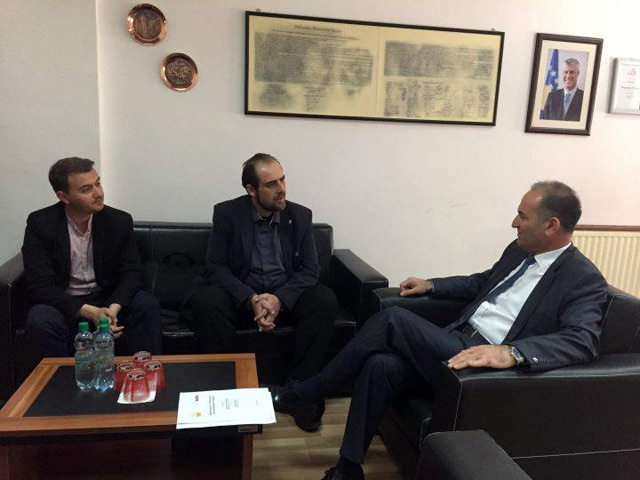
Kosovo Albanian and Serb Civil Society and Media Agree to Further Cooperation

On May 23rd, in Prishtina, a third roundtable was held with the title “Perception of NGOs and Media in their role and engagement in the Brussels’ dialogue,” organized by the NGO New Social Initiative (NSI) from Mitrovica and BIRN Kosovo as part of the project “Increasing capacities and credibility in Albanian and Serbian NGOs and media in Kosovo”.  The purpose of this UNMIK-funded project is to establish cooperation between Kosovo Albanian and Kosovo Serb civil society and media organizations.

The moderator of the roundtable was Lazar Rakic from the Alternative Dispute Resolution Center. He asked the media and civil society representatives whether they have a system of exchanging experiences and information sharing in regards to the Kosovo-Serbia dialogue process.

“I think that there has been enough space for the civil society to be engaged indirectly in the dialogue. Part of the blame is with the government; they haven’t always been forthcoming with discussions, and there was something they were not telling us,” Shpetim Gashi from the Center for Inclusive Governance said.

Sonja Sovrlic from RTV Mir in Mitrovica said that this is a painful topic for Belgrade, and that Pristina has not included many people in the process. She added that some of the agreements reached have been lacking in clarity, with clear divisions in how Albanian and Serb media report on the issues. Some agreements have still not been implemented, she said.

Lura Limani from Prishtina Insight emphasized that only after media lobbying, and in particular the lobbying efforts of BIRN, did the Brussels-negotiated agreements become publically accessible. She also emphasized that the negotiation process lacks the involvement of Kosovo Serbs because Belgrade speaks on their behalf; meanwhile, she said, Kosovo Albanians also do not feel that they are part of the process.

Shkelqim Hysenaj from the Association of Journalists in Kosovo argued that the dialogue process has been plagued by several failings, including negotiators not responding to phone calls from journalists. Additionally, there have been issues with transparency, and both teams have not had strategies for communicating with the public and the media, or how to discuss the agreements with other ethnic groups. He said that the Kosovo representatives have not answered why there is no person of reference to communicate directly with journalists.

Milica Andric from NGO Aktiv in Mitrovica said that it is problematic when negotiators are not well informed about the situations of people in reality. According to her, implementation is the most crucial aspect of the dialogue process.

“There are so many small practical problems which can be easily solved, but are important because without them, you cannot get into the fruitful aspects of the agreements. For instance, if you don’t have access to IDs, or drivers’ licenses, you cannot get into verification of diplomas, or the agreement on license plates.”

The roundtable also included representatives from Epoka e re, Tribuna, BIRN, and Kosovo’s public broadcaster, RTK. Participants were eager to continue such discussions on the dialogue between Kosovo Serb and Kosovo Albanian civil society and media organizations.  Prior to this roundtable, two other roundtables were held in North Mitrovica and in Leposavic, where similar concerns and issues were raised.

‘Jeta ne Kosove’ and KALLXO.com Win EU Prize for Investigative Journalism

On May 5th, 2017, BIRN Kosovo’s television programme Jeta ne Kosove and the anti-corruption platform KALLXO.com were awarded with second place for investigative journalism by the European Union Office in Kosovo. 

The investigation that appealed to the five-member jury was “Organized Tax Fraud,” which revealed that over 300 Kosovo businesses were involved in a tax evasion scheme through the use of shell companies. 

The three-part, 11-month investigation also revealed that the state prosecutor went after the shell companies, which had homeless and poverty-stricken people listed as owners, instead of the actual companies that benefitted from the scheme. After the affair was reported to the state prosecutor, he decided not to go after the businesses that were involved in tax evasion, and instead went after the vulnerable owners of the shell companies, who were unaware of the situation they were involved in.

Accepting the prize, Faik Ispahiu, the show’s producer and director of KALLXO.com, said that to this day the same prosecutor was handling the case, and instead of being punished, he was being rewarded with a trip to the US. The results of the investigation, Ispahiu said, are still ongoing.

This is the second time that Jeta ne Kosove has been awarded with a prize for investigative journalism by the European Union, after receiving an earlier award for the investigation into the “Stents Affair.” During the ceremony, Luigi Brusa, Head of Cooperation Section of the EU office, said that his organization is pleased to support people who support the principles of the European Union.

U.S. Ambassador to Kosovo and Former Kosovo President Visit BIRN

On April 28th, BIRN Kosovo delightfully ended the month of April by hosting two important diplomatic figures in Kosovo, the current U.S Ambassador to Kosovo, Greg Delawie, and Atifete Jahjaga, who served as the fourth president of Kosovo.

In their separate discussions at the BIRN Kosovo office, Delawie and Jahjaga each emphasized that producing in-depth analytical and investigative journalism on complex political, economic and social issues in Kosovo is an absolute necessity. They declared their appreciation for BIRN’s commitment to fighting endemic corruptive behavior in the country. They also applauded BIRN’s success in conducting the annual report on the monitoring of Kosovo’s courts, in which BIRN Kosovo and Internews Kosova monitors tackled challenges and shortcomings in the justice system.

U.S. Ambassador Delawie expressed his concerns about the imbalanced judicial system in Kosovo, emphasizing the need to combat the partiality and injustices within the system. He went on to congratulate BIRN’s efforts to continuously conduct analysis on corruption within the judicial system in order to assess its performance in respecting legislation and adhering to work ethics and procedural regulations. The Ambassador said that BIRN Kosovo, by producing top-quality, timely, and relevant coverage, is a trendsetter in Kosovo’s media landscape.

Similarly, Jahjaga voiced her concern that Kosovo’s justice institutions infrequently address high-profile corruption cases and instead focus on processing petty corruptive cases, for which soft sentences are often delivered. She congratulated BIRN’s efforts to focus on the treatment of corruption charges, analyzing the problems and obstacles faced in the war against corruption. Jahjaga, the first woman to be president in Kosovo, said that though she is keeping her options open regarding her future plans, there is one particular issue she is certain about: she will continue to work for the survivors of wartime sexual violence, which during her five-year mandate remained one of her main priorities. 

BIRN and Internews Kosova Launch the Annual Court Monitoring Report 2016

On May 8th, 2017, BIRN and Internews Kosova marked a decade of monitoring Kosovo’s judicial system with the launch of the 2016 Court Monitoring Report. This project has been implemented for ten years now, and each year it has provided an overview of the situation in Kosovo’s justice system and has offered recommendations on how to increase transparency and accountability at all levels of the system. 

This year’s report reflects the monitoring of 600 court hearings across 26 courts in the country throughout 2016, including basic courts, the Supreme Court, and the Court of Appeal. Panel participants included BIRN Kosovo Director Jeta Xharra, Internews Kosova Executive Director Faik Ispahiu, Chief Prosecutor Aleksandër Lumezi, as well as representatives from the Supreme Court, the Prosecutorial Council, and the Judicial Council.

The author of the report, Petrit Kryeziu, summarized the report’s main findings, including delays on filing criminal charges from the police and the prosecution, failures to justify decisions on pre-detention, and flaws in the strategy for detaining suspects awaiting trial. One of the report’s general recommendations is that Kosovo courts need to work harder on improving the way they treat pre-detention cases. Another recommendation is that the Ministry of Justice needs to consider strengthening the option for alternative sentences, such as referring appropriate cases to mediation.

The report also revealed concrete examples of procedural violations in the judicial system during 2016. These violations included cases in which the defendant’s right to be informed in the native language was denied, unnecessary postponements of court hearings, and lack of court order during trials.

Internews Kosova’s Executive Director Faik Ispahiu expressed gratitude to the entire team who contributed to the making of this project and emphasized that there have been over 50 monitors who worked on this project, some of which are now prosecutors, judges and lawyers. BIRN Kosovo’s Director Jeta Xharra added that despite the fact that the findings indicate room for courts to increase transparency, the ten-year collaboration shows that there is no rivalry between monitors and employees within the justice system.

Kosovo’s Chief Prosecutor Aleksandër Lumezi stated that he appreciates the findings and recommendations of the report and expressed his readiness to cooperate with the media. He emphasized that the flaws in the system will be improved upon and organized crime and corruption will be properly fought only through cooperation.

Please, click here to download report.

BIRN Offers Internship Opportunities to University of Prizren Students

On April 24th, BIRN signed a cooperation agreement with the University of Prizren “Ukshin Hoti” in Kosovo on providing students with the opportunity to jumpstart their careers by embarking on professional internships at KALLXO.com, the anti-corruption platform.

BIRN has also offered numerous internship opportunities to the students of University of Prishtina, helping to advance students’ professional careers. Dozens of law and journalism students were provided with opportunities to pursue professional experience at KALLXO.com, with a focus on training students and helping them to produce in-depth analytical and investigative journalism on complex political, economic, and social themes.

Through the cooperation agreement, law students will particularly benefit from such practical experience, during which they will be exposed to BIRN Kosovo’s methods of professional reporting, established to foster change in society while upholding accuracy, fairness and balance.  

Since BIRN is engaged in court monitoring, which aims to reduce wrongdoings spotted within the judicial system, the students will be familiarized with the methods used to identify  irregularities. According to the University’s rector, interning at KALLXO.com—as a bona fide source of objective, unbiased, and accurate information—provides an excellent opportunity for building the students’ personal and professional skills.

BIRN also strongly believes that these internships will equip students with the necessary skills to develop investigative, impartial, unbiased and publicly beneficial reporting in Kosovo. As BIRN is widely known for offering meaningful exposure to on-the-ground work experience, it plans to also provide students from other public universities across the country with similar internship opportunities, in order to expand students’ knowledge of the necessary skills to flourish in a diverse and multicultural work environment.

Krypomëter Explained at University of Prishtina

April 4th saw the first public lecture on fact checking at the University of Prishtina’s Faculty of Philology, Department of Journalism, concerning the “Krypometër’’ tool created by Kallxo.com. 

The lecture was delivered by the head of planning at Kallxo.com, author of DnK and editor-in-chief of newsletter JnK , Kreshnik Gashi and by Visar Prebreza.

The University of Prishtina and Professor Remzie Shahini Hoxhaj were partners behind this event, which included an open discussion with senior students.

Gashi opened the discussion by introducing the idea for a so-called Krypometër as a tool for fact-checking statements about politics, economics and other social aspects of life in Kosovo.

Fact checking has come to attention as a new part of global trend towards holding public figures more accountable for statements and promises they make.

The new tool was developed as an idea last year, but there were some time-consuming problems to solve first, since kallxo.com had to create a proper mechanism for weighing declarations made in the media.

Finally launched early in December 2016, the Krypometër now serves as a method of verifying and checking the statements and promises of public figures. The measuring tool has so far evaluated more than 40 such statements.

During the discussion, Gashi said the main difference between Krypometër and other media communication tools was that the Krypometër “does not judge but evaluates”. While explaining how this evaluation happens, he recalled also that citizens have a right to know the truth between the lines.

Prebreza, general editor of Kallxo.com, gave examples of typical statements that are considered right for fact checking.

“Our President, while serving in his [earlier] Prime Minister’s mandate, promised to create 200,000 jobs vacancies in his electoral campaign but statistical figures late showed the contrary,” he noted. “When promises are made we as people need to rely on facts provided by the state institutions,” Prebreza added.

He also said no complaints had been received in regard to their fact-filtering, or about ethical violations, noting that the work takes place under the close supervision of a legal department.

More aspects of fact checking will covered in an episode of the TV show “Jeta ne Kosove” and in another lecture, at University AAB. Also, at Dit’ e nat’, an open discussion entitled “How true is the news today?” will be held opened by Faik Ispahiu, founder of kallxo.com.

#Factcheck

Fact-checking Day Honoured at University of AAB

On April 5th, in honour of international fact-checking week, the kallxo.com team in cooperation with University of AAB’s Department of Mass Communications in Pristina, held a lecture at the university.

The main goal of the talk was to explain the on-going work of the “Krypometer’’, a tool for measuring factual errors launched last December, which has been used so far to measure more than 40 official statements from all fields of public life in Kosovo.

The lecture opened with a welcome by the host professor Zija Rexhepi and united two of the best-known faces of kallxo.com, Faik Ispahiu, executive producer of kallxo.com and Kreshnik Gashi, the author of DnK.

Ispahiu stated the importance of fact checking, referring to it as a new era of professional journalism.

Proving the truth, even though it is not easy to do, respects people’s desire for freedom and their right to know the truth. If news is fact-checked, it automatically has more quality and credibility, he said, explaining also how the Krypometer divides its subject matter into five categories of lies, which are explained on Prishtina Insight website.

Gashi explained how the idea behind this platform took more than a year to complete, the difficulties that were encountered while training the editors and how the process of measuring a lie is done.

According to Gashi, the platform has already succeeded in making those who issue official statements think twice about what they are going to say.

BIRN Chats with Student Participants in “Dialogue Across Borders”

On March 10th, 2017, BIRN hosted a group of students, primarily studying political science, who were participating in a workshop organized by “Dialogue Across Borders: Overcoming Borders through European Integration.” The project specifically aims to facilitate dialogue between Kosovo and Serbia, while assisting in the normalization of relations between the two.

“Strengthening multi-ethnic dialogue among journalists in Kosovo” Final Conference

On February 21st, 2017, a final conference was organized in Prishtina in order to reflect on the work and results of the “Strengthening multi-ethnic dialogue among journalists in Kosovo” project. The final conference focused on promoting the improvement of inter-ethnic relations and conflict resolution by altering the way media organizations in Kosovo operate.

The conference gathered 40 participants, including journalists, editors, journalism academics, media-related institutions and so forth. It revealed that there is readiness from all communities to collaborate and cooperatively report on issues of common interest.

As a result of several tasks that took place before the final conference, reflections were gathered on what had been done to improve cooperation between journalists from different communities in Kosovo. For instance, all journalists representing the partners of the project, such as BIRN Kosovo, the Press Council, Mreza TV, the Association of Journalists in Kosovo, and other journalists from Serbian-majority municipalities were divided into groups to write about common issues concerning different regions in Kosovo.

The results were achieved as part of the activities that were attended by journalists from the different communities, which made it easier for them to commonly discuss what to work on. As the project was supported by the European Union Special Representative, they visited EU-funded projects and factories being implemented in the north in order to get a better idea of how the EU contributed to improving the lives of people in certain areas of Kosovo.

The targets of the project were productive in a way that they identified the issues that the journalists from Kosovo-Albanian and Kosovo-Serbian regions face. In the future, the outcomes of this project will serve as a fruitful means to pay attention to the lessons learned, and realize that only through strengthened teamwork can the media landscape in Kosovo be improved.

Cooperation between Journalists from the South and the North on Issues and Problems Concerning the Communities

On January 25th, 2017, another debate as part of the “Strengthening multi-ethnic dialogue among journalists in Kosovo” project was organized in the municipality of Gjilan. It gathered 34 journalists and editors from Albanian and Serbian media organizations that operate in Kosovo. 

This activity was an initiative to concretely identify the issues between journalists from Kosovo Albanian and Kosovo Serb communities. This debate was named “Cooperation between journalists from the South and North on issues and problems concerning the communities,” and resulted in potential ideas about future solutions for the media landscape around Kosovo. For instance, this debate revealed that Kosovo Serb journalists coming from Gjilan were not receiving adequate information from the municipality. As a result, the participants kindly showed willingness to improve this level of cooperation with their colleagues from other communities.

Another aspect of this project was to organize a retreat in another region of Kosovo, which took place in the municipalities of Prizren and Gracanica. This retreat took place on January 27th and 28th and it gathered 30 journalists. The retreat lasted for two days, with tasks such as visiting different significant parts of the municipalities and exchanging ideas about cultural perspectives on how to contribute to better integration and collaboration between different communities in Kosovo.

The main task of this retreat was to identify the topics that the journalists could collaborate on. As a result, the group was divided into three teams after being combined from different backgrounds. The issues identified to write about included accommodation of returnees in Roma Mahalla (Mitrovica South), pollution of the Ibar River, the treatment of stray dogs in different municipalities, social and medical care for elderly people from non-majority municipalities, and joint Kosovo-Albanian and Kosovo-Serbian markets. Journalists who were a part of this discussion represented Albanian, Serb, Bosnjak and Roma communities.

These two activities contributed to teambuilding between journalists from various communities, to be of future use for tackling issues of common interest and reaching the targets of the project as a whole.