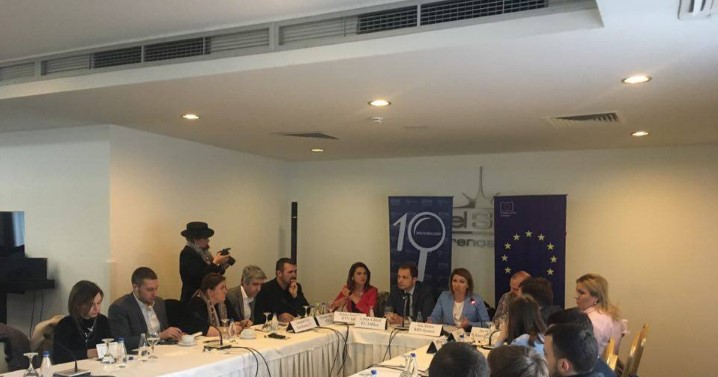
BIRN Kosovo holds a discussion between British Ambassador and Law students

At the Faculty of Law in Prishtina, British Ambassador to Kosovo, Ruairi O’Connell discussed the current state of affairs and justice in Kosovo with future lawyers and judges.

On Tuesday, the British diplomat opened the discussion with students from the Faculty of Law – future judges, prosecutors and lawyers – with a single, straight-forward proposal: “Do not become corrupted.”

For the last two years, O’Connell served as an ambassador of Great Britain to a country that is listed by international reports as one of the most corrupt, especially regarding the judicial system.

“Kosovo needs a new generation of lawyers. It is disturbing to witness the level of corruption operating in Kosovo. It is almost unbelievable,” he said. “Do not place a price on yourself with which you can be bought.”

O’Connell also commented on the roles and power of foreign diplomats, including himself, saying it was limited in terms of reforming the current political class.

“I haven’t done anything to remove Kosovo’s corrupted class. I am not responsible for deciding who will be a prime minister or an MP in Kosovo. You, on the other hand, have the power to vote. You have more power than I do here. I don’t have a drop of power, I can only speak for Great Britain,” said the British ambassador.

In many court cases, he recalled, the outcome favoured the political class, such as in the case of Sami Lushtaku, the mayor of Skenderaj.

“Let’s discuss the case of Mr. Lushtaku, who unfortunately was released from the correctional facility and did not stay in prison. He was allowed to go to the hospital, to stay there for a bit and then go home. When we talk about principles it is easy, but when we discuss specific cases, it’s not always the same,” he said.

“Judges need to act according to the law, impartial to the very end,” added O’Connell.

Although nepotism is an apparent problem in Kosovo, he also added that it does not mean that Kosovars are more susceptible to corruption than others.

“The problem lies with the system that was created shortly after the war. As such, Kosovo has not fought for its independence to only then be ruled by others,” he said.

International Fact Checking Day celebrated in Kosovo

BIRN Kosovo marked April 2, the International Fact-Checking Day, which saw fact-checking organisations across the world celebrating under the motto “Do not let them fool you: Facts are important”.

April 2nd is International Fact Checking Day – just a day after April Fools’ Day. In Kosovo, those who want to check facts have a lot on their plates. Krypometer, a joint project of BIRN Kosova and Internews Kosova,  is the leading platform on fact-checking in Kosovo.

The purpose of the Krypometer is to reflect on the truthfulness of a public statements, to scan and inspect the statement of a political figure regarding issues of great local, central, or international importance. Video launched through social media, shows some of the most important pledges fact-checked by Krypometer, while public discussions, lectures with students and more fact-checking are just some of the activities that will be carried out to honor this day. 


New Investigative Journalism Project Launched

The Balkan Investigative Reporting Network, BIRN, is carrying out a three-year investigative journalism programme thanks to support from the Austrian Development Agency, ADA. BIRN Kosovo director Jeta Xharra and Gunther Zimmer, ADA’s Kosovo director, signed an agreement in Pristina this week, marking the start of the project.

The programme is a continuation of BIRN’s award-winning “Paper Trail to Better Governance”, which produced a series of innovative and hard-hitting investigations between October 2013 andJuly 2016.

Journalists from Albania, Bosnia and Herzegovina, Kosovo, Macedonia, Moldova, Montenegro and Serbia worked together to produce more than 30 pieces of watchdog journalism,www.balkaninsight.com/en/page/paper-trail, with many of the stories published alongside major international outlets such as The Guardian.

Reporters were provided with training in investigative journalism and given subject-specific briefings related to their stories.  

The investigations used public documents, often obtained through Freedom of Information laws, to shine a light on corruption in the private and public sector. The findings have sparked a number of official investigations which are ongoing.

The new, three-year programme will continue to use public documents and FOI laws to uncover wrongdoing, while integrating new, computer-assisted techniques.

Xharra said: “We’re pleased that ADA continues to support BIRN’s work building a cohort of talented investigative journalist who have the skills, means and passion to hold the powerful to account. “

BIRN Kosovo Wins Anti-Corruption Reporting Award

The Association of Journalists in Kosovo in cooperation with United Nations Development Programme and the Kosovo Anti-Corruption Agency awarded BIRN Kosovo for the Best Television Story on Transparency and Anti-Corruption at the Anti-Corruption Journalism Awards on December 9.

The award was given to BIRN Kosovo’s TV programme ‘Justice in Kosovo’ for a story by journalist Naim Krasniqi entitled ‘The Wrong Lunch’.

Krasniqi investigated how a prosecutor named Visar Musa was attending lunches with indicted suspects despite the fact that their cases were yet to finish working their way through the courts.

After the story was aired, the prosecutor tendered his resignation.

The award was presented during Anti-Corruption Week in Kosovo.

PDK and Nisma fined after complaints from BIRN & Internews Kosova

Kosovo parties reprimanded for violating Kosovo law on elections during Drenas runoff mayoral elections.

Following a complaint by BIRN and Internews Kosova, the Election Complaint and Appeal Panel, PZAP, fined political parties NISMA and the Democratic Party of Kosovo, PDK, for placing posters of their respective Drenas mayoral candidates within 100 meters of polling stations. 

According to Article 36 of the Kosovo Law for General Elections, it is forbidden to place any promotional material within a 100 meter radius of a polling station during elections. 

After approving the complaint of BIRN and Internews Kosova, PZAP fined NISMA and PDK with 3,000 euros. The parties have to pay the fine within 15 days of receiving the decision or they will be reprimanded. 

The posters were detected by BIRN and Internews Kosova on December 18 during the runoff elections for mayor of Drenas. The posters were placed in the vicinity of polling station 0302e at Xheladin Gashi-’Plaku’ school in the village of Komoran.

PZAP justified its decision for fining PDK and NISMA by specifying the violations committed by the poster placement close to the school in Komoran.

“The PZAP took the circumstances under consideration: the nature of the violation and its potential influence in the the election process, the level and weight of the violation. The political subjects participated in the previous elections and it is considered that they were introduced to the obligations and responsibilities during the election campaigning,” informs the PZAP decision.

BIRN and Internews Kosova filed three complaints during the election to the PZAP, all of which were approved.

During the first round of elections in Drenas, BIRN and Internews Kosova submitted five complaints to the PZAP, one of which was approved.

The snap mayoral elections in Drenas were held after former mayor Nexhat Demaku resigned after being found guilty and sentenced to prison for war crimes. 

Krypometer, Kosovo’s first fact checker

Kallxo.com launches a new tool to rate the truthfulness of public statements made by high public officials. We called it Krypometer. Here’s why.

Either deliberately or due to ignorance, for the past 17 years multiple presidents, prime ministers, ministers, and politicians have issued false statements in order to achieve their goals or propagate uncertainty. These statements have been discussed and debated in various circles, but less so in the media. 

Until now, this social debate has proceeded without a real measuring tool to clarify the truth for citizens. 

In the past 17 years, there has been no systematic verification of the truthfulness of statements made by individuals who held public office. 

Due to the uncertainty, obscurity, and lack of accountability for public statements, KALLXO.com and Life in Kosovo are launching the first tool that will rate truthfulness–in other words, a fact checker. 

We decided to call our truth-o-meter KRYPOMETËR, which would translate from Albanian as Salt-o-meter. 

“Na krypi tu na rrejt (He salted us!)” is an Albanian idiom used to refer to liars. More specifically, it alludes to a situation in which the level of salt in a dish becomes the measurement of how tolerable the dish is. Various international media have called such tools differently. We have chosen to measure the level of falseness, or truthfulness in statements made by public officials with saltshakers. We will use salt as a popular synonym to the lie. 

The purpose of the Krypometer is to reflect on the truthfulness of a public statements, to scan and inspect the statement of a political figure regarding issues of great local, central, or international importance. 

We will select written and broadcasted speeches, news articles, interviews, press statements, campaign brochures, advertisements, and Facebook posts. Since we cannot select every assertion, we will focus on the ones that are current and important. We will not work only during election campaigns, but at all times. As we have witnessed in the past, it is quite normal for many untruths, especially about the future, to be told during election campaigns. 

Nevertheless, the choice of statements will not be only ours. Citizens including experts, intellectuals, and scientists who are listening to statements, can suggest specific statements to be considered for the Krypometer. 

We aim to create an active citizenry and intellectual class by providing citizens with a platform where they can contradict public statements with facts. 

The statements will be measured by criteria that will be public, and for which we are happy to receive comments, critiques, and suggestions. There are five levels in the truth-o-meter, all denoted by salt. 

A single saltshaker shall be used to denote a statement which is true. All other categories list untruths. So we have four categories for lies, in order to classify half-truths from outright lies. Two saltshakers denote a statement which is selectively true. In other words, a statement that has a few flaws, exaggerations, or bends the truth a bit, but makes no outright lie. 

We also have foreseen a category which in Albanian we called “me kos” (with sour milk) to denote those statements that have serious lapses and/or exaggerations. This category includes statements that might have factual inaccuracies, but not at all costs. A politician can create a false impression by playing with words or using a discourse that means nothing to common people. This will be classified as “half true.”

When a statement is not true, then we will use four salt shakers. A statement is categorized as such because it is an untruth and has factual inaccuracies. Such statements can include data that are technically correct (like: statistical data), but that are used out of context and end up being misleading. 

The fifth category, which we have called ‘pants on fire’ in English, refers to outright lies. This category includes statements that are complete lies – not only are they not true, but they are also ridiculous/unheard of and absurd in their implications. We will use “investigations continue” in cases when we cannot check the statement quickly or when we are dealing with complex cases in which there are good points for both sides of the argument. We will stop our assessment to gather more facts. We will use this forum to illuminate controversial statements that are not easily solved. 

All assessments are open for discussion and criticism from our readership and all stakeholders. At the same time, all assessments can be updated once new facts come to light.

To a large extent, the success of this project also depends on you – our readers and viewers. We shall rely on the public to suggest statements made by politicians, interest groups, and the media so that we can inspect them and see whether they are based on facts. We welcome any comments and suggestions, which can be submitted by using the @krypometer on Facebook and Twitter. The final goal of this project is not to tell someone that they are lying, but to lower the level of deception and manipulation from people who hold power.


KALLXO.com and Jeta ne Kosove are part of the International Fact-Checking Network, IFCN, by the Poynter Institute. In addition to being part of an international network of fact-checkers, we also subscribe to the Ethical Principles that need to be applied when facts are checked. An impartial and transparent verification of facts can become a powerful instrument for accountable journalism.

BIRN Kosovo publishes report on women’s property rights

BIRN Kosovo published an analysis on Thursday, July 28, of women’s property rights in Kosovo in order to present a picture of the major problems around a woman’s right to inherit property.

According to recent data, women are only registered as owning  16 per cent of real estate in Kosovo. Kosovo law stipulates that equal rights in general, and particularly the right to inheritance, are guaranteed under the Constitution of the Republic of Kosovo, the Law on Out of Contentious Procedure, and the Law on Contested Procedure. 

Despite the legal framework in place, the popular traditions of dividing the riches are based on customary rights, such as Lekë Dukagjini’s Kanun, or less commonly on inheritance rights according to Sharia law in Islam.

This research published today contains short comparisons with the legal frameworks of neighbouring countries along with concrete recommendations.

Low percentages of female ownership of property estates result from non-implementation of the law in the maximum of its possibilities. This means that renouncing the right to inherit plays an important role in worsening the situation when it comes to the division in percentages of women and men owners of estate in Kosovo.

The possibility for agreement between inheritors and the possibility to renounce the right of inheritance has resulted in women renouncing their rights to inherit for various reasons that are related to the patriarchal mentality of Kosovar society.

The Kosovar discourse around property inheritance is heavily influenced by patriarchal concepts. Women consider their shares as a share that they have to earn from the male inheritors, and this causes impossibilities for a normal functioning of laws, since they are instead replaced with traditions.

The non-harmonization of laws that regulate property inheritance results in an overlap of competences and legal uncertainties regarding the functioning of courts and the notary system in Kosovo. These legislative issues are real obstacles to solving inheritance cases in Kosovo. There is also a lack of electronic databases that would speed up procedures of inheritance and would minimize the possibility of fake declarations or frauds of different natures.

This publication also provides concrete recommendations on interventions that must be made in order to increase the number of claims for inheritance by female heirs and to improve implementation of inheritance rights in the near future.

More than 30 representatives of Kosovo judicial and security institutions, notary officials, lawyers, women rights activists, and public officials took part in the discussion.

BIRN wins legal battle against Kosovo Prosecutorial Council

The decision taken by the Basic Court in Prishtina was the second court ruling in favor of Balkan Investigative Reporting Network in Kosovo in a legal battle against the Kosovo Prosecutorial Council for access to decisions on disciplinary cases against prosecutors.

In October 2012, BIRN requested access to public documents regarding the final verdicts and disciplinary measures taken against prosecutors for misconduct. Both the Law on Access to Public Documents and the Kosovo Constitution guarantee the right to access to such documents.

After being rejected access to information from KPC, BIRN took the Council to court in November 2012. In 2015, the Court ruled in favor of BIRN but the decision was appealed and sent to retrial.

Four years later, the Basic Court verdict of June 28 proved for the second time that the plaintiff’s allegations were grounded.

“The right to access public documents is a fundamental right for a free and democratic society and is one of the indicators of transparency and accountability of public authorities towards citizens, civil society, media, et cetera,” said the verdict.

“The required information according to the evaluation of the Court cannot be considered private since the actions of the individuals in their official capacities as prosecutors are official actions of public employees that fulfill public duties. Their actions have a direct impact on the legal rights of citizens of the Kosovo Republic, in which case they ask for integrity and trust in the decision-making process by the prosecutors, and as a result, indecent behavior of prosecutors does not violate ‘privacy,’ and in the case that it would fall within the domain of their privacy, it would eliminate the public nature of their duty as prosecutors and defenders of the law in Kosovo at the core,” continued the verdict.

The court rejected the defendant’s allegations that BIRN would violate the privacy of the prosecutors if given access to the required documents.

“Kosovo public prosecutors are known by name and surname, and in the moment they are decreed, they are public and publishing the name and surname of the prosecutor. The disciplinary measures taken against them by the plaintiff would not infringe upon their personal data. The plaintiff did not request documents from the defendant during the disciplinary investigation against prosecutors, but has requested documents, specifically final decisions,” the verdict says.

According to the verdict, KPC violated Kosovo’s Constitution, the Law for Administrative Procedures, the Law for Access to Public Documents, and the Law for Protection of Personal Data.

The court has obligated the KPC to annul the 2011 decision in which they refused access to the requested documents for BIRN. Thus, they have obligated KCP to allow BIRN access in all final decisions with which disciplinary measures were taken against prosecutors of the Republic of Kosovo.

In October 2015 BIRN won a legal battle against the Prime Minister’s Office, which previously denied access to public documents regarding expenditures of the prime minister, ministers, and other state officials. Although the court’s ruling was final, the PM’s office has yet to provide the requested information.

BIRN Kosovo Published Annual Public Procurement Monitoring Report

BIRN Kosovo and Internews Kosova published their second annual report on public procurement on June 29th. 

The report, titled “Tenders of Endearment,” includes many important elements that have to do with public expenditures by local and state and institutions in 2015.

The report has eight categories and includes 169 contracting authorities who have developed procedures through procurement.

Through statistics data, BIRN showed which categories spend the most from the state budget, highlighted irregularities during the procedures and cast light on cases that are under investigation.

This report also offers recommendations for relevant institutions in the procurement field and suggestions on how to improve the procurement processes.

The report authors found that the phenomenon of awarding tenders to family members and friends of politicians in power, or of procurement officials is a hallmark of the procurement process.

Shqipe Pantina, a Kosovo opposition MP who is also part of the Finance Commission of the Parliament, said that corruption is increasing in Kosovo because those who were declared guilty have not been punished.

She added that corruption is not just a perception in Kosovo, but this phenomenon has turned into organized crime.
BIRN Kosovo Executive Director Jeta Xharra, said that despite the fact that public opinion is becoming aware of reporting abuse and corruption, the budget is still suffers from dishonourable procurement.

“Public money is one of the ways that people in power get rich but their abuse of public money is becoming intolerable for citizens. The more time passes, the more the citizens’ will to report abuse of public money is growing,” said Xharra.
The General Auditor in Kosovo, Besnik Osmani, said that the institutions that abuse the budget should be punished with a smaller budget the following year.

According to the co-author of the report Florina Ujupi, Kosovo institutions need to work urgently in raising human and technological capacities in the procurement sector and in fostering collaboration between procurement professionals and judges and prosecutors.

In the report there are infographics that show the statistics about the tenders published by the Public Procurement Regulatory Commission (PPRC) in which the pending differences between institutions are made plain.

The report also presents a few monitored court sessions about procurement and analyzes contracts in which the contracting had violated the administrative guideline of PPRC by publishing tenders without a set amount.

This is BIRN’s second annual report on public procurement. Last year’s was titled “Hidden Tenders”.