Follow the Paper Trail

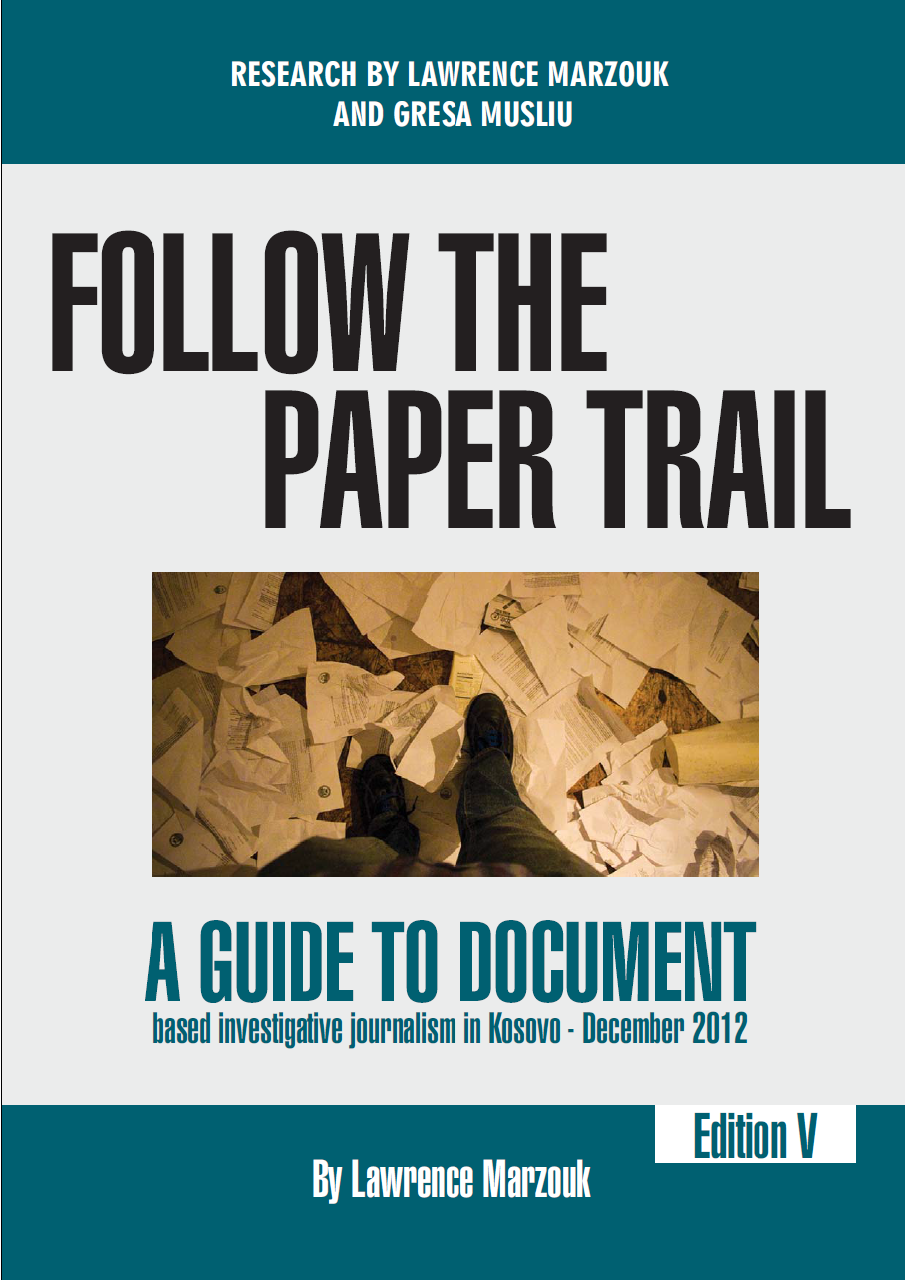
Follow the Paper Trail, a guide to document-based journalism in Kosovo, explains relevant laws, access to public documents, how to publish safely, where to find databases on investigative journalism, and how to locate documents online through various search engines.

Download the Guide: English
| Albanian

FollowFor those wanting to uncover wrongdoing, knowing how to follow the paper trail is crucial, and this means a strong grasp of relevant media laws, a host of web-based skills and the ability to manage large quantities of documents.

Journalists must know how to prize documents from secretive institutions using ,Right to Know” laws but also find key reports which are already in the public do-main, many online. An in-depth knowledge of Google and other online search tools is also essential.

Reporters who cannot follow the paper trail across borders will soon find they are hitting brick walls in their quest for truth.

BIRN Kosovo Presents Report on Court Monitoring

The Balkan Investigative Reporting Network (BIRN) in Kosovo published its fifth report on court monitoring for the January-December 2012 period on Wednesday.  The information in the report was the result of monitoring a total of 1,441 court sessions, which resulted in 1,040 verdicts.

BIRN’s main findings are categorised in twelve points which refer to a variety of problems ranging from the monitoring of corruption cases, procedural violations, failure to respect the rights of parties during court hearings, to the use of mobile phones during the trial sessions.

The press conference at which the BIRN report was presented was attended by representatives of several judicial institutions including the Kosovo Judicial Council, the Supreme Court of Kosovo, the State Prosecution, the Ombudsperson, representatives of embassies in Kosovo, representatives from OSCE, EULEX, and civil society.

The head of the Judicial Council of Kosovo, Enver Peci, congratulated BIRN for the work conducted so far, which, he said “represents a target for the fields where the judicial system should be more engaged”.

The  President of the Supreme Court, Fejzullah Hasani, said that BIRN had helped to illuminate errors which legal officials had been unable to investigate. 

“I have read BIRN’s report carefully and with pleasure, and I express congratulations for the realistic findings that are welcome for our work,” said the special prosecutor, Besim Kelmendi.

Diane E. Tourell, legal analyst at the OSCE, also complimented the BIRN report and emphasised that the OSCE echoes the concerns caused by procedural violations and would welcome similarly thorough reports in the future.

Download the full report as a PDF file in English
Download the full report as a PDF file in Albanian


Kosovo – Serbia: Can history be written without insulting others?

TV debate series “Tema” brings in its second episode a debate between historians, two from Kosovo, and two from Serbia on the topic: “Is it possible to write history without insulting others?”

Jusuf Buxhovi and Enver Rexhaj from Kosovo and Cedomir Antic and Momcilo Pavlovic from Serbia often agreed that they disagree during this debate, but they all underlined the necessity of mutual cooperation between historians from Kosovo and Serbia. 

Two key points, which the historians agreed upon during the debate, were that “History never changes, but the perception of history often does” and that “history has been very often misused for achieving political objectives”. 

Historians participating in this TV debate, which was organized by Internews Kosova and BIRN also agreed that history schoolbooks in Serbia and Kosovo must be free of hate speech and should not hesitate to speak the truth. 

Despite profound differences and even mutual accusations, the panellists offered to one-another to exchange information and documentation needed for their future scientific researches.

The debate will premiere on January 7, at 10.30 pm at RTV21 (available on SAT).

Life in Gjakova

“Life in the Municipality” team went on 30 August 2012 to Gjakova municipality in order to organize a debate with mayor if thus municipality as well as with citizens and representatives if civil society. Both sides – the mayor on the one hand and the opposition parties and citizens clashed their arguments regarding fulfilment of the promises made by mayor Pal Lekaj at the end of 2009.

Those promises were mostly related to sustainable local economic development, revitalization of old part of the city, support for small and medium enterprises, and development of education, health and agriculture as well as improvement of water supply and heating for Gjakova citizens.

Monitors of the Gap Institute and BIRN went to there in order to monitor to what extent mayor has fulfilled the abovementioned promises.

The monitors found that, the work to revitalization of the old part of the city has not started yet. Among others they have revealed that the construction of two riverbeds within municipality have not started yet too.

On the other hand, according to the inhabitants of Osek village, the mayor Lekaj has promised the construction of roads, street lighting, and contraction of water supply as well as construction of the village school but he didn’t fulfilled these promises at all.

Besides the critics addressed to the mayor, the debate offered Mr. Lekaj the opportunity to present the projects conducted successfully. He presented a series implemented projects – which have improved the lives and welfare of Gjakova’s citizens.

The moderator has opened the debate with the audience, who asked challenging questions for mayor Leka and also raised the discussion of many crucial issues for their lives.

At the end of the debate, a 16-year-old Arlind Basha considered to be the “Pride of the Municipality” was presented to audience. Basha has managed to reach the record of making goals and has been recruited by a very famous football Croatian team – Hajduk Split.

Life in Mitrovica

In the beginning, the moderator of “Life in the Municipality” firstly invited the viewers and audience consisting of civil society, journalist and opposition to watch the report which talked about what the mayor Kastrati has promised during the election campaign at the end of 2009.

In order to see to what extent those promises have been met, researches of BIRN and Gap Institute were in the field. To show what they have found on the ground, they have prepared a reportage which clearly showed how mayor Kastrati had been meticulous in the fulfilment of promises.

Among others mayor Kastrati had promised that he will engage to release the Albanians occupied homes in the northern part of the city, but according to the researchers this thing had not happened.

Even the improvement of the infrastructure had been one of the promises of mayor, but the opposition was shown very critical about what have been done in Mitrovica municipality. In the long list of promises, made during the election campaign, had also taken place the greater care to the associations that came out of war (i.e. war veterans, invalidated soldiers, martyrs’ families) as well as the greater care for retirees – however in the Council for Defence of Human Rights and Freedoms say that they have a numerous complaints that came from citizens who belong to these categories.

On the other hand, regarding with releasing of Albanians’ usurped homes in the north part of the city mayor Kastrati said “we all are working to create conditions for all citizens who are interested to go back to their homes. It’s up to their willingness whether they want to go back in the north or not,” he said.

Besides failures of Mitrovica governance, “Life in the Municipality” has also presented the successes – among others there was presented the opportunity for online applying for documents as well as the construction of the promenade in the vicinity of the river.

 The debate also included opposition representatives and citizens who expressed their dissatisfactions and critics to the mayor Kastrati.

At the end, there was broadcast the rubric “Pride of the Municipality” whereby was presented Rock School – Mitrovica as a role model for multiethnic cooperation between Albanian and Serbian musicians.  

Life in Shtime

Shtime was the next municipality to host the team of “Life in Municipality”. The debate which took place there involved a lot of citizens, journalists, representatives of opposition parties as well as representatives of civil society.

This municipality as well as other municipalities throughout Kosovo, has a series of problems. According to the interviewed citizens, the main problems of their municipality remains to be the high unemployment rate, poverty, lack of economic development and lack of electricity. Based on the research conducted by Gap Institute and BIRN monitors, 580 families in Shtime municipality depend on social services.

Despite the abovementioned problems, the municipality also faces the following issues: lack of adequate water supply, lack of kindergartens and busses for public transport and there is also a very obvious absence of activities for the young.

First, a report was broadcasted reminding the audience about the promises the mayor made two years back. The researches of BIRN and Gap Institute went to the municipality in order to see to what extent has mayor Naim Ismaili fulfilled his promises.

The promises made by mayor Ismaili had mostly to do with construction of a cultural centre and a bus station – (both?) planned as public-private partnership(s?) – as well as construction of a new school, fixing the problem with sewage and building a bridge and pavements for citizens.

Regarding the construction of the cultural centre, BIRN monitors found that nothing has been done in this direction. Failing to build a bus station is also considered a promise mayor Ismaili’s administration did not meet. This issues remains to be a major concern of Shtime citizens.

The promise to make a sewage system in rural areas falls in the cathegory of unfulfilled promises, according to a report made by BIRN and Gap Institute researchers. Several inhabitants spoke to “Life in the Municipality” and said that the municipality officials have been promising for two or three years to solve this problem.

“We hope that this year will mark the start of the sewage system construction, because we find it very difficult to live in such conditions,” a resident of Petrova village said.

Many other inhabitants complained about the poor quality of the village bridge. They said that the bridge poses a danger to car drivers since it is very narrow.

Regarding the unfulfilled promises, in particular the failure to complete the bus station, mayor Ismaili said: “since Shtime has only three main roads it is almost impossible to find a location within the city that meets the requirements for constructing a bus station.

Major added that, “in order to create a suitable space, we are currently working on the first segment of the ring road. We are dependent on the Ministry of Infrastructure because regional roads are under jurisdiction of this ministry,” he conducted.

Besides citing the projects where the municipal authorities failed to meet the promises made during the election campaign, “Life in the Municipality” left the space to speak about the works conducted successfully, something which both the mayor and the citizens of Shtime are proud of.

Life in Fushe-Kosova

Fushe-Kosova municipality was the next station for “Life in Kosovo”. The fulfilment of mayor Burim Berisha’s promises was the centre topic of the debate taking place in Fushe-Kosova.  

Besides the mayor, the representatives of civil society, journalists and citizens also took part in the debate.

“Life in Municipality” begun with a broadcast, which was a summary of promises Mr. Berisha had given two years ago, when he asked the citizens to vote for him.

This summary served as a reminder of promises, which mayor Berisha said would be priorities of his mandate. Those promises had to do mainly with improving the conditions of education, health, culture, youth and sport, archaeology, lighting all of public spaces in the city as well as with construction of parks as areas of public significance. The mayor also promised to improve the infrastructure by asphalting roads, and constructing the water supply and sewage network.

On the other hand, GAP Institute and BIRN researchers went to Fushë-Kosova to check whether or not mayor’s promises were met.

For example, the residents of “Bardhi i Madh”, the largest village in this municipality, were complaining about the lack of drinking water.

They said that the water supply system was built with materials which pose a serious risk to human health. They also mentioned that, according to international standards, it is prohibited to use (build?) such water supply systems.

When it comes to investments in health sector promised by mayor Berisha, opposition said that the ambulances through village have not been functionalized yet. Opposition representatives added that only 13% of the budged allocated for this sector was spent.

Commenting on references about him failing to fulfil the election campaign promises, Mr. Berisha said that there is a range of factors which caused delays in important projects, like, for example, the water supply project.

“The inadequate attitude of the state water company and the Ministry of Trade and Industry towards this issue is the key reason these projects have not been seen through”, major Berisha said.

Mayor Berisha also spoke about the successes of municipality’s football team – this contributing to development of football and sport in general in Fushe-Kosove municipality. He explained that the investments he made in some sport schools have made it all worthwhile because the footballers became champions in the respective category.

He said that the other success of his governance is public lights which work on solar energy and also paving the municipal roads.

Meanwhile, wastewater continues to be the problem in this municipality. The pollution and landfills, delays in construction of the schools and the water factory in Kuzmin – were cited as promises Mr. Berisha did not fulfil.

At the end of the debate, mayor Berisha answered some questions asked by the residents of Fushe-Kosove municipality.

Life in Junik

The next municipal debate was held in Junik municipality were the host of the “Life in Municipality” team was the mayor Agron Kuçi – who comes from AAK.

At the beginning there was broadcast a reportage which covered the pledges of mayor made two years ago.  In order to see whether those promises have been met, monitors of Gap Institute as well as those from BIRN have emerged in the field to verify whether the promises presented in the paper have been concretized in practice.

During the debate there has been discussed problem with which Junik municipality is faced in daily basis. These problems require greater commitment and engagement by the officials of the municipality, claimed mayor Agron Kuçi. Among the mayor issues discussed were: deforestation, lack of irrigation system, as well as lack of tourism and culture development.

Also, there was raised the education situation within the municipality.  The lack of kindergarten was the main concern that citizens and opposition parties presented.

In regard of education, mayor Kuçi said that the schools building are new and are quite suitable for teaching. However, the mayor admitted that these schools do not have yet sports halls where students can develop their physical and cognitive skills.

Being asked about the developments in culture sector, mayor Kuçi said that despite the investments made over three past years, the Junik municipality has lack of Culture House which could be used for cultural activities and about other citizens meetings.

“When we mention culture there inevitably should be included the sport – in which aspect unfortunately our municipality lacks a lot, said Mr. Kuçi.

Although most mined areas in Kosovo have already been cleaned of mines, the residents of rural parts of Junik are still feeling in danger due to un-cleaned areas. The Junik municipality is one of the few cities that still have mined territory. Mine risk is also one of the reasons why two villages Gjocaj and Jasiq have divided to move to the town of Junik – said the “Life in Municipality”.

Meanwhile in terms of the municipal budget, in 2009 Junik had 841.000 euros. Of this amount, municipality has carried own revenues in the amount of 35,000 euros and 806.103 euros of total budget, which was intergovernmental grant. But, as in any other municipality, this budget as well as capital investments are expected to be increased.

Life in Rahovec

Rahovec municipality is an agriculture locality. The land in this area is suitable for planting grapes. This region has a large number of wine makers.

Like with other municipalities, Rahovec hosted the team of “Life in Municipality”. The debate involved a lot of citizens, journalists, representatives of opposition parties as well as representatives of civil society.

Mayor, Smajl Latifi faced criticism during the debate, which had to do mainly with his failure to fulfil the election pledges made at the end of 2009.

At the beginning, a report revealing municipality’s most significant problems was aired. According to the interviewed citizens the main problem of their municipality remains to be the lack of electricity supply. 

In the absence of a power station, Rahovec municipality receives its electricity from Gjakova. The electricity reductions happen very frequently and affect the business.

The citizens of Rahovec also are concerned about municipal investments being focused only on the urban part of the municipality, with local government ignoring villages and rural areas.

In connection to this, they mentioned the investment in youth sports centre – a project which was considered significant. On the other hand, there was no investment to ensure the water supply for villages Dobidol, Çiflag, Kromovik, Palluzh, Gur and Kuq which have around 9000 residents, but no drinking water.

Citizens also expressed their concerns regarding the lack of school infrastructure and the risk of river flooding.

During the election camping, the current mayor promised better infrastructure and in general he managed to meet those promises. However, many promises failed to be realized. The municipality finished the construction of a road of five kilometres. It also succeeded to make the city park functional; despite the citizens arguing that this was unnecessary, since the city already had a park.

It is worth mentioning that the mayor has failed to implement the promises he gave about improving the situation in the sector of culture. He specifically promised to increase the book volume in city’s libraries. There is also delay in fulfilling the promises about investing in education.

The schools that the mayor, during his campaign in 2009, promised will be built, have seen just the earliest phase of construction. GAP Institute and BIRN monitors went to the municipality to see if mayor Qeska had fulfilled his promises.

One of mayor’s many promises was to improve water supply for villages of Pagasos and Çilak. Unfortunately, despite mayor’s promises, the residents of these villages continue to experience shortage of drinking water. 

Life in Ranillug

Mayor of this municipality is Gradimir Mikic from the party “The Civic Initiative for Ranillug Municipality”, which won eleven seats in November 2009 elections. The “Serbs Party of Kosovo and Metohia” came second.

During the election camping, candidate, Gradimir Miukiq, during the pre-electoral debates broadcasted within “Life in Kosovo” as well as during other public appearances, made a multitude of promises. Monitors of GAP institute and BIRN has came to Ranillug to check whether those promises have been met. In 2010 they wrote a public letter to Mr. Mikiq, reminding him once again that he is responsible for meeting those promises. 

The research which measured the level to which the promises have been fulfilled, revealed that even after two years of governance, only two promises have seen realization, while the mayor made no concrete steps to fulfil other three major promises he had given.  

Most of the promises had to do with the construction of Ranillug, Gllogovc and Kremjan roads, which was to be finished until the end of the mandate. The research shows that this project is not finished yet. But there were some successful projects which were finished on time. One such project was the construction of sewage in the village of Domoroc. The mayor has promised that he will fix this problem, and he did. This sewage was constructed in 2011 with a budget of 46.785 euro.

Among other things the mayor has promised better maintenance of environment cleaning of wastewater in Morava River as well as cleaning of the waste in the villages. Regarding this, it can be said that this municipality is generally clean.

On the other hand, the establishment of the municipal company for waste management is considered an unfulfilled promise.

The municipal authorities have not considered the issue of transparency to be an important one. The organizational structure of this institution does not include a public relations office, which means that no one person no a department have the responsibility of informing the public about everything that happens in the municipality.

In addition, the information on the official web site of the municipality mostly covers only the activities of the mayor’s office and his daily agenda but there are no documents or information which could be important to citizens, the public and the municipality.

The website of the Ranillug municipality can be considered very poor, since there is no regulation, decisions or regulatory plans published. There is generally a lack of information on the website, since the municipality failed to publish the budget reports for 2011-2012.