BIRN’s Transitional Justice Programme Enters New Phase

Over the next three years, BIRN’s transitional justice initiative, which is supported by the EU, will focus on building the capacities of local media and civil society in order to promote reconciliation and intercultural dialogue.

From 2018 to the end of 2020, the Balkan Investigative Reporting Network’s Balkan Transitional Justice Initiative will work to promote and strengthen transitional justice mechanisms and processes through regular, in-depth, high-quality reporting from Albania, Bosnia and Herzegovina, Croatia, Kosovo, Macedonia, Montenegro and Serbia.

Supported by the European Union, BIRN has partnered with the Netherlands-based organisation Impunity Watch in order to increase and strengthen the capacities of local journalists, civil society activists and victims’ groups to monitor, effectively engage and shape ongoing transitional justice processes, including the implementation of the EU policy framework on transitional justice.

In the upcoming months, besides daily reporting on transitional justice issues, BIRN’s team will produce investigations across the region, televised debates in Kosovo and Bosnia and Herzegovina, and create a focus page about the newly-established Specialist Chambers in The Hague.

It will also continue to work on data journalism, update BIRN’s war crimes verdict map and develop a new database of wartime mass graves.

BIRN will also support local journalists through training sessions, study tours, small grants and mentoring to report on transitional justice.

Impunity Watch will hold workshops and produce policy papers about victims’ participation and guarantees of non-recurrence.

BIRN’s Transitional Justice Initiative has been run since 2011 and besides the EU, it has been supported by the Foreign Ministry of the Netherlands and the Robert Bosch Stiftung.

BIRN Kosovo Publishes Report on Media and Rule of Law

Following a regional conference at which a regional report on the relationship between media and rule of law institutions on fighting corruption and organised crime was launched, BIRN Kosovo held a roundtable event to discuss the topic at the local level.

The roundtable, which took place on January 30, was organised as part of a mutual project with BIRN Bosnia and Herzegovina and BIRN Serbia called “Exercising Freedom of Expression and Openness of State Institutions in Bosnia & Herzegovina, Kosovo and Serbia”, an endeavor supported by the German Foreign Office Stability Pact.

More than 30 representatives from the NGO sector, Kosovo media groups, Kosovo Police, and the Kosovo judiciary—including representatives from Kosovo basic courts and the Kosovo Prosecution—were present. Some interviewees who contributed to the report’s study of Kosovo were also present at the roundtable.

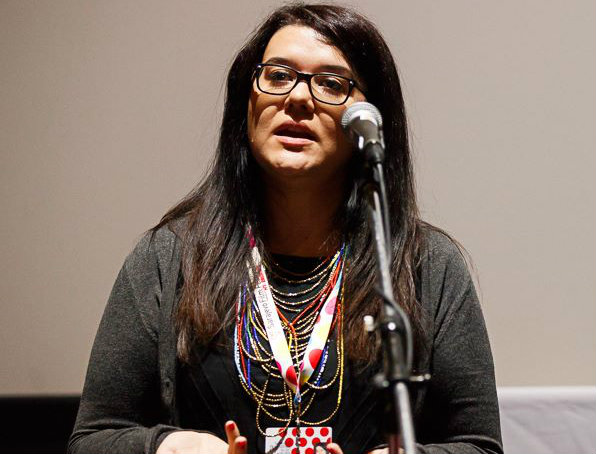
The panel consisted of seven people: Kreshnik Gashi, a BIRN editor who also moderated the discussion; Arben Qirezi, the author of the Kosovo report; Enver Peci, the head of the Kosovo Supreme Court; Ewa Korpi, EULEX prosecutor; Besim Kelmendi, prosecutor at the Kosovo State Prosecution; Baki Kelani, spokesperson from the Kosovo Police; and Petrit Çollaku from the Kosovo Association of Journalists.

The panel discussed this central question: Who sets the agenda on reporting organised crime and corruption?

The head of the Supreme Court of Kosovo, Enver Peci, said that this court has published 2,000 verdicts, and that the Supreme Court has achieved success despite complaints about financial problems.

State prosecutor Besim Kelmendi said that cases of organised crime and corruption “are not easy to investigate”, and that the biggest difficulties are with high-level corruption cases.

“We have prosecutors that are more open and some that hesitate to communicate with media, and I can say that prosecutors should not hesitate to talk to media within the legal framework”, Kelmendi said.

EULEX prosecutor Ewa Korpi talked about the presence of fake news in reporting on organised crime and corruption.

“During this year’s local elections, I had several cases when it was reported that a certain investigation was over while I had that case on my table, investigating it. And this for sure comes from political pressure, and I have to say that in the place where I come from, Sweden, I have never seen such a case”, Korpi said.

After the report was presented, participants were given the opportunity to pose questions to the panel and engage in an interactive discussion. Representatives from media organizations and NGOs in Kosovo were pleased to have a chance to address questions on access to public documents to representatives of the panel and the judiciary.

Through this report, BIRN Kosovo aims to foster freedom of expression and transparency in relevant institutions in Kosovo and to contribute to the debate among journalists, civil society and public officials of judicial institutions on the elimination of barriers to reporting on organised crime and corruption.

Revealing Corruption Remains Challenge for Balkan Media

Reporters on corruption and organised crime in the Balkans are subject to a range of different pressures and challenges – as our comparison of reporting on such cases in Bosnia, Kosovo and Serbia shows.

Organised crime and corruption are among the key challenges facing the societies of the Western Balkans, with corruption in particular being a key grievance for ordinary citizens and voters.

As in any democracy, the media play a crucial role when it comes to informing the public on these subjects and shaping public debates.

The extent to which the media are able to do so objectively and independently will help the public to both better understand the scale of the problem and assess what their elected representatives and institutions, tasked with upholding the rule of law, are doing to combat organised crime and corruption.

During 2017, BIRN conducted a regional study that examined how the media report on organised crime and corruption in Bosnia and Herzegovina, Kosovo and Serbia.

Aside from the looking at how media report on the topic, the study also sought to unpack why media report on organised crime and corruption in the way they do.

Specifically, our study sought to identify the challenges and constraints faced by media organisations across the region when it comes to reporting on organised crime and corruption.

Clik here for full article.

Click here for photo gallery.

BIRN to Host Regional Conference on Media and Rule of Law

BIRN will host a regional conference on access to information and media reporting on investigative and judicial proceedings in cases of organised crime and corruption on Thursday in Sarajevo.

The event will bring together representatives of the judiciary, non-governmental organisations and media representatives from Bosnia and Herzegovina, Kosovo and Serbia.

The conference is being organised as part of a project entitled ‘Exercising Freedom of Expression and the Openness of State Institutions in Bosnia and Herzegovina, Kosovo and Serbia’, supported by German Foreign Office Stability Pact funds and implemented by BIRN Hub in cooperation with BIRN Serbia and BIRN Kosovo.

In 2017, BIRN undertook a regional study which examined how the media report on organised crime and corruption in Bosnia and Herzegovina, Kosovo and Serbia.

As well as looking at how media report on these topics, the study also sought to analyse why media report on organised crime and corruption in the way that they do.

The study also sought to identify the challenges and constraints faced by media organisations across the region when it comes to reporting on organised crime and corruption.

The media monitoring was carried out in the period from April-June 2017 and involved six media outlets in Bosnia and Herzegovina and Serbia respectively as well as five in Kosovo.

In-depth interviews were conducted with 72 people during this period – 29 in Bosnia and Herzegovina, 22 in Kosovo and 21 in Serbia. Among those interviewed were a broad range of current or former judges, prosecutors, policemen, lawyers, editors, journalists, politicians and experts.

The project resulted in three unique country-based analyses and one cross-regional analysis, the first such study to offer a regional perspective on this topic.

The findings will be presented on Thursday in Sarajevo, together with a debate divided into three panels, including guests from the media, police and judiciary across the region, who will conduct a dialogue on issues arising from the analyses.

BIRN Journalist Wins “Best Story on Education” Award

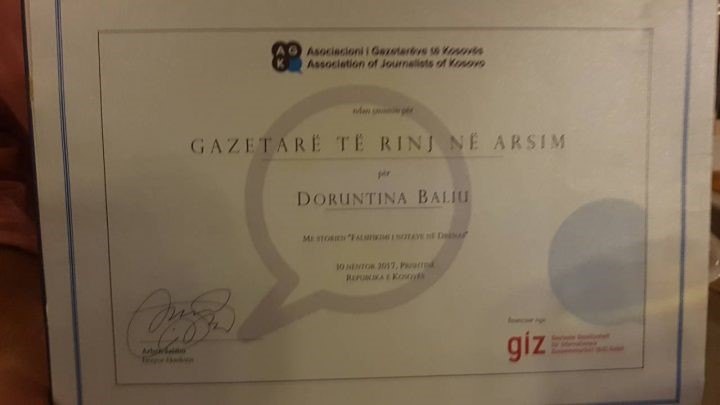
On November 30, 2017, BIRN Kosovo journalist Doruntia Baliu was awarded the “Best Story on Education” prize by the Kosovo Journalist Association and German Corporation for International Cooperation (GIZ). The award was given to the young journalist for her investigation into a grade falsification scandal in the municipality of Drenas. The story, named “The Silence toward Falsifying Grades,” was illustrated with a show published as a weekly program on “Life in Kosovo.”

The investigation into the Shote Galica School revealed that a teacher named Fehmi Ramaj curved and falsified grades for 12 students. The whistleblower in the story, Ramadan Ramaj, had noticed that the teacher, by the end of 2013/2014 academic year, had falsified the grades of 12 students, including his son’s, in the subject of biology.

Once Ramadan Ramaj provided proof, the teacher himself admitted his wrongdoings in front of other teachers, the school principal, as well as the Education Director. Ramaj had reported this case to the school principal, Sokol Ramaj, who happens to be his brother; however, all the principal did was issue a warning for Fehmi Ramaj, which, according to Ramadan Ramaj, was not enough. Ramadan Ramaj sent the case to the Education Director in Drenas, Sadik Tahiraj.

However, even Tahiraj did not take the issue seriously enough or do anything more than issuing another written warning. The whistleblower, Ramadan Ramaj, continued his struggle to bring attention to the case, which according to him was a crime against students’ success, by going to Prishtina several times to take the case to higher institutions. He then submitted a report to BIRN’s anti-corruption platform KALLXO.com. According to whistleblower Ramaj, the reason why Fehmi Ramaj had this impunity was because he had a so-called ‘certified booklet’ from the political entity Democratic Party of Kosovo (PDK).

“Life in Kosovo” managed to find several other breaches in the case.

Ramadan Ramaj, despite the pressure against him, sent the case to the Kosovo Police. As a result, the Education Director of Municipality of Drenas, Tahiraj, was dismissed from his duty due to neglecting the reported case and staying “silent about grade falsification.”

Doruntina Baliu’s investigative reporting revealed this case and the damages it caused to the education system.

BIRN Kosovo Organizes Discussions with Law Students at Prishtina Basic Court


On November 27 and 29, 2017, BIRN Kosovo organized two discussions as part of the “Promoting Transparency in Kosovo’s Judicial System” project, supported by USAID’s Justice System Strengthening Program, JSSP, at the Prishtina Basic Court.

During the first discussion, moderated by BIRN Kosovo’s Chief Editor Kreshnik Gashi, law students were briefed regarding the audio and video recording devices in court hearings. According to the panelists, it is highly important that participants of the court proceedings are fully committed to maintaining the integrity of the proceedings and operating in favor of justice. Moreover, public access to court records and hearings holds the courts accountable by ensuring that any errors, misunderstandings, or injustices are completely transparent. Lastly, according to the judges, public access to court records and proceedings assists in upgrading our justice system to the highest standard of accuracy and integrity.

The publicity of detention hearings sparked a lengthy debate among the students and judges during the second discussion, held on November 29, at the Prishtina Basic Court. This time, the discussion hosted not only law students from the University of Prishtina “Hasan Prishtina”, but also students from the Faculty of Law at AAB College in Prishtina. The panelists briefed the students on the standards that limit the circumstances in which the detention hearing may be followed and closely observed by the media,

the public, and court monitors. They also talked about specific cases where the media, observers, and the wider public may not be granted with the opportunity to closely follow such proceedings.

BIRN Kosovo, under the “Increasing Transparency in Kosovo’s Judicial System” Project, supported by USAID’s JSSP, will continue to conduct debates of similar nature in the coming months.

BIRN Kosovo Holds a Debate with Law Students at Gjilan Basic Court

On November 24, 2017, BIRN Kosovo held another debate within the “Promoting Transparency in Kosovo’s Judicial System” project, supported by USAID’s Justice System Strengthening Program, JSSP, at the Gjilan Basic Court.

During the discussion, moderated by BIRN Kosovo’s Chief Editor Kreshnik Gashi, the panelists provided lectures to law students on attending court hearings and accessing court record information. The panelists also briefed the students on the rules and regulations regarding photographing, broadcasting, and recording within a court hearing; moreover, they specifically mentioned that such actions may be fully permitted in a manner that ensures that the fairness and dignity of the proceedings are not adversely affected.

Additionally, panelists and students discussed public participation within court proceedings related to divorce, child custody, property disputes, inheritance, labor disputes, and financial disputes. For instance, according to the panelists, if a case involves certain claims of physical or sexual abuse, the judge has the right to decide on making the case private. Additionally, judges have the authority to restrict public participation, if, for instance, confidentiality is deemed significant.

Nevertheless, public participation is allowed during a divorce trial, unless any particular reasons requiring confidentiality are outlined in advance. Last but not least, students learned that courts are also authorized to limit what may be reported in order to protect the welfare of families and children.

BIRN Kosovo, under the “Increasing Transparecy in Kosovo’s Judicial System” Project, supported by USAID’s JSSP, will continue to conduct debates of similar nature in the coming months.

Global Shining Light Award Judges Honour BIRN

The judges of the prestigious Global Shining Light Award have honoured an investigation by Balkan Investigative Reporting Network with citations of excellence.

BIRN’s investigation “Making a Killing” received special recognition – certificate of excellence – at the Global Investigative Journalism Conference 2017 in Johannesburg on Saturday.

Making a Killing”, which was jointly produced with the Organized Crime and Corruption Reporting Project, uncovered how billions of euros of arms from the Balkans and Eastern Europe are illegally ending up with Syrian rebels, including Islamic State, ISIS.

In July this year, the story was shortlisted for the Global Shining Light Award, an award sponsored by the Global Investigative Journalism Network, GIJN, an association of 155 non-profit organisations in 68 countries.

The story was produced as part of “A Paper Trail to Better Governance” project supported by the Austrian Development Agency to promote rule of law, accountability and transparency in six South-Eastern Europe countries.

Global Shining Light Award Judges Honour BIRN from BIRN on Vimeo.

Lack of transparency and drinking water in Mamusha

What are the duties of the future mayor of Mamusha?

There are three candidates running for Mayor of the Municipality of Mamusha.

Whoever gains the trust of citizens, either on October 22 or four weeks after during the run-offs, will face plenty of obligations.

Mamusha was transformed from a Prizren-area village to its own municipality in 2008, and with 5,507 residents, it is one of the smallest municipalities in Kosovo. The process of becoming a municipality happened during the time of decentralization and it is a municipal unit without any single village.

Mamusha, which is 93.1 per cent Turkish, is the only place in Kosovo that has a Turkish majority. The other minorities are Albanians, with 5.9 per cent, and Roma, Egyptians, and Ashkalis, with a total of .9 per cent.

The economy of this municipality is mainly based in agriculture and by a low scale in an active market. Mamusha is known for cultivating plants, especially tomatoes; the municipality produces 90,000 tons of tomato are produced annually, all within a surface of 23 kilometers.2

The Municipality of Mmausha has had problems with drinkable water ever since its establishment. The residents of this municipality are supplied with water from Prizren and from the surrounding villages. For years, residents of Mamusha have been asking for a watering canal for agricultural lands, while the sewage and waste continue to be poured in the Topllua River, which passes through Mamusha.

Mamusha is a municipality with no parking lots, no public kindergartens, and no sports hall.

One of the weakest aspects of this municipality is the lack of transparency: it does not have an information official or a coordinator for access to public documents. The municipality does not even publish vacancy announcements on its official site.

Above all, Mamusha is a municipality that has no directorate that is run by a woman.

In order to deal with solving all these problems, there are three candidates running for the head of the municipality: Abdylhadi Krasniç from KDTP, Arif Bytyç from KTAP and Riza Kryezi, who is an independent candidate.

The current mayor of Mamusha is Arif Bytyc from KTAP, who declined the invitation to directly confront his opponents in BIRN Kosovo’s mayoral debate series #DebatPernime (#RealDebates). In this unfortunate situation, #DebatPernime conducted separate interviews with each of the mayoral candidates of the municipality, so that it could understand the candidates’ governing program plans for the future four-year mandate.

In order to solve its problems, the municipality of Mamusha has 1.8 million euros per year to be spent on capital investments.

Lack of drinkable water

One of the biggest problems for the citizens of Mamusha is the issue of not having drinkable water and the inability to solve such a problem because the municipality does not manage or engage a municipal company. Both the opposition and the citizens express their dissatisfaction regarding this point.

Mamusha residents are obliged to buy filters for cleaning the water that comes from the wells that they have opened in their yards. Such a filter costs approximately 700 euros per family.

The citizens expect their mayor to solve this issue.

Irrigation for Mamusha

Agriculture is the main source of income for Mamusha. The farmers have continuously received promises that they will be supported by the municipality. They expect that by implementing a project related to an irrigation system for their lands, the municipality can make their work easier and costs lower.

The citizens complain that they spend hundreds of euros per season only on fuel, because they need it to transport water from wells opened in the fields with their cars. They say that would be able to pay up to 150 euros per month if they had a watering canal.

Sewage and waste

There are three illegal waste disposals in Mamusha, which are mainly located in the suburbs of the municipality.

Waste is mainly dumped in the Topllua River, which passes through Mamusha. Sewage continues to be poured into this River, and the citizens that live nearby the river cannot stand its bad odor.

Lack of transparency

One of the points where the municipality of Mamusha stagnates is the lack of transparency. According to the Kosovo Democratic Institute’s (KDI) evaluation of the Municipality of Mamusha, it is the least transparent municipality in the region of municipalities surrounding Prizren, with only 19.8 per cent of the general level based on 44 indicators taken from KDI.

Meeting minutes taken in this municipality are never published; minutes are a key element of transparency in local institutions. It has not been reported in the Assembly twice a year, as foreseen by law. The municipality does not have an information official or a coordinator for access to public documents. They also don’t practice the possibility of receiving weekly visits by citizens.

No vacancy announcements, including criteria for employment, are published on the website.

Health

There is one center for family medicine in the Municipality of Mamusha. However, the citizens often complain that there is oftentimes a lack of basic materials and the third shift does not work.

Citizens of Mamusha expect that their municipality should have a hospital center or at least a clinic to perform surgeries or gynecology check-ups, since they receive such services in Prizren, which comes with a cost and is quite far for Mamusha residents.

Education

The municipality of Mamusha has two schools, one of them is an elementary school and the other one is a high school; both are subjects of resident complaints that there is a politicization of education.

In the entire municipality of Mamusha, there is neither a public nor a private kindergarten.

Culture and sports

The municipality of Mamusha does not have any active sports clubs or a sports hall.

The house of culture in Mamusha remains empty and until now, no steps have been taken to activate it.

Property taxes

The municipality of Mamusha, according to the findings of the audit, did not manage to finish verifying 1/3 of real estate, as required by the Law on Property Taxes on Real Estate and the administrative order in power.

Out of 1,059 properties in total, until now, the municipality has managed to verify only 48. The municipality has not managed to settle the data system, because there was lack of inquiry of officials in the field in order to verify the properties.

The non-verification of 1/3 of properties can result in the lack of full information on real estate, which can influence that the assessed income on property tax can decrease. The non-application of liabilities in accordance with legal requests of property tax increases the danger that the income from this category will be lower.

Gender representation

In the municipality of Mamusha, as of now, no women have been municipal directorates