BIRN Editor Discusses Srebrenica on State TV

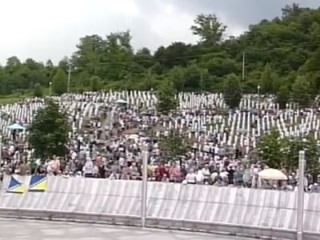
The editor-in-chief of BIRN’s Justice Report, Erna Mackic, was a guest on a BHT 1 television programme dedicated to the 18th anniversary of the Srebrenica genocide on Thursday.

Mackic spoke about possibilities of coexistence in Srebrenica as well as other towns in BiH that were devastated by the war. She also touched upon the processing of war crime cases at courts in BiH and The Hague.

Mackic said that politicians, researchers, NGOs as well as ordinary citizens should respect the courts’ final verdicts.

Ignoring verdicts is yet another way of dismissing war crimes and the genocide committed in Srebrenica, Mackic stated.

Alongside Mackic, the other guests included Nina Seremet from the Youth Initiative for Human Rights in BiH and Cedomir Glavas from Bratunac-based NGO Odisej.

All the speakers agreed that Srebrenica genocide should not only be remembered on the annual commemoration day on July 11, but at other times during the year too.

On July 11, BHT 1 broadcast special programming throughout the day dedicated to the burial of 409 Srebrenica victims in Potocari.

BIRN Steering Board and Assembly Meets in Belgrade

BIRN is holding its annual Steering Board and Assembly meeting from July 9-12 in Belgrade.

The meeting is organised to discuss strategic and operational issues facing BIRN, ongoing programmes and plans for the future. 

The Steering Board is composed of BIRN country directors. Each board member will make a presentation about country specifics and fundraising activities.

The Assembly brings together Tim Judah, author and Balkans correspondent for The Economist, Wolfgang Petritsch, Austria’s permanent representative to the OECD, Steve Crawshaw, international advocacy director at Amnesty International, Stefan Lehne, former Austrian diplomat and visiting scholar at Carnegie Europe in Brussels, and Per Bymon, secretary-general of Swedish Radio and Television’s humanitarian foundation, Radiohjälpen.

‘Stop Censorship About War Crimes’ Campaign Launched

The ‘Stop Censorship About War Crimes’ campaign, launched on Wednesday at a conference organised by BIRN in Sarajevo, is calling for the names of war crimes defendants not to be kept anonymous and for full audio and video recordings of all hearings to be made public.

The campaign aims to amend current rulebooks which are denying journalists and ordinary citizens full access to judicial institutions in the country.

BIRN Bosnia editor Erna Mackic said that the state court uses initials instead of full names in war crimes verdicts and that it has stopped issuing full video and audio recordings from hearings.

Mackic added that the state prosecution has also stopped publishing indictments, which and prevents journalists from objectively reporting on trials.

“We want to show that war crimes are always a matter of public interest,” Mackic said.

“We should stop the selective approach of judicial institutions, so that sometimes you have direct feeds of verdicts, and other times you get a ten-minute recording. This is wrong, since crimes are crimes and all crimes are important,” she said.

Mia Karamehic from the Human Rights Centre at the University of Sarajevo said that the practices are absurd because according to the law, hearings are public.

“According to the law, media can attend hearings and report on anything. However, if they are unable and want to get a document from the court, or a verdict, they cannot, which is absurd. This renders war crime trials, for instance, meaningless,” said Karamehic.

She said that judicial institutions are refusing to accept that Bosnian law accepts the primacy of public interest over individuals’ rights to privacy.

Bakira Hasecic, president of the association Women – Victims of War, said that it is vital for victims, and the entire community, to have full access to information about such crimes. It is especially important for future generations, she added.

“We must speak openly about war crimes. If a victim wants to testify publicly, why should a court limit that right? We must end the cycle of silence,” said Hasecic.

Her view was shared by a representative of the International Commission on Missing Persons, Klaudia Kuljuh, who said that the practice breached the right to truth for all war victims and citizens.

“According to the law on missing persons in Bosnia, all victims have the right to know the truth,” said Kuljuh.

“Victims come to ask and ask about their lost loved ones. It is natural that they want to know how they died and who is responsible. That information is hidden in verdicts and this is why we want to see all institutions publish all data,” she said.

To take part in the campaign, see www.justice-report.com and www.depo.ba or call the toll-free number: +387 33 911 555. More information about the campaign and related events is also available at the Facebook page: STOP cenzuri o ratnim zlocinima.

BIRN Holds Sarajevo Debate on Post-War Memorialisation

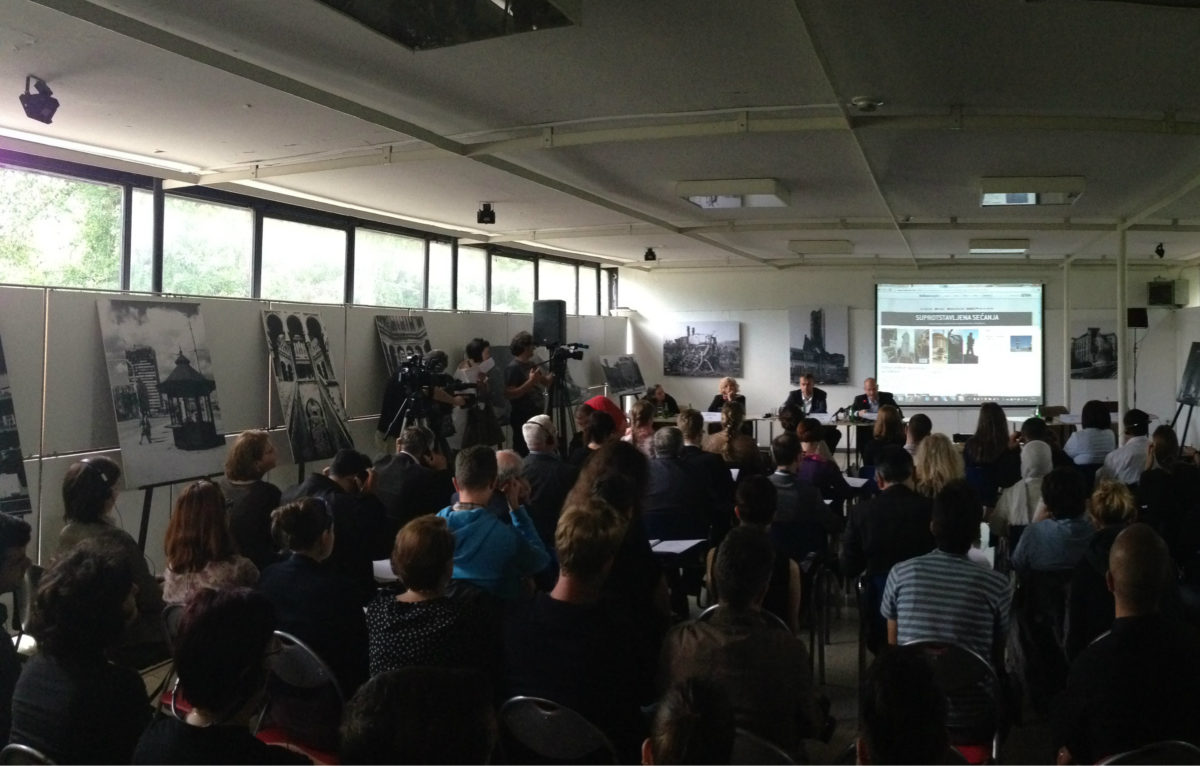
BIRN presented the results of its investigation into memorialisation in the Balkans at a round-table debate in Sarajevo on Thursday, where participants discussed the problems caused by the post-war monument-building boom in the former Yugoslav region.

The in-depth investigation examines how different states and ethnic groups use monuments to promote their own versions of past events, how governments use them to manipulate history for political advantage, and how they are used as a tool for nation-building in the region.

It was put together by reporters from BIRN’s Balkan Transitional Justice project in seven countries across the region.

The debate was led and moderated by Sarajevo-based researcher and memorialisation expert Nicolas Moll.

Participants included by Amra Custo from the Institute for Protection of Cultural, Historical and Natural Heritage of the Sarajevo canton, Petar Todorov from the National Institute of History from Skopje, Ljubinka Petrovic Ziemer from forumZFD, Almina Jerkovic from the Ministry for Human Rights and Refugees of Bosnia and Herzegovina, as well as representatives from an organisation called Four Faces of Omarska.

For more information, see the Conflicting Memories focus page: http://www.balkaninsight.com/en/page/balkan-transitional-justice-memorialisation-conflicting-memories


BIRN Bosnia Editor Gives Lecture to US Students

BIRN Justice Report’s deputy editor Denis Dzidic gave a lecture on June 21 in Sarajevo about transitional justice in Bosnia and Herzegovina, organised by the European Union Centre Institute for the International Education of Students Abroad.

The lecture was attended by 24 students from the United States who were taking part in the German European Union Centre of IES Abroad summer programme on Bosnia and Turkey.

The students were in Sarajevo from June 15 to 22, where they met with NGO representatives, government officials and international experts to learn about the challenges the country is facing.

In the first session, Dzidic spoke about war crimes trials and reconciliation processes in Bosnia and Herzegovina, and especially the role of media in these processes.

He highlighted the problems with establishing the rule of law in post-conflict Bosnia and Herzegovina and spoke about the changes seen after the departure of the international judges at the Bosnian State Court.

In the second session, Dzidic spoke with a representative of the Ministry for Civil Affairs of Bosnia and Herzegovina about the political, economic and social fabric of the country today.

University of Pristina honours US and EU envoys

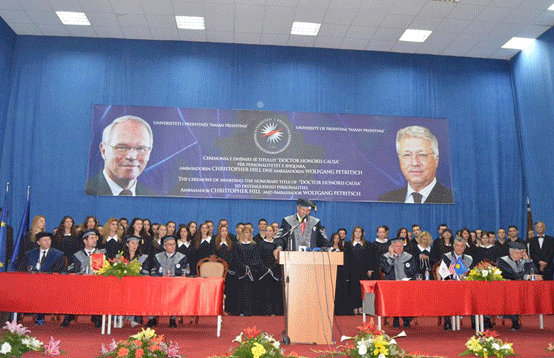
Hasan Pristina University honoured former special envoys Christopher Hill and Wolfgang Petritsch on Wednesday with the title of Doctor Honoris Causa in a ceremony held at the faculty of philology. They were awarded the title for their contribution to the resolution of the Kosovo conflict.

Hill and Petritsch, who worked as the special envoys of the United States and the European Union respectively during attempts to stop the Kosovo conflict in the late 1990s, were honoured for their outstanding contributions to creating conditions for peace, justice, freedom and democracy and increasing opportunities for the development of education, science and academic freedoms in Kosovo.

The rector of Hasan Pristina University, Ibrahim Gashi, opened the ceremony.

“We were lucky to have you and your peoples as our friends during our worst, hardest time,” said Gashi.

Prime Minister Hashim Thaci praised the two former envoys for bringing together the Albanian political spectrum.

“Mr. Hill and Mr. Petritsch stood by Kosovo when Kosovo needed friends the most,” said Thaçi.

The two former envoys also addressed the gathering.

“Kosovo has changed a lot since the time when I was here. You cannot choose your neighbours, but you can live in peace with them,” said Hill.

“The European Union is facing many problems, but Kosovo is moving towards the EU,” said Petritsch.

Petritsch and Hill acted as mediators during the talks between Kosovo Albanians and the Yugoslav authorities at the Rambouillet Conference in 1999 before the NATO bombing campaign ended the conflict.

Petritsch, from Austria, is also a member of BIRN’s Regional Board.

Balkan Insight Media Watch Page Launched

BIRN has launched a special focus page on media in the Balkans – the first of its kind in the region.

All media-related news and analysis from the Balkans are now available on Balkan Insight’s Media Watch Page.

It features a brand-new analysis package on the media situation in Albania, Bosnia and Herzegovina, Macedonia, Kosovo, and Serbia.

It also features a regional analysis on the role of the EU. Some praise the EU for pushing for the adoption of media legislation that meets European standards. But others are more critical, saying that the EU should have been much more proactive in combating growing political pressures on independent media.

The launch comes ahead of the second ‘Speak Up!’ conference on June 20, at which the European Commission will gather hundreds of media experts from all over Europe to discuss media freedom in the Western Balkans and Turkey. 

In its progress reports, the European Commission has repeatedly set out its concerns about restrictions on freedom of expression and the media in the Western Balkans and Turkey, noting that threats to freedom of expression also threaten the foundations on which the “union of values” is built.

In an effort to identify solutions, the European Commission’s ‘Speak Up’ conference is bringing together participants from international, regional and national media organisations, civil society, academia and national administrations.

Public Interest Overcomes Private Interests

The application of the existing Law on Free Access to Information of Bosnia and Herzegovina vary from one institution to another. One third of institutions respond to requests for access to information in accordance with the Law, while some do not respond at all.

When journalists request information, PR officers often ask them: “Why do you need it?; I do not understand what you want to receive from us; We have not received your request; I must ask my boss if I can give you an answer”.

After insisting on getting the information, which lasts for months in some cases, journalists manage to obtain the requested information from institutions, but it does not happen within the legally set deadline of 15 days.

These are some of the results of the application of the Law on Free Access to Information, which were presented at a conference organised by the Ombudsman of Bosnia and Herzegovina with support from the OSCE Mission in BiH.

Although their opinions are not harmonised, the Ombudsman noticed that the right to free access information was violated by the anonymisation of court decisions by the Court of Bosnia and Herzegovina.

As said by judge Hilmo Vucinic, the Court of Bosnia and Herzegovina is exposed to criticism by the media, as well as experts and international officials, for implementing the anonymisation decision, which includes using initials instead of first and last names of indictees.  

Vucinic said that, for this reason the Court embarked on introducing revisions and amendments to its Rulebook on co-operation with the community.

“When the institution estimates that a court decision is of general interest for the public, it will allow its publishing. This means that verdicts of interest for the public and legal practice will be published. This certainly includes war crimes, organised crime, terrorism etc.,” judge Vucinic said.

Personal identification numbers, ID card numbers, drivers’ licence numbers and other documents’ numbers, as well as racial origin, political opinion, membership in a political party, sexual affiliation etc., contained in those verdicts, will not be published.

Vucinic said that the revisions to the Rulebook had still not been adopted, but the Court of Bosnia and Herzegovina would do it in the upcoming period, because it had concluded that “public interest should overcome private interests”.

Anisa Suceska-Vekic, Director of BIRN in Bosnia and Herzegovina, said that verdicts had been anonymised for more than a year and that this had already had a harmful effect when it came to war crimes trials.

A provision, saying that court decisions in cases of general public interest, such as war crimes cases, organiaed crime cases and so on, which, according to an assessment by the relevant public body, were of general public interest, has become an integral part of the proposed revisions and amendments to the Law on Free Access to Information in Bosnia and Herzegovina.

In terms of the proposed changes, a question arose as to whether the public bodies would be able to realistically assess what was of public interest and what was not.

Following a detailed discussion at the conference, it was concluded that it was necessary to strike a balance between the protection of privacy and public interests and the conduct training of information officers.  

“Nobody is against the improvement of the Law on Free Access to Information, if such a need exists. However, we call on the authorities to respect the international standards,” said Jasminka Dzumhur, Ombudsman in Bosnia and Herzegovina.

The conference participants raised a question on publicity of trials for the media. According to the Criminal Code, all trials are public unless a decision is rendered to exclude the public due to protection of witnesses or similar measures.

Representatives of the Court of Bosnia and Herzegovina say that they issue ten-minute audio or video recordings to public in order to prevent witnesses from using statements contained in those recordings to prepare for their own testimonies.

Dzumhur pointed out that trials were public and that, in addition to testifying at trials, witnesses also gave statements during investigations. She said that trial chambers should determine whether a witness had changed his/her statement or not. 

The entire show is available to watch here: http://www.federalna.ba/bhs/vijest/66205/dnevnik-2-13062013

The entire show is available to watch here:
BIRN BiH Joins Transitional Justice in Universities Project

BIRN Bosnia and Herzegovina’s deputy editor Denis Dzidic participated in a Helsinki Committee for Human Rights in Republika Srpska education session in Bijeljina this week, an event being held from May 20-24 under the banner ‘Transitional Justice in Universities’. 

Seventeen students from political science and philosophy faculties in Banja Luka, Tuzla, Sarajevo, Mostar and Istocno Sarajevo attended the Bijeljina seminar.

It was the third such seminar organised by the Helsinki Committee for Human Rights in Republika Srpska and funded by the Norwegian government.

Dzidic gave the opening lecture, an introduction to transitional justice. He discussed the four pillars of the concept – the right to justice, truth, reparations and institutional reforms – and talked with the students about why all of them had a vital role to play in order that Bosnian society overcomes the divisions caused by the 1990s war.

During the week, the students will also have an opportunity to hear from Refik Hodzic, communications director at the International Centre for Transitional Justice, and learn about the experiences of other countries in the field.

Dzidic and BIRN BiH will continue to be involved in the project and future education sessions held as part of the ‘Transitional Justice in Universities’ project.

Justice Report Editor-in-Chief Speaks at Press Council Seminar

BIRN Justice Report’s editor-in-chief Erna Mackic was one of the speakers at a one-day seminar on April 6 in Teslic organised by the Press Council of Bosnia and Herzegovina, which brought together representatives of the Bosnian judiciary, police and media.

Erna Court and media conf

Mackic spoke on a panel called ‘The Judiciary and the Media Acting in the Public Interest’ about the transparency of the BiH court and the extent to which the Law on personal data protection is applied to official court documents.

“The current practice of protecting data from court proceedings, to the extent of complete anonymisation, hampers professional courtroom reporting. This is especially problematic when war crimes cases are in question. The anonymisation practice does not only influence accuracy, but also contributes to speculative media reporting,” emphasised Mackic.

The panel was moderated by Ljiljana Zurovac, executive director of the Press Council. Other speakers included Borka Rudic, secretary general of the Association of BiH Journalists, and Petar Kovacevic, director of the Personal Data Protection Agency.

Kovacevic said that judges and prosecutors across the country have expressed their readiness to cooperate with the media as long as their reporting is kept professional and does not jeopardise judicial proceedings in any way.

Rudic, however, focused more on lawsuits filed against the media for defamation, and issues surrounding the implementation of the Law on Freedom of Access to Information.

“It is very important to get data on the number of lawsuits filed against the media. This is necessary for us in order to determine the appropriate direction for better education of journalists,” stated Rudic.

The seminar was organised as part of the Council of Europe project Promotion of Professionalism and Tolerance in the BiH Media, funded by the governments of Norway and Ireland.

Photo courtesy of Press Council BiH.