BIRN Albania Holds Investigative Journalism Training

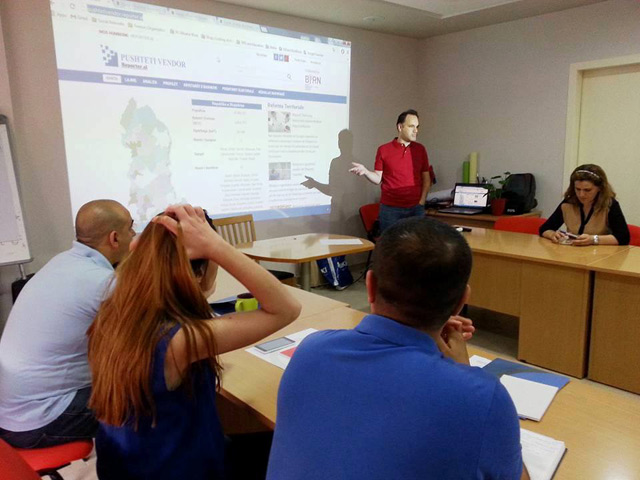
BIRN Albania held an advanced investigative journalism training workshop for nearly 30 local journalists from print, online and broadcast media from June 30 to July 3.

The workshop in the village of Drymades in southern Albania, supported by the Open Society Foundation in Albania and the Swedish Development Agency, SIDA, was aimed at refining the skills of investigative journalists with whom BIRN Albania has been working over the past two years.

The training programme introduced journalists to advanced techniques for harnessing the power of Google in their search for information and tracking offshore companies, as well as to open source investigative techniques in social media, how to deal with massive leaks of data, investigating extremist groups and the use of Albania’s Freedom of Information Law.
The training programme was headed by BIRN investigative editor Lawrence Marzouk, who in recent years has coordinated regional teams of journalists to produce hard-hitting investigations published by BIRN’s Balkan Insight website and republished by international media outlets like The Guardian in Britain.
Stevan Dojcinovic, the editor-in-chief of the Serbia-based Crime and Corruption Reporting Network, KRIK, was also a trainer at the workshop.
Dojcinovic is an investigative journalist based in Belgrade, and from 2005 to 2012 was the editor-in-chief of the Center for Investigative Reporting in Serbia, CIN. He has also worked for the Organized Crime and Corruption Reporting Project, OCCRP.
Another key trainer was the editor-in-chief of the daily Zeri in Kosovo, Arbana Xhara, the winner of the 2015 US Secretary of State’s International Women of Courage Award for Europe, who went into detail about her investigations into jihadist networks in Kosovo and how she handles threats from corrupt officials and religious extremists.
The roster of trainers was completed by BIRN Albania editor-in-chief Besar Likmeta, 2009 winner of the CEI-SEEMO Award for Outstanding Merits in Investigative Journalism, and Ardita Shehaj, from the office of Albania’s Freedom of Information Commissioner.

BIRN BiH Presents Terror, Corruption Case Analysis

BIRN Bosnia and Herzegovina presented an analysis of terrorism, corruption and organised crime courts cases, as well as launching its new web portal detektor.ba.

BIRN BiH presented its analysis of cases dealing with terrorism, corruption and organised crime from the beginning of 2016 a press conference on July 7.

The research indicates that the Bosnian state prosecution and court has processed more than 20 cases relating to terrorism in Bosnia and Herzegovina, most of which concern suspects who have gone to fight abroad and joined terrorist organizations.

The problems in these cases relate to cooperation between investigative agencies, the exchange of data and the deradicalisation of convicts after they have served their sentences.

As far as corruption is concerned, BIRN BiH’s analysis shows that the state prosecution has focused on smaller corruption cases, because most of ended with acquittals, conditional sentences or sentences of up to one year that can be avoided through payments of small amounts of money.

The state judiciary also resolved more than 230 cases of organised crime.

A big problem in these cases concerned the confiscation of property illegally acquired through the commission of the crimes.

The BIRN BiH analysis indicates that prosecutors involved in organised crime cases sometimes do not request the confiscation of property because it is too time-consuming during the evidence presentation process.

The analysis also points to the inability of the Bosnian state court to ensure the money is collected, as well as to situations in which convicts sentenced to up to one year in prison pay a fine but still fail to return the illegally-acquired property.

At the press conference, BIRN BiH also presented its new portal detektor.ba which contains articles, analysis pieces, research results and interviews, as well as audio and video materials on war crimes, transitional justice, the monitoring of the judiciary, terrorism, corruption and organised crime.

The detektor.ba site also contains a unique archive consisting of more than 25,000 articles, 1,553 radio shows, 78 episodes of ‘TV Justice’, numerous special issues, interviews and footage amassed over many years of monitoring war-crime trials and journalistic work in the field of transitional justice.


Participatory Budgeting Project Completed in Serbia

Ten municipalities in Serbia in cooperation with BIRN Serbia and the National Alliance for Local Economic Development successfully implemented all activities with the aim of introducing the practice of public participation in the decision-making process on local budgets.

From December 2014 to June 2016, around 16,000 people participated in Participatory Budgeting Project. Over 200 representatives of civil society organizations attended workshops dedicated to the inclusion of CSOs in the project held from April to June 2016.

Local people and local governments had a chance to nominate projects that they thought would best advance their communities, after which people selected the ones that they wanted to see financed from their municipal budgets.

Municipalities taking part in the Participatory Budgeting project have assigned nearly 800,000 euros of their 2016 budgets for financing 53 projects that were chosen as the best among 2,400 proposed.

All the municipalities also held local budget forums where over 200 local residents, representatives of the business community and the media, as well as citizens’ associations, discussed the 2016 budget.

As part of the project, Citizen Budget Guides of 10 municipalities have been drawn up, aiming to simplify and make more understandable the way budgets are created and how public money is spent.

Local government employees who actively worked on the project underwent training while online experts gave recommendations to local governments on how to communicate more effectively with citizens with the help of the online platforms they use.

The Participatory Budgeting Project included ten municipalities – Sombor, Knjazevac, Trstenik, Pancevo, Zrenjanin, Pirot, Ruma, Sabac, Sremska Mitrovica and Vracar.

As part of its future activities, BIRN Serbia will strive to continue with the Participatory Budgeting Project and to include more municipalities.

BIRN BiH Joins Panel at Sarajevo’s WARM Festival

BIRN Bosnia and Herzegovina participated in a panel discussion about survivors of sexual violence during wartime at the WARM Festival in Sarajevo.

Mirna Buljugic, director of the Balkan Investigative Reporting Network Bosnia and Herzegovina (BIRN BiH), participated in the panel discussion at the Meeting Point Cinema in Sarajevo on June 27.

Buljugic spoke about the BIRN documentary ‘The Silent Scream’, which is dedicated to survivors of wartime sexual violence.

“Our aim was to initiate a debate in society on the position of victims of sexual violence and show them they are not alone and explain to them why it is important for them to share their experiences so the perpetrators will be punished,” she said.

Buljugic also spoke about the problem of the legal regulation of the status of victims, which is not harmonised in Bosnia’s two entities, as well as the lack of political support for the harmonisation of the laws.

Belma Becirbasic, a researcher and journalist, said many perpetrators were still at large.

“The fact that impunity is still a norm when it comes to sexual crimes during the conflict is one of the biggest problems,” said Becirbasic.

The film ‘Thinking of You’, about a project to help women who raped during the war in Kosovo, produced by Ana di Lellio, was screened before the panel discussion.

Tatjana Milovanovic of the Post-Conflict Research Center spoke about visual art as a strong platform for reconciliation.

“We should focus on young people in the reconciliation process, because they are the bearers of future changes,” Milovanovic said.

The WARM Festival, which was held in Sarajevo from June 26 to July 2, brings together journalists, artists, historians, researchers and activists involved in war reporting, art and memorialisation. 


BIRN BiH Story on Arabs Marrying Bosnian Women Stirs Region

A story by BIRN BiH journalist Albina Sorguc on the unexplored phenomenon of Bosnian women marrying Arab men who already had wives – mostly from Kuwait, Saudi Arabia, the UAE, Egypt and Libya – echoed throughout the entire region, causing much interest and drawing reactions from the media and general public http://www.justice-report.com/en/articles/arabs-marry-bosnian-women-to-establish-parallel-families.   

Soon after it was published on BIRN BiH’s portal, www.justice-report.com, it was republished by 169 domestic and regional print and electronic media outlets, including several daily newspapers and portals with the highest readership in Bosnia, such as Dnevni Avaz, N1, FTV and Klix.ba, as well as by Croatian Index.hr, Dnevnik.hr and Serbian Blic.rs.

According to Google Analytics, a large number of visits to the article was registered on the original platform, making it the most-read article, while analysis of its publication on BIRN BiH’s Facebook page was read by 15,000 people. The story was also published on our regional portal www.balkanisight.com, where it became one of the most read articles on the portal.   

The exploration of the issue of polygamy and illegal marriage in Bosnias, as well as the increased presence and influence of Arab citizens in Bosnia, generated strong reactions on forums in Bosnia. Republication of our story on the most widely read portal in Bosnia, Klix.ba, drew the most comments over the course of one day, while the news was conveyed via the social networks of other media stations, as well as on a large number of private profiles of citizens in Bosnia and the region, all during a short period of time.

The article also prompted the most viewed regional info TV station, N1, to film its own footage on the “buying” of Bosnian wives and of sexual services by Arab tourists, which directly drew on BIRN BiH’s research. Nova TV’s magazine Provjereno, ARD’s Europamagazin and Weltspiegel have meanwhile have expressed interest in presenting the data obtained by BIRN BiH to the public.

Pulitzer Winner Hosts Sessions at BIRN Summer School

BIRN Summer School of Investigative Reporting will be held from 21 to 27 August in Konjic Bosnia and Herzegovina. In its seventh edition, the School will be organised in the form of Master Class.

The course will include sessions in mastering the latest techniques for searching the web and social media, interviewing techniques, working with sources and how to scale up your investigations generally.

Trainers at this year’s Summer School, as in the previous six years, experienced internationally recognized journalists and editors from Reuters, Columbia University, OCCRP and others.

Lead trainer is Blake Morrison, investigative editor for Reuters, New York.

Social media expert Paul Myers, three time Pulitzer Prize winner Martin Kaiser, Knight Award winner Miranda Patrucic, from OCCRP and Columbia University lecturer Jim Mintz are some of the trainers at the School.

In the afternoon hours trainer will held small group or one-on-one sessions with participnats.

For 20 Balkan journalists BIRN is providing scholarships, while 10 international journalists will need to cover tuition fee.

BIRN is also providing funds for the best story idea. Three best story pitches will be able to get from 1,500 to 3,000 euros.

Participants will also have a bit of time to enjoy rafting down Neretva river and visit Tito’s nuclear bunker.

Applications for scholarships must be received by 20th July 2016.

BIRN Kosovo Published Annual Public Procurement Monitoring Report

BIRN Kosovo and Internews Kosova published their second annual report on public procurement on June 29th. 

The report, titled “Tenders of Endearment,” includes many important elements that have to do with public expenditures by local and state and institutions in 2015.

The report has eight categories and includes 169 contracting authorities who have developed procedures through procurement.

Through statistics data, BIRN showed which categories spend the most from the state budget, highlighted irregularities during the procedures and cast light on cases that are under investigation.

This report also offers recommendations for relevant institutions in the procurement field and suggestions on how to improve the procurement processes.

The report authors found that the phenomenon of awarding tenders to family members and friends of politicians in power, or of procurement officials is a hallmark of the procurement process.

Shqipe Pantina, a Kosovo opposition MP who is also part of the Finance Commission of the Parliament, said that corruption is increasing in Kosovo because those who were declared guilty have not been punished.

She added that corruption is not just a perception in Kosovo, but this phenomenon has turned into organized crime.
BIRN Kosovo Executive Director Jeta Xharra, said that despite the fact that public opinion is becoming aware of reporting abuse and corruption, the budget is still suffers from dishonourable procurement.

“Public money is one of the ways that people in power get rich but their abuse of public money is becoming intolerable for citizens. The more time passes, the more the citizens’ will to report abuse of public money is growing,” said Xharra.
The General Auditor in Kosovo, Besnik Osmani, said that the institutions that abuse the budget should be punished with a smaller budget the following year.

According to the co-author of the report Florina Ujupi, Kosovo institutions need to work urgently in raising human and technological capacities in the procurement sector and in fostering collaboration between procurement professionals and judges and prosecutors.

In the report there are infographics that show the statistics about the tenders published by the Public Procurement Regulatory Commission (PPRC) in which the pending differences between institutions are made plain.

The report also presents a few monitored court sessions about procurement and analyzes contracts in which the contracting had violated the administrative guideline of PPRC by publishing tenders without a set amount.

This is BIRN’s second annual report on public procurement. Last year’s was titled “Hidden Tenders”.

BIRN Macedonia Trains Albanian-Language Journalists

In a day-long course in Skopje, BIRN’s Jeta Xharra shared her insights into ethics, undercover reporting, how to conduct interviews and manage sources and much more. 

BIRN Macedonia held a journalism training session for a dozen journalists from the local Albanian-language media on June 28 in the Macedonian capital, Skopje.

The training course was designed to boost the skills of journalists from different media outlets, offer insight into BIRN’s standards of reporting and provide opportunities for journalists to expand their knowledge.

Attending were journalists from Skopje and other parts of the country engaged in web portals, national and local TV stations, newspapers and magazines.

Jeta Xharra, BIRN Kosovo director and lead trainer of the course, used case studies drawn from her extensive experience as a journalist and an editor Xharra to give the journalists her insights into how to produce a story on the Balkans, how to use sources and establish trustworthy relations with them, what to do when institutions are not responsive, tips on how to conduct an interview, and more.

The training included an extensive debate on ethics in reporting at which the journalists shared their diverse experiences and knowledge from the country and the region and learned more about ethics and undercover reporting.

This training course was part of the BIRN’s Project for Investigative Journalism and Cooperation between Media and Civil Society, funded by USAID Macedonia.

BIRN Albania Holds Roundtables on Local Government

Eleven roundtables held across the country discussed ways to empower actors for change and increase transparency at municipal level.

During June BIRN Albania held a series of 11 regional roundtables across the country with civil society activists and community leaders, addressing key issues for local government and discussing ways to empower actors for change in local communities
The regional roundtables were held in the towns and cities of Elbasan, Korce, Berat, Fier, Vlore, Gjirokaster, Kukes, Burrel, Lezhe, Shkoder and Tirana, as part of BIRN Albania’s project, Strengthening the Local Partnership between Media and Civil Society.

The project, funded by Leviz Albania and the Rockefeller Brothers Fund, aims to strengthen the pressure mechanisms of the public on local government institutions and increase transparency, by strengthening cooperation between journalists, civil society groups and grassroots organizations.

The roundtables aimed to identify problems crucial to local communities. They will be used by a network of journalists – trained by BIRN Albania across the country – in order to draw up a list of interview questions for the mayors of Albania’s 61 municipalities.

Apart from carrying out interviews with mayors on issues important to their communities, the journalists will also produce a series of features on actors for change in local communities – in order to empower them through media exposure.

The features and interviews produced as part of the project will be published on BIRN Albania’s special focus page pushtetivendor.reporter.al, which is part of its award winning local publication Reporter.al.

The project, which apart from the BIRN team also involves 11 local journalists, will also produce two monitoring reports on the implementation of the requirements of the Freedom of Information Law by Albania’s local government institutions.

Thirrje për artikuj investigativë në fushën e Pushtetit Vendor

Thirrja organizohet nga Rrjeti Ballkanik për Gazetarinë Investigative në Shqipëri (BIRN Albania), si pjesë e programit të saj “Zbardhja e Korrupsionit në Shqipëri”, të mbështetur nga Fondacioni Shoqëria e Hapur për Shqipërinë, Balkan Trust for Democracy dhe National Endowment for Democracy.

Nëpërmjet këtij konkursi tre (3) gazetarë investigativë do të përzgjidhen për të prodhuar artikuj investigativë në fushën e pushtetit vendor, në bashkëpunim me shoqërinë civile. Fituesit do të përzgjidhen nga një juri e pavarur e përbërë nga gazetarë me eksperiencë dhe ekspertë në fushën e mirëadministrimit të pushtetit vendor.

Aplikantët e përzgjedhur, të cilët do marrin një bursë prej 1,200 USD (minus taksën të ardhurave personale), do kenë në dispozicion një periudhë tre mujore për të përfunduar investigimin e tyre dhe përgatitjen e artikullit për publikim. Bursat për gazetarët mundësohen nga Fondacioni Shoqëria e Hapur për Shqipërinë.

Kandidatët fitues pritet që të angazhohen dhe të përmbushin të gjitha detyrimet në lidhje me investigimin, siç janë: takimet e shpeshta me redaktorin, publikimin e tekstit në faqen e BIRN Albania www.Reporter.al dhe gjithashtu në www.BalkanInsight.com, si dhe respektimin e standardeve të gazetarisë investigative dhe etikës profesionale.

Kandidatët duhet të formulojnë një propozim të detajuar për konkursin. Propozimet duhet të kenë për qëllim ekspozimin e rasteve konkrete të korrupsionit, pandëshkueshmërisë dhe mungesës së zbatimit të ligjit në pushtetin vendor.

Prioritet në përzgjedhje do i kushtohet propozimeve të cilat përfshijnë një nga temat e mëposhtme, të sygjeruara si prioritare gjatë një tryeze të rrumbullakët midis gazetarëve dhe përfaqësuesve të shoqërisë civile të organizuar nga BIRN Albania:

– Problematikat në riorganizimin dhe ofrimin e shërbimeve të decentralizuara dhe të barabarta ndaj të gjithë qytetarëve të bashkisë, pavarësisht zonës së banimit;
– Mungesë transparence në vendimmarrje, e cila mund të përfshijë mungesë të njoftimeve dhe konsultimeve publike ose moszbardhje të vendimeve nga bashkia ose këshilli bashkiak;
– Favorizim, nepotizëm ose mungesë transparence në marrëdhënie të ndryshme kontraktuale;
– Keqmenaxhim i burimeve natyrore ose aseteve publike;
– Ndryshime jo transparente në administratën lokale ose në emërime;
– Raste korrupsioni ose abuzimi me pushtetin në administratën vendore.

Aplikantët mund të dërgojnë më shumë se një aplikim, por vetëm një propozim për kandidat do të përzgjidhet.
Të drejtën për të aplikuar e kanë të gjithë gazetarët në Shqipëri, të punësuar pranë mediave të tjera apo në profesion të lirë.

Kandidatëve u kërkohet të dërgojnë propozimet e tyre në formularin e aplikimeve (Kliko këtu për formularin), një CV dhe tre shembuj të punës së tyre me email në: [email protected]

Afati i Aplikimit: 15 Korrik, 2016
Kandidatët e përzgjedhur do të njoftohen deri më datë: 25 Korrik, 2016