BIRN Summer School Day 4: Scaling Up Investigations

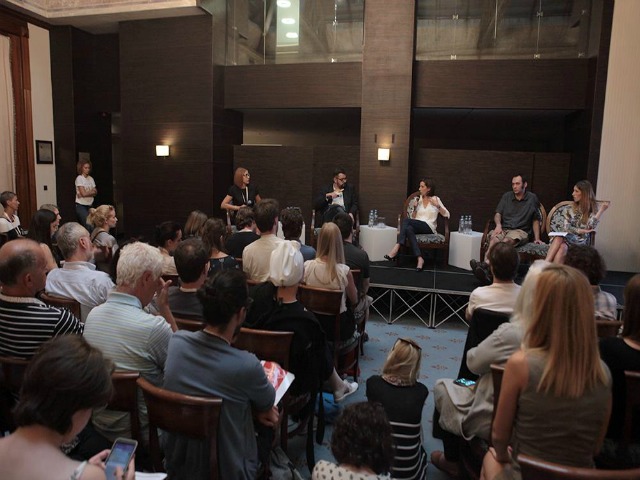
On the fourth day of BIRN’s Summer School, trainers advised the journalists on how to pitch stories, structure investigative projects and use technology to assist their work.


The fourth day of BIRN’s Summer School Master Class of Investigative Journalism in the historic town of Konjic in Bosnia and Herzegovina on Thursday started with a session on pitching story ideas, run by Blake Morrison, lead trainer and investigative projects editor at Reuters.

Blake explained how stories can be pitched to editors without overpromising while bearing in mind all the possible outcomes.

“As reporters, you’ll have real highs and real lows, and we have a job to even them up… Sometimes as investigative reporters we dig a dry well and that’s normal. But nevertheless, we aim to have less of them,” he told the participants.

“Sometimes you work on a story that just doesn’t resonate. And that’s why we have to give them ‘legs’, which will make them have an effect,” he added.

Blake explained that journalist should not promise too much from a story and must be realistic, but nevertheless should believe in the most positive outcome, while not pretending it’s possible to predict every possible outcome of their research.

Blake concluded that journalists should know that they are not alone in their work, and if they do not have editors to support them, they should find support among colleagues or elsewhere.

Lawrence Marzouk, a journalist and editor with Balkan Investigative Reporting Network, BIRN, shed light on a case study about the arms trade from the Balkans and Central Europe to the Middle East, a report that caused serious reactions in the countries mentioned.

“You should first ‘pick the lowest hanging fruit’,” he said, while explaining how the reporting team tracked 1.2 billion euros of weapons sold to Middle Eastern countries.

Marzouk explained how reporters, while researching a “controversial industry” like the arms trade, “have to harvest all the possible open source databases” because the industry is highly regulated, meaning that there is a lot of documentation.

“To find the weakest link in the system, you have to know the system,” he.

Participants then had the opportunity to discuss techniques and databases with Marzouk using the arms trade story as an example.

Miranda Patrucic, an investigative reporter and regional editor with the Organized Crime and Corruption Reporting Project, presented her work connected to the Panama Papers, giving an insight into how the research was done.

Patrucic explained how the offshore industry functions, through proxies, different types of companies, trusts and bearer shareholders. She also explained the interest countries with tax heavens have in allowing offshore companies to operate.

“These island states are very small with small costs. And all the documents for opening offshore companies, such as a certificate of good standing, cost something and the states make a significant profit on it,” she explained.

By showing concrete examples from the Panama Papers, Patrucic explained to the participants how to ‘follow the money’ and the businesses of offshore companies.

The former editor at the Milwaukee Journal Sentinel, Martin Kaiser, ended the day with his masterclass session on investigative journalism.

“First of all, a journalist’s first obligation is to the truth,” Kaiser said.

“[Journalism’s] essence is discipline and verification… it must serve as an independent monitor of power,” he added. “It must provide a forum for public criticism and compromise, meaning you have to listen… We make mistakes and when we do, we correct them.”

He also said that stories must be interesting and relevant.

“You got a significant story, how do you make it interesting? How do you make it relevant? How do you write in such a manner that it captures people’s attention?” Kaiser asked.

He explained that contemporary journalism has to use all the newest technologies and tools for writing stories, but underlined that journalists should remain “great storytellers” who “shed light where there was darkness”.

After presenting an outline of his work on a story about the high incidence of drunken drivers in the US state of Wisconsin, Kaiser gave the participants the opportunity to discuss what works and what does not in investigative journalism.

The Summer School is organised by the Balkan Investigative Reporting Network, BIRN, in cooperation with the Media Program South East Europe of the Konrad-Adenauer-Stiftung and with the support of the Open Society Foundations and USAID Macedonia.
BIRN Summer School Day 2: Social Media for Investigators

On the second day of BIRN’s Summer School, journalists learned how to creatively structure stories and use various databases and other investigative tools.

Lead trainer and investigative projects editor at Reuters, Blake Morrison, showed the participants of the BIRN Summer School Master Class of Investigative Journalism in Konjic, Bosnia and Herzegovina on Tuesday how to use a creative approach to structuring stories.

Morrison emphasised the need to persuade people who are sceptical about the narrative.

“Your job is to persuade people who fundamentally disagree with what you say,” Morrison said, underlining the importance of being imaginative when structuring a story.

“I want you to imagine the best story possible. To ask yourselves: ‘What would be the best source [for the story] imaginable that’s out there,’” he said.

“You need to believe that you’re able to make any story possible… but you need to manage your stories possible,” Morrison told the participants.

He explained how all investigative stories should be explained within six words and can be described using three questions: what is the issue, what is the harm and who is to blame.

Morrison concluded that journalists have to ask themselves the “so what?” question – why is something important – and “why now?” question, which explains the importance of the story at that moment in time.

Also on Tuesday, Crina Boros, a watchdog reporter from Centre for Investigative Journalism, continued her training on data journalism, answering questions from the participants through stories she has covered over the years.

She showed the participants how to use public registers and databases while writing stories.

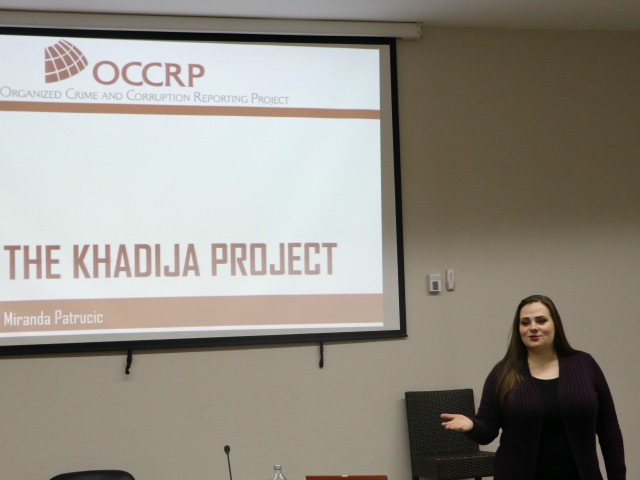
Miranda Patrucic, an investigative reporter and regional editor with the Organized Crime and Corruption Reporting Project, also held an interactive lecture on how to ‘follow the money’ and find sources for stories abroad.

She presented The Khadija Project – named after Azerbaijani investigative journalist Khadija Ismayilova, who was imprisoned in Azerbaijan after reporting on the financial schemes of President Ilham Aliyev’s family. 

“One day she [Ismayilova] took part in a training, like the one you will get today, and learned how to follow the money abroad,” Patrucic told the participants.

She did an exercise about tracking money and companies through various databases, both open-source and paid-for.

Paul Myers, an expert in using social media for investigations, did a presentation on technical sites, tools and techniques. He showed how keywords are searched on Google and through social media, cutting the number of search results.

“Logic dictates search on Google, so you have to think what you search and discover logic behind it and look for that in Google,” he explained, while showing practical examples.

The Summer School is organised by the Balkan Investigative Reporting Network, BIRN, in cooperation with the Media Program South East Europe of the Konrad-Adenauer-Stiftung and with the support of the Open Society Foundations and USAID Macedonia.

The seventh BIRN Summer School has brought together young journalists from Albania, Austria, Bosnia and Herzegovina, Bulgaria, Croatia, Greece, Hungary, Ireland, Kosovo, Macedonia, Montenegro, Romania, Serbia, Slovenia, United Kingdom and the United States of America.


Seventh BIRN Summer School Begins in Bosnia

BIRN’s latest Summer School kicked off on Monday with interactive sessions on data journalism and fact-checking.

Journalists from across Europe and the USA have gathered in historic town of Konjic in Bosnia and Herzegovina for the BIRN Summer School Mater Class of Investigative Journalism.

After greeting this year’s participants, Blake Morrison, the school’s lead trainer and investigative projects editor at Reuters, held an interactive exercise on establishing facts in stories. Morrison showed journalists how to hone in on important details in complex investigations.

The first day continued with an introductory workshop on data journalism with Crina Boros, a watchdog reporter from Centre for Investigative Journalism, during which participants learnt the analytical tools needed for data journalism.

In the afternoon, the participants divided up into smaller group for in-depth sessions with Morrison and Martin Kaiser, a retired editor who led the Milwaukee Journal Sentinel to three Pulitzer prizes.

The Summer School is organised by the Balkan Investigative Reporting Network, BIRN, in cooperation with the Media Program South East Europe of the Konrad-Adenauer-Stiftung and with support of the Open Society Foundations and USAID Macedonia.

The seventh BIRN Summer School brings together young journalists from Albania, Austria, Bosnia and Herzegovina, Bulgaria, Croatia, Greece, Hungary, Ireland, Kosovo, Macedonia, Montenegro, Romania, Serbia, Slovenia, United Kingdom and United States of America.

BIRN Presents War Stories at Sarajevo Film Festival

The first ‘True Stories Market’ aimed at film and TV professionals at the Sarajevo Film Festival included three stories from BIRN relating to Bosnia and Herzegovina’s wartime past.

The first ‘True Stories Market’ was held at the 22nd Sarajevo Film Festival on Wednesday as part of the Dealing with the Past project, after a screening of ‘Depth Two’ by Ognjen Glavonic from Serbia.

The market is intended to serve as an inspiration to directors, producers, film and television professionals to turn genuine and rarely-told stories into feature and documentary films.
 
At the first market, the Balkan Investigative Reporting Network Bosnia and Herzegovina (BIRN BiH) presented three stories, created out of BIRN journalists’ long-term work on dealing with the past, documenting war crime trials and collecting the testimonies of survivors.
 
BIRN BiH director Mirna Buljugic familiarised the directors and producers with a story about the village of Baljvine, where no conflicts between Bosniaks and Serbs have ever happened, about the phenomenon of how numerous victims of sexual abuse cannot get pregnant, and about one man’s daily search for bones of the victims of the Srebrenica genocide.
 
A total of seven stories about the recent past and unhealed wounds were presented at the market that the Sarajevo Film Festival organised in collaboration with institutions from Bosnia and Herzegovina, Croatia, Montenegro, Serbia and Kosovo.  
 
The Dealing with the Past project was launched last year under the auspices of the Robert Bosch Stiftung with the aim of using the film industry to intensify dialogue in the region and promote peace through raising awareness and spotlighting indisputable facts about the 1990s conflict.

The project encourages the participation of the public, primarily the younger generation, to foster understanding, acceptance and the tolerance of mutual differences.  

The Dealing with the Past project continued on Thursday with screenings of the films ‘The People vs. Fritz Bauer’ by Lars Kraume and ‘Unwanted Heritage’ by Irena Skoric. The screenings are being followed by debates. 

BIRN Bosnia Becomes Sarajevo Film Festival Partner

The Balkan Investigative Reporting Network Bosnia and Herzegovina (BIRN BiH) will participate as a partner in the “Facing the Past” at this year’s Sarajevo Film Festival.

As of this year, the Sarajevo Film Festival is starting its Facing the Past project, within which testimonies and stories about the war in the former Yugoslavia and the unhealed wounds in the society will be presented.

As part of its activities during the past 11 years, BIRN BiH has contributed to the process of facing the past and getting justice for victims of crimes committed from 1992 to 1995.

By continuously monitoring war crime trials, working with victims and reporting on their personal stories, BIRN BiH has gathered a unique archive of testimonies and untold stories, which is the reason why it has been selected as the only partner from the country to participate in the new Festival project.

Testimonies and stories to be provided by BIRN BiH will serve as a source of ideas for experts and film-industry professionals, who can use them to help promote peace-building in the region and throughout the world.

Using cinema as a tool, the project attempts to accentuate the importance of facing the past and determining the truth about wartime and post-war events and their influence on society.

The testimonies will be presented at the Market of True Stories on August 17.

Out of a total of seven stories to be presented at the Market, three will be provided by BIRN BiH.

Organisations from Montenegro, Serbia, Croatia and Kosovo are also participating in the project.

This year’s Sarajevo Film Festival will run from August 12 to 20.

BIRN BiH Joins European Integration Monitoring Initiative

The Balkan Investigative Reporting Network Bosnia and Herzegovina (BIRN BiH) has joined the Initiative for Monitoring the European Integration of Bosnia and Herzegovina, which is intended to help develop the democratic process and the rule of law. 

BIRN BiH has become a member of the Initiative for Monitoring the European Integration of BiH and joined efforts intended to monitor reforms and provide an overview of the implementation of the policies, laws and standards of the European Union, focusing on the issues of democratisation, the rule of law, human rights and the rights of minorities.

The Initiative focuses on monitoring, documenting, reporting, research, members’ capacity building, advocacy, promotion and education.

The Initiative is seen as an important factor in Bosnia and Herzegovina’s European integration process. It plays an active role in creating policies that contribute to the democratic process and the rule of law.
Civil society organisations involved in the work of the Initiative share values based on human rights, the rule of law, equality and democracy.

The Initiative’s work is coordinated by the Sarajevo Open Center.

BIRN Kosovo publishes report on women’s property rights

BIRN Kosovo published an analysis on Thursday, July 28, of women’s property rights in Kosovo in order to present a picture of the major problems around a woman’s right to inherit property.

According to recent data, women are only registered as owning  16 per cent of real estate in Kosovo. Kosovo law stipulates that equal rights in general, and particularly the right to inheritance, are guaranteed under the Constitution of the Republic of Kosovo, the Law on Out of Contentious Procedure, and the Law on Contested Procedure. 

Despite the legal framework in place, the popular traditions of dividing the riches are based on customary rights, such as Lekë Dukagjini’s Kanun, or less commonly on inheritance rights according to Sharia law in Islam.

This research published today contains short comparisons with the legal frameworks of neighbouring countries along with concrete recommendations.

Low percentages of female ownership of property estates result from non-implementation of the law in the maximum of its possibilities. This means that renouncing the right to inherit plays an important role in worsening the situation when it comes to the division in percentages of women and men owners of estate in Kosovo.

The possibility for agreement between inheritors and the possibility to renounce the right of inheritance has resulted in women renouncing their rights to inherit for various reasons that are related to the patriarchal mentality of Kosovar society.

The Kosovar discourse around property inheritance is heavily influenced by patriarchal concepts. Women consider their shares as a share that they have to earn from the male inheritors, and this causes impossibilities for a normal functioning of laws, since they are instead replaced with traditions.

The non-harmonization of laws that regulate property inheritance results in an overlap of competences and legal uncertainties regarding the functioning of courts and the notary system in Kosovo. These legislative issues are real obstacles to solving inheritance cases in Kosovo. There is also a lack of electronic databases that would speed up procedures of inheritance and would minimize the possibility of fake declarations or frauds of different natures.

This publication also provides concrete recommendations on interventions that must be made in order to increase the number of claims for inheritance by female heirs and to improve implementation of inheritance rights in the near future.

More than 30 representatives of Kosovo judicial and security institutions, notary officials, lawyers, women rights activists, and public officials took part in the discussion.

Transitional Justice Training for Journalists

BIRN’s Balkan Transitional Justice Programme is organising a two-day training session for 20 journalists from the region on 22 and 23 September in Sarajevo.

Training aims to improve journalists’ reporting skills in the field of transitional justice.

As well as focusing on the specifics of reporting on issues related to transitional justice, the training session includes attendance at a regional conference on war crimes as well as a visit to the State Court of Bosnia and Herzegovina.

The training is primarily intended for journalists interested in the topic of transitional justice in Bosnia and Herzegovina, Croatia, Kosovo, Macedonia, Montenegro and Serbia.

Applicants should submit a CV, a letter of motivation, and an example of a published article which should be sent to [email protected].

As the training is being conducted in English, a solid knowledge of the language is essential.

The deadline for applications is August 15, 2016.

The transport costs and accommodation on full board basis costs will be paid for by the organisers of the training session.

The programme is supported by the European Commission, the Federal Department of Foreign Affairs of Switzerland  and the Robert Bosch Foundation.

Serbian Ruling Party Exhibits ‘Media Lies’

Serbia’s ruling Progressive Party (SNS) organized an unusual exhibition of negative press articles to back its claim that there is no official censorship in Serbia.

Claiming it wanted to document wrongful attacks on the government it leads, the Progressive Party opened a new exhibition called, ‘Uncensored Lies’, at Belgrade gallery Progress on Monday.
The Progressive Party insisted it was not targeting journalists that are critical of it.
Most of the critical articles on display were from weekly magazines like NIN and Vreme, independent media organizations such as BIRN, KRIK, CIRN and the television station N1.
The exhibit also featured material from the television comedy show ‘24 Minutes’, whose host, satirist Zoran Kesic, recently received death threats because of his criticisms.
Among the articles on display is BIRN’s investigation, “Pumping Out the Open Pit and the Budget”, written by journalist Aleksandar Djordjevic.

Djordjevic won an EU Award for investigative journalism in May of this year for the article. The government and Prime Minister designate Aleksandar Vucic often cite this article as an “example” of how independent media “lie.”

However, Vucic, or SNS, has not filed any complaints or lawsuits against the author or BIRN.

Djordjevic’s investigation was widely republished by other media in Serbia, and each publication was displayed on the wall and described as a lie by the ruling Progressive Party.

Many of BIRN’s regional director Gordana Igric’s statements and interviews were also included in the display.

Her statements and interviews on the state of the media in Serbia are published by SNS alongside fragments of the reports of Reporters Without Borders, Serbian Ombudsman Sasa Jankovic and OSCE Representative on Freedom of the Media Dunja Mijatovic.

BIRN Serbia’s project manager and editor Slobodan Georgiev tweets and interviews are also displayed on the walls as an “example” of media freedom in Serbia.

Human rights and watchdog organizations warned that the government is undermining its acceptance of an independent media and critical journalism by organizing the exhibition, and encouraging a climate of fear and intimidation amongst outspoken journalists.

BIRN wins legal battle against Kosovo Prosecutorial Council

The decision taken by the Basic Court in Prishtina was the second court ruling in favor of Balkan Investigative Reporting Network in Kosovo in a legal battle against the Kosovo Prosecutorial Council for access to decisions on disciplinary cases against prosecutors.

In October 2012, BIRN requested access to public documents regarding the final verdicts and disciplinary measures taken against prosecutors for misconduct. Both the Law on Access to Public Documents and the Kosovo Constitution guarantee the right to access to such documents.

After being rejected access to information from KPC, BIRN took the Council to court in November 2012. In 2015, the Court ruled in favor of BIRN but the decision was appealed and sent to retrial.

Four years later, the Basic Court verdict of June 28 proved for the second time that the plaintiff’s allegations were grounded.

“The right to access public documents is a fundamental right for a free and democratic society and is one of the indicators of transparency and accountability of public authorities towards citizens, civil society, media, et cetera,” said the verdict.

“The required information according to the evaluation of the Court cannot be considered private since the actions of the individuals in their official capacities as prosecutors are official actions of public employees that fulfill public duties. Their actions have a direct impact on the legal rights of citizens of the Kosovo Republic, in which case they ask for integrity and trust in the decision-making process by the prosecutors, and as a result, indecent behavior of prosecutors does not violate ‘privacy,’ and in the case that it would fall within the domain of their privacy, it would eliminate the public nature of their duty as prosecutors and defenders of the law in Kosovo at the core,” continued the verdict.

The court rejected the defendant’s allegations that BIRN would violate the privacy of the prosecutors if given access to the required documents.

“Kosovo public prosecutors are known by name and surname, and in the moment they are decreed, they are public and publishing the name and surname of the prosecutor. The disciplinary measures taken against them by the plaintiff would not infringe upon their personal data. The plaintiff did not request documents from the defendant during the disciplinary investigation against prosecutors, but has requested documents, specifically final decisions,” the verdict says.

According to the verdict, KPC violated Kosovo’s Constitution, the Law for Administrative Procedures, the Law for Access to Public Documents, and the Law for Protection of Personal Data.

The court has obligated the KPC to annul the 2011 decision in which they refused access to the requested documents for BIRN. Thus, they have obligated KCP to allow BIRN access in all final decisions with which disciplinary measures were taken against prosecutors of the Republic of Kosovo.

In October 2015 BIRN won a legal battle against the Prime Minister’s Office, which previously denied access to public documents regarding expenditures of the prime minister, ministers, and other state officials. Although the court’s ruling was final, the PM’s office has yet to provide the requested information.