BIRN Albania Launches Call for Investigative Reports on Justice System

The Balkan Investigative Reporting Network in Albania launched a call for investigative stories on justice system on November 3.

The call is part of the project ‘Exposing the integrity gap in the justice system through investigative journalism’.

Three journalists will be awarded grants to cover their expenses while doing their investigations and writing their stories on justice system.

The journalists will have three months to dig deeper and research their ideas, and will also have the opportunity to work with experienced editors as their mentors to guide them through the process of writing to BIRN standards.

The call only applies to journalists from Albania. It closes on November 25.

Click for more information about the application procedure, with details in Albanian.

BIRN Albania Holds Multimedia Training for Journalists

The Balkan Investigative Reporting Network in Albania held a workshop on multimedia techniques for 20 local journalists in the city of Durres.

The workshop in Durres from November 4-6 focused on multimedia techniques which can be used by journalists in telling stories about people making change in their communities as well as the transparency of local governance.

The training was part of BIRN Albania’s project, Strengthening the Local Partnership between Media and Civil Society.

The project, funded by Leviz Albania and the Rockefeller Brothers Fund, aims to strengthen the mechanisms available to the public to influence local government institutions and increase transparency by increasing cooperation between journalists, civil society groups and grassroots organisations.

During the first day of the workshop, BIRN Albania editor Besar Likmeta presented the key findings of the report Local Government Under the Lens of Freedom of Information, in which the journalists present at the workshop had participated as monitors.

New opportunities to contribute video-based stories to BIRN Albania’s publication Reporter.al were also discussed with local reporters.

On the second day of the workshop, documentary film-maker Elton Baxhaku held three training sessions on video reportage, the techniques of shooting and editing a mini video documentary.

On the third day of the workshop, well-known Albanian photojournalist Armando Babani held a workshop on the importance of photography to illustrate feature stories.    

The goal of the three-day workshop was to raise BIRN contributors’ capacities to produce multimedia-rich stories which increase their audience reach.

Serbia Tabloid Targets BIRN, Other Media, as ‘Mercenaries’

The Serbian pro-government Informer newspaper on Monday accused several investigative media outlets, including BIRN, of working as foreign mercenaries for the CIA and others.

Serbia’s notorious pro-government tabloid, Informer, on Monday – under the front-page headline reading, “America and the EU paying liars and racketeers” – accused the investigative media organizations KRIK, CINS and BIRN, as well as the daily Kurir, of being financed by Western countries to destabilise the country.

It quoted an analyst called Dragomir Andjelkovic as saying that Serbia should follow Russia’s example and adopt a special law curbing NGOs in Serbia.

Russian law allows prosecutors to declare foreign and international organizations undesirable and shut them down.

Slobodan Georgijev, an editor with BIRN whose photograph was published on Informer’s front page, said the article marked “another step towards the criminalization of journalists.

“We’re talking about criminalization by the people who are in power. They are creating an atmosphere to label us as foreign mercenaries in order to force us to make excuses for doing our job,” he said.

Branko Cecen, head of CINS, said labelling journalists as spies was becoming a common way to frustrate their work in Serbia, but added CINS was going to continue with its work, despite the growing pressure.

“Russian law on NGOs has practically stopped the NGO sector in that country, so what Andjelkovic says might be a verbalization of the wishes of some in the Serbian executive,” Cecen told BIRN.

Since President Vladimir Putin took power in Moscow, 120 journalists have been killed in Russia, he noted.

Stevan Dojcinovic, head of KRIK, called the latest Informer article just “an update” on its prevous efforts in this field.

“We have two new donors this year, the Rockefeller Brothers Fund and Civil Rights Defenders, and it’s all public, we’re not hiding this. It just happens that they [Informer] call us once a month without reason,” Dojcinovic said.

“This has been going on for so long that you simply need to get used to it, although I am far from underestimating it,” he added, referring to the tabloid.

On November 4, Informer wrote that the Serbian Security Service, BIA, had received information from Russian colleagues that the Americans intended to push Serbia into crisis.

Informer claimed the CIA was either planning to assassinate Prime Minister Aleksandar Vucic and present this as a mafia war, or to kill the loudest critics of the government and blame the murders on the government.

The article caused fury on social media, with some voicing the fears that Informer might be preparing the ground for attacks on government critics and on the independent media.

Tamara Skrozza, a member of the Appeal Commission of Serbia’s Press Council and a journalist for the weekly magazine Vreme, said the latest Informer report added to the feeling of insecurity among many journalists.

“I’m worried about the possible results of this campaign. In my opinion, the security of the mentioned journalists is under serious threat, so if the Prime Minister supports the rule of law, he should be the one to react to this,” Skrozza told BIRN.

She said that tensions in Serbia had risen to unprecedented proportions, creating an even more dangerous environment for critical thinkers.

On October 25, Montenegrin Prime Minister Milo Djukanovic said the authorities in Podgorica would investigate the extent of Russian and Serbian involvement in a alleged coup attempt there.

Twenty people, including the former commander of the Serbian Gendarmerie Bratislav Dikic, were arrested in Montenegro on October 16 on suspicion of planning to overthrow Djukanovic.

On October 24, Prime Minister Vucic said the Serbian authorities had arrested several people who were allegedly following Djukanovic and planning illegal acts in Montenegro. However, he also insisted they had no connection to the Serbian state, but had connections to a unnamed third country.

The Serbian Prime Minister also claimed the number of members of “powerful foreign intelligence agencies”, from both East and West, was increasing in Serbia. He added that a senior police officer had also been arrested for “disclosing confidential information” to a foreign intelligence service.

Amid the turmoil cased by the Montenegrin claims, stashes of arms were found near Vucic’s home in Jajince.

Concerns were raised that the weapons were intended for use against Vucic or his brother, especially after Interior Minster Nebojsa Stefanovic on Tuesday said the Prime Minister had expressed fears for his brother’s safety.

Informer has a history of accusing independent journalistic organisations of working against Serbia – as do some politicans.

Last week, BIRN’s Georgijev was labelled a state enemy who “wanted to see something happened to the Prime Minister in terms of an assassination” by the Minister of Social Affairs Aleksandar Vulin during a debate on state television, RTS.

BIRN Romania Launches Black Sea Area Journalism Training

BIRN Romania is calling on journalists from three countries in the Black Sea region – Bulgaria, Moldova and Romania – to apply to attend a training seminar from December 12-14 in Bucharest.

Up to eight journalists will be selected to take part.

The seminar, entitled “Reporting Security in the Black Sea Area”, aims to raise awareness of regional security issues, by promoting best practices in terms of reporting on issues such as energy, military, migration, reconciliation.

The journalists will be trained with the aim of creating an informal, professional network of journalists interested in covering security issues. Following the training, the participants will be expected to produce in-depth news analysis pieces related to regional security issues. A special media package containing all the analyses will be published by BIRN (www.balkaninsight.com).

The project is being funded by the Black Sea Trust for Regional Cooperation. Meetings and lectures will be held in English.
The organisers will cover travel and accommodation costs.

For more information, please write to Marian Chiriac (BIRN Romania) at [email protected]

BIRN Albania Publishes Report on Transparency of Local Government

On October 28th the Balkan Investigative Reporting Network in Albania, launched in Tirana its national monitoring report: Local Government Under the Lens of Freedom of Information. 

This report was published as part of BIRN Albania’s project, Strengthening the Local Partnership between Media and Civil Society.

The project, funded by Leviz Albania and the Rockefeller Brothers Fund, aims to strengthen the pressure mechanisms of the public on local government institutions and increase transparency, by strengthening cooperation between journalists, civil society groups and grassroots organizations.

The report contains the results on the transparency of the 61 local government units in Albania, based on 50 indicators. According to the monitoring data this indicators were realised by local municipalities on the level of 43 per cent, with the majority of the municipalities failing to realize half of the monitored indicators.

The findings of the report show that local municipalities in Albania are more transparent when it comes to the category/indicator of “freedom of information” “municipal councils,” while the category where they are less transparent on a national level are: “financial transparency,” “legislation” and “public consultation.”

Apart from the big picture created on the measurement of these indicators on a national scale, the detailed results for every municipality reveal an even more chaotic situation, where the application of the law on freedom of information, which forces municipalities to make public or available certain amount of information and documents in hardcopy and online, it’s not determined by the size of the municipality, geographic location or budget.

The monitoring of municipalities for this report was carried out in June 2016 from a network of local journalists across Albania

Click here for copy of the report in Albanian

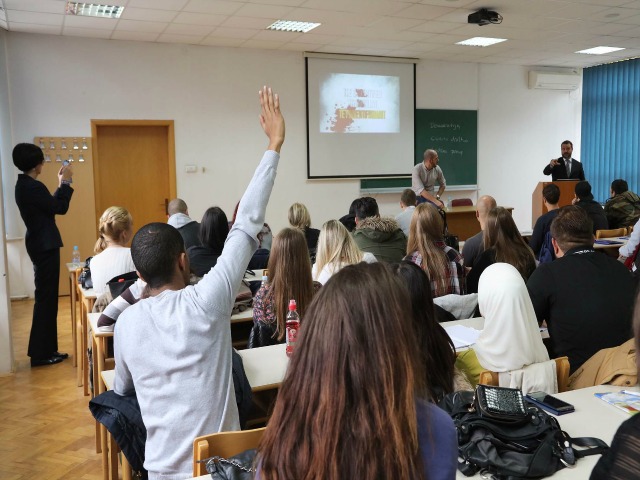
Sarajevo Students Visit State Court with BIRN BiH

Students studying at the Faculty of Political Sciences in Sarajevo attended a war-crime trial at the state court with journalists from the Balkan Investigative Reporting Network Bosnia and Herzegovina (BIRN BiH).

First- and second-year students at the Sociology Department and Security and Peace Studies Department of the Faculty of Political Sciences on Tuesday attended the trial of Djordje Ristanic, who has been charged with committing crimes against humanity in the municipality of Brcko during wartime.

For most of them, this was their first visit to a judicial institution.

The students were led by Emir Vajzovic, a professor and representative of the Institute for Social Research at the Faculty of Political Sciences in Sarajevo.

Erna Mackic, BIRN BiH’s editor-in-chief, addressed the students and explained to them the history of the Bosnian state court’s work in trying war crimes.

The students spoke to Vajzovic and Mackic about the importance of trying war crimes irrespective of the ethnicity of the defendants, as well as the importance of informing the public about the work of one of the highest-level judicial institutions in Bosnia and Herzegovina.  

The students agreed that trying all crimes and coming to terms with the past was necessary for implementing the reconciliation process and sustaining peace in this area.   

The visit to the Bosnian state court resulted from a collaboration between the Faculty of Political Sciences in Sarajevo and BIRN BiH, which involves various joint projects and the education of students in all of the faculty’s departments.  

BIRN Joins Countering Violent Extremism Panel

Balkan Investigative Reporting Network Bosnia and Herzegovina (BIRN BiH) editor Denis Dzidic took part in a panel discussion on methods of countering violent extremism online.

BIRN BiH Denis Dzidic took part in a panel discussion entitled ‘Countering violent extremism online and protection of the right to freedom of speech’ on Friday at the Sarajevo Bristol Hotel, as part of the second annual Bosnian Forum on Internet Management. 

The panelists discussed terrorist propaganda and threat of social media being used to radicalise young people. 

Dzidic said that it is vital for media, when reporting on violent extremism, to be wary of sensationalism, but also added that state institutions should be more open towards journalists. 

“What we are seeing in Bosnia today is that the system is confusing and the way they communicate with journalists is also confusing, so whenever an incident happens, you have on one side institutions that do not want to give any information and even when they do, often different levels give different statements, which leads to sensational headlines,” he said. 

Mario Janacek from the Security Ministry said that Bosnia and Herzegovina was looking for a systematic solution for preventing abuse of the internet for terrorist purposes or any other types of propaganda and hate speech. 

Janacek said that terrorists had moved ahead in terms of using internet platforms, adding that they invested in marketing more than individual corporations. 

“What we currently see in European practices is not promising. It does not look like it might offer any results in terms of removing such material from the internet. It is mainly focused on a certain type of censorship. According to practices applied in most of the countries, such materials are removed without too much thinking about the consequences. In some European countries, police block such content even without court warrants, so we are also considering such possibilities,” Janacek said. 

Analyst and theologian Muhamed Jusic spoke about violent extremism justified by religion, primarily the practice of the so-called Islamic State, as well as giving an analysis of content published and quickly spread on social networks. 

“The internet is not a key factor in radicalisation, which has to go through personal contacts and happen inside smaller circles. There must be someone whom you trust when you speak to them. However, the internet has a great importance in reinforcing those stances and additionally persuading yourself that what someone told you during a closed meeting was true,” Jusic said. 

The participants at the panel discussion also discussed projects aimed at creating positive narratives via the network of ‘Super Citizens’, who are fighting against hate speech, as well as the role of the media in reporting on radicalisation and terrorism.

BIRN’s Kosovo War Film Screened at Sarajevo University

Sarajevo University’s law and political sciences faculties screened BIRN’s documentary ‘The Unidentified’, about the Serbian fighters responsible for some of the worst atrocities of the Kosovo war in 1999.

‘The Unidentified’, which investigates attacks on Kosovo villages in 1999 and names those involved in an attempted cover-up operation to conceal the crimes, was screened for students of communications, security, journalism and law at Sarajevo University on Tuesday and Wednesday.

“My idea was to make sure that, when people hear and watch this film, be it in Belgrade, Novi Sad or Kragujevac, they will not be able to say that no crimes happened in Kosovo,” the film’s director Marija Ristic said in a video message to the students.

‘The Unidentified’ was made as a result of two years of research, and takes viewers back to the villages of Ljubenic, Cuska, Pavljan and Zahac, near Pec/Peja in Kosovo, in the spring of 1999, when Serbian forces killed more than 118 Albanian civilians.

The victims’ bodies were burned or removed, and some of them were subsequently found in a mass grave at a police raining centre in Batajnica, near Belgrade, in 2001. Eleven former members of Serbian forces are on trial in Belgrade for committing those crimes. In February 2014, nine men were sentenced to a total of 106 years in prison, but the appeals court quashed the verdict in March last year, saying it was “incomprehensible and contradictory”, and ordered a retrial.

Midhat Izmirlija, a professor at the Faculty of Law, said after the screening that ‘The Unidentified’ was a great example of socially-engaged journalism.

“This is an excellent way for the media to work with the aim of determining the truth about certain events and presenting the truth to the victims and the public,” Izmirlija said.

Lejla Turcilo, a professor at the Faculty of Political Sciences, said it was very important for young journalists to be exposed to such works of research works during their studies.

“Our students do not come across these type of stories while studying theory. Our goal is to offer them practical experiences, which they lack during their education, but it is important not to always engage in daily journalism, but in investigative journalism, which is scarce,” she added. She said such projects could motivate students by “showing them there is a possibility for making changes in society”.

Following the screening of the documentary, the Law Faculty students had a lecture and held a discussion on the legal challenges involved in monitoring war crime trials, while the students at the Faculty of Political Sciences had a discussion on journalism and transitional justice with BIRN Bosnia and Herzegovina editor Denis Dzidic.

Serbian Culture Ministry Gives Support to Belgrade Insight

The Ministry of Culture and Information of the Republic of Serbia provided support for BIRN’s Belgrade Insight starting in September 2016 as part of the annual assistance it provides for local media outlets through open call for proposals.

The ministry’s support was provided through financial assistance to help cover the costs of coordination, distribution and printing of seven issues of the publication. 

Belgrade Insight, which began circulation in 2008, covers all aspects of life in the Serbian capital – from politics to business, culture to sport and lifestyle to current affairs. It still remains the only biweekly newspapers in English language in the Serbian capital.

BIRN Holds Transitional Justice Training in Sarajevo

BIRN Hub opened a two-day training course on transitional justice reporting for 23 journalists from Bosnia and Herzegovina, Croatia, Montenegro, Macedonia, Kosovo and Serbia.


The two-day training course began in Sarajevo on Thursday with the aim of introducing the 23 reporters to the topic of transitional justice from a journalistic perspective and deepening their knowledge of war crimes trials and related issues.

The training started with a regional conference entitled ‘War Crimes Proceedings and Regional Cooperation’ which gathered prosecutors, experts and journalists from across the former Yugoslavia.

Journalists had the chance to watch a debate which was also addressed by representatives from the OSCE, the EU-rule-of-law mission in Kosovo, EULEX and the International Criminal Tribunal for the Former Yugoslavia.

The prosecutors talked about challenges to war crimes prosecutions in the Balkans, particularly in light of the ICTY closing its doors next year.

The training continued with an afternoon session which hosted Kevin Hughes, legal adviser to the chief prosecutor at the ICTY, who gave an overview of international courts and tribunals as well as the ICTY’s achievements and legacy.

Sven Milekic, a journalist from Croatia who works on BIRN’s Balkan Transitional Justice project, outlined the concept of transitional justice as well as the role of journalists in war crimes trials.

Denis Dzidic, a journalist from Bosnia and Herzegovina who works on BIRN’s Balkan Transitional Justice project, gave an insight to transitional justice resources for journalists as well as looking at the obstacles facing transitional justice reporters and how to deal with them.  

Dzidic then gave an overview of war crimes trials in Bosnia and Herzegovina together with Ivan Jovanovic, an international humanitarian law expert who gave an overview of war crimes trials in Croatia, Kosovo, Serbia, Montenegro and Macedonia.

As part of the training session, BIRN launched its War Crimes Verdicts Map – an interactive tool intended to provide an overview of court rulings on the crimes that were committed during the wars in the former Yugoslavia in the 1990s.

Comprising a total of 386 verdicts, it represents a unique database of publicly-available final judgements issued by national courts in Bosnia and Herzegovina, Croatia, Montenegro, Kosovo and Serbia.

It also includes verdicts handed down by the International Criminal Tribunal for the Former Yugoslavia in The Hague.

On the second day of the training course, the journalists visited the Court of Bosnia and Herzegovina, where they had a guided tour and attended a war crime case hearing at which the closing arguments were given by the state prosecutor.

After the visit to the court, the group was given a presentation at the International Criminal Tribunal for the Former Yugoslavia’s Liaison Office in Sarajevo by the office representative, Almir Alic.

At the afternoon session, the journalists met with Boris Grubesic, the head of the Public Relations Department at the Prosecutor’s Office of Bosnia and Herzegovina, Murat Tahirovic, president of the Association of Victims and Witnesses of Genocide, and Lejla Softic from the International Commission on Missing Persons.

BIRN Bosnia and Herzegovina journalists Erna Mackic and Marija Tausan then gave a presentation about the challenges and pitfalls of court reporting.

The conference and the training session are part of BIRN’s Balkan Transitional Justice initiative, funded by the European Commission, the Federal Department of Foreign Affairs of Switzerland and the Robert Bosch Stiftung.

The project aims to improve the general public’s understanding of transitional justice issues in former Yugoslav countries – Bosnia and Herzegovina, Croatia, Kosovo, Macedonia, Montenegro and Serbia.

To find out more about the conference: http://www.balkaninsight.com/en/article/birn-to-host-regional-conference-on-war-crimes-prosecution-09-20-2016