BIRN Serbia begins journalism training within EU PROGRES programme

The first training session for journalists and editors organised by BIRN Serbia as part of the project ‘Europe, It’s You’ was held in Leskovac in southern Serbia from March 15-17. The training sessions are part of The European Partnership with Municipalities – EU PROGRES across south and southwest Serbia.

PROGRESS training

The participants included 13 journalists and editors from eight municipalities and cities from this region.

The trainers and speakers were representatives of the EU PROGRES Programme, an expert from the Serbian government’s office for EU integration (SEIO), Zoran Sretic, and an assistant from Belgrade University’s political science faculty, Aleksandra Krstic. 

Sretic explained the details of Serbia’s progress towards joining the European Union, particularly the Interim Trade Agreement and the Stabilisation and Association Agreement.

The participants were mostly interested in finding out how these agreements will affect their own communities.

Serbian and European media coverage of the EU was the main topic of Krstic’s presentation. She explained in detail what kind of tools and information that could be useful for journalists are to be found on EU institutional web pages.

The next training will be organised from March 29-31 and involve a new group of participants. 

Suddeutsche Zeitung’s Balkans correspondent joins Fellowship committee

The award-winning German journalist Florian Hassel will be representing Suddeutsche Zeitung on the selection committee of the Balkan Fellowship for Journalistic Excellence this year. The respected German newspaper has been the Fellowship’s media partner since the establishment of the programme in 2007. Hassel will replace his colleague Christiane Schloetzer, who was a member of the jury for six years until she took up a new post in Turkey in late 2012.

Florian Hassel‘s journalistic carrier started back in 1986, and since then he has written for a number of leading German papers, such as Die Welt, Frankfurter Rundschau, Die Zeit, Stern, following domestic affairs and working as Moscow correspondent. He also worked as a correspondent from Germany for the Austrian news magazine Profil.

In 2002, Hassel was awarded the Wächterpreis der Tagespresse (German newspaper investigative reporting prize) for a series of investigative reports on the war in Chechnya, while in 2011 he won the Ernst-Schneider-Preis (the most prominent German prize for economic reporting) for a series of reports on the debt crisis in Greece in Welt am Sonntag.

Since January 2013 he has been the Balkans correspondent for Suddeutsche Zeitung.

 The Balkan Fellowship for Journalistic Excellence is an annual bursary for cross-border investigative and long-form reporting. Ten journalists are picked by the Fellowship’s selection committee each year to receive funding, training and professional support to conduct fresh, in-depth investigations. The independent selection committee is made up of regional and international journalists, editors and prominent Balkan experts. It consists of six permanent and one annual member, selected in accordance with the annual topic. This year’s Fellowship programme topic is Integrity.

You can find out more about the project on its website: http://fellowship.birn.eu.com/en/page/home

BIRN’s legal adviser participates in justice system discussion

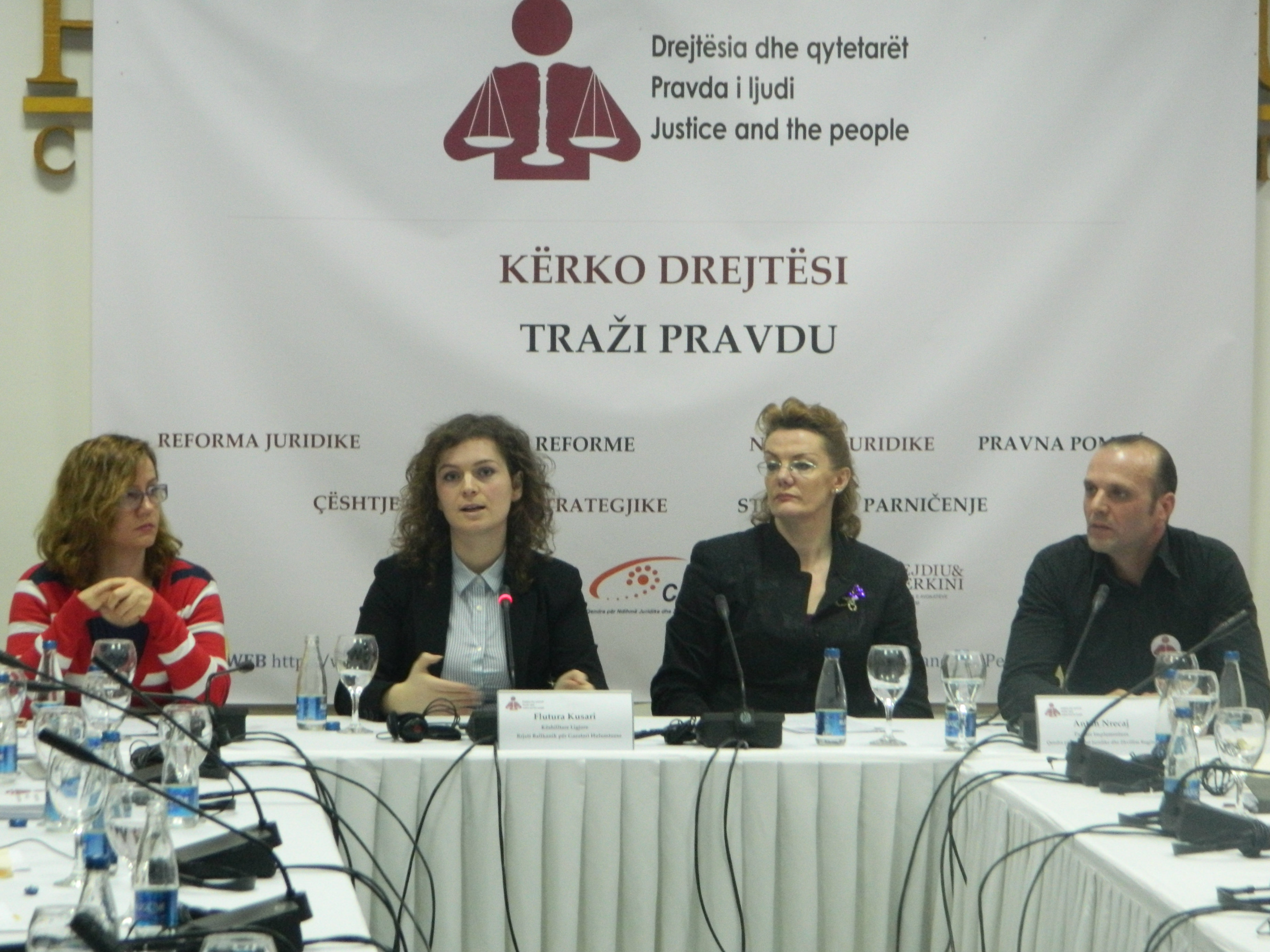
BIRN Kosovo’s legal adviser Flutura Kusari spoke at an expert roundtable on the subject of citizens’ rights and accountability in the Kosovo justice system that was organised by Advocacy Training and Resource Centre in cooperation with Centre for Legal Aid and Regional Development as well as law firm Sejdiu and Qerkini.

BIRN’s legal adviser participates in justice system discussion

The roundtable involved the United States ambassador Tracy Ann Jacobson, Kosovo’s justice minister Hajredin Kuci, Michelle Lakomy from the US Department of Justice and several media and civil society representatives. 

Jacobson expressed her dissatisfaction with the justice system and suggested that everyone involved in it needed to work harder and with greater commitment in order to strengthen confidence in the judiciary.

Jacobson referred to the case of Diana Kastrati, who was killed by her estranged husband, saying the municipal court in Pristina showed a lack of responsibility by not issuing a protection order within 24 hours despite her request for one. 

The case was seen by many of the roundtable’s participants as a critical example of the justice system failing Kosovo’s citizens.

Kuci also admitted the judiciary was dysfunctional and said it should increase its transparency and accountability.

Kusari meanwhile addressed a range of problems that citizens as well as journalists face on a daily basis, including the lack of spokespeople for the Kosovo Judicial Council and the Kosovo Procurement Council as well as the outdated web-sites of relevant institutions, both judicial and prosecutorial. 

Based on a BIRN court monitoring project, Kusari also pointed out that the majority of court hearings are held in judges’ offices, not in trial chambers.

BIRN Serbia holds public debate on health in Serbia

BIRN Serbia organised a panel discussion in Belgrade on March 13 about introducing a better system of protection of patients’ rights as a part of its ‘Monitoring Policies of the Government of Serbia’ project in the fields of the economy, health, education and the fight against corruption. 

Tanja Maksic, project coordinator at BIRN Serbia, said that the results of the project’s monitoring showed that the election campaign promises that have been fulfilled so far are those relate to healthcare availability, expanding the list of free medicines and financial support to pregnant women.

“When it comes to the law on the protection of patients’ rights, it was not explicitly announced during the election campaign, but it was mentioned in the prime minister’s speeches. Also, I want to remind you that Serbia is the only country in the region that has not adopted this law,” said Maksic.

She added that the draft law on the issue defines in detail the rights of patients, but not their protection or any potential sanctions against those who violate them.

“The draft law on the protection of patients’ rights will be available to the government of Serbia by the end of March or early in April, while the law should be adopted by parliament during the spring session,” said Perisa Simonovic, state secretary at the health ministry.

Radmila Ivanek, special adviser to the health minister, said that several months of public debate had helped to improve the text of the legislation.

“In addition to the existing 11 rights, eight new rights are incorporated in the new law. Among them are the right to preventative measures, the right to quality health services, the right to a second opinion, the right to patient safety, and the rights of children in hospitals,” said Ivanek.

The topic of the patients’ rights protector and its relocation to local government under the new legislation caused most debate during the panel discussion. The law says the position will be relocated from healthcare facilities to local municipalities and that its name will be changed to patients’ rights advisor.

The Serbian ombudsman’s office, which supports the adoption of the law, pointed out some of the problems surrounding the current situation.

“The problem was that the protector, while working in health institutions, was also performing a numerous of other legal issues, therefore it’s important that this will be someone whose main activity will be protection of patients’ rights. It is also important to regulate the whole procedure, because in practice we were faced with situations in which its role was limited to forward complaints and responses among patients and doctors,” said Gordana Stevanovic, a representative of the ombudsman’s office.

But Marina Mijatovic, director of the NGO Legal Scanner, disagreed with the new name because the role of the position is not just to advise patients but to protect their rights as well.

The panel discussion was part of a project entitled Development of Mechanisms for Monitoring and Measurement of Government Policy, conducted under the auspices of the British Embassy in Belgrade.

Award-Winning UK journalist Joins Fellowship Jury

Paul Lewis, special projects editor at the British daily newspaper The Guardian, has joined the annual jury for the Balkan Fellowship for Journalistic Excellence.

He recently received the European Press Prize’s Innovation Award for spearheading a major research project into the causes and consequences of the riots in England in summer 2011.

Lewis lectures across Europe about the use of social media in journalism and teaches a masterclass in investigative reporting. You can watch his TED talk here. Last year, he trained journalists at BIRN’s investigative reporting summer school.

He was named Reporter of the Year at the British Press Awards in 2010 and won the 2009 Bevins Prize for outstanding investigative journalism. He previously worked at the Washington Post as a Stern Fellow. In 2012, he was nominated for both Reporter of the Year and the Orwell Prize for Journalism. He was also the winner of the ‘Best Twitter Feed’ award at the Online Media Awards.

He joined the Guardian as a trainee is 2005 after studying at Cambridge University and Harvard University. He lives in London and can be followed on Twitter: @paullewis

The Balkan Fellowship for Journalistic Excellence is an annual bursary for cross-border investigative and long-form reporting. Ten journalists are picked by the fellowship’s selection committee each year to receive funding, training and professional support to conduct fresh, in-depth investigations. The independent selection committee is made up of regional and international journalists, editors and prominent Balkan experts. It consists of six permanent and one annual member, selected in accordance with the annual topic. This year’s Fellowship programme topic is Integrity.

You can find out more about the project on its website: http://fellowship.birn.eu.com/en/page/home

More than 100 Applicants for Balkan Fellowship for Journalistic Excellence

This year’s competition for the Balkan Fellowship for Journalistic Excellence programme closed on March 5.

After receiving more than 100 applications, the BIRN team has now launched preparations for the selection process and eligibility checks, after which members of the selection committee will begin the process of choosing the journalists to participate in this year’s programme. The criteria for selection are based on the quality of applications and the journalistic merits of the candidates.

The results of the committee’s deliberations will be announced on March 29 on our website, fellowship.birn.eu.com, while all candidates will be individually informed about the results of the annual competition.

Each year, ten Balkan journalists are selected to take part in the programme. Successful applicants receive a bursary, an additional travel and research allowance of up to €2,000 and the chance to participate in a seven-month programme of professional development and excellence in reporting. Experienced regional and international editors provide hands-on support throughout.

Fellows must be available to attend seminars and editorial sessions during the course of the programme. Participants are expected to complete 2,000-word stories, which will be subject to international-style editing processes and will showcase top-quality journalism with a cross-border reporting angle. The final articles are disseminated in local languages, English and German and are republished in the Balkans and beyond.

The Balkan Investigative Reporting Network, alongside its partners, the Robert Bosch Stiftung and ERSTE Foundation, would like to thank all the applicants for their interest in the programme and wish them the very best of luck.

BIRN Serbia Conducts Debate on Education in Serbia

Public discussion about education in Serbia is currently limited and the impact of educational policies is not matching up to expectations, it was concluded at a debate dealing with education policy organised by BIRN Serbia on February 27.

BIRN Serbia debate on education

“Nobody expected a breakneck shift in the field of education from the new government, but it feels that the issue remains on the fringes – there is a mismatch between expectations and the way in which this very important subject is treated in public,” said Dragana Zarkovic-Obradovic, the director of BIRN Serbia, during the debate entitled ‘How to Write Education in Serbian’.

Vlasta Matejic, one of the creators of the strategy which ensures that the state allocates 4.5 per cent of its budget to education, said it was “untrue that the Serbs are an educated nation” – a fact which is one of Serbian society’s biggest contemporary problems, he said.

According to Matejic, the development of education in Serbia depends on the courage of the state: “If we are bold enough, we will have better education, but if we allow politics to mix with education, we will have education as usual, and that’s not good,” he said, adding that the ultimate outcome is likely to fall somewhere between these extremes.

Matejic warned that there are many illiterate people in Serbia, and that “academic people do not even read their own works, nor [their] publications”.

Radivoje Mitrovic, state secretary at Serbia’s education ministry, said that education is not just a matter for the ministry and the state, but for all – from nurseries to universities, from pupils, students and parents to the economy and local governments.

Mitrovic said that it is very important that education is seen as an opportunity and a tool to overcome the current crisis.

A survey conducted by BIRN Serbia showed that education was very little represented as an issue in last year’s election campaign; it was mostly raised by the Serbian Socialist Party but absolutely sidelined by the Serbian Progressive Party and United Regions of Serbia coalition.

The panel discussion was part of a project entitled Development of Mechanisms for Monitoring and Measurement of Government Policy conducted under the auspices of the British Embassy in Belgrade.

BIRN BiH Director Interviewed in Bosnia’s Dani Magazine

Anisa Suceska-Vekic, director of BIRN in Bosnia and Herzegovina, gave an interview to weekly magazine Dani, which was published on February 22. In the interview, Suceska-Vekic speaks about BIRN BiH and its work, as well as her family, as she is the mother of three small children.

“What is characteristic of our team is that, despite the fact that we deal with serious issues, we perform our job happily and invest maximum efforts [in it]. The atmosphere in the office (or on Skype, as we are often at different locations) and between the team members is always positive,” Suceska-Vekic said.

“My working day in the BIRN office is never a typical one and it never ends after nine working hours. Most of my days are marked by stress, but at the end of each day I am pleased with what has been done,” she said.

Besides being a director of BIRN in Bosnia and Herzegovina, which follows the processing of war crimes and other activities related to ensuring the transparency of court processes, as well as investigative reporting in the field of coming to terms with the past, Suceska-Vekic is a mother of three children, one of whom was born recently.  

“Our small family consists of six members, with equally numbered male and female squads: Zaria (five years), Pegy (bearded collie, two years) and my humble self are in the female team. Our most important guys are Dan (three), Lun (two months) and dad Dejan,” she told the magazine.

In the interview, Suceska-Vekic also speaks about the rights of women in Bosnian society, as well as the possibilities for balancing private life and work.

Download the full inteview as a PDF file in BCS language

BIRN Director Speaks About Balkan Media on Berlin Panel

BIRN’s regional director Gordana Igric spoke in Berlin on February 25 on a panel about reporting in south-east Europe and the pressures on journalists that exist in all the countries in the region.

Igric talked about political pressures on the media in the Balkans, noting that political parties try to influence the media elsewhere too but the phenomenon is more pronounced in countries which are suffering economically.

“I don’t see any sources for mainstream media to be independent,” she said, referring to a discussion about the impact of financing on media independence.

Igric also said that one of the problems of the media in the Balkans is ownership, which is often not as transparent as it should be.

Ljiljana Zurovac of Bosnia and Herzegovina’s Press Council said that the media laws in her country were very good, but what was lacking was their proper implementation. She agreed that one of the problems for the media in the Balkans is the lack of money.

But Goran Milic of Al Jazeera Balkans said that the lack of money is not always a problem because a large number of media have managed to develop strong audiences.

The panel was a part of an alumni meeting of past participants in Economic and Political Reporting From South-East Europe journalism training courses organised by the Robert Bosch Stiftung and the Thomson Reuters Foundation.

The three-day meeting brought together six groups of journalists who had been on the course at different periods for panel debates, discussions and workshops.

UNDP Praises BIRN’s Transitional Justice Reporting

The United Nations Development Programme in Kosovo published a new report called ‘Perceptions on Transitional Justice’ on Tuesday, outlining the current problems that Kosovo is facing over reconciliation, missing persons, reparations and other key post-conflict issues including media coverage of war crimes topics.

The UNDP report analysed the role of media in reporting on transitional justice issues, comparing the current situation with a previous survey published by the organisation in 2007.

“Although print and electronic media throughout the region still continue to reproduce nationalistic narratives, it is evident that respondents [to the latest survey] can clearly make a distinction between media that are professional in researching and reporting on war crimes,” the report said.

“New media cooperation initiatives in the Western Balkans that cover transitional justice issues have become more visible after the 2007 survey. For example, the Balkan Investigative Reporting Network and Balkan Insight have managed to cover these topics successfully,” it underlined.

The report, based on a public opinion survey of 1,250 people from all Kosovo’s ethnic groups, said that past grievances were still obstructing progress on reconciliation within society.

The survey’s authors interviewed 850 ethnic Albanians, 200 ethnic Serbs and 200 people of other ethnicities in Kosovo.