BIRN Journalist Comments on Vlahovic Verdict on BHT 1

BIRN Bosnia and Herzegovina journalist Mirna Buljugic featured on BHT1’s main news programme on March 29, 2013, speaking about last month’s conviction of paramilitary Veselin ‘Batko’ Vlahovic, who was given Bosnia’s longest ever war crimes sentence.

Mirna Buljugic RTV BiH dnevnik

Buljugic said that the trial had been completed relatively quickly considering the fact that it was a major case and more than 100 witnesses had testified, some of them offering highly moving testimony before the Sarajevo court.

“Emotions are important for us journalists. I therefore emphasise the moving testimonies, but neither the law nor courts recognise emotions. The trial chamber assessed all pieces of evidence, both the common and individual ones, before it rendered its verdict, pronouncing Vlahovic guilty, beyond reasonable doubt, of 60 out of 66 counts against him,” said the BIRN journalist, who has followed the trial since its beginning. 

During the course of the trial, the prosecution presented a BIRN BiH article entitled ‘Synonym for Fear’, written by Merima Husejnovic, as evidence. Vlahovic’s lawyers meanwhile used other BIRN BiH articles containing all testimonies as a resource for preparing his defence.

In his closing arguments, defence attorney Radivoje Lazarevic acknowledged BIRN BiH’s expertise and objectivity in reporting on the Vlahovic trial, as distinct from other media outlets reporting on the court case. 

Under the first instance verdict, Vlahovic, also known as Batko, was sentenced to 45 years in prison for wartime crimes against civilians in the Grbavica, Vraca and Kovacici neighbourhoods of Sarajevo in 1992, including murders, rapes, enslavement, physical and mental abuse, unlawful detention and robbery. 

The entire show is available to watch here: Dnevnik 2 – 29.3.2013

Al Jazeera Balkans Hosts Balkan Insight Managing Editor

Ana Petruseva, BIRN Macedonia director and Balkan Insight managing editor, took part in Al Jazeera Balkans’ current affairs TV show ‘Kontekst’ on April 4.

The topic of the programme was the upcoming second round of the local elections in Macedonia. Another guest on the show was Macedonian political analyst and professor at Skopje University of Political Science, Vladimir Bozinovski.

‘Kontekst’ is a daily programme aired by the Balkans branch of the international Al Jazeera news network, which was launched in 2011. The April 4 edition can be seen by following this link:

BIRN Fellowship Alumnus Wins Journalism Prize

Stevan Dojcinovic, editor of the Centre for Investigative Journalism Serbia and an alumnus of the Balkan Fellowship for Journalism Excellence, has won the 2012 Jug Grizelj award for investigative journalism.

Stevan Dojcinovic

Dojcinovic won with a series of articles on organised crime and corruption in Serbia and the Balkans region which were published by several newspapers and magazines.

The members of the jury were Antonela Riha, Filip Svarm, Vukasin Obradovic and Velimir Curguz Kazimir.

The awards ceremony will take place on April 5 at the Media Centre in Belgrade.

The annual prize has been awarded for achievements in investigative journalism from 1991 onwards, in memory of journalist Jug Grizelj.

Several journalists set up a fund in the early 1990s to preserve Grizelj’s memory and encourage investigative reporting.

Dojcinovic is took part in the Balkan Fellowship for Journalistic Excellence programme in 2011 and won third prize for his story on dubious privatisations in Serbia, entitled Serbian Privatisation: Criminals Still Cash In.

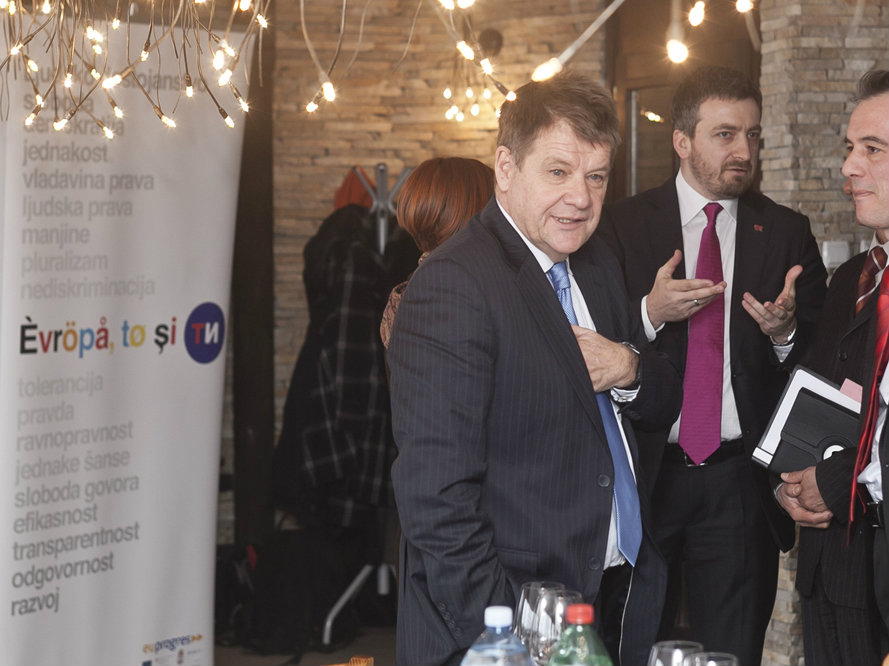
Southern Serbian Cities and Municipalities Join ‘Europe – That Is You’ Campaign

Representatives of the Delegation of the European Union’s delegation to Serbia, the Serbian government office and EU’s PROGRESS European Partnership with Municipalities Programme sent out a message to mayors and heads of municipalities in south and south-west Serbia, saying that the amount of donations they will get in the coming period depends on their abilities and competence, which is why it is necessary to strengthen the capacities of the local administrations so they can respond to the challenges of EU integration in the best possible way.

A working lunch took place on March 22 in Topola in Serbia to mark the beginning of the ‘Europe – That Is You’ campaign. In attendance were mayors and heads of 25 cities and municipalities in south and south-west Serbia, from the Pcinja, Jablanica, Toplica, Zlatibor and Raska districts, and they all voiced their readiness to support the activities aimed at bringing Europe closer to the local communities that they represent.

The deputy head of the EU delegation to Serbia Adriano Martins confirmed the European Union’s resolve to give Serbia strong support on its path towards European integration and said that the coming period will be marked by an even more intense cooperation on initiatives coming from underdeveloped or insufficiently developed regions.

“EU funds are open to all projects whose foundation is the development of your communities, inter-municipal cooperation or the strengthening of cross-border initiatives. We will be together on this job and all EU institutions that have their representatives in Serbia will stand at your disposal. However, you are the bearers of these projects and initiatives,” said Martins.

EU PROGRESS manager Graeme Tyndall commented on the results jointly achieved by his team and the local administrations by implementing dozens of projects and stressed that south and south-west Serbia have the capacity to respond to the challenges that the next phase of EU integration will bring.

“If over the past three years we have helped you get some important things started in your local communities then our mission has been fulfilled. However, what is crucial is the depoliticisation of development. The important thing is not that the local president launched a project but for that project to be in the benefit of all members of a community and for it to be successfully completed,” said Tyndall.

European Integration Office director Milan Pajevic spoke about the importance of cooperation between local government units and state institutions. He explained his institution’s role in the system of allocating donor assistance and voiced readiness to assist, with his team, local administrations in improving ways of accessing European funds.

“It is important that we understand each other well and that we know what our goals are. I believe that this campaign will help us get there. The European Union’s support is already noticeable in local communities and we will make efforts to ensure that this also continues to be the case in the coming period,” said Pajevic.

Representatives of the cities and municipalities spoke during the working lunch and had many comments on the cooperation established so far with the EU, the EU Integration Office and the EU PROGRESS Program.

The overall conclusion was that the projects funded by the European Union, the Swiss government and the Republic of Serbia through the programme have produced results which have given the people in local communities a new energy, improved their living conditions and equipped the local administration with new strength to work even more decisively on developing these cities and municipalities.

„You helped us obtain funds so we could improve our people’s quality of life and, by doing so, you made our work easier,” said Jovan Corbic, the president of the Municipality of Raska.

“It is our job to set up a good team, a team skilled in producing developmental projects. Only then can we say that we have been successful in our work,” added Semsudin Kucevic, the head of the Municipality of Tutin.

BIRN Kosovo Wins Three Journalism Awards

BIRN Kosovo’s ‘Gazeta Jeta ne Kosove’ (‘Life in Kosovo Newspaper’) won three journalism awards on Monday, including the ‘best journalist of 2012’ prize.

BIRN Kosovo wins journalistic prizes

The newspaper’s reporter Parim Olluri was named the best journalist of 2012 by the Association of Professional Journalists of Kosovo for a number of investigative stories published during the year.

‘Gazeta Jeta ne Kosove’ won most of the annual awards given out by the Association’s jury this year.

The ‘best culture story’ award was given to Jeton Musliu for the article ‘Kosovo Textbooks Soften Line on Ottoman Rule’ and Virtyt Gacaferri won the prize for the best sports story with ‘The Match That Showed Many Albanian Realities’.

The Kosovo daily ‘Koha Ditore’ was awarded for publishing the best economic and social feature, written by Vehbi Kajtazi and Visar Preberza, while Agron Halitaj won the award for the best political feature.

Jeton Llapashtica from another Kosovo daily, ‘Zeri’, was given the prize for writing the best investigative story, while photographer Ridvan Svilova got the award for the best photo.

Private television broadcaster Klan Kosova received two prizes, with the channel’s Naim Selmani receiving the award for the best sports feature and Ilir Hasani the award for best camerawork.

BIRN Serbia Launches Website “JAVNO”

The Balkan Investigative Reporting Network (BIRN Serbia) launched a portal called Javno.rs, an open and fully searchable database containing thousands of documents on public expenditure, on March 28. The link for the site is http://javno.skockajtebudzet.rs/index.php.

The database that the BIRN team has been compiling since 2010 is primarily meant for journalists and researchers as well as for all interested citizens. The aim of the Javno.rs  website is to make information about the spending of public funds easily accessible to the wider public.

Javno is devised as a constantly growing resource that is regularly updated. The databases that have been created will be supplemented every year while new ones will be developed, covering fields of interest that we assess as murky areas of public expenditure or as potential generators of corruption in Serbia.

The website currently contains six databases:

1. Discretionary expenditures of the Serbian government, containing information on how the ministries spent public funds on budget lines 423 and 424 Specialised services and Contracted services for 2010 and 2011.

2. Public funds and the media, containing information on how local government bodies financed the media, what particular content they financed, what was the scope of this financing and what criteria were applied during the process.

3. Belgrade promotional costs, a database of the expenditures of the City of Belgrade Administration and city public companies on hiring PR agencies and on promotion.

4. One hundred biggest public procurements, a database of the 100 biggest procurements in the past ten years.

5. Investments for investors, a database on the programme for attracting direct investments to the Serbian state and the employment of new workers over the past seven years

6. 2012 elections, a database of all candidates who participated in the Serbian parliamentary elections in 2012.

The idea for Javno came from BIRN but our many partners helped to implement it: from the British Embassy in Belgrade to IREX.

Kosovo Court Holds BIRN Media Harassment Hearing

The court in Pristina held a closed session in the case against a municipality chief and a group of newspaper staff over a slur campaign against BIRN Kosovo director Jeta Xharra.

A protected witness testified on Tuesday in the case against the head of the Skenderaj/Srbica municipality, Sami Lushtaku, and a group of five journalists and executives from the now-defunct Infopress newspaper, who are all accused of staging a negative media campaign against Xharra.

The hearing was held behind closed doors because the witness is protected by the EU rule of law mission in Kosovo, EULEX, due to their involvement in another case. The testimony was presented to the court via video link.

Lushtaku is charged, along with Infopress’s former owner Rexhep Hoti, former executive director Arizona Dibra, former editor-in-chief Avni Azemi and former journalists Rizah Hajdari and Qani Mehmeti with making threats against Xharra and violating her citizen’s right to equality in May and June of 2009.

According to the indictment, the campaign was launched after Radio Television Kosovo broadcast an edition of BIRN’s TV programme, ‘Jeta ne Kosove’ (‘Life in Kosovo’) dealing with alleged mismanagement and unfavourable conditions in Skenderaj/Srbica where Sami Lushtaku was acting chief at the time.

Over the course of 12 articles published by Infopress, Xharra was called a “Serbian spy”, a “professional bomb” and subjected to other insults, the indictment says.

The trial started earlier this month and the next hearing is scheduled for April 15.

Fellows for 2013 selected

The jury in the Balkan Fellowship for Journalistic Excellence has selected 10 participants for this year’s programme.

The fellows were drawn from more than 100 applicants. The competition for the top places was once again extremely close, and the quality of shortlisted entries was very high.

BIRN would like to congratulate the winners, and to thank all who applied this year. BIRN would also like to encourage candidates who were not successful to consider applying again next year.

The journalists were selected through open competition to receive funding and professional support that would help them conduct cross-border research into a topic of regional and EU significance. Participants in the programme are selected based on the relevance, feasibility and originality of their proposals, as well as their professional qualifications, motivation and journalistic approach.

The Selection Committee is comprised of seven prominent media figures from the Balkans and Europe. Each year, committee members read, evaluate and select story proposals for the fellowship.

Alongside six permanent committee members, an expert in the fellowship investigation topic is appointed as an annual member, and this year it was Paul Lewis, award-Winning UK journalist and special projects editor at the British daily newspaper The Guardian.

Here are the fellows for 2013, listed alphabetically by surname:

Dino Jahic, Bosnia and Herzegovina

Meri Jordanovska, Macedonia

Hana Marku, Kosovo

Marija Milosevic, Serbia

Vlad Odobescu, Romania

Goran Rizaov, Macedonia

Mirko Rudic, Serbia

Erjona Rusi, Albania

Melisa Skender, Croatia

Elena Stancu, Romania

BIRN and Transparency Serbia hold debate on tackling corruption

As a part of the ‘Monitoring Policies of the Government of Serbia’ project, a conference on systematic approaches to fighting corruption was organised by BIRN Serbia in cooperation with Transparency Serbia on March 20.

BIRN Serbia debate on corruption

The key panelists were Michael Davenport, the United Kingdom’s ambassador to Serbia, Louis Laurent Stokvis, the Netherlands’ ambassador to Serbia, Rodoljub Sabic, the Commissioner for Information of Public Importance, Tatjana Babic, the director of the Anti-Corruption Agency, Radoslav Sretenovic, president of the State Audit Institution, Radomir Ilic, special advisor at the justice ministry and representatives of other independent bodies. More than 50 state, NGO and media delegates took part in the debate.

Michael Davenport said that Serbia, with a corruption perception index of 39, is in 80th place out of 186 countries and is recognised as a highly corrupt country.

He emphasised the importance of independent bodies such as the commissioner, the ombudsman, the Anti-Corruption Agency and the State Audit Institution in the construction of high-quality anti-corruption mechanisms.

“All these bodies submit to the parliament their annual reports in which they indicate the identified problems and recommend how to resolve them. In that way they are helping parliament to fulfill one of its main roles, which is the control of the executive branch, and enable better public insight into the work of independent bodies,” said Davenport.

Louis Laurent Stokvis said that parliament has a key role to play in the fight against systemic corruption. He stressed that no country can be satisfied with a high corruption index, especially Serbia, which aspires to join the EU.

“The government and parliament can work together to eradicate corruption and it is necessary to create a practical structure for the systematic fight against corruption,” said Stokvis.

Rodoljub Sabic pointed out that it is a serious problem for democratic society if Serbia does not implement the conclusions made by parliament.

“After parliament has considered the reports of independent institutions and reached a conclusion about them, they become official. It is necessary to have a mechanism to implement these conclusions in practice,” said Sabic.

Radoslav Sretenovic, president of the State Audit Institution, said that the most frequent problems arise during the implementation of the law on public procurement. Sretenovic also emphasised that the authorities do not use the right to list public officials’ financial and non-financial assets.

Ana Jerosimic, a representative of the Anti-Corruption Agency, announced changes in the national anti-corruption strategy reporting process, the extension of the agency’s rights in the fields of supervision of the implementation of the strategy and more accountability for non-compliance with the strategy.

“The new strategy provides that the duty bearers submit to the Agency semi-annual and annual reports, as well as evidence of activities carried out. If the agency is in doubt whether something is done, it will have the right to seek additional verbal explanations,” said Jerosimic.

The conference was the third in a series of public debates addressing topics like corruption, health, education and the economy. The debates are part of the BIRN Serbia’s project to monitor election campaign promises.

The conference was organised with the support of the embassies of the United Kingdom and the Netherlands to Serbia.

Harvard Students Visit BIRN Sarajevo Office

A group of students from the Harvard Law School International Human Rights Clinic visited the offices of BIRN Bosnia and Herzegovina to learn about war crimes prosecutions in the country.

BIRN BIH Harvard visit

The editor-in-chief of BIRN Bosnia and Herzegovina Erna Mackic and deputy editor Denis Dzidic met the students, who are conducting research about war crimes against civilians and prisoners of war, on March 18.

The group wanted to learn from BIRN BiH about how the Bosnian state court differentiated between civilians and combatants in war crimes cases. 

Mackic and Dzidic provided the students with examples from the six-year history of the court and also gave them information about the case of Alija Osmic, who was found guilty of crimes against prisoners of war despite originally being charged with crimes against civilians in Bugojno in 1993.

The students also wanted to find out about the concepts of command responsibility, civilian support for army units and the role of civilian defence forces during the early 1990s Bosnian conflict.