Balkan Fellowship Journalist Elvis Nabolli Wins Investigative Award

Elvis Nabolli, a 2016 fellow in the Balkan Fellowship for Journalistic Excellence, has won the award for best article by young investigative journalist, as part of the part of EU Investigative Awards in Albania.

Nabolli won for his article produced as part of the fellowship ‘An Albanian War on Drugs,’ published by Balkan Insight.

“Freedom of expression and freedom of the media implies a commitment to democracy, good governance and political accountability. These are some of prerequisites for a country to become part of the EU and one of the reasons why each of you play such an important role in creating EU standards,” said Jan Rudolph, Head of Political, Economic and Information Section announcing the EU Investigative Journalism Awards.

The Award ceremony was held on June 7th, 2017, at the European Union Info Center, Tirana. A total of 28 investigative stories were nominated for this year’s EU Award in Albania, 18 of whom from journalists under 35. Jury consisted of five prominent media professionals and civil society representatives: Rrapo Zguri, professor of journalism and jury chair, Aleksander Cipa, head of Union of Albanian Journalists, Valbona Sulce, media expert and member of Steering Council of public broadcaster, Lutfi Dervishi, media expert, and Adi Krasta, TV personality.

Valbona Sulce, member of the jury, stated that the jury faced a difficult task, given that the quality of nominations was good, covering a wide range of topics that are relevant to the society. In addition, the predominance of young journalists among the nominations received is also a good sign for the future of investigative journalism in the country, she said.

Resonant Voices Workshops Begin Across Balkans

A series of interactive workshops has started in five Western Balkan countries aimed at enabling critical voices to respond to dangerous messages and radicalisation online.

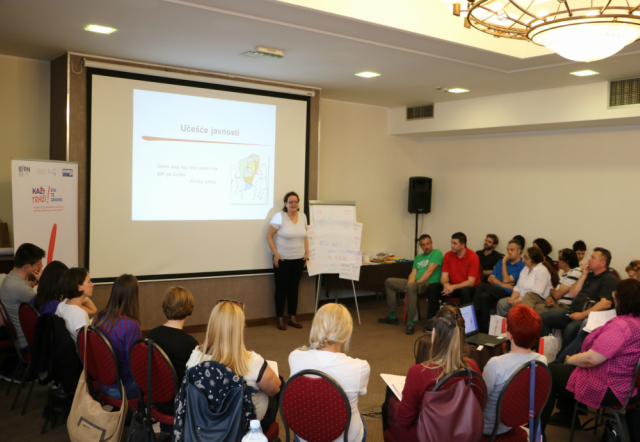
In cooperation with CIJA US and Talk 2.0, BIRN has organised workshops in Skopje, Tirana, Pristina, Belgrade and Sarajevo with the participation of more than 80 activists, journalists, bloggers, educators, religious communities representatives and other online and offline influencers in order to help them develop online communication strategies to respond to dangerous content.

The training sessions were led by Sanjana Hattotuwa, special advisor at the ICT 4 Peace Foundation, and Sarah Oh, a US-based communication expert, while participants also had the opportunity to hear from Facebook experts and Balkan-based organisations such as Sbunker, Halakate, Helsinki Committee, Vidiovo, Hocu.ba, Istinomer and others.

“In recent months we have seen increased propaganda, hate speech and calls for violence online, which in some cases like in Kosovo or Macedonia resulted in physical attacks on prominent activists and political figures. In parallel, there is a global trend to curb free media, either through fake news or economic and political pressure. In a circumstances like this, we believe our initiative will help local stakeholders to respond to these negative trends in a timely and proper way,” BIRN’s project manager Marija Ristic said.

Workshops were held under the umbrella of the Resonant Voices Initiative – a project implemented by the CIJA US, the Balkan Investigative Reporting Network and Talks 2.0.

The initiative aims to challenge extremist narratives in public discourse throughout the Western Balkans – in particular those disseminated online – and to equip critical voices in the target countries with the skills, know-how and resources to counter radicalisation, the recruitment of foreign terrorist fighters and violent extremists and other dangerous trends.

It will also empower a diverse group of civil society actors – activists, journalists, bloggers, educators and other online (and offline) influencers – to become resonant voices, able to counter violent extremism, to push back against extremist propaganda and to increase and amplify alternative, positive messages.

To learn more about the project, follow the Resonant Voices Initiative on Facebook and on Twitter.

BIRN Holds ‘Public Money for Public Interest’ Workshops

Forty local civil society representatives attended two workshops in Belgrade in May as part of the “Public money for public interest” project, which is being implemented by BIRN Serbia in cooperation with the Independent Association of Journalists of Serbia and Slavko Curuvija Foundation, and financed by the European Union. 

The workshops focused on education in the fields of defining the public interest in the media and monitoring the flows of public money in the local media.

The first workshop from May 15-17 gathered 14 organizations across Serbia that were interested in learning how to include citizens in the process of defining, implementing and monitoring the public interest in the media.

Through practical work, participants had chance to familiarize themselves with conditions and obstacles related to the implementation of participatory projects.

The second workshop, entitled “Research techniques and monitoring public money in the media sector,” ran from May 24-26.

Twenty CSO representatives were introduced to basic models and mechanisms on how public money is spent in the media sector. During the workshop participants acquired skills that will enable them to monitor the effect of spending public money on media content creation.

Both groups of participants will have an opportunity to continue working on the “Public money for public interest” project as researchers or as grantees in further project phases.

Nataliya Apostolova Urges Kosovo Law Students to Vote at a Forum Organized by BIRN Kosovo

On May 30th, students from the University of Prishtina’s, UP, Faculty of Law engaged in a discussion with the Head of EU Office in Kosovo, Nataliya Apostolova, moderated by BIRN Kosovo Executive Director Jeta Xharra. 

During the discussion, Apostolova provided a comprehensive overview of the relationship between Kosovo and the EU. She also congratulated Kosovo on its continuous commitment to advancing its path towards EU integration.  

Apostolova, a firm believer that education remains a key driver of a democratic state’s long-term competiveness and growth, said that Kosovo should focus on improving the quality of education. Students presented their concerns about Kosovo’s current situation as one of the most isolated citizenship regimes in the world in terms of freedom of movement. Apostolova responded by highlighting the importance of visa liberalization for Kosovo’ citizens, and she confirmed the EU’s full support on further advancing this process. However, she noted that Kosovo should fulfill the remaining criteria, including the finalization of the border demarcation agreement with Montenegro, which is a condition for visa liberalization. The EU remains committed to Kosovo’s European future, she emphasized, and the EU is eager to see Kosovo seize this opportunity.

The guest speaker urged the participants to make use of their fundamental right to vote in the upcoming parliamentary elections.  It remains within the citizens’ responsibility, Apostolova said, to uphold Kosovo’s democracy by casting their choices for the political leaders. The failure to vote, she continued, not only implies consent to the existing public officeholders’ governance, but also equates to forfeiture of any right to complain about the current government officials, regardless of how incompetent or corrupt they might be.

The interactive debate was part of BIRN Kosovo’s series of forums organized in collaboration with the UP Faculty of Law.


BIRN Albania Trains Journalists on Crime and Court Reporting

The Balkan Investigative Reporting Network in Albania held a three-day training session on May 19-21 in the city of Durres, which aimed to sharpen the skills of local reporters in court and crime reporting. 

The training was made possible with support from the USAID funded “Justice for all” project.

About 15 journalists from Tirana and across Albania participated in the three days of training, which provided a guide to the court system in Albania, basic methods and techniques of court reporting and the access to court records through the freedom of information law.

The training also focused on the definition of the public interest angle while reporting judicial and criminal cases, protection of sources and whistleblowers and the best practices in the region and internationally on court transparency.

The training aimed to strengthen the skills of mid-career journalists to report from the courts and the prosecutor’s office in Albania as well as from other law-enforcement institutions.

Presentations were given by Dorian Matlija and Irena Dule from the Respublica legal centre in Tirana; BIRN Albania editor Besar Likmeta and Flutura Kusari and Elira Canga – authors of an upcoming guide on crime and court reporting to be published by BIRN Albania.

A special presentation for the attendees was held by the Chief Justice of the Court of Korca, Admir Bilishta, who explained the new role that court press officer will have in granting journalists and the public greater access to documents and verdicts.

The three-day workshop will be followed by on the job training and mentoring for the journalists by BIRN Albania editors, which will commission and publish reports from the judiciary as the country gears to implement a key reform of the justice system.

BIRN Macedonia Database Wins EU award

Aleksandar Dimitrievski, author of BIRN’s database for agricultural subsidies, was awarded the first EU prize for investigative journalism for 2016, at a ceremony in Skopje, Macedonia on May 26.

The database documents agricultural subsidies granted to individuals and companies over four years, from 2010-2014, worth about 450 million euros. 

The database, compiled from data obtained through access to information requests, shows the main companies that won public money and how much the invested funds have contributed to the development of agriculture and food production in the country.

Zoran Jovanovski, from the programme 360 degrees, won the second prize for a story on the environmental impact of the Oslomej mine. Slavica Filipovska, also from 360 degrees, won the prize for best young investigative journalist for a story on how Macedonians obtain Bulgarian passports.

BIRN Kosovo Organizes a Discussion between Law Students and the Head of EULEX

On May 25th, law students in Kosovo enjoyed an interactive discussion with Alexandra Papadopoulou, the Head of European Union Rule of Law Mission in Kosovo, at a forum organized by BIRN Kosovo in collaboration with the University of Prishtina’s Faculty of Law. 

Alexandra Papadopoulou delivered her opening remarks to a welcoming audience, which included future lawyers, prosecutors, and judges. During the discussion, which was moderated by BIRN Kosovo Executive Director Jeta Xhara, Papadopoulou presented her remarks on the current state affairs, including the upcoming parliamentary elections in Kosovo.

Shortly after providing the audience with a brief introduction on EULEX’s mission in Kosovo, Papadopoulou applauded the students and noted that she was delighted to have been invited to chat with such a promising bunch of young people. Students raised questions of various natures, and specifically were interested to know more about EULEX’s current mandate and its role in strengthening the rule of law in Kosovo.

Considering that Kosovo’s general parliamentary elections are rapidly approaching, Papadopoulou urged students to exercise their civic right to vote; since Kosovo’s young voters account for a large portion of the voting population, the youth vote is seen as a driving force for affecting political change.

A functional democratic society, she noted, is attained through citizens’ active participation, including that of the younger generations. It is the citizens’ responsibility to hold their leaders accountable, she declared, and all citizens should not neglect the importance of voting and its power to initiate change.


Kosovo Albanian and Serb Civil Society and Media Agree to Further Cooperation

On May 23rd, in Prishtina, a third roundtable was held with the title “Perception of NGOs and Media in their role and engagement in the Brussels’ dialogue,” organized by the NGO New Social Initiative (NSI) from Mitrovica and BIRN Kosovo as part of the project “Increasing capacities and credibility in Albanian and Serbian NGOs and media in Kosovo”.  The purpose of this UNMIK-funded project is to establish cooperation between Kosovo Albanian and Kosovo Serb civil society and media organizations.

The moderator of the roundtable was Lazar Rakic from the Alternative Dispute Resolution Center. He asked the media and civil society representatives whether they have a system of exchanging experiences and information sharing in regards to the Kosovo-Serbia dialogue process.

“I think that there has been enough space for the civil society to be engaged indirectly in the dialogue. Part of the blame is with the government; they haven’t always been forthcoming with discussions, and there was something they were not telling us,” Shpetim Gashi from the Center for Inclusive Governance said.

Sonja Sovrlic from RTV Mir in Mitrovica said that this is a painful topic for Belgrade, and that Pristina has not included many people in the process. She added that some of the agreements reached have been lacking in clarity, with clear divisions in how Albanian and Serb media report on the issues. Some agreements have still not been implemented, she said.

Lura Limani from Prishtina Insight emphasized that only after media lobbying, and in particular the lobbying efforts of BIRN, did the Brussels-negotiated agreements become publically accessible. She also emphasized that the negotiation process lacks the involvement of Kosovo Serbs because Belgrade speaks on their behalf; meanwhile, she said, Kosovo Albanians also do not feel that they are part of the process.

Shkelqim Hysenaj from the Association of Journalists in Kosovo argued that the dialogue process has been plagued by several failings, including negotiators not responding to phone calls from journalists. Additionally, there have been issues with transparency, and both teams have not had strategies for communicating with the public and the media, or how to discuss the agreements with other ethnic groups. He said that the Kosovo representatives have not answered why there is no person of reference to communicate directly with journalists.

Milica Andric from NGO Aktiv in Mitrovica said that it is problematic when negotiators are not well informed about the situations of people in reality. According to her, implementation is the most crucial aspect of the dialogue process.

“There are so many small practical problems which can be easily solved, but are important because without them, you cannot get into the fruitful aspects of the agreements. For instance, if you don’t have access to IDs, or drivers’ licenses, you cannot get into verification of diplomas, or the agreement on license plates.”

The roundtable also included representatives from Epoka e re, Tribuna, BIRN, and Kosovo’s public broadcaster, RTK. Participants were eager to continue such discussions on the dialogue between Kosovo Serb and Kosovo Albanian civil society and media organizations.  Prior to this roundtable, two other roundtables were held in North Mitrovica and in Leposavic, where similar concerns and issues were raised.

BIRN Macedonia Shortlisted for Data Award

BIRN Macedonia’s database, Foreign Investments Uncovered, has been shortlisted among five others nominated for the Data Journalism Award 2017 in the small newsrooms category.

Of 573 projects from around the world, 69 were selected in 11 categories.

The competition is organized by Global Editors Network, with support from the Google News Lab, the John S. and James L. Knight Foundation, and in partnership with Chartbeat.

Simon Rogers, Data Editor at Google News Lab, is the director of the DJA competition, which takes place under the presidency of Paul Steiger, chairman of ProPublica’s board of directors.

This year, the prizes will be awarded at a special ceremony at the Hofburg palace in Vienna during the seventh annual GEN Summit on 22 June 2017.

Previous winning organisations include BuzzFeed, Quartz, The New York Times, The Guardian, ProPublica, La Nación as well as smaller organisations such as Ojo Publico, Civio Foundation and Convoca.

The database Foreign investments Uncovered investigates the results of the Macedonian government’s policy of attracting foreign investment.

It shows that the amount of the investments than seven times lower than the goverbnment announced, and that the number of people who gained employment through these investments was three times less than they predicted.

Justice Sector in Bosnia Needs Urgent Reform

The Balkan Investigative Reporting Network in Bosnia and Herzegovina, BIRN BiH, organized its third and final presentation of its analysis, “Bosnia’s Justice Sector Reform: Optimism and Delay’,” on May 23, 2017 in the American Corner in Mostar.

The key issues for lawyers and representatives of veterans’ organizations were seen as transparency and the efficiency of the state and local courts.

Talking about the quality of indictments and about the cases now in front of Bosnia’s state court, Zvonko Vidovic from the Office of the Legal Aid for Defenders, said the quality must be improved.

“What will be the legacy of the current judiciary? The state court needs to reorganize immediately and send more cases to the lower level courts if we want to see results,” Vidovic explained.

“I am very interested in the justice sector in BiH being demystified. They have abolished the principle of material truth. Now, we do not establish truth in justice. We suffer because truth is not in justice,” Nenad Gvozdic, a lawyer from Mostar said.

Analysis on the implementation of the State Strategy for Justice sector reform between 2014 and 2018 was carried out with the support of the US embassy in Sarajevo.