Annual meeting of BIRN Assembly and Steering Board

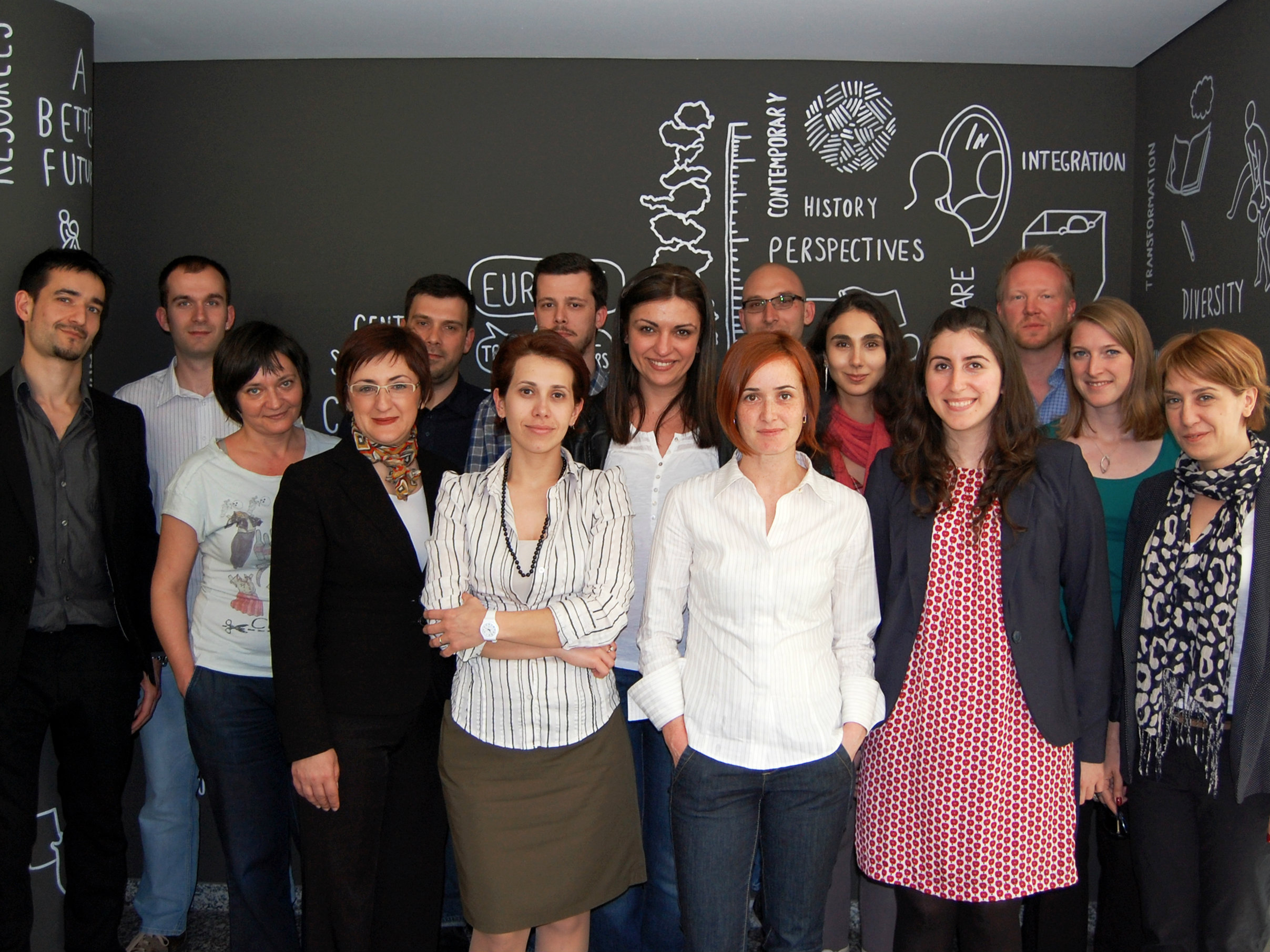
BIRN brought together its Steering Board and Assembly members for their annual meeting in Belgrade from July 9-12.

The meeting takes place each year in the Serbian capital to enable Board and Assembly members to discuss BIRN’s ongoing activities and its plans for strategy development.

During the three-day meeting, a new BIRN statute that was presented last year at the Board meeting and an audit of BIRN HUB was endorsed.

Ana Petruseva, one of the founders of the BIRN regional network and BIRN Macedonia, said: “This helps us get clear picture how to proceed with new and ongoing BIRN activities.”

Local BIRN directors presented also all their country activities and strategic and operational issues to the members of the Assembly.

The possibility of opening a BIRN office in Albania was also discussed.

BIRN Steering Board and Assembly Meets in Belgrade

BIRN is holding its annual Steering Board and Assembly meeting from July 9-12 in Belgrade.

The meeting is organised to discuss strategic and operational issues facing BIRN, ongoing programmes and plans for the future. 

The Steering Board is composed of BIRN country directors. Each board member will make a presentation about country specifics and fundraising activities.

The Assembly brings together Tim Judah, author and Balkans correspondent for The Economist, Wolfgang Petritsch, Austria’s permanent representative to the OECD, Steve Crawshaw, international advocacy director at Amnesty International, Stefan Lehne, former Austrian diplomat and visiting scholar at Carnegie Europe in Brussels, and Per Bymon, secretary-general of Swedish Radio and Television’s humanitarian foundation, Radiohjälpen.

BIRN Holds Sarajevo Debate on Post-War Memorialisation

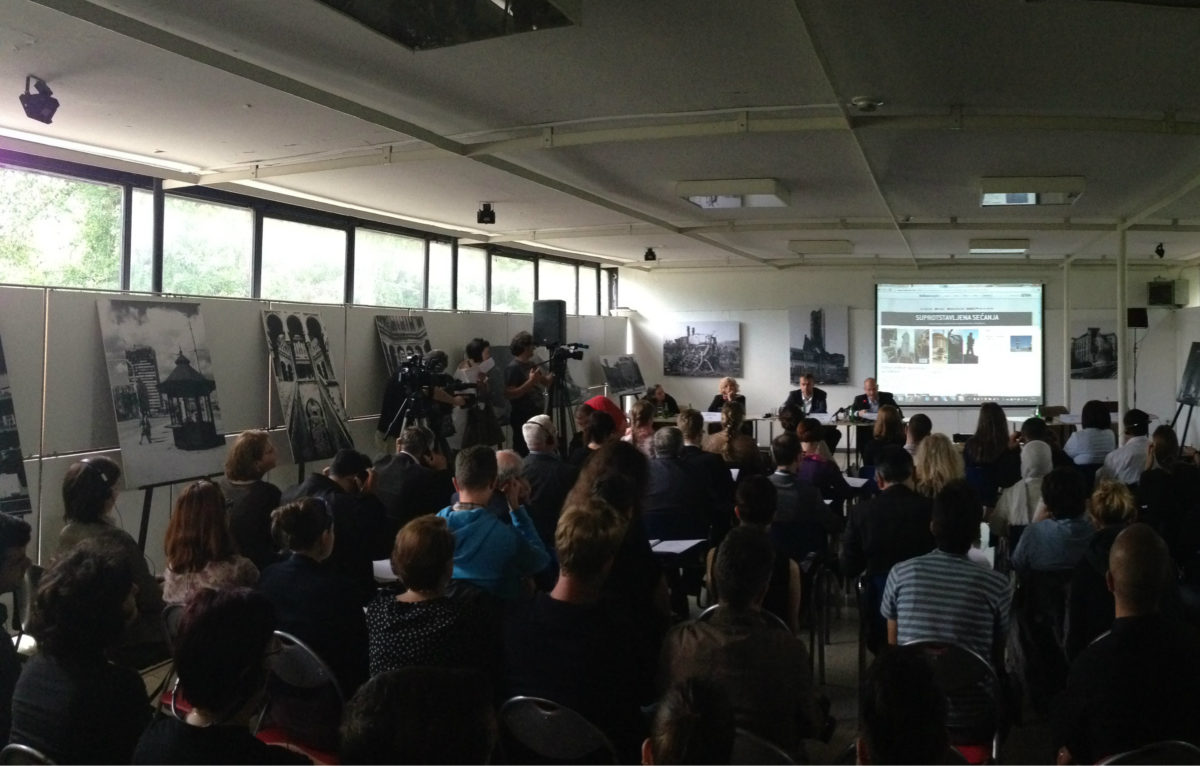
BIRN presented the results of its investigation into memorialisation in the Balkans at a round-table debate in Sarajevo on Thursday, where participants discussed the problems caused by the post-war monument-building boom in the former Yugoslav region.

The in-depth investigation examines how different states and ethnic groups use monuments to promote their own versions of past events, how governments use them to manipulate history for political advantage, and how they are used as a tool for nation-building in the region.

It was put together by reporters from BIRN’s Balkan Transitional Justice project in seven countries across the region.

The debate was led and moderated by Sarajevo-based researcher and memorialisation expert Nicolas Moll.

Participants included by Amra Custo from the Institute for Protection of Cultural, Historical and Natural Heritage of the Sarajevo canton, Petar Todorov from the National Institute of History from Skopje, Ljubinka Petrovic Ziemer from forumZFD, Almina Jerkovic from the Ministry for Human Rights and Refugees of Bosnia and Herzegovina, as well as representatives from an organisation called Four Faces of Omarska.

For more information, see the Conflicting Memories focus page: http://www.balkaninsight.com/en/page/balkan-transitional-justice-memorialisation-conflicting-memories


BIRN launches special focus page on memorialisation

The ‘Conflicting Memories’ focus page presents the results of an investigation into the post-war Balkan monument-building boom, put together by BIRN’s Balkan Transitional Justice team of journalists from seven countries across the region.

The investigation examines how different states and ethnic groups use monuments to promote their own versions of past events, how governments use them to manipulate history for political advantage, and how they are used as a tool for nation-building in the region.

The focus page includes six features and an interactive map – a guide to the number of memorials built across the Balkans, their cost, and which of them have proved the most controversial and unusual – as well as a photo gallery.

All content is presented in Macedonian, Albanian and Bosnian/Croatian/Montenegrin/Serbian as well as in English. 

The focus page was launched ahead of a BIRN debate in Sarajevo which will bring together a panel of experts to discuss memorialisation issues in depth. The event will take place on June 27 at the Historical Museum of Bosnia and Herzegovina.

To find out more: www.balkaninsight.com/en/page/balkan-transitional-justice-memorialisation-conflicting-memories.

University of Pristina honours US and EU envoys

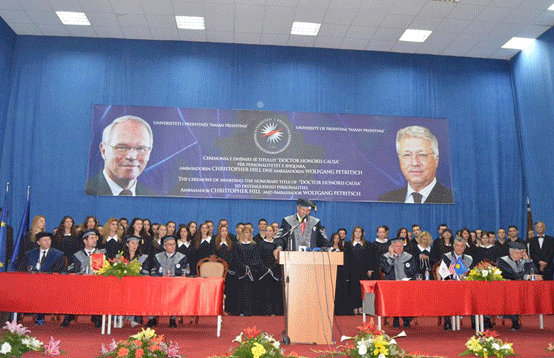
Hasan Pristina University honoured former special envoys Christopher Hill and Wolfgang Petritsch on Wednesday with the title of Doctor Honoris Causa in a ceremony held at the faculty of philology. They were awarded the title for their contribution to the resolution of the Kosovo conflict.

Hill and Petritsch, who worked as the special envoys of the United States and the European Union respectively during attempts to stop the Kosovo conflict in the late 1990s, were honoured for their outstanding contributions to creating conditions for peace, justice, freedom and democracy and increasing opportunities for the development of education, science and academic freedoms in Kosovo.

The rector of Hasan Pristina University, Ibrahim Gashi, opened the ceremony.

“We were lucky to have you and your peoples as our friends during our worst, hardest time,” said Gashi.

Prime Minister Hashim Thaci praised the two former envoys for bringing together the Albanian political spectrum.

“Mr. Hill and Mr. Petritsch stood by Kosovo when Kosovo needed friends the most,” said Thaçi.

The two former envoys also addressed the gathering.

“Kosovo has changed a lot since the time when I was here. You cannot choose your neighbours, but you can live in peace with them,” said Hill.

“The European Union is facing many problems, but Kosovo is moving towards the EU,” said Petritsch.

Petritsch and Hill acted as mediators during the talks between Kosovo Albanians and the Yugoslav authorities at the Rambouillet Conference in 1999 before the NATO bombing campaign ended the conflict.

Petritsch, from Austria, is also a member of BIRN’s Regional Board.

BIRN holds debate on post-war memorialization

BIRN’s Balkan Transitional Justice team will hold a debate on memorialisation and the findings of a wide-ranging investigation into the post-war Balkan monument-building boom put together by its journalists from seven countries across the region.

Hundreds of monuments and statues have been built since the conflicts in the former Yugoslavia amid a largely unregulated memorialisation spree that has sometimes exacerbated the divisions that led to war in the first place, rather than promoting reconciliation.

The investigation examines how different states and ethnic groups use monuments to promote their own versions of past events, how governments use them to manipulate history for political advantage, and how they are used as a tool for nation-building in the region.

As part of BIRN’s Balkan Transitional Justice project, the BIRN investigation also examines the question of what kind of monuments should be built to promote peace rather than reviving past disputes.

The debate will be held on June 27, 2013, at Historical Museum of Bosnia and Herzegovina in Sarajevo.

Debate will bring together a panel of experts to discuss these issues in depth, such as Ljubinka Petrovic – Ziemer, Programme Manager at forum ZFD, expert group on Bosnia’s Transitional Justice Strategy, historians and NGO representatives.

Dowload full Agenda.

Balkan Insight Media Watch Page Launched

BIRN has launched a special focus page on media in the Balkans – the first of its kind in the region.

All media-related news and analysis from the Balkans are now available on Balkan Insight’s Media Watch Page.

It features a brand-new analysis package on the media situation in Albania, Bosnia and Herzegovina, Macedonia, Kosovo, and Serbia.

It also features a regional analysis on the role of the EU. Some praise the EU for pushing for the adoption of media legislation that meets European standards. But others are more critical, saying that the EU should have been much more proactive in combating growing political pressures on independent media.

The launch comes ahead of the second ‘Speak Up!’ conference on June 20, at which the European Commission will gather hundreds of media experts from all over Europe to discuss media freedom in the Western Balkans and Turkey. 

In its progress reports, the European Commission has repeatedly set out its concerns about restrictions on freedom of expression and the media in the Western Balkans and Turkey, noting that threats to freedom of expression also threaten the foundations on which the “union of values” is built.

In an effort to identify solutions, the European Commission’s ‘Speak Up’ conference is bringing together participants from international, regional and national media organisations, civil society, academia and national administrations.

BIRN Fellowship journalist takes European award

The 2013 Reporting Europe Prize has been handed to Sorana Stanescu for her story about the exploitation of migrant workers in the UK, produced under the Balkan Fellowship for Journalistic Excellence.

Sorana award

The annual award is organised by UACES, the world’s largest European studies association. Previous winners include journalists from the BBC, The Economist and the International Herald Tribune.

Stanescu, a TV journalist based in Romania, received the prize at a ceremony in Westminster, central London, on 13 May.

The chair of UACES, Helen Drake, also conducted a short discussion with Stanescu and her editor at the Fellowship, Neil Arun. They spoke about the background to the story and about some of the issues it had raised.

Handing over the award, Dr Martyn Bond, a jury member and deputy chair of the London press club, praised the winning story as “particularly apposite” and “well-written”.

“The whole question of migrant labour in a highly developed economy… is illustrated through this,” he said. “But it doesn’t do it in a preachy didactic manner. It does it through a human story. And that’s the best sort of journalism.”

“It gives us facts behind the fictions… that we hear trotted out daily in the political ding-dong that passes for serious debate here on the immigration issue.”

Stanescu’s story, Cheap and Far from Free, revealed how the UK’s labour restrictions had left Romanian and Bulgarian construction workers underpaid and vulnerable to exploitation. It was published by Balkan Insight, and by the New Statesman magazine.

The report was the result of several months’ research, sponsored by the Balkan Fellowship for Journalistic Excellence.

The Fellowship’s annual bursary promotes investigative and long-form reporting of complex reform issues in the Balkans.

It was established in 2007 by the Erste Foundation and the Robert Bosch Stiftung, in co-operation with the Balkan Investigative Reporting Network.


BIRN Fellowship 2013 gets off to flying start

The ten reporters chosen for this year’s Balkan Fellowship of Journalistic Excellence have planned their assignments over the course of an intensive three-day seminar in Vienna.

Fellowship group 2013

The reporters – drawn from seven Balkan countries – will cover issues ranging from corruption to media and the legacy of the conflicts in the region.

They will supplement information gathered in their own countries with material from trips to at least two other European countries.

The seminar kicked off on April 23 with a crash course in cross-border reporting techniques.

Each fellow received instructions from a team of BIRN editors, including Ana Petruseva, Gordana Igric and Neil Arun.

The fellows also spent a morning at the offices of the Fellowship’s media partner, Austrian newspaper Der Standard. Journalists from the newspaper later joined the fellows for a networking dinner at a Viennese restaurant.

The 2013 Fellowship stories are being developed under the umbrella of the this year’s annual topic, integrity.

The fellows were selected through open competition to receive funding and professional support that will help them conduct cross-border research into a topic of regional and EU significance.

The fellowship programme was established in 2007 by the Robert Bosch Stiftung and ERSTE Foundation in cooperation with the Balkan Investigative Reporting Network.

BTJ Program Hits Readership Record

BIRN’s transitional justice project has increased its readership in the countries of the Balkan region with more than 90 per cent.

Logos of widget pages

This positive result comes from an introduction of a new promotional tool, a news widget, which has been placed on media portals across the region. 

Balkan Transitional Justice (BTJ) content on the web sites novatv.mk, offnet.mk, time.mk, tportal.hr and e-novine.rs, has increased the visibility of Balkan Insight and Balkan Transitional Justice by 14 per cent since the beginning of March.

In comparison to previous months hits on BTJ web pages in local languages have increased by 220 per cent in Croatia, by 51 per cent in Macedonia and by 33 per cent in Serbia.

In the course of the last two months the new promotional tool brought 15,000 new visitors to Balkan Insight.