Kosovo, Serbia Experts Duel over Trepca Mine

Economists from Kosovo and Serbia debate the future of the disputed Trepca mine complex, in the new episode of the TV debate series “Tema”, produced by Internews Kosovo and BIRN.

Two economists from Kosovo and two from Serbia debated the economic potential of the disputed Trepca mining complex, which according to estimates could be exploited profitably for decades to come.

Panelists agreed that only dialogue can resolve the differences between Serbia and Kosovo over the half-defunct mine and restore production.

Radoman Rabrenovic, director of the Institute of Geology of Serbia, said the reserves of metal resources in Kosovo merit particular attention.

However, according to Rabrenovic, many political questions currently impede the revitalization of Trepca.

Trepca today shares the same fate as the nearby divided town of Mitrovica. In the south, the socially owned enterprise is managed by the authorities of Kosovo.

Assets in the north are managed by an administration installed by the government of Serbia.

The ethnic Albanian former director of Trepca, Nazmi Mikullovci, said that it would take less than 200 million euro to revitalize the company that he managed back in the 1980s.

“To produce metal, Trepca needs 174 million euro, according to a study we conducted in 2005. But the problem is not with money but rather the administrative division between the south and north,” he said.

“We need to overcome this this division and have Trepca function as one entirety; the investment funds are the least of problems,” he added.

 The Trepca complex comprises an 80km-long and 30km-wide network of dozens of active and inactive mines, which are estimated to hold at least 50 million tons of exploitable ore.

Both sides agree that the revival of this industrial behemoth would benefit both economies, regardless of how the current political and administrative problems are resolved.

The deputy president of the Chamber of Commerce of Serbia, Mihajlo Vesovic, said the risk of inappropriate and irrational exploitation of the resources should unite the interests of both Serbia and Kosovo.

According to him, low production levels in the company caused more trouble to Serbia than to Kosovo, as Serbian industry relied heavily on metals produced in Trepca.

Vesovic said the demand for lead and zinc, the two main ores in Trepca, was much greater in Serbia than in Kosovo.

The President of the Chamber of Commerce of Kosovo, Safet Gerxhaliu, said the impact of revitalization would be felt more in Kosovo than Serbia, as it would create at least 10,000 new jobs and exports worth around 300-500 million euro per year.

“In addition to 10,000 new jobs as a direct effect, there would be indirect employment as well, generating roughly over 20,000 jobs. This would have a very positive effect over the next 10-20 years in Kosovo,” he added.

The programme also discussed the economic interdependence between Kosovo and Serbia, where the two chambers of commerce challenged each other on the obstacles facing businessmen in the two countries.

Tema is produced by Internews Kosova in partnership with BIRN in Kosovo and Serbia and supported by the United Kingdom’s Foreign and Commonwealth Office.

The episode will be aired this Saturday, May 25, 2013, at 7pm on TV PINK 2.

BIRN Macedonia Holds Debate on Good Governance

About 20 journalists and representatives from civil society held a debate on May 21 in Skopje on good governance in Macedonia.

The debate was organized by the Balkan Investigative Reporting Network Macedonia in partnership with the Center for Civil Communications, part of the Project for Investigative Journalism and Cooperation between Media and Civil Society funded by the USAID programme for strengthening independent media in Macedonia.

Journalists and NGO representatives agreed that the topic good governance is broad and that there are dozens of priorities for Macedonian society, such as corruption, quality of the public services and accountability of institutions.

Participants agreed that journalists and NGOs should help each other and use the tools that each has as its disposal to detect and giving bigger visibility to the problems.

The debate was the fourth in a series of 10 being organized as part of a project for investigative journalism and cooperation between media and civil society.

The subjects were selected at a meeting between journalists and NGOs in mid-April.

Others include health, cultural policy, education and youth, human rights EU integration, inter-ethnic relations; environmental issues; and marginalized groups. 

BIRN BiH Joins Transitional Justice in Universities Project

BIRN Bosnia and Herzegovina’s deputy editor Denis Dzidic participated in a Helsinki Committee for Human Rights in Republika Srpska education session in Bijeljina this week, an event being held from May 20-24 under the banner ‘Transitional Justice in Universities’. 

Seventeen students from political science and philosophy faculties in Banja Luka, Tuzla, Sarajevo, Mostar and Istocno Sarajevo attended the Bijeljina seminar.

It was the third such seminar organised by the Helsinki Committee for Human Rights in Republika Srpska and funded by the Norwegian government.

Dzidic gave the opening lecture, an introduction to transitional justice. He discussed the four pillars of the concept – the right to justice, truth, reparations and institutional reforms – and talked with the students about why all of them had a vital role to play in order that Bosnian society overcomes the divisions caused by the 1990s war.

During the week, the students will also have an opportunity to hear from Refik Hodzic, communications director at the International Centre for Transitional Justice, and learn about the experiences of other countries in the field.

Dzidic and BIRN BiH will continue to be involved in the project and future education sessions held as part of the ‘Transitional Justice in Universities’ project.

BIRN Macedonia Launches Call for Investigative Reports

BIRN Macedonia, together with Centre for Investigative journalism, SCOOP Macedonia and the Centre for Civil Communications launched a call for investigative stories on May 17.

The call is part of the ‘Project for Investigative Journalism and Cooperation Between Media and Civil Society’, part of a USAID programme for strengthening independent media in Macedonia.

In the first call that closes on June 7, at least five journalists will be awarded a grant to cover their expenses while doing the investigation and writing the story. More calls for investigative grants will follow, for a total of 40 stories until June 2015.

Journalists will have about three months to dig deeper and research their ideas, but also will have the opportunity to work with experienced editors as their mentors to guide them through the process of writing to BIRN standards.

Topics for investigations include: health; cultural policy; education and youth; human rights; EU integration; good governance; inter-ethnic relations; environment issues; marginalised groups; quality of life.

The call only applies to journalists from Macedonia.

Click here for more detailed information.

BIRN Kosovo urges Kosovo Assembly to approve draft law on protecting journalists’ sources

The Balkan Investigative Reporting Network Kosovo and ARTICLE 19 have welcomed the draft law on the protection of journalists’ sources which was sent for its first reading by the Kosovo assembly’s media committee on April 19.

BIRN Kosovo has urged the assembly, which is to discuss the draft law on Thursday, to adopt the legislation with some amendments proposed by BIRN and ARTICLE 19.

Currently, Kosovo lacks the legal basis for the protection of journalists’ sources following the removal of previous protections. Kosovo’s constitution, criminal code and criminal procedure code do not regulate the protection of sources.

The draft legislation is based on Belgian law, which is considered one of the best such laws in Europe, but needs to be updated in order to take into account developments in the sphere of journalism.

Good legislation on the protection of sources has also been adopted in Armenia, Croatia, Cyprus, Denmark, Finland, Georgia, Lichtenstein, Lithuania, Malta, Norway, Poland, Romania, and Turkey.

BIRN Kosovo and ARTICLE 19’s full recommendations can be seen by following this link.

BIRN Macedonia Holds Debate on Quality of Life

Quality of life was the subject of a debate in Skopje on May 15 organised by the Balkan Investigative Reporting Network Macedonia in partnership with the Centre for Civil Communications, part of the USAID programme for strengthening independent media in Macedonia.

BIRN Macedonia debate on quality of life

Journalists and NGO representatives spoke openly about problems in Macedonian society – highlighting high poverty and unemployment rates, misuse of the minimum wage, living conditions in rural areas, demographics and disproportional regional development. Both the NGO representatives and journalists agreed that there is a state strategy to address these quality of life issues but that it mostly stays on paper without serious implementation. The journalists also questioned the NGOs on their data and about the possibilities of future cooperation on specific topics.

The debate was third in a series of 10 which are being organised as part of a project for investigative journalism and cooperation between media and civil society, funded by USAID to strengthen independent media in Macedonia. The subjects were selected at a meeting between journalists and NGOs in mid-April. Other debates topics include health; cultural policy; education and youth; human rights; EU integration; good governance; inter-ethnic relations; environment issues; and marginalised groups.

BIRN Fellowship journalist takes European award

The 2013 Reporting Europe Prize has been handed to Sorana Stanescu for her story about the exploitation of migrant workers in the UK, produced under the Balkan Fellowship for Journalistic Excellence.

Sorana award

The annual award is organised by UACES, the world’s largest European studies association. Previous winners include journalists from the BBC, The Economist and the International Herald Tribune.

Stanescu, a TV journalist based in Romania, received the prize at a ceremony in Westminster, central London, on 13 May.

The chair of UACES, Helen Drake, also conducted a short discussion with Stanescu and her editor at the Fellowship, Neil Arun. They spoke about the background to the story and about some of the issues it had raised.

Handing over the award, Dr Martyn Bond, a jury member and deputy chair of the London press club, praised the winning story as “particularly apposite” and “well-written”.

“The whole question of migrant labour in a highly developed economy… is illustrated through this,” he said. “But it doesn’t do it in a preachy didactic manner. It does it through a human story. And that’s the best sort of journalism.”

“It gives us facts behind the fictions… that we hear trotted out daily in the political ding-dong that passes for serious debate here on the immigration issue.”

Stanescu’s story, Cheap and Far from Free, revealed how the UK’s labour restrictions had left Romanian and Bulgarian construction workers underpaid and vulnerable to exploitation. It was published by Balkan Insight, and by the New Statesman magazine.

The report was the result of several months’ research, sponsored by the Balkan Fellowship for Journalistic Excellence.

The Fellowship’s annual bursary promotes investigative and long-form reporting of complex reform issues in the Balkans.

It was established in 2007 by the Erste Foundation and the Robert Bosch Stiftung, in co-operation with the Balkan Investigative Reporting Network.


Kosovo Judicial Council Elections

On Sunday “Justice in Kosovo” discussed the elections of the Kosovo Judicial Council, KJC.

Among the questions discussed were: Why has the appointment of Enver Peci as a head of KJC been contested? Why did Sali Mekaj make false accusations about irregularities in the election process? Why were his claims rejected by members of the KJC? With how many votes has Peci become the head of KJC? Will Peci resign if he does not fulfill his election promises?

Recognized as one of the most important events for Kosovo’s judiciary, the KJC elections saw Enver Peci re-elected as the head of the institution.

Problems emerged when one of the members of the council – respectively the head of the Appeal Court, Sali Mekaj voiced problems about the process.

Mekaj said his rights as a candidate were denied. He outlined his grievances in a letter to KJC members.

“The irregularities make the process non-transparent, irregular and unlawful. In my case, it resulted in the violation of my right to be a candidate for the head of KJC and to participate equally in this competition,” Meka wrote.

In addition, two candidates, Valdete Daka and Enver Peci, presented their platforms for justice reforms. Peci won, getting six voters more than Daka. After Peci get a new mandate for the next three years, he vowed that if he does not succeed in implementing his platform, he will resign.

Also, “Justice in Kosovo” broadcast a report about a trial at the Economic Court in Prishtina. The trial concerned a libel lawsuit by businessman Bejtush Zhugolli against Zeri newspaper for an article titled “Godfathers of tenders in Kosovo” written by journalist Arbana Xharra. The lawsuit was filed last year.

After three court hearings, the judge in Economic Court in Prishtina, Fetije Sadiku announced the verdict, rejecting the lawsuit, arguing that the article of journalist Xharra was based on official documents.

Regarding with this verdict, “Justice in Kosovo” asked Sadiku for a statement, but she refused to speak in front the camera – reasoning that the case is still in process at a higher court.

In its decision, the court reasoned that the respondent, Arbana Xharra only quoted her sources of information and did not use her opinion. Xharra had, in fact, revealed the sources of her information and adhered to the code of ethics of print media in Kosovo.

Finally the judgment of the court said that the plaintiff, Zhugolli, did not give sufficient reasons to the court that publication of his name has influenced the damage of his prestige and reputation. Furthermore, he did not offer sufficient evidence to support his suit, either.

Also during the program, BIRN aired a report that showed how KJC deals with cases in which a judge violates the rules. It showed that within KJC there exists a Disciplinary Commission that takes disciplinary action against those judges who do not respect the ethics code.

If Kosovo citizens have any dissatisfaction with any judge, they can complain to the Office of Disciplinary Council or to the Disciplinary Committee. The most frequent cases involve negligence and misconduct. Sanctions can include a warning, final warning, written warning and dismissal, said the “Justice in Kosovo” report.

The third report talked about a case in which the prosecution and court investigated and convinced two policemen in the region of Mitrovica. They were convinced of misuse of official position and bribery. The judgment was made possible by a cooperative witness. 

The case utilized covert monitoring of conversations, which the court authorized. 

One of the policeman was sentenced to five months imprisonment while the other to 14 months.

BIRN Macedonia Holds Debate on Marginalised Groups

The Balkan Investigative Reporting Network Macedonia in partnership with the Centre for Civic Communications organised a debate on May 13 in Skopje entitled ‘Detecting common issues as a basis for cooperation between journalists and non-governmental organisations about the inclusion of marginalised groups in society’.

Marginalised debate MAcedonia

The debate about marginalised groups and the problems they are facing in Macedonia was the second in a series of nine held as part of the ‘Project for investigative journalism and cooperation between media and civil society’, which is part of a USAID programme for strengthening independent media in Macedonia.

Debates are being organised on topics selected at a large meeting between journalists and NGOs in mid-April. They include: quality of life; health; cultural policy; education and youth; human rights; EU integration; good governance; inter-ethnic relations.

About 20 journalists and representatives of non-governmental organisations took part in the latest debate, talking about possibilities and ways of cooperation.

The NGO representatives concluded that media often publish negative reports about marginalised groups, and emphasised that sometimes positive examples can be useful for tackling certain problems.

They listed dozens of topics concerning marginalised groups that are a priority for society and need to be tackled.

The journalists showed interest in most of the topics, asking for more details about some of them, but adding that cooperation with the NGOs should be intensified because writing about marginalised groups is sensitive and needs serious preparation.

BIRN Serbia Journalist Wins Investigative Journalism Award

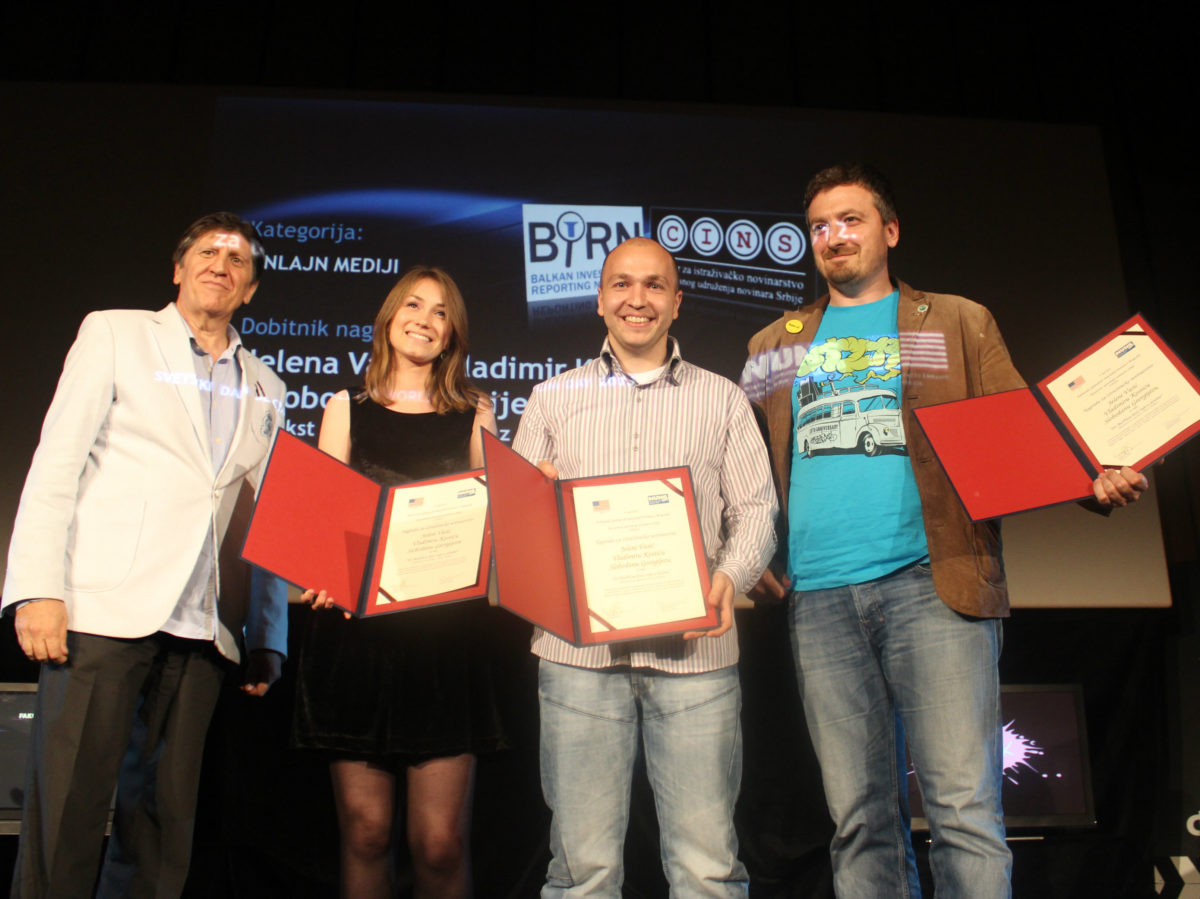
BIRN Serbia journalist Slobodan Georgiev has won the 2013 National Investigative Journalism Award, a prize given by the Independent Association of Journalists in Serbia.

NUNS investigative award

Georgiev, together with Jelena Vasic and Vladimir Kostic from the Centre for Investigative Journalism in Serbia, won in the online media category with their investigation into irregularities in Belgrade’s BusPlus system.

The award in the print media category was given to Sandra Petrusic for her series of articles entitled ‘Hospital Files – Money for Decay’, which was published in the weekly NIN.

In the electronic media category, the award went to Dragan Stankovic and Zorana Jovicic from RTV Belle Amie for their story ‘How 19 Million Was Spent on Konsantin’.

Two more BIRN Serbia journalists, Aleksandar Djordjevic and Ana Novakovic, were nominated in the online media category for their series of articles about Belgrade’s expenditure on promotion. 

Aleksandar Djordjevic was also nominated in this category for his story ‘The Electric Power Industry of Serbia Sends Incorrect Bills’.

The members of the jury were Brankica Stankovic, Milorad Ivanovic, Sasa Lekovic and Branko Cecen.

Each award is accompanied by a prize of 1,200 dollars, and this year 51 journalists entered the competition, submitting 101 articles or contributions.

The annual awards are organised by the Independent Association of Journalists in Serbia and supported by the US Embassy in Belgrade.