BIRN Summer School Kicks off in Montenegro

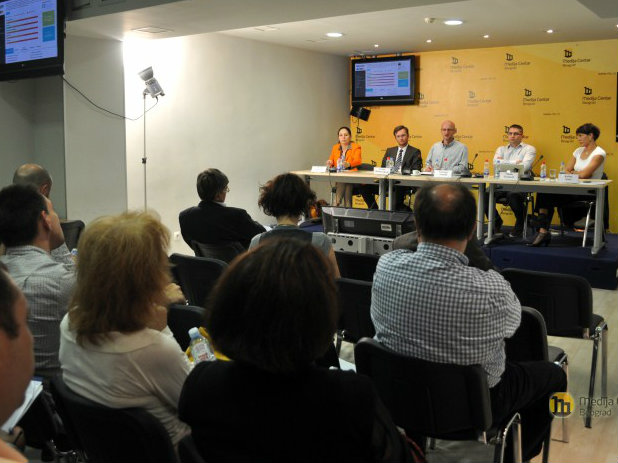
The fifth BIRN summer school of investigative journalism has opened in the Montenegrin coastal town of Becici, bringing together top trainers and journalists.


Some 35 reporters from the Balkans and across the world have gathered on Monday for the five-day summer school, aiming to boost their skills.

The school was kicked off by lead teacher and Guardian journalist Paul Lewis, who will teach students how to think about data in the digital age and use social media to investigate.

The introductory lecture was followed by investigative case studies from BIRN editor Lawrence Marzouk, while in the afternoon participants were given a detailed session in data journalism by Markus Lindemann.

Miranda Petrucic from the Organized Crime and Corruption Reporting Project explained to students how she exposed high profile corruption cases in Montenegro.

The day finished with a panel debate focused on the challenges of tackling corruption within the defence and security sector in the Western Balkans.

Alberto Bin, director of Integration, Partnership and Cooperation at NATO, spoke about reforms in South East Europe, while Dina Bajramspahic, from Montenegrin NGO Alternative, and Katarina Djokic, from Belgrade Centre for Security Policy, reflected on the current methods of fighting corruption in their countries.

The Summer School is organised in cooperation with the Media Program South East Europe of the Konrad-Adenauer-Stiftung and with support of the Austrian Development Agency (ADA), the operational unit of Austrian Development Cooperation, the North Atlantic Treaty Organization, OSCE Mission in Kosovo, OSCE Mission to Serbia, OSCE Presence in Albania, OSCE Mission to Montenegro and USAID Macedonia.

BIRN Macedonia Launches Fifth Call for Investigative Reports

BIRN Macedonia, together with Centre for Investigative journalism – SCOOP Macedonia and the Centre for Civil Communications launched the fifth call for investigative stories on August 25th.

The call is part of the ‘Project for Investigative Journalism and Cooperation Between Media and Civil Society’, part of a USAID programme for strengthening independent media in Macedonia.

In this call that closes on September 8th, at least five journalists will be awarded a grant to cover their expenses while doing the investigation and writing the story. More calls for investigative grants will follow, for a total of 40 stories until June 2015.

Journalists will have about three months to dig deeper and research their ideas, but also will have the opportunity to work with experienced editors as their mentors to guide them through the process of writing to BIRN standards.

Topics for investigations include: health; cultural policy; education and youth; human rights; EU integration; good governance; inter-ethnic relations; environment issues; marginalised groups; quality of life.

The call only applies to journalists from Macedonia.

Next call for investigative stories will be published by the end of 2014.

Click for more information about the application procedure, with details in Macedonian.

Serbian Tabloid Targets BIRN after Airline Revelations

The pro-government tabloid ‘Informer’ has published a series of allegations about the Balkan Investigative Reporting Network, following its investigation into a secret government contract with the UAE’s Etihad Airways.

Informer on Wednesday wrote that journalists from the Balkan Investigative Reporting Network, BIRN, and Serbia’s Centre for Investigative Journalism, CINS, had been stalking Serbian Prime Minister Aleksandar Vucic, causing him to cancel his summer holiday – its second highly critical report about BIRN following the high-profile airline contract investigation.

Citing an unnamed government source, the tabloid newspaper claimed that Vucic cancelled his vacation at Serbia’s Lake Bor two weeks ago after learning that “suspicious guys” from BIRN and CINS were staying at the same hotel. “Vucic cancels vacation because of ‘spies’ in hotel,” the headline read.

The allegations follow publication of a BIRN investigation into whether Serbia overpaid for an airline contract with the United Arab Emirates carrier Etihad.

The investigation, published by BIRN and in the weekly Vreme news magazine, revealed that for a 51-per-cent stake in the newly founded company, Air Serbia, Serbia paid several times more than its UAE partner.

The director of BIRN Serbia, Dragana Obradovic, said the tabloid’s allegations were a campaign to discredit the work of BIRN and CINS.

“Nobody was in Bor to spy on the Prime Minister, which is a ridiculous claim, considering that BIRN and CINS are far from paparazzi journalism,” Obradovic said.

Last Saturday, Informer also alleged that the EU was secretly financing BIRN and CINS, which were keeping contracts with the European Commission worth millions of euros.

Obradovic explained that BIRN and CINS won a project through a public call and said that BIRN had not sought to hide the contracts but had directed Informer to the EU mission in Serbia, which has the right to reveal the details.

Informer also insisted that BIRN has denied to respond whether the EU contract imposed what BIRN can and cannot investigate, suggesting the EU has forbidden investigations that involve EU companies.

But Obradovic said that this was also untrue.

“We have explicitly said that the EU does not set the topics we investigate, nor does it forbid certain issues to be looked into as the Informer journalist suggested,” she said.

The day after the BIRN revelations were published last week, Vucic held a press conference at which he insisted that the report was based on an incorrect version of the contract with Etihad. “They must have received some previous drafts,” he said.

He also suggested the investigation was serving the interests of a controversial Serbian tycoon, Miroslav Miskovic, who is awaiting trial for corruption.

Vucic said that Vreme was owned by Miskovic, who has become a symbol of the premier’s anti-corruption drive.

Serbia’s Association of Independent Journalists, NUNS, insisted that BIRN’s and CINS’ revelations about the airline deal were in the public interest.

“In a democratic society it is unacceptable for the PM to discredit media in such a manner in public,” NUNS said last Friday.

At Vucic’s press conference last week he also officially revealed details of the Etihad deal for the first time.

NUNS responded by saying that it was “obvious that the article published in Vreme forced the government and the PM to finally make the Etihad contract public”.

Vreme has meanwhile accused Vucic of “trying to prevent free, objective and independent journalistic work”, comparing his criticism of BIRN and CINS’ probe to his actions as information minister in the government of Slobodan Milosevic in the 1990s.

PM Vows Response After BIRN Serbia Reveals Airline Deal

Prime Minister Aleksandar Vucic promised to publish the text of a previously confidential deal between Serbia and United Arab Emirates airline company Etihad Airways on Friday, a day after BIRN Serbia published an article revealing the content of the agreements that appear unfavourable for the country.

BIRN Serbia revealed that, for a 51 per cent stake in the newly founded company Air Serbia, the country paid several times more than its UAE partner. Details of the contract have remained unknown since it was signed on August 1, 2013. 

The documents published on BIRN’s website provoked widespread debate in the country and reactions from the ruling and opposition parties.

According to the information in the agreements, Serbia had to pay over $90 million in 2013 alone the UAE paid $40 million, in the form of a loan, for a 49% stake in the company.

In addition to this, the state has yet to pay all the debts that the former Serbian state-owned airline Jat Airways built up before it became Air Serbia – estimated at more than $230 million, according to the agreements published by BIRN.

However the government committee responsible for approving such state aid made its decision to supply the funds confidential. This was the first time since the committee was set up in 2010 that it failed to make public such expenditure figures, despite the fact that public money was involved.

The BIRN article is available in Serbian on the javno.rs website.

BIRN Albania Seeks Three Monitoring Experts on How Media Report Corruption

The Balkan Investigative Reporting Network in Albania launched an open call on Wednesday for media monitoring experts for a study on how corruption is reported by local media outlets.

The call is part of the programme ‘Exposing Corruption in Albania’, supported by the Open Society Foundation in Albania (OSFA), the Balkan Trust for Democracy (BTD) and the National Endowment for Democracy, NED.

The purpose of the programme is to contribute to overall democratization processes in Albania by bridging the gap between civil society organizations and journalists, building their capacities and creating common ground for joint action in exposing corruption cases in the country, by providing journalists with necessary reporting skills, and regular reporting in the Albanian language on the misuse of power in the country. 

BIRN Albania seeks three monitoring experts, who will be engaged for a three-month period, starting August 20, 2014, to monitor six media outlets, three newspapers and three national television stations.

The successful candidates should fulfill the following requirements:

–          University degree, preferably in communications or journalism;
–          Excellent Albanian and English language skills;
–          Previous experience in media monitoring or media development;
–          Excellent communication skills and willingness to work as part of a team.

The candidates who are chosen will have the following responsibilities:

–          Daily monitoring of articles on corruption in selected media outlets for a three-month period;
–          Preparing daily reports on published or broadcast stories;
–          Contributing to data analysis for a monitoring study;
–          Contributing to the writing of the media monitoring study.

Deadline for applications is August 12, 2014.

Only shortlisted candidates will be contacted.

Interested candidates should send a CV and a letter of interest to [email protected]

BIRN Albania is an equal opportunity employer.

Serbian Govt Falls Short on Reform Pledges

In its first 100 days, the Serbian government has only fulfilled a handful of the tasks it set itself when taking office, a new report by BIRN shows.

Research conducted by BIRN Serbia shows that out of 29 promises that Serbian government pledged to meet while taking office, only two have been completely fulfilled.

The government adopted a new Labour Law in July and has introduced stricter control over public procurements.

The research monitored the government’s action on the promises made in five areas that citizens perceived as crucial – public finance, the economy, corruption, education and health.

While some progress has been made in fulfilling about half of the promises, in the fields of education and health, nothing has been done, or started, the research says.

“Although there were some reform efforts, mainly regarding legislative changes, matters are far from ideal,” BIRN Serbia report states.

Jelena Bojovic, from the National Alliancefor Local Economic Development, NALED, said the first 100 days of the government had been marked with “great instability”.

“The period was marked by constant changes in regulations, new drafts and new proposals of the laws, new people at the forefront of the ministries. Great instability is a problem for the economy,” Bojovic said on August 5 at a conference organised by BIRN Serbia.

Nemanja Nenadic, programme director at Transparency Serbia, the local branch of international watchdog organisation, said the fight against corruption had not been kept in due focus.

“When it comes to fight against corruption, the period has been marked by lack of transparency regarding government’s deals with investors. This refers not only to deals made by this government, but also to deals made before 2012,” Nenadic said.

He added that a lack of transparency concerning the government’s business operations with foreign partners was worrying as the constitution grants inter-governmental agreements high legal status than local laws.

“The issue is that the constitution does not set boundaries on what can be determined in inter-governmental agreements,” he said.

Nenadic said the government had been using inter-governmental agreements to make deals between Serbian national carrier Jat Airways and Etihad of the United Arab Emirates, for example, as well as for the deal for real estate in the Belgrade Waterfront project.

In this way, the government bypassed Serbian law on Public-Private Partnerships, as well as Privatisation Law and Law on Public Companies.

The full report is available on this link, while follow-ups on the government’s measures are available on the website www.meravlade.rs.

BIRN Energy Investigation Makes Waves in Albania

BIRN’s hard-hitting series of investigations into energy deals in Albania has generated widespread interest in the country.

The revelations have hit the front pages of most of the country’s newspapers in recent weeks, have been aired by leading television stations and have led to calls for a tax investigation to be opened into the family of former prime minister Sali Berisha. 

The investigation was also picked up in Bosnia and Herzegovina, Serbia and Kosovo where it was republished in more than 20 media outlets.

The Balkan Investigative Reporting Network has revealed how Berisha’s daughter Argita Malltezi, and her husband and colleague, made huge profits from selling worthless land to Bosnian businessman Damir Fazlic.

Fazlic, a friend and adviser to Berisha, then made millions of euros when the premier designated the land an “energy park”, paving the way for massive investment.

BIRN also traced the origin of the investment to controversial Serbian tycoon Vojin Lazarevic and revealed the extraordinary number of foreign energy investors who employed Malltezi as their solicitor as they attempted to launch businesses in Albania.

Fazlic has denied any wrongdoing while Malltezi and her father have yet to comment.

In an editorial for the newspaper Tema, journalist Mero Baze, a vocal critic of Berisha, lauded BIRN and Lindita Cela, the lead journalist in Albania on the investigations.

The story also sparked a reaction from Erion Brace, Socialist MP and chairman of the Parliamentary Commission on the Economy, who called on the tax authorities to investigate BIRN’s findings.

The stories are the first to be published as part of BIRN’s “Power Games” project, a detailed investigation into the energy sector in the Balkans.

BIRN has spent nine months looking at the key companies, players and state officials involved in this lucrative, secretive and critical sector of the economy.

Power Games is part of “A Paper Trail to Better Governance” project financed by Austrian Development Agency to hone investigative journalism in the Balkans, hold officials to account and improve the implementation and use of freedom of information laws.

BIRN Macedonia Wraps up Workshops Linking Journalists and NGOs

BIRN Macedonia in partnership with the Center for Civil Communication has concluded a series of ten workshops aimed at boosting cooperation between journalists and the NGO sector.

The Project for Investigative Journalism and Cooperation between the Media and Civil Society, supported by USAID, ran the ten workshops between February and June 2014.

Each was designed to empower NGO representatives with skills and techniques to increase their visibility and establish long-lasting cooperation with the journalists. At the same time, journalists gained an opportunity to learn more about investigative journalism and about the benefits of working with NGOs as partners.

The workshops brought together representatives of civil society and journalists working in ten pre-determined thematic areas of common interest.

These were quality of life, healthcare and rights of patients, environment, cultural policy, education and youth, inclusion of marginalized groups, human rights, EU accession, good governance and ethnic relations.

Some sessions were intended to provide an open platform for discussion between the participants, sharing the latest information and insights from the work of the NGOs, so that journalist could later on report on it and produce stories from the information presented at the workshops.

Toni Dimkov, a journalist in the news portal MKD.MK, said the most important aspect of the workshops for him was the opportunity to share his experience with other journalists and with representatives from the non-governmental sector.

“Communication between those two, which often is based on sending and receiving press releases, was now transferred to the same room, allowing all participants to interact between each other and discuss their latest activities,” he said.

Velimir Savevski, from HERA, the Association for Health Education and Research, took part in the workshop on health policy and quality of life held in Strumica in February. The workshop helped him meet journalists that were interested in these fields and explore ways for further cooperation, he said.

“These workshops were helpful in detecting relevant stakeholders for each of the selected common issues and sharing contacts between the participants, so that both sides can get access to relevant sources and expertise for their work,” he added.

 “Journalists cannot always get hold of relevant sources and information, especially when it comes to public institutions, so… cooperation with NGOs that are specialized in a specific area is more than welcome,” Biljana Stojanovska, a journalist from the daily Nova Makedonija, said.

For Ana Dimovska from Step by Step, Foundation for Education and Cultural Initiatives, it was useful to work on mapping and sharing the contacts of the key stakeholders in her respective field with the other participants at the workshop.

“I shared my experience from the workshop with colleagues afterwards and I believe that more workshops like this will follow, which will allow joint work with journalists and will result with stories in the media inspired by our work as civil society,” Dimovksa said.

Around 100 participants were involved in the events, with 47 representatives of local and national NGOs and 50 journalists, coming from different media outlets. Each workshop was organized in a different part of Macedonia, making them accessible for many correspondents, local journalists and representatives of local organizations as well. 

Zoran Madzoski, a correspondent from Gostivar, a town in western Macedonia, concluded that the cooperation unfortunately remained at a far from satisfactory level – and one reason for that was lack of knowledge and communication skills.

He ended with the hope that this problem would be solved by workshops such as these. He said he was most impressed by the session on investigative journalism and data-journalism.

With the last workshop held in Berovo, on June 28-29, the Project for Investigative Journalism and Cooperation between the Media and Civil Society successfully concluded the ten workshops.

In future, the project will continue to organize smaller, more frequent ad-hoc debates, which will help both journalists and NGOs collaborate, increase their influence in society and increase the number of stories published in the media.

BIRN Kosovo Presents Report on Access to Public Documents

Balkan Investigative Reporting Network (BIRN Kosovo) published its report on access to the public documents on Monday. 

 Access to Public Documents

BIRN submitted 125 official requests to access public documents to the majority of public institutions in Kosovo. From these requests 68 were denied, 50 were approved and seven were partially denied. This shows that the institutions fulfilled only 40 per cent of requests.

To launch and discuss the report, BIRN organized a roundtable with representatives of public institutions from the local and central governments.

The report found that the implementation of the law on access to public documents has not improved since the year prior. The report also identified transparent and non-transparent institutions.

The roundtable included:

Zekirja Shabani – Association of Professional Journalists of Kosovo,

Arianit Bytyqi – Prime Minister’s Office,

Fidan Kalaja – Open Government Partnership,

Mentor Hoxhaj – National Agency for Data Protection,

Florent Rrahmani – Office of the President of Republic of Kosovo.

Arianit Bytyqi from the Prime Minister Office congratulated BIRN for the work conducted so far, which, he said “is a great help on going on supporting further more an efficient implementation of the law on access to the public documents”.

Fidan Kalaja said BIRN is supporting his work in Kosovo on the Open Government Partnership, a global initiative to promote government transparency.

Download full report.