Tenth Edition of BFJE Launched in Vienna

The tenth Balkan Fellowship for Journalistic Excellence got underway in Vienna with a multimedia workshop, reporting/writing tips and tailored editorial guidance for 10 new fellows from across the Balkan region.

With the participation of the ERSTE Foundation, Open Society Foundations and BIRN, fellows from Albania, Kosovo, Serbia, Croatia, Bulgaria, Romania, Greece and Macedonia came together with the Fellowship team to begin work on their in-depth stories.

They received practical tips from Fellowship programme editors, focused on planning, research, reporting and writing, as well as individually tailored advice and workshops on multimedia journalism.

The sessions were led by former Reuters bureau chief for the Balkans Andrew Gray, who was BFJE editor for the previous two years, and his successor as BFJE editor Matt Robinson, who also formerly led the Reuters bureau in Belgrade. Matt will now mentor and support the fellows over the months to come.

The 10 journalists also benefited from a workshop by Romanian photographer Cosmin Bumbut and BFJE alumna Elena Stancu, an EU Press prize nominee in 2015, on the value of multimedia in storytelling.

The fellows now embark on four months of research, reporting and writing, involving trips within Europe, before submitting their final work.


BIG DEAL: The Association should not be prioritized over rule of law

On Tuesday, April 19, the Balkan Investigative Reporting Network (BIRN) and Internews Kosova held a roundtable to launch and discuss the most recent publication by BIG DEAL,  a civic oversight initiative on the Kosovo-Serbia negotiations.

Three years since the ‘historic’ “First agreement on principles” was signed in Brussels by Ivica Dacic and Hashim Thaci, only four of sixteen agreements have been implemented.

On the other hand, the formation of the Association/Community of Serb-majority municipalities poses challenges for Kosovo’s political stability, its rule of law, and for the credibility of the European Union, the BIG DEAL report argues.

“By making the dialogue their top priority, the EU and the US have constantly tolerated the weakness of democracy and the rule of law in Kosovo. Yet the damage inflicted on both as a consequence has risked to undo even the limited progress achieved in the dialogue so far,” said Bodo Weber of the Democratization Policy Council, the author of the report. “Therefore the US and the EU need to demonstrate full commitment to and respect for the constitutional and legal foundations of the state of Kosovo in the framework of the Serbia-Kosovo dialogue.”

The report, entitled “Awkward Juggling: Constitutional insecurity, political instability and rule of law in the Kosovo- Serbia dialogue” examines the way forward for the implementation of key agreements in the wake of the December ruling by Kosovo’s Constitutional Court on the general principles of the future Association/Community of Serb-majority municipalities.

The report calls on the European External Action Service to “engage international experts on the topics of constitutional law, forms of positive discrimination in multi-ethnic polities and on local self-governance to participate in the process of drafting the Statute of the future Association/Community of Serb majority municipalities.”

Panelists, including the EU representative in Kosovo, Samuel Zbogar and Jelena Milic from the Center for Euro Atlantic Studies, also discussed the current stagnation with implementation of agreements in general.

“It is unfortunate that, similar to six months ago when we presented our comprehensive monitoring report, only four of 16 reached agreements have been fully implemented,” said Faik Ispahiu, Executive Director of Internews Kosova. “Five years after the Kosovo-Serbia dialogue began, Kosovo and Serbia are refusing to recognize one another’s diplomas. The draft law on cadastre has been blocked for two years with no progress, and Kosovars still don’t have an operating telephone code despite the fact that not one, but two agreements have been signed about this very topic.”

Samuel Zbogar, EU representative in Kosovo stated that their job was to facilitate the process and believed normalization was in Kosovo’s interest.

However, we warned that with the political situation in Kosovo, there is a need to build wider political consensus around the dialogue.

“Although it has been plainly stated by members of the Serbian government that their top priority is the formation of the Association/Community, this should not be the condition for the implementation of other agreements that were signed long before the 19 April 2013 agreement,” Xharra said. “The fair implementation tempo should push for the agreements to be chronologically implemented: those that were signed first should be fully implemented first.”

Moreover, said BIRN Kosovo Director Jeta Xharra, EU and US diplomats need to send clear signals to both Prishtina and Belgrade that the implementation of all other pending agreements is just as important as the one on the Association/Community.

BIG DEAL is a platform for civic oversight of the Kosovo-Serbia dialogue led by BIRN Kosovo, Internews Kosova and BIRN Serbia. Members of BIG DEAL include the Advocacy Center for Democratic Culture (ACDC) of North Mitrovica. The Belgrade-based Center for Euro-Atlantic Studies, and the Berlin-based Democratization Policy Council.

“Our civic oversight initiative has brought progress,” said Tanja Maksic, Program Coordinator of BIRN Serbia.

“We as BIG DEAL have demanded that delegations of Serbia and Kosovo bring down the cost of travel because it was costing a fortune for people to cross the border from one neighbour to another – today, I am glad this cost has come down significantly,” said Maksic.

Government to stop with witch hunt

BIRN Serbia calls representatives of the Serbian government to stop deceiving the public and participating in the campaign against civil society organisations, which report professionally and objectively on the work of Serbian institutions.

We request that instead of suppressing dissenting voices, the government create an environment where organisations that point to criminal actions and corruption will be involved in debate on fundamental issues in our society in a fair and free manner.
Instead of openness to criticism, Serbian Prime Minister Aleksandar Vucic has joined an ongoing campaign led by major Serbian tabloids against independent media outlets such as the Balkan Investigative Reporting Network, BIRN, Serbia’s Centre for Investigative Journalist, CINS, and the Crime and Corruption Reporting Network, KRIK.
In the television show Cirilica [Cyrillic], broadcast on Serbia-wide Happy TV on November 9, Prime Minister Vucic once again accused those pointing to corruption in the state of aiming to overthrow the Serbian government. These government watchdogs, BIRN Serbia included, are accused of using lies to attack the state.
It is an extremely dangerous environment when the prime minister is using his position to dismiss opponents, qualifying them as mobsters, thieves and criminals despite no evidence or opportunity for them to defend themselves. This creates an atmosphere where unpredictable and sometimes lethal consequences exist.
During his interview with Happy TV, Prime Minister Vucic voiced his support of the theory that independent investigative centres in Serbia are paid by foreign donors to destabilise the government.
The day prior, the interior minister Nebojsa Stefanovic addressed the same theory in his appearance on national broadcaster TV Pink’s programme Teska rec. He used his public podium to express allegations that BIRN, CINS and KRIK are being financed exclusively by foreign donations. This approach suggests that BIRN’s financing is controversial.
We would like to remind the public that BIRN is not exclusively financed from foreign funders, but also with taxpayers’ money through the government’s office for cooperation with civil society. BIRN Serbia is not a phantom organisation on a secret mission to cause unrest, but an organisation that has worked in Serbia for ten years, in accordance to all the laws of our state. BIRN Serbia also makes all data, including financial records, publically available through the competent bodies.
The latest attacks are merely a continuation of the campaign against BIRN, which started in April 2014. The initial attack was sparked when BIRN published the draft agreement between the Serbian government and Etihad Airways, which showed that the state had paid more for its stake in carrier Air Serbia than it had revealed to the public. That campaign reached a peak earlier this year after an investigation into the controversial tender for de-watering Serbia’s biggest mine, Tamnava, was published. To this day, the findings have not been denied.
BIRN believes that this continual campaign was directed at discrediting the organisation in the absence of arguments, which would deny the findings of our published investigations.

BIRN Praised for Good Practice in Journalism

Media experts and journalists from south-east Europe who met to discuss how to preserve journalistic integrity said that only a few media in the region, including BIRN, were serving as role models.

The South East European Media Observatory brought together journalists and media experts in Sarajevo on April 14 to discuss the reasons for the deterioration of media integrity in the region at a round-table entitled ‘How to save the integrity of journalism and the media? Learning lessons from good practice in the protection of media integrity in the countries of south-east Europe’.

The panellists said that the issues that usually affect media integrity include problematic and non-transparent ownerships, politically-controlled advertisng and non-transparent state advertising.

Although the situaiton in media previous years has been worsening, they said there were some examples of good practice in defending media freedoms, citing the weekly magazine Novosti in Croatia, the online magazine Žurnal.info and the Buka online portal from Bosnia and Herzegovina, the Sarajevo-based Centre for Investigative Reporting and the Balkan Investigative Reporting Network, BIRN.

“All the good examples are non-profit media, established by journalists, and they are all clear what the purpose of journalism is. They are clear about their public mission, and journalism as a public service,” Brankica Petkovic of the Peace Institute from Ljubljana said during the discussion.

“Only journalists can save journalism – not the state, not the government, not researchers,” Petkovic added.

The panellists expressed concern about a sigificant decline in foreign financial support for independent media in the region, which is threatening their sustainability.

BIRN regional network director Gordana Igric said this should be addressed as a matter of urgency.

“Media debates in the region should therefore only be directed towards finding new ways of funding investigative and independent reporting,” said Igric.

“Investigative reporting is expensive and some of the biggest media outlets, like Britain’s The Independent, have failed to find a sustainable model and faced closing. If such big media shut down, this could happen to anyone,” she warned.

The round-table participants concluded that they ought to start searching for and developing new financial models because although Balkan countries are in great need of objective and independent journalism, ways have to be found for these media to become sustainable.

BIRN Serbia Launches Government Performance Report

Much-needed reforms are still being delayed and persistent problems such as corruption have yet to be tackled, says the latest Government Performance Report from BIRN Serbia.

BIRN Serbia’s newly-published report analyses developments in the economy, the fight against corruption and the education and health sectors under Prime Minister Aleksandar Vucic’s government from 2014 to the announcement of early elections in 2016.

The report shows that reduced wages and pensions caused stagnation in consumer spending, unemployment remained high, and economic reform has been much slower than promised.

Serbia is still suffering from widespread corruption and the government has had limited impact on the problem, while convictions for corruption at the highest levels are still lacking, the report says.

The government’s time in office was marked by serious protests by education workers, while plagiarism scandals involving senior state officials have yet to be unresolved.

One of the biggest problems in healthcare relates to the financing of the health system. The anti-corruption struggle in the healthcare sector has only been partially successful, while access to healthcare is still not at a satisfactory level.

The full report is available at Mera Vlade.

BIRN Bosnia Journalists Get New Media Training

BIRN Bosnia and Herzegovina’s journalists have attended training sessions on new technologies, social networks, video editing, online analytical systems and investigative journalism in recent months.

BIRN BIH journalists underwent the training sessions as the organisation began following the work of judiciary in the field of the rule of law in addition as well as reporting on war crimes and preparing a new modern media platform called detektor.ba.

The goal of the specialised training sessions was to modernise the journalists’ working tools and present the content produced by BIRN BiH to as many readers as possible, without compromising its journalistic ethics.   

Producers and editors from the leading media outlets in the region and community managers presented BIRN journalists with contemporary methods for creating and organising content with the aim of attaining a better outreach and having better communication with the audience.

The BIRN BiH team learned how to achieve achieving bigger presence and better positioning of their products on social networks like Facebook and Twitter, as well as increasing readership on BIRN’s own media outlet.  

Gordana Igric, BIRN’s regional director, also held a training session for junior journalists on investigative journalism, accentuating the importance of fact-checking, objectivity and impartiality, as well as the rule of having at least two sources.

BIRN Macedonia Lifts Lid on Farm Subsidies


Following the Skopje 2014 Uncovered database, BIRN Macedonia is promoting a second database, on how much the government spends on agricultural subsidies and who gets them.


The Balkan Investigative Reporters Network Macedonia has launched a database on government agricultural subsidies from 2010 to 2014.

According to BIRN, over four years, the country has spent 150 million euros on subsidies for livestock and 296 million for crop production, making a total of 446 million.

The data come from official documents obtained from the Agency for support of agriculture and rural development, referring to direct payments for plant and livestock production.

The data reveal that most of the money, or 83 percent of the total budget, was allocated in subsidies for individuals – over 370 million in the period from 2010 to 2014.

The participation rate of companies in the budget for subsidies is 17 per cent, about 75.7 million euros.

The database records 2,480 companies that benefited from grants from 2010 to 2014 and 53 measures for subsidies.

“Pelagonija”, “Povardarie” Winery, JSC “Varda” and, surprisingly, the Ministry of Agriculture, were the top four legal entities in terms of receiving most subsidies.

“Asked why they were on the list of legal entities taking subsidies, the Ministry of Agriculture responded that it was a settling of debts to farmers. Most of the subsidies were paid during the elections, and it is interesting that companies that receive major subsidies also have accounts abroad,” Aleksandar Dimitrievski, the author of the study, said.

Agricultural Engineering Professor Jovan Azhderski, who attended the promotion, said the effect of the subsidies had been almost nonexistent, although he added that it might take time to see the difference.

“From 2006 to now we should have seen some serious benefits… in improved quality, cost, technological processes for production, but we do not eat cheaper food yet and it is questionable if the quality has improved,” Azhderski said.

He also stressed that people with the same name and surname appear in the database several times.

However, there is not enough data to determine whether they are the same people, since the ID numbers of individual beneficiaries are classified data.

The database is available at the following link: www.subvencii.prizma.mk

MEPs ‘Deplore’ Defamation Threat Against BIRN Albania

In an amendment to the draft-resolution on Albania’s reform progress in 2015, two members of the European Parliament have expressed strong worded condemnation of a defamation threat issues against BIRN Albania from local officials, on the heels of investigation that exposed the criminal background of a number of mayor candidates in the June 2015 local elections.

The European Parliament “deplores that the Balkan Investigative Regional Network, an independent and investigative media outlet, has been threatened with a defamation case, following its investigations into the criminal past of a mayoral candidate during the local elections in 2015,”reads the amendment proposed MEPs Marietje Schaake and Ilhan Kyuchyuk, from the Group of the Alliance of Liberals and Democrats for Europe.

On the eve of the local elections BIRN Albania published an investigation exposing evidence that three mayor candidates running in the local elections had a criminal background.

Evidence obtained by BIRN showed that two candidates running for the Socialist-led ruling coalition, Artur Bushi and Elvis Rroshi, standing for the posts of mayor of Kruja and Kavaja , had been arrested for drug trafficking.

A candidate for the opposition Democratic Party in the municipality in Kelcyra, Gentian Muhameti, was meanwhile convicted of drug trafficking.

After the publication of the story the mayor of Kavaja Elvis Rroshi issued a statement threatening to sue BIRN for defamation in the amount of €100,000. The threat articulated by Rroshi, which included a three-day ultimatum for BIRN to withdraw the story, was repeated several times by Prime Minister Edi Rama in prime-time interviews.

BIRN Albania stood by its report and the threat of a lawsuit issued by Rroshi never materialized.  

In the draft-resolution prepared by the Rapporteur for Albania, Knut Fleckenstein, the European Parliament also expressed concern about the widespread censorship in the local media.

The concerns expressed by the MEPs come on the heels of a land-mark study published by BIRN Albania in October 2015 on the roots and causes of self-censorship among local journalists.

The report not only offers a complete overview of the roots and causes of self-censorship in the Albanian media as well as the forms in which it appears, but also proposes a series of recommendations on the necessary means and mechanisms that should be raised to combat it.

OSCE: Political Influence Undermines Serbia’s Prosecution

The way that Serbia’s State Prosecutorial Council is run raises concerns because it allows political influence on its election procedure, the OSCE Mission in Serbia told BIRN Serbia.

The OSCE Mission in Belgrade has told BIRN Serbia that progress isn’t possible in the existing constitutional and legal framework, and recommended removing opportunities for political influence during the appointment of prosecutors and judges.

“The State Prosecutorial Council should be the body that protects the independence of the prosecution,” the OSCE said.

“The State Prosecutorial Council is responsible for the selection of prosecutors. However, the structure of the Council allows political influence on the election procedure,” it added.

BIRN Serbia published two reports in December last year and January this year showing that prosecutors are elected on political rather than professional criteria.

Commenting on these reports, the OSCE Mission said that to have people on the State Prosecutorial Council who are not prosecutors was unacceptable.

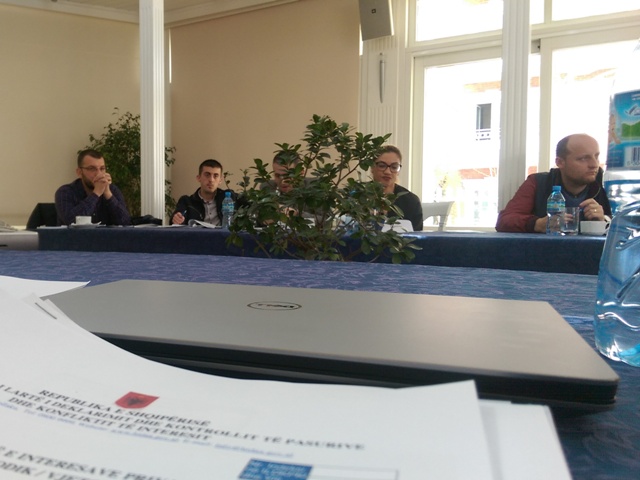
BIRN Albania Holds Training on Asset Declarations of Judges

The Balkan Investigative Reporting Network in Albania held a training session on March 9th in Tirana on the investigative techniques used to expose the illicit wealth of officials in the justice system.  

About 15 mid-career journalists from local and national media participated in the training, which provided p a guide to the basic methods and techniques of investigative journalism as well as an overview of the asset declaration system and procedures in Albania.

The training aimed to strengthen the skills of journalists to look closely at systemic issues of illicit wealth and conflict of interest, with a special focus on the red flags raised by the audit of asset disclosures by judges and officials of the justice system.

During the training key aspects of the asset declaration system in Albania were discussed as well as ongoing investigations by law-enforcement agencies and methods investigative journalist can employee to unearth the hidden assets of corrupt public officials.   

The training is part of the project ‘Exposing Illicit Wealth in the Albanian Justice System’ supported by the Democracy Commission Small Grants Programme of the US Embassy in Albania.

The journalists who take part in the training will participate in a competition from which BIRN Albania through an independent jury will select story ideas for five investigations and five in-depth analyses related to judges’ asset declarations that will be funded from the project and published with the help of BIRN editors via the online publications BalkanInsight.com and Reporter.al.