BIRN Albania Holds Workshop on Organised Crime

The Balkan Investigative Reporting Network, BIRN, in Albania held a workshop between civil society and journalists on the topic of organised crime on Tuesday.

Around 17 journalists, experts and civil society representatives, from the fields of security and organised crime, gathered in Tirana on October 2 for a workshop organised by BIRN Albania to discuss topics and strategies that investigative reporters can use in order to better report on organised crime and its role in society.

The event was part of a project called ‘Strengthening Media’s Role in the Fight Against Corruption,” financed by the Open Society Foundation in Albania. The project’s aim is to strengthen journalist’s reporting on corruption in the country through cooperation with civil society, in order to contribute to a more informed citizenry that is engaged in the democratic process.

Dalina Jashari from the Institute of Democracy and Mediation facilitated the workshop, in which participants suggested a series of key topics centred on organised crime, including the nexus between it and politics, the poor record of the justice system in enforcing extradition of drug pins wanted in the EU and money laundering, among others.

The goal of the workshop was to inform the upcoming call for investigative reporting grants on the topic of organised crime, which will be launched in the coming week by BIRN Albania. Through the call, three journalists will be selected by an independent jury and will be mentored by BIRN editors for a period of three months to produce hard-hitting investigative reports on the topic of organised crime.

After the ICTY: Regional Cooperation, Accountability, Truth and Justice in the Former Yugoslavia

Twenty years after the conflicts in the former Yugoslavia and a year after the International Criminal Tribunal for the Former Yugoslavia closed down, accountability, truth and justice still seem more like an ideal than a reality.

The conference, organised under the umbrella of BIRN’s Transitional Justice Initiative, will discuss regional cooperation in war crimes prosecution and missing persons, victims’ participation, and the role of archives, art, media and museums in dealing with the past.

Participants from civil society, the expert community, institutions, academia and the media will try to answer the overarching questions – how far we are from reconciliation, and what more we could do to combat impunity and increase intercultural dialogue?

The conference aims to have a results-oriented approach that will be reflected in a policy paper that will be used to further influence policies on both the national and EU levels with the goal of making transitional justice one of the key areas within the framework of EU negotiations.

The working languages of the conference are English, Albanian and BCS. Simultaneous translation will be provided during the whole event.

For more information about the conference, click here.

BIRN Holds Discussion with Kosovo Ombudsperson

The Balkan Investigative Reporting Network and the Centre for Advocacy Democracy and Culture, ACDC organised a discussion in Prizren, Kosovo on September 21 about the role of the Ombudsperson in dealing with issues of public interest.

The discussion’s focus was on the possibility of cooperation between the Ombudsman, civil society and the media in addressing issues of public interest, especially human rights.

The discussion was held with the support of the Dutch Embassy as part of the project ‘OmbudsWatch’, which aims to promote the role of the Ombudsperson.

Panellists and participants had the opportunity to put questions to Ombudsman Hilmi Jashari and the Dutch Ambassador, Gerrie Willems.

Willems said that this project aims to increase people’s awareness about the role of the Ombudsperson as well as increasing the interest of civil society and the media in monitoring the work of the Ombudsperson.

She added that through the implementation of the project, she hopes to improve the situation as regards human rights in Kosovo.

Hilmi Jashari said that according to a report issued by the Ombudsperson, 117,000 court cases have not yet been brought to a conclusion.

Jashari also cited delays in court proceedings for which mean that some poeple have wait eight or nine years for a court ruling.

He further criticised the way in which laws are drafted in Kosovo, citing the short period of time in which they are drafted by experts who he said did not have enough experience in the area.

Study on Rising Public Debt in Western Balkans Launched

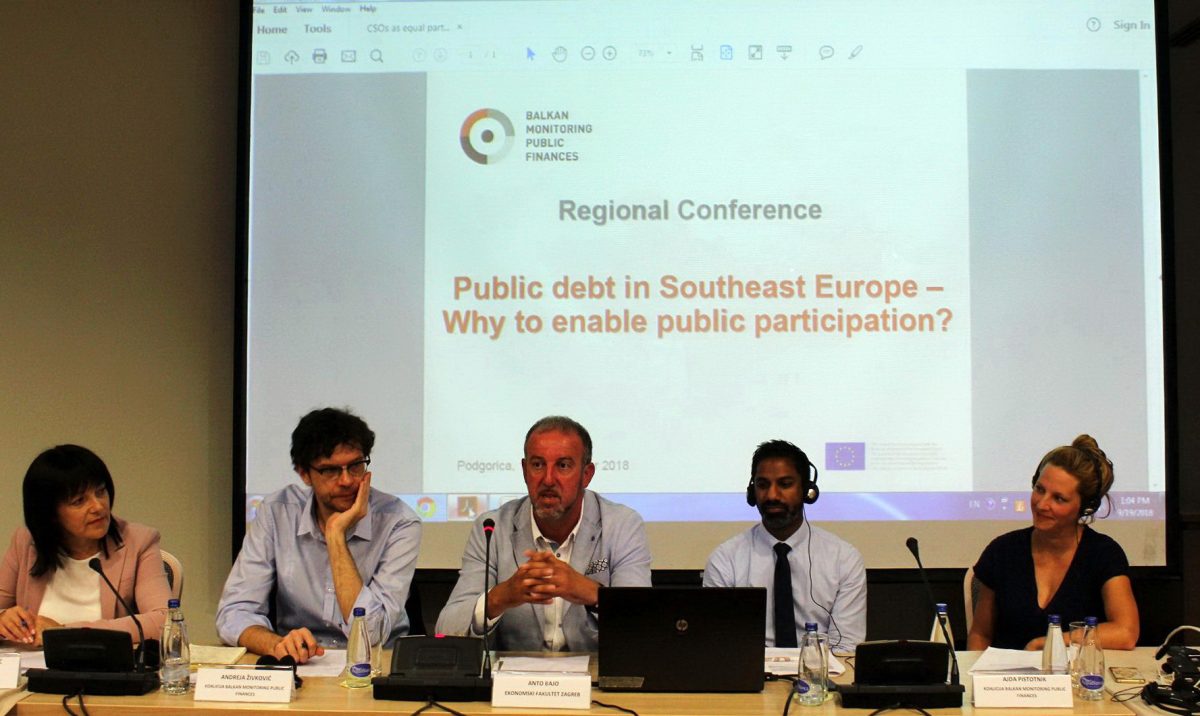
A regional study of public debt in the Western Balkans was launched at an event in Podgorica, Montenegro on September 19.

The study is part of the Balkan Monitoring Public Finance project, a joint effort involving BIRN and nine other civil society organisations from EU accession countries in the Western Balkans (Bosnia and Herzegovina, Macedonia, Montenegro, and Serbia) and EU member states (Slovenia and Bulgaria).

It is designed to improve the accountability and transparency of public finances in the targeted countries and strengthen civil society’s role and voice in monitoring countries’ performance in this area.

The study shows that rising public debt has raised concerns about the long-term sustainability of public finances, particularly given that debt tolerance level is lower for lower-income economies.

The event in Podgorica included a discussion with representatives of the World Bank, the Montenegrin parliament, Western Balkan civil society organisations and prominent media from the region about how to jointly tackle the unsustainable levels of public debt in Western Balkans.

“Debt management activities should be audited annually by external auditors and audits of government financial statements should be conducted regularly and publicly disclosed,” argued of the authors of the study, Andreja Zivkovic from Wings of Hope in Bosnia and Herzegovina.

“The State Audit Office should have a legal obligation to inform and educate citizens in finance issues, about the fiscal performance of governments and state institutions and about the work of the Audit Office itself,” Zivkovic added.

Ajda Pistotnik from EnaBanda in Slovenia, another one of the authors of the study, argued that the public should be involved in discussions on the issue.

“Greater participation by citizens in affairs that directly concern them is in itself a public benefit and is a stimulus to greater transparency and accountability in public finance,” Pistotnik said.

BIRN Holds Meeting on Regional War Crimes Cooperation

After previous meetings in Zagreb and Sarajevo, BIRN organised a meeting of transitional justice stakeholders in Belgrade on September 11 to develop recommendations for improving regional cooperation in prosecuting crimes committed during the 1990s wars.

The meetings are being held as a part of BIRN’s Balkan Transitional Justice programme, bringing together representatives of war victims’ associations and the courts, as well as NGO members, humanitarian law experts and representatives of international organisations.

At the meeting in Belgrade, the participants raised various issues concerning regional cooperation in prosecuting war crimes committed during the 1990s conflicts, such as trials of defendants in their absence, the lack of cooperation between countries’ prosecutor’s offices and the lack of political will for states to fully cooperate.

As well as raising their concerns about such problems, the participants suggested possible solutions.

This input, along with input from the meetings in Zagreb and Sarajevo and the upcoming one in Pristina in September, will be formulated into recommendations.

After all four meetings with stakeholders, one final conference will be held at the regional level in Sarajevo on October 3-4.

The recommendations from the stakeholders’ meetings and the conference will be used to create a policy paper for improving regional cooperation between states in prosecuting war crimes.

Moldova – Romania: A Network of Stories

BIRN Romania
The project aims to foster mutual understanding among people from Moldova and Romania by creating a network of human interest stories (print and audio) related to what does it mean to be a Moldovan citizen today in relation with a Romanian one, in an era of geopolitical tensions and radical social change.

Summary

At least ten journalists from both countries will produce some 20 long form, in-depth stories, which will be published on local and international level. A selection of stories will be published as an e-book which will be highly redistributed to general public and stakeholders.

Donor: Open Society FoundatioBlack Sea Trust Fund – A German Marshall Projectn, Serbia

Information Sheet

Main Objective

To contribute to the confidence building and mutual understanding process among the citizens from Moldova and Romania.

Specific Objectives

  • To involve at least 10 journalists from Moldova and Romania to report on human interest stories relevant for both countries
  • To supply local media from both countries with interviews, good-quality analytical articles and opinion pieces
  • To support informed debate on key challenges both countries are facing, both at national and regional level.

Main Activities

  • BIRN Romania team will activate its network of journalists and stringer from Moldova and Romania but will also launch a public call for contributors. Basic rules of editorial policies and communication will be established.
  • BIRN Romania will commission the stories and will schedule their publication date
  • Under guidance from BIRN team (on-the-job training), the journalists will write up to 20 long form, in-depth articles. The articles will be published simultaneously on SINOPSIS website and on BIRN’s media partners from Moldova and Romania. A selection of the articles (or brief version of them) will be published in English on the Balkan Insight website and also distributed to an international audience.
  • A selection and revised version of the articles will be published as an e-book, which will be distributed to general public and stakeholders.

Target Groups

  • At least 10 journalists from Moldova and Romania.
  • General public from the above mentioned countries
  • International audience interested in the Eastern Europe region.

Main implementer

BIRN Romania

Partners

Several publications from Romania and Moldova

BIRN Journalists Trained in Data-Driven Reporting

The Balkan Investigative Reporting Network in Albania held a three-day training course on data-driven journalism for the network’s journalists across the region from September 6-9 in Tirana.

Seventeen reporters and editors from Albania, Bosnia and Herzegovina and Serbia participated in the training, led by Lawrence Marzouk and Crina Boros. Marzouk and Boros are authors of the recently-published BIRN Albania guide, ‘Getting Started in Data Journalism’, which aims to introduce journalists to data-driven reporting techniques that are essential fror contemporary investigative journalism.

As an editor for BIRN, Marzouk leads a cross-border team of journalists, sending huge volumes of freedom of information requests, scraping data and using traditional reporting methods to delve into high-level corruption in the Balkans and beyond.

Boros is an intrepid investigative journalist who reports on conflicts of interest, vulnerable groups, problematic policies and the use of public funds.

The three-day training course gave the journalists an intensive introduction to data journalism, which ranged from its definition to the location of credible sources of data, the mining of data, open data, wall gardens and the databases that hold information that is most valuable to investigative reporters.

Boros also held a crash course in Excel sheets and descriptive statistics as a powerful tool for data reporters, with added real-world exercises using trade and airline industry data.

A special session was held by Boros on Pivot Tables and how they can analyse big data sources.

Association of Online Media – AOM

PARTNER
Association of Online Media – AOM was established in 2015 and gathers more than 20 independent digital media outlets.

Its goal is to develop and promote ethical standards of reporting on the Internet as well as strengthening the role of online media in the democratisation of society.

AOM aims to improve the online media and civil society organizations cooperation and to raise citizens and authorities awareness about online media and their role in public information.

Web: http://www.aom.rs/

Public Money for Public Interest – Measuring Index of Transparency of Public Money in the Media

BIRN Serbia
Through this project, BIRN will encourage the participation of civil society in the process of increasing transparency of public spending for media.

Summary

In the cross-sectoral cooperation, 10 representatives of local CSOs throughout Serbia will be involved.

Donor: Open Society Foundation, Serbia

Information Sheet

Main Objective

To increase transparency and accountability in the spending of public money in the media sector through the involvement of civil society and joint activities of monitoring and public advocacy.

Specific Objectives

  • Mentoring, capacity-building and networking of 10 representatives of local CSOs, enabling them to adequately monitor budget money spending in the media sector.
  • Systematic monitoring of media financing from local budgets, through the methodology of the Transparency Index
  • Presentation of results and joint public advocacy activities that promote the transparency of public funding and procedures and practices of allocating public money to media

Main Activities

A1: Networking, capacity-building, learning by doing
A2: Data collection and monitoring
A3: Promotion of results and public advocacy
A4: Evaluation

Target Groups

Primary target group: an informal group of local CSOs that BIRN has gathered within the project Public Money for Public Interest.
Secondary target groups: decision-makers at local and national level, media, civil society organisations, professional associations and the general public.

Highlights

  • The Transparency Index reserch results
  • Local public debates
  • Policy briefs

Main implementer

BIRN Serbia

Partners

  • Independent Journalists’ Association of Serbia (IJAS)
  • Slavko Curuvija Foundation (SCF)

Transparent Allocation of Public Funds for Media

BIRN Serbia

Summary

Through systematic research into the transparency of budget allocation, analysis of collected data, and practical policy suggestions for improving established practices, the project will affect the reduction of the ‘grey area’ in which there is a room for non-transparent treatment, discretionary interpretation and corruptive practices.
The policy change proposals will be promoted at four public debates, through social networks, websites and advocacy activities.

Donor: Ministry of Culture and Information Serbia

Information Sheet

Main Objective

Increasing transparency and accountability in the spending of budget money in the media sector by reducing regulatory risks of corruption, and monitoring and evaluating the effects of this type of public spending.

Specific Objectives

Systematic monitoring of the budgetary financing of the media: Improving the transparency of public allocation and procedures and practices of allocating public money through policy proposals and public advocacy.

Main Activities

A1: Data collection, monitoring and analysis
A2: Writing a proposal for practical policies – policy briefs
A3: Public advocacy

Target Groups

Primary target group: decision-makers at local and national level
Secondary target groups: professional organisations and associations, as well as other CSOs that have complementary public advocacy activities and with which BIRN cooperates; the general public.

Highlights

Results of the research
Policy briefs

Main implementer

BIRN Serbia