BIRN Holds Debate on Audit Reports in Gjilan/Gnjilane

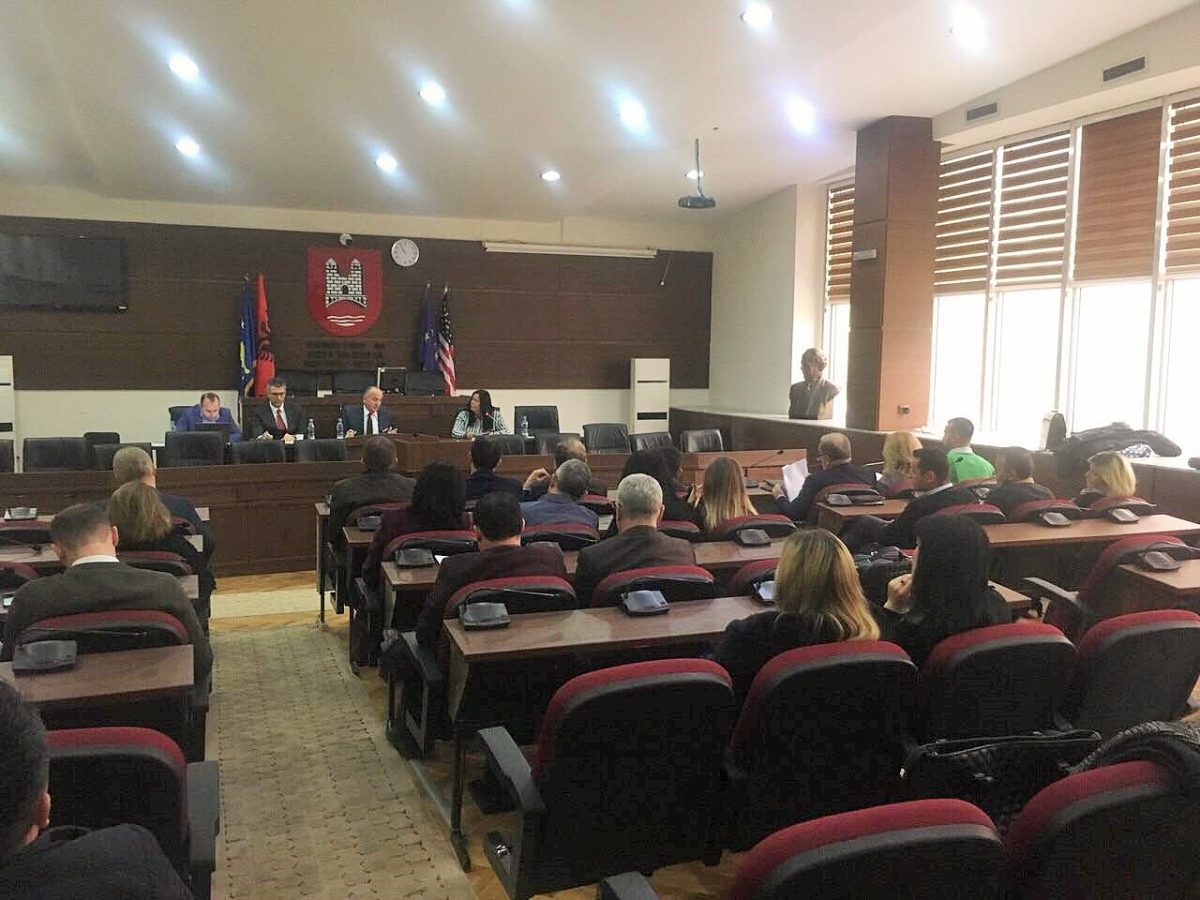
BIRN Kosovo held its third debate on November 26 to present findings from its analysis of Auditor General’s reports, this time for the Gjilan/Gnjilane municipality.

The results of BIRN Kosovo’s monitoring of the implementation of audit recommendations for the Gjilan/Gnjilane municipality were presented in an open debate on November 26, with more than 30 representatives from the municipality, civil society and Auditor General in attendance.

BIRN Kosovo Editor Visar Prebreza gave a brief presentation of the project and its findings, which showed that of the 45 recommendations provided to the municipality, only ten have been implemented.

The Mayor of the Municipality of Gjilan/Gnjilane, Lutfi Haziri, addressed the main points of the analysis and declared that for the upcoming years, work will be done to strengthen the capacities of auditing, procurement, and finance management in his municipality.

A representative of the National Audit Office, Ilir Salihu, was also present to answer questions from the panel and the audience.

Salihu, said that such meetings contribute to inter-institutional communication, transparency, and clarifications that might be needed after the provision of recommendations.

The debate was organised within the framework of the project, ‘Support civil society to increase public oversight and accountability of Kosovo public institutions’, funded by the British Embassy in Pristina. It specifically addressed the project component that looks at the compliance of targeted institutions with recommendations of the National Audit Office.

Similar debates will be held in more municipalities in Kosovo with the aim to present the BIRN Kosovo analysis on the implementation of audit recommendations.

Every debate will be held in the municipal assemblies of the municipalities in question, and will be livestreamed by BIRN Kosovo.

BIRN Albania Holds Court and Crime Reporting Training

The Balkan Investigative Reporting Network in Albania held a three-day training course in Tirana from November 24-26 for local journalists on court and crime reporting techniques, the transparency of the courts and mobile video reporting.

The training course was made possible with support from the USAID-funded Justice for all Project, which is implemented by the East-West Management Institute with local partners like BIRN Albania. Fifteen journalists representing all the regions of Albania attended the training course, at which advanced court and crime reporting techniques were discussed.

The workshop was greeted by EWMI Media Advisor Elira Canga, who underlined the importance of court reporting to advance Albania’s justice reform.

During the training course, the journalists were presented with the recently-published BIRN Albania report on the transparency of courts in Albania and told about techniques of how to use court websites and databases to identify leads.

The training course aimed to strengthen the skills of mid-career journalists to report from the courts, the prosecutor’s office and other law-enforcement institutions, as well assisting them to better use multimedia tools in their stories.

A special session on mobile video reporting was held during the training session by Ivana Dervishi, BIRN Albania’s multimedia journalist, at which the latest techniques of using cellphones to shoot video were presented.

The journalists who attended the three-day workshop have already been given on-the-job training and mentoring by BIRN Albania as part of the project ‘Enhancing the Transparency of Justice Reform in Albania’.

BIRN Holds Debate on Audit Reports in Prizren

BIRN Kosovo held its second debate to present findings from its analysis of municipality audit reports, this time for the municipality of Prizren, on November 23.

The outcomes of the analysis and monitoring were presented in an open debate with more than 20 participants from the municipality, the auditors and civil society, as well as local media including RTK and TV Prizreni.

Kreshnik Gashi, editor and moderator of BIRN Kosovo’s TV programme ‘Justice in Kosovo’, gave a brief presentation on the project and the findings of the analysis on the audit of the municipality.

The mayor of Prizren, Mytaher Haskuka, then discussed the situation with the implementation of recommendations from the National Audit Office.

Haskuka emphasised that the crucial issue for the municipality remains the managing of contracts with economic operators – suppliers of goods, works or services. Haskuka said the reason for this is the large number of contracts compared to the small number of directorate officials who have to deal with the contracts.

A representative of the National Audit Office, Ilir Salihu, was also present to answer questions from the panel and the audience.

Regarding the municipality of Prizren, Salihu said that activities that were planned have not been implemented, and advised that municipalities should be more careful when drafting action plans.

“I would like to emphasise an important thing… I think that neither the municipalities nor the other entities audited should draft action plans just for the sake of fulfilling a legal obligation, because the purpose of our recommendations is not to overburden the municipal or central administration with activities that are not important or necessary. So my personal advice is that when drafting action plans, [municipalities] should look at activities that are reasonable and feasible, and second, target realistic deadlines,” Salihu said.

This debate was organised within the framework of the project ‘Support civil society to increase public oversight and accountability of Kosovo public institutions’funded by the British Embassy in Pristina. This part of the project looks at compliance by institutions with recommendations in the Auditor General’s reports.

Similar debates will be held in other municipalities to present the findings of BIRN Kosovo’s analysis of the implementation of audit recommendations. Each debate will be held at municipal assemblies and will be livestreamed by BIRN Kosovo.

Accurate and Ethical Reporting in Online and Televised Journalism

BIRN Kosovo

Through this project, BIRN Kosovo aims to empower young journalists and lawyers in Kosovo, through capacity-building training courses on accuracy and ethical reporting, access to public documents, and the consequences of inaccurate reporting, among other subjects.

Summary

Through this project, BIRN Kosovo aims to empower young journalists and lawyers in Kosovo, through capacity-building training courses on accuracy and ethical reporting, access to public documents, and the consequences of inaccurate reporting, among other subjects.

Information Sheet

Donor:

Funded by Grand Duchy of Luxembourg, led by Kosovo Cicil Society Foundation (KCSF)

Main Objective:

Increasing the capacity and professionalism of students of law and journalism in journalistic reporting, access to data, and the legal consequences of incorrect reporting.

Specific Objectives: 

  • Increasing capacities of young students of law and journalism in fair journalistic reporting, compiling requests for access to public documents, and the legal consequences of inaccurate reporting;
  • Raising awareness and public debate about fair journalistic reporting and the safety of journalists.

Main Activities:

  • Organising seven training sessions with young journalism and law students on journalistic ethics and the legal consequences of incorrect reporting;
  • Offering legal assistance on access to public documents for journalism and law students;
  • Distributing 15 scholarships to students of journalism and law universities for conducting joint investigations;
  • Editing and publishing 15 investigations in cooperation with students who won the scholarships;
  • Producing two TV debates through the TV programmes “Life in Kosovo” and “Justice in Kosovo” on the topic of journalists’ security and accurate and impartial reporting;
  • Producing 5 long articles in Krypometër on the accuracy of information.

Target Groups:

  • Students of journalism and law;
  • Marginalised gender and ethnic groups;
  • Civil society.

Highlights:

  • 124 students were trained in Improving Research Reporting Standards Through Joint Experiences. The students were from different educational backgrounds, mainly from Journalism and Law. The training included students from the municipalities of Prishtina, Gjilan, Prizren and Mitrovica.
  • BIRN Kosovo distibuted 15 scholarships to students interested in investigating on and publishing a journalistic story while applying high journalistic standards;
  • BIRN Kosovo opened its legal office to assist students of Journalism and Law with access to public documents, with the aim of verifying facts.


BIRN Editors Address Nuremberg Trial Reporting Seminar

BIRN editors from Kosovo and Bosnia and Herzegovina participated in a seminar in Nuremberg, Germany, on journalism and trial reporting on November 19-22.

BIRN Kosovo’s Kreshnik Gashi and BIRN Bosnia’s Denic Dzidic travelled to the German city of Nuremberg to address a seminar organised by the Kosovo Specialist Chambers and the International Nuremberg Principles Academy on journalism and trial reporting.

Gashi, editor and moderator of BIRN Kosovo’s TV programme ‘Justice in Kosovo’, made a presentation about the work of BIRN Kosovo’s site KALLXO.com on reporting war crimes, covering the legal responsibilities of journalists writing such sensitive reports, accurate and objective reporting, and the verification of facts before reporting on cases.

Dzidic, editor in chief of BIRN Bosnia’s online publication Detektor, spoke about lessons learned from following international tribunals and war crimes trials in Bosnia and Herzegovina. He highlighted how BIRN had become a specialised news media for transitional justice and what importance that played for the victims and diaspora communities in Bosnia and Herzegovina.

The seminar focused on the key role of journalists on informing the public about criminal trials, the seminar was structured into three modules – Basics of International Criminal Law; Journalism and International Criminal Tribunals, and Reporting on International Criminal Tribunals.

Opening remarks at the seminar were made by the director of the International Nuremberg Principles Academy, Klaus Rackwitz, and Dr. Fidelman Donlon from the registrar’s office at the Kosovo Specialist Chambers.

Empowering Women to Seek Their Inheritance Rights

BIRN Kosovo

The project aims to educate, raise awareness and empower women about their property rights. Through TV, online publishing and social media, BIRN will reach out to women and men of all ages and ethnic backgrounds throughout Kosovo.

Summary

In addition to raising awareness, the activities also address the unsatisfactory level of implementation of the law, and the prolonged judicial procedures that discourage women from seeking their rights.

Information Sheet

Donor:

Funded by United States Agency for International Development (USAID), managed by Advocacy Training and Resource Center (ATRC)

Main Objective:

Enhance awareness among women and men in Kosovo regarding property rights.

Specific Objectives: 

Increasing the public’s awareness of women’s property rights through impartial and objective reporting on women’s inheritance rights through televised and online reporting;
Monitoring the implementation of the legal obligation to register property in the names of both spouses by political representatives and policymakers;
Contributing to positively influencing policies related to women’s inheritance rights by initiating public discussion and providing concrete policy recommendations.

Main Activities:

A series of 10 articles on the current state of affairs in the implementation of the legal framework pertaining to women’s inheritance rights;

Producing two televised analyses to be broadcast on the television programme Justice in Kosovo;

Publishing 4 extensive research papers in Gazeta Jeta ne Kosove;

Organising 2 roundtables to discuss the legislation pertaining to women’s inheritance;

Publishing five extensive legal analyses in Gazeta Jeta ne Kosove;

Drafting proposals for amendments to laws.

Target Groups:

The main target group for the programme ‘Engagement for Equity’ is women from ages 18-65. BIRN will target the stakeholders involved in judicial cases, while an extended target group will be the general public.


BIRN Holds Debate on Audit Reports in Peja/Pec

BIRN Kosovo held a debate on November 19, presenting findings from its analysis of the Auditor General’s reports for the municipality of Peja/Pec.

The debate at the municipal assembly was attended by more than 30 participants including representatives of the municipality, the Auditor General and civil society.

Visar Prebreza, editor at BIRN Kosovo, gave a brief presentation about the project and introduced the findings of the analysis.

The mayor of the municipality, Gazmend Muhaxheri, discussed the audit situation and crucial issues in Peja/Pec. Muhaxheri called on BIRN Kosovo to monitor all auditing processes in the future.

The third speaker was a representative of the Auditor General, Ilir Salihu, who discussed in detail the achievements and obstacles to auditing in the municipality of Peja/Pec.

Salihu said that municipalities should sit down with the auditors and discuss the recommendations they are given.

“It is crucial that complex recommendations are followed by a dialogue between the auditor and municipal officials in order to prevent uncertainties that can be reflected in the implementation and measurement of recommendations,” Salihu said.

Following a discussion of BIRN Kosovo’s analysis, audience members asked questions and expressed criticism of the work of the municipality in implementing the audit recommendations.

BIRN Kosovo journalists recorded the promises made by the General Audit and the municipality to be followed up and fact-checked by Krypometer, BIRN Kosovo’s fact-checking site.

This debate was organised within the framework of the project ‘Support civil society to increase public oversight and accountability of Kosovo public institutions’, funded by the British Embassy in Pristina. This part of the project looks at compliance by institutions with recommendations in the Auditor General’s reports.

Similar debates will be held in other municipalities to present the findings of BIRN Kosovo’s analysis of the implementation of audit recommendations. Each debate will be held at municipal assemblies and will be livestreamed by BIRN Kosovo.

Delegation of the European Union to Montenegro

DONOR
The Delegation of the European Union to Montenegro is responsible for analysing and reporting on political, economic and trade developments, promoting reform progress, implementing and managing an EU financial assistance portfolio and improving the visibility and communication of the EU in Montenegro.

The Delegation of the European Union to Montenegro started working in November 2007.

The Delegation in Montenegro supports the project by BIRN Hub and CIN Montenegro entitled Media Investigations: Stop to READ (Regional Environmental Acts of Devastation).

In 2017-2018 it backed the project Investigate for ME and EU.

Webhttps://eeas.europa.eu/delegations/montenegro_en