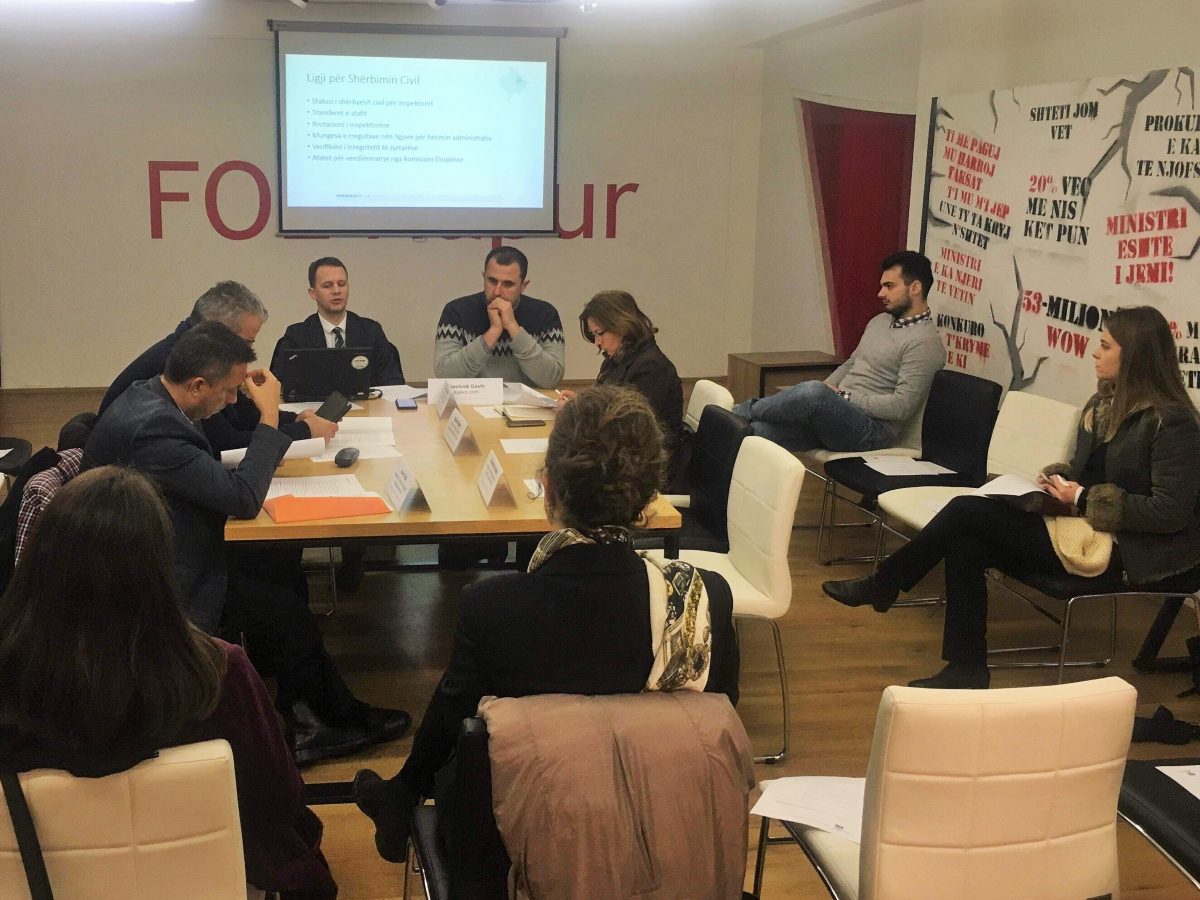
BIRN Kosovo Co-Hosts Discussion on Tax Administration

Democracy Plus (D+) and the Balkan Investigative Reporting Network Kosovo held a round table in Pristina on December 18 entitled ‘Legal challenges on protecting integrity and combating conflict of interest in the Tax Administration of Kosovo (TAK)’.

The aim was to discuss the findings from an analysis of legislation which regulates integrity and conflict of interest at TAK. Present at the round table were representatives of TAK, the government of Kosovo, and civil society.

Isuf Zejna, manager of the rule-of-law programme at D+, and Kreshnik Gashi, editor at BIRN’s Kallxo.com site, presented the findings of the analysis.

Arsim Syla, Office Manager for Professional Standards at TAK, discussed the legislation and the current draft law for public officials with the other panelists, Shqipe Pantina from the Kosovo parliament, and Dr. Bedri Peci, professor of tax and budget rights. Peci said that “legislation should be prepared by people who have experience in legislation, and not by tax officials”.

Following the panel discussion, Shqipe Shoshi Dermaku, Human Resources Manager at TAK, joined an open discussion, pointing out that the internal procedures and status of TAK are crucial to the legislation.

Feedback and suggestions from the discussion will be used to finalise a needs assessment analysis for TAK compiled by Democracy Plus and BIRN Kosovo.

This debate was organised within the framework of the project ‘Support civil society to increase public oversight and accountability of Kosovo public institutions’, funded by the British Embassy in Pristina.

The Commission for International Justice and Accountability (CIJA)

PARTNER
The Commission for International Justice and Accountability (CIJA) is a non-profit, non-governmental organisation dedicated to conducting criminal investigations during armed conflict and analysing evidence of genocide, war crimes, and crimes against humanity.

Commission is apolitical and carries out its investigative activities independently from any government.  Through its work CIJA provides support for local capacity building, war crimes and counterterrorism investigations, and countering violent extremism (CVE) programmes.

website: https://www.cijaonline.org/

Balkan Fellowship for Journalistic Excellence 2018 — Winners Chosen

Romanian freelance journalist Claudia Ciobanu was awarded first prize for the 2018 Balkan Fellowship for Journalistic Excellence programme at a closing ceremony in Podgorica on Friday.

Ciobanu won the award of 4,000 euros for her investigation into global ties between ultra-conservative groups waging war on gay marriage and gender rights in the Balkans — and the movement’s corrosive effects on democracy.

Serbian investigative journalists grabbed second and third prizes. Ivana Jeremic won 3,000 euros for her meticulous reporting on hooliganism in Serbia while Andjela Milivojevic got 1,000 euros for her work exploring political violence in lawless northern Kosovo.

Jury members praised Ciobanu for revealing how a growing network of ultra-conservative activists, lawyers and consultants is sharing strategy and resources across borders in a bid to defend what they call the “natural family”.

Her investigation, ‘New World Order’: The ‘Natural Family’ Franchise Goes Global, reveals webs of influence extending as far as US evangelical groups close to the Trump White House and Russian oligarchs with links to the Kremlin. It also highlights how populist leaders are jumping on the “natural family” bandwagon.

“She provides a crucially important insight into attempts to influence popular views on abortion and gay marriage in a more conservative direction throughout Europe,” said Brigitte Alfter, co-founder of the European Investigative Journalism Conference & Dataharvest and author of a handbook on cross-border journalism. “In terms of influencing opinion, this is a crucially important topic to gain a deeper understanding of.”

Jeremic, until recently deputy editor-in-chief of the Center for Investigative Journalism of Serbia, won praise for shining a light on Serbia’s hooligan problem.

“Investigative stories are like puzzles, with journalists trying to put together many individual pieces,” said Kristof Bender, deputy chairman of the European Stability Initiative. “Often, there are still bits and pieces here and there and it remains unclear how they relate. But Ivana Jeremic has managed to put a lot pieces together so that a whole new picture emerges of hooliganism at the junction of politics, crime and society.”

The jury singled out Milivojevic, also from the Center for Investigative Journalism of Serbia, for her bravery and sensitivity in reporting in turbulent northern Kosovo.

“Her persistence is outstanding,” said Adelheid Wolfl, correspondent for Austrian daily Der Standard. “She sets events in a reasonable political framework and timeframe, so that details merge into a total puzzle. Her capacity for political analysis goes hand in hand with a neutrality towards all those involved, no matter which ethnic groups, an attitude that is rarely found in former Yugoslavia.”

Ten journalists from the Balkan region spent more that six months of 2018 pursuing in-depth stories and investigations linked to this year’s theme: “Truth”. They came from Romania, Serbia, Croatia, Montenegro, Kosovo, Albania and Greece.

The jury congratulated all of this year’s fellows on the courageousness of their work, which included stories on corruption, miscarriages of justice, illegal logging, diaspora politics, the subversion of transparency laws and the exploitation of minorities.

A collection of their stories will be published in the new year.

The jury members were Elena Panagiotidis, editor of Swiss daily Neue Zürcher Zeitung; Florian Hassel, Central and Eastern Europe correspondent for German Süddeutsche Zeitung; Remzi Lani, executive director of the Albanian Media Institute; Kristof Bender, deputy chairman of the European Stability Initiative; Milorad Ivanovic, representative of the BFJE alumni network; Adelheid Wolfl, correspondent for Austrian daily Der Standard; and Brigitte Alfter, co-founder of the European Investigative Journalism Conference & Dataharvest.

With the conclusion of this year’s programme, the 10 fellows join the BFJE alumni network, which consists of more than 100 journalists from 10 Balkan countries who collaborate on stories and promote the highest professional standards.

The Balkan Fellowship for Journalistic Excellence was launched in 2007 to promote high-quality, cross-border reporting. The programme provides fellows with financial and editorial support, allowing them to travel, report and write their stories and develop their journalistic skills.

A project that promotes the development of robust and responsible press, the Balkan Fellowship for Journalistic Excellence has evolved into a decade-long platform that has helped shaping journalism standards in the Balkans and the very careers of participating reporters.

The fellowship will issue a call for applications for next year’s programme in January 2019.

The Balkan Fellowship for Journalistic Excellence is implemented by the Balkan Investigative Reporting Network, supported by ERSTE Foundation and Open Society Foundations

BIRN Report Says Media Freedom Declining in Serbia

A new BIRN report on the state of the media in Serbia notes abuses of funding, lack of pluralism in terms of content, an unclear legislative framework and administrative pressure on independent media as some of the most concerning issues.

A BIRN report on the media in Serbia, presented on Wednesday, emphasises a decline in freedom of expression and media pluralism, citing an absence of social, political and economic conditions conducive to the development of a professional and sustainable media sector.

“This report focuses primarily on the allocation of state funds in the media sector, as BIRN’s long-term monitoring indicates that this is one of the key preconditions for the economic sustainability of media outlets, and, as such, a powerful instrument of misuse and corruption,” it reads.

According to the report, independent media and journalistic organizations monitoring the allocation of funds reported abuses in the distribution of some 10 million euros in the media sector.

BIRN has submitted the report to the EU Delegation in Serbia as its contribution to the compilation of Serbia’s next European Commission Country Report.

It was produced in partnership with the Independent Journalists’ Association of Serbia and the Slavko Curuvija Foundation, as part of the EU-funded project.

The report says pluralism in terms of media content is largely missing, the media’s legislative framework is not fully implemented and administrative pressure on independent media is increasing.

Significant abuses of funds through project co-financing scheme still persists, and media are often discriminated against because of their editorial policies, it says.

Most of these issues should be deliberated through the Coordination Body, an ad-hoc mechanism established as a dialogue platform between media associations and government.

But the report says the results have been disappointing.

“So far, four monthly meetings were held and the media community submitted 13 requests to governing bodies. The success of this mechanism has yet to be proven, with mild results achieved in the previous period,” it says.

Another issue is the state’s unwillingness to divest itself from ownership in the media sector, the deadline for which expired in October 2015.

Despite this, privatisation process is still not fully finished. The daily newspapers Politika and Vecernje Novosti still function as partly state owned companies, while the news agency Tanjug exists and operates in a legal void, according to the report.

Originally published on Balkan Insight.

BIRN Kosovo Marks International Human Rights Day

GIZ, BIRN Kosovo and other non-governmental organisations took part in an event organised by the Ombudsperson to mark International Human Rights Day under the slogan “Stand up for human rights”.

Participants in the International Human Rights Day event, including representatives of marginalised groups and human rights advocates, made speeches at the National Theatre of Kosovo in Pristina on Monday.

Following the speeches, they marched from Skenderbeu Square to Zahir Pajaziti Square, supported by various NGOs that deal with women’s rights, children, retirees, minorities and LGBT issues.

BIRN Kosovo produced seven video clips in Albanian and Serbian aimed at raising awareness of the situation of children, youth, women, Roma Ashkali and Egyptian communities, the LGBTI community, people with disabilities and senior citizens in Kosovo.

The clips were played at the event organised by the Ombudsperson, posted on BIRN Kosovo’s KALLXO.com site and broadcast on Public Radio Television of Kosovo.

December 10 is marked around the world as International Human Rights Day, commemorating the drafting of the Universal Declaration of Human Rights that was adopted at the UN General Assembly on December 10, 1948.

BIRN Serbia Film: ‘SNS – the start’

A new film by BIRN Serbia, “SNS – pocetak, 2008” [“SNS – the start, 2008”], delves into the origins and rise of the Serbian Progressive Party, SNS, which has ruled the country since 2012.

During the making of the film, BIRN journalists talked with many  individuals from Serbian public life, but also from the US, who had a role in the creation of the SNS.

The movie starts back in 2008, when a group of Radical Party members, then advocates of the nationalist “Greater Serbia” idea, turned into “Euro-fanatics”.

Journalists have used extensive archive material to tell a thriller-style story about how a faction composed of minor political individuals became rulers of a country.

The movie can be watched on YouTube.

BIRN Kosovo Holds ‘Equality on Paper’ Debate

A roundtable discussion entitled ‘Equality on Paper’ was held by BIRN Kosovo at the ORION Conference Center in Pristina on December 4 to mark 16 Days of Activism Against Gender-Based Violence, an international campaign to challenge violence against women and girls.

The roundtable aimed to discuss the findings of BIRN Kosovo on the legal framework for property registration by state officials in Kosovo, findings on the representation of women in politics, law adaptation processes in the Kosovo Assembly with regards to laws that have an impact on women’s rights to property, and findings on specific cases of women seeking employment.

Key speakers at the discussion included Nehat Idrizi, chairman of the Kosovo Judicial Council, Hasan Shala, president of the Court of Appeals, Rozafa Ukimera, general secretary of the Ministry for Local Government Administration, and Leonora Selmani, head of the Division for Legislation, Agency for Gender Equality.

Idrizi claimed that based on various analyses and studies, it is apparent that women face many challenges in the process of acquiring their rights. He said this was a result of people’s mentality and social traditions.

Idrizi said that the length of judicial procedures was another factor that causes women difficulties.

Shala suggested an increase in the number of judges and other professional associates in order to increase efficiency, arguing that there is a lack of judges compared to a large number of cases.

“It is impossible for only five judges to complete these cases, since the number of cases is extremely big compared to the number of judges,” said Shala.

Labinot Leboshtica from the legal team of BIRN Kosovo pointed out that only 16 per cent of women have property registered in their names.

Blerta Iberdemaj from the legal team of BIRN Kosovo raised concerns about the fact that only four mayors of Kosovo municipalities have registered their property in the name of both spouses.

Iberdemaj also stated that less than 20 per cent of directorates in municipalities are led by women. The percentage shows that municipalities are not respecting the Law on Gender Equality, she added.

Leonora Selmani asked the municipalities to ensure a permanent budget so that offices for gender equality have enough financial resources to cover their activities.

Rozafa Ukeimeraj claimed that some progress has been made. She stated that in 2018, the number of women selected as the heads of municipality directorates increased by 8.54 per cent.

BIRN Bosnia Celebrates 100th Edition of ‘TV Justice’

In November this year, the Balkan Investigative Reporting Network in Bosnia and Herzegovina produced the 100th edition of its television programme ‘TV Justice’.

The 100th edition covered judicial institutions’ reluctance to share information and the fact that they use internal regulations to limit media access to court processes.

Problems facing journalists in their everyday work include inaccessible indictments, anonymised verdicts, low-quality recordings from trials lasting ten minutes only, and the refusal by judicial officials to give interviews or make public appearances.

All this is happening despite the fact that the Bosnian laws stipulate that trials should be public and the international standards call for transparency, which means quick responses to inquiries, as well as the availability of indictments and verdicts.

Transparency was reduced in 2012 when the Agency for Protection of Personal Data submitted letters to the state court and prosecution of Bosnia and Herzegovina, telling them they do not have to automatically publish all data.

The state prosecution then removed all indictments from its web page, while the Bosnian state court adopted changes to its regulations on access to information, which entailed using initials instead of full names in court documents and issuing only ten-minute recordings from trials, which significantly reduced the potential for media reporting.

This meant the quality of material that could be used by electronic media fell significantly, so the format of specialist shows had to be changed.

After that BIRN Bosnia and Herzegovina launched a campaign titled ‘Stop Censorship’, which was supported by international organisations and associations of victims such as the International Commission for the Missing Persons and the Women, Victims of War association.

The director of BIRN Bosnia and Herzegovina, Mirna Buljugic, said the ‘Stop Censorship’ campaign was initiated because war crimes are of public interest and the public should know who was indicted for the gravest crimes. She said the campaign was eventually successful, as it was followed by a decision to change the rulebook and discontinue the anonymisation of verdicts.

“BIRN’s mission was not only to tell those stories to Bosnian citizens, but also to make an impact on positive changes in society in some way. Through our stories and stories told by witnesses, we tried as journalists to help judicial institutions reach out to certain witnesses and certain stories which could actually be translated into court processes later on,” Buljugic said.

In the 100th edition of ‘TV Justice’, journalists and editors say that judicial bodies are increasingly closed to the media, which prevents quality reporting on legal processes related to war crimes, as well as on corruption and organised crime cases.

BIRN Film Charts Rise of Serbia’s Ruling Party

A new film by BIRN Serbia, ‘SNS – the start,’ follows the origins and rise of Serbia’s ruling Progressive Party, SNS – and how it became the most powerful political force in the country.

A new film by BIRN Serbia, “SNS – pocetak, 2008” [“SNS – the start, 2008”], delves into the origins and rise of the Serbian Progressive Party, SNS, which has ruled the country since 2012.

During the making of the film, BIRN journalists talked with many  individuals from Serbian public life, but also from the US, who had a role in the creation of the SNS.

Among them are the leader of the hardline nationalist Serbian Radical Party, Vojislav Seselj, and his party colleague, Vjerica Radeta.

Others include Serbia’s former president, Boris Tadic, a former vice president of the government, Bozidar Djelic, a former US ambassador to Serbia, Cameron Munter, and the Balkan analyst and former US diplomat, Daniel Serwer.

BIRN journalists also spoke with the Economist correspondent and political analyst Tim Judah, from Britain.

The movie starts back in 2008, when a group of Radical Party members, then advocates of the nationalist “Greater Serbia” idea, turned into “Euro-fanatics”.

Journalists have used extensive archive material to tell a thriller-style story about how a faction composed of minor political individuals became rulers of a country.

The movie will be shown on Monday, November 26, at N1 regional television, at 8pm.

Originally published on Balkan Insight.

BIRN Editor Talks About Transitional Justice at Leipzig Conference

BIRN Bosnia and Herzegovina Editor Denis Dzidic participated in a conference in Leipzig, Germany for young journalists entitled ‘Correcting Images’ (‘Bildkorrekturen’) from November 23 to 25.

Dzidic spoke about the role of media in peace-building and how reporting on transitional justice topics can assist reconciliation in a post-conflict society.

The ‘Correcting Images’ conference is financed by the German Ministry for Economic Development and Cooperation and the German Academic Exchange Service. It was organised by Engagement Global in cooperation with the universities of Munich, Leipzig and Bamberg, the German School of Journalism and the Deutsche Welle Academy.

Its aim is to promote accurate images of developing countries in Germany and to motivate the general public to contribute to global reconstruction for social justice. The conference provides a forum for dialogue on global issues between participants, especially young students of journalism and journalists from the North and South.