The Freedom of Press in Kosovo

The United Nations General Assembly declared May 3 as the World Press Freedom Day to raise awareness of the importance of freedom of the press. To discuss the freedom of press in Kosovo “Rubikon” TV programme  invited representatives from Association of Professional Journalists in Kosovo, media commission from the parliament, Radio Television of Kosovo, and BIRN – represented by Flutura Kusari.

The main issue discussed was the transparency of institutions on providing public documents. There is not enough transparency of these institutions since there are a lot of barriers to have access on the public documents.

Kusari, legal advisor at BIRN, explained the law on Access to Public Document, adopted by the Assembly on October 7, 2010, which gives full access to public documents.

BIRN has sent official requests to institutions asking for accessibility in the public documents. “The most transparent institution regarding the accessibility to documents is the Kosovo Business Registration Agency, while the least transparent ones are Data Protection Agency and the Prime Minister’s Office,” Kusari said.

Illegal Gravel Exploitation

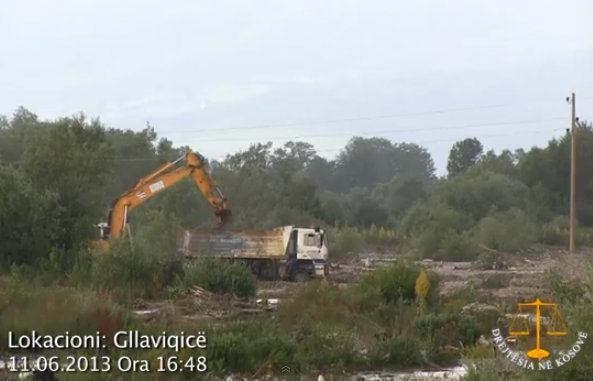
A two-month investigation by BIRN Kosovo’s “Justice in Kosovo” TV programme has found numerous instances of illegal gravel excavation from Kosovo’s rivers.

The June 24 programme also aired exclusive footage of government inspectors from the Independent Commission for Mines and Minerals being attacked during the seizure of an excavator.

“People are following me, and I am scared. I had to take a vacation from the job and I have not left home since then alone,” said inspector Refki Morina, who reported that the threats stopped after the programme aired.

“Justice in Kosovo” found that those taking the gravel were doing so at the expense of the environment.  Furthermore, judicial bodies have failed to prosecute the exploiters, who typically start work at 4 p.m., when inspectors are off-duty.

Live Web Debate on the Amnesty Law

BIRN Kosovo streamed its first live web debate on July 4. The debate on the amnesty law represented a new product for BIRN Kosovo, and it gained the attention of numerous viewers.

The guests were Daut Xhemajli – deputy minister of justice, Albulena Haxhiu – deputy from Vetevendosje, and Florent Spahija – legal advisor in BIRN. Also, prisoners from the prison of Dubrava were a part of the live debate through telephone.

This law has been opposed by some members of the opposition in the parliament, while the government said the law was crucial.

A prisoner from Dubrava said that they want to benefit from the law on amnesty just like the other prisoners from the region. “We are not asking get fully amnestied, but just for an acceptable percentage,” added the prisoner. He also claimed that they had a decent support from the government, but no support at all from the other parties from the opposition.

Fugitives Change their Names

On June 20, “Justice in Kosovo” revealed that fugitives wanted by Interpol had changed their names in Kosovo. The programme found that four fugitives were able to do this because of a lack of coordination among authorities in Kosovo.

For instance, Enver Aliu, wanted on drugs charges, ,successfully changed his identity in the municipality of Vitia. He changed his name even though the persons that are under investigation legally cannot change their name or surname.

He changed his name to Mehmet Mjaku. “Justice in Kosovo” verified this by comparing his personal ID number.

The Police of Kosovo also confirmed that it is the same person. “The person that you are referring to is wanted from the authorities of Macedonia,” said Kosovo police spokesperson Baki Kelani.

There are three similar cases of fugitives that changed their names. Because of these occurrences, the Ministry of Internal Affairs decided in July 2012 that municipalities must require verifications from Kosovo Police when people petition to change names.

Annual meeting of BIRN Assembly and Steering Board

BIRN brought together its Steering Board and Assembly members for their annual meeting in Belgrade from July 9-12.

The meeting takes place each year in the Serbian capital to enable Board and Assembly members to discuss BIRN’s ongoing activities and its plans for strategy development.

During the three-day meeting, a new BIRN statute that was presented last year at the Board meeting and an audit of BIRN HUB was endorsed.

Ana Petruseva, one of the founders of the BIRN regional network and BIRN Macedonia, said: “This helps us get clear picture how to proceed with new and ongoing BIRN activities.”

Local BIRN directors presented also all their country activities and strategic and operational issues to the members of the Assembly.

The possibility of opening a BIRN office in Albania was also discussed.

BIRN Steering Board and Assembly Meets in Belgrade

BIRN is holding its annual Steering Board and Assembly meeting from July 9-12 in Belgrade.

The meeting is organised to discuss strategic and operational issues facing BIRN, ongoing programmes and plans for the future. 

The Steering Board is composed of BIRN country directors. Each board member will make a presentation about country specifics and fundraising activities.

The Assembly brings together Tim Judah, author and Balkans correspondent for The Economist, Wolfgang Petritsch, Austria’s permanent representative to the OECD, Steve Crawshaw, international advocacy director at Amnesty International, Stefan Lehne, former Austrian diplomat and visiting scholar at Carnegie Europe in Brussels, and Per Bymon, secretary-general of Swedish Radio and Television’s humanitarian foundation, Radiohjälpen.

University of Pristina honours US and EU envoys

Hasan Pristina University honoured former special envoys Christopher Hill and Wolfgang Petritsch on Wednesday with the title of Doctor Honoris Causa in a ceremony held at the faculty of philology. They were awarded the title for their contribution to the resolution of the Kosovo conflict.

Hill and Petritsch, who worked as the special envoys of the United States and the European Union respectively during attempts to stop the Kosovo conflict in the late 1990s, were honoured for their outstanding contributions to creating conditions for peace, justice, freedom and democracy and increasing opportunities for the development of education, science and academic freedoms in Kosovo.

The rector of Hasan Pristina University, Ibrahim Gashi, opened the ceremony.

“We were lucky to have you and your peoples as our friends during our worst, hardest time,” said Gashi.

Prime Minister Hashim Thaci praised the two former envoys for bringing together the Albanian political spectrum.

“Mr. Hill and Mr. Petritsch stood by Kosovo when Kosovo needed friends the most,” said Thaçi.

The two former envoys also addressed the gathering.

“Kosovo has changed a lot since the time when I was here. You cannot choose your neighbours, but you can live in peace with them,” said Hill.

“The European Union is facing many problems, but Kosovo is moving towards the EU,” said Petritsch.

Petritsch and Hill acted as mediators during the talks between Kosovo Albanians and the Yugoslav authorities at the Rambouillet Conference in 1999 before the NATO bombing campaign ended the conflict.

Petritsch, from Austria, is also a member of BIRN’s Regional Board.

Balkan Insight Media Watch Page Launched

BIRN has launched a special focus page on media in the Balkans – the first of its kind in the region.

All media-related news and analysis from the Balkans are now available on Balkan Insight’s Media Watch Page.

It features a brand-new analysis package on the media situation in Albania, Bosnia and Herzegovina, Macedonia, Kosovo, and Serbia.

It also features a regional analysis on the role of the EU. Some praise the EU for pushing for the adoption of media legislation that meets European standards. But others are more critical, saying that the EU should have been much more proactive in combating growing political pressures on independent media.

The launch comes ahead of the second ‘Speak Up!’ conference on June 20, at which the European Commission will gather hundreds of media experts from all over Europe to discuss media freedom in the Western Balkans and Turkey. 

In its progress reports, the European Commission has repeatedly set out its concerns about restrictions on freedom of expression and the media in the Western Balkans and Turkey, noting that threats to freedom of expression also threaten the foundations on which the “union of values” is built.

In an effort to identify solutions, the European Commission’s ‘Speak Up’ conference is bringing together participants from international, regional and national media organisations, civil society, academia and national administrations.

Court Acquits Defendants in BIRN Kosovo Case

A court has acquitted five defendants accused of staging a hate campaign in the media against BIRN director Jeta Xharra.

A mixed panel of Kosovo and EULEX judges found five defendants not guilty of threatening Xharra and violating her rights in May and June 2009.

They were the former mayor of Skenderaj, Sami Lushtaku, the former owner of Infopress, Rexhep Hoti, the former editor-in-chief, Avni Azemi, and two former journalists, Rizah Hajdari and Qani Mehmeti.

In 12 articles published by Infopress, Xharra was called a “Serbian spy”, a “professional bomb”, an “embassy slut” and subjected to other insults, the indictment said.

It said a campaign against Xharra was launched after Radio Television Kosovo, RTK, aired an edition of BIRN’s TV programme, “Jeta ne Kosove” (“Life in Kosovo”,) dealing with alleged mismanagement in Skenderaj/Srbica where Lushtaku was mayor at the time.

The court on Wednesday ruled the articles did not pose a threat to Xharra even if they damaged “her honour and reputation”.

“We did not find that the content of the articles were a coded threat,” Judge Vladimir Micula said.

Referring to threatening emails that Xharra and the BIRN office in Pristina received after the programme was aired, the EULEX judge said that “no link was found between the articles and those acts”.

The prosecution said it was unhappy with the verdict and would appeal. “It is necessary for a democratic society like Kosovo to do everything it can to protect the precious right of freedom of the press and punish those who undermine it,” EULEX prosecutor Maria Bamieh said.

“The threats and the defamation made against her had a clear goal. The accused wanted to scare Jeta Xharra and her team,” she added.

“They wanted to humiliate her and… get a critical and credible journalist off the table who had dared to criticize the political achievements of Mr Lushtaku, a very powerful politician and social figure indeed in Kosovo,” she continued

Xharra said of the verdict that she “never thought it would be easy but we won’t give up”, adding: “I encourage you [in the media] not to give in, to have a better media environment compared to what there is now.”

Xharra has already filed a libel case, seeking compensation from the former defendants.

Arianit Koci, lawyer for Lushtaku, described the verdict as “just and legal”.
“It was a legal and professional battle,” he said. “Our arguments were stronger and it was proven that Sami Lushtaku did not threaten Jeta Xharra.”

The trial started in March.

Kosovo, Serbia Experts Duel over Trepca Mine

Economists from Kosovo and Serbia debate the future of the disputed Trepca mine complex, in the new episode of the TV debate series “Tema”, produced by Internews Kosovo and BIRN.

Two economists from Kosovo and two from Serbia debated the economic potential of the disputed Trepca mining complex, which according to estimates could be exploited profitably for decades to come.

Panelists agreed that only dialogue can resolve the differences between Serbia and Kosovo over the half-defunct mine and restore production.

Radoman Rabrenovic, director of the Institute of Geology of Serbia, said the reserves of metal resources in Kosovo merit particular attention.

However, according to Rabrenovic, many political questions currently impede the revitalization of Trepca.

Trepca today shares the same fate as the nearby divided town of Mitrovica. In the south, the socially owned enterprise is managed by the authorities of Kosovo.

Assets in the north are managed by an administration installed by the government of Serbia.

The ethnic Albanian former director of Trepca, Nazmi Mikullovci, said that it would take less than 200 million euro to revitalize the company that he managed back in the 1980s.

“To produce metal, Trepca needs 174 million euro, according to a study we conducted in 2005. But the problem is not with money but rather the administrative division between the south and north,” he said.

“We need to overcome this this division and have Trepca function as one entirety; the investment funds are the least of problems,” he added.

 The Trepca complex comprises an 80km-long and 30km-wide network of dozens of active and inactive mines, which are estimated to hold at least 50 million tons of exploitable ore.

Both sides agree that the revival of this industrial behemoth would benefit both economies, regardless of how the current political and administrative problems are resolved.

The deputy president of the Chamber of Commerce of Serbia, Mihajlo Vesovic, said the risk of inappropriate and irrational exploitation of the resources should unite the interests of both Serbia and Kosovo.

According to him, low production levels in the company caused more trouble to Serbia than to Kosovo, as Serbian industry relied heavily on metals produced in Trepca.

Vesovic said the demand for lead and zinc, the two main ores in Trepca, was much greater in Serbia than in Kosovo.

The President of the Chamber of Commerce of Kosovo, Safet Gerxhaliu, said the impact of revitalization would be felt more in Kosovo than Serbia, as it would create at least 10,000 new jobs and exports worth around 300-500 million euro per year.

“In addition to 10,000 new jobs as a direct effect, there would be indirect employment as well, generating roughly over 20,000 jobs. This would have a very positive effect over the next 10-20 years in Kosovo,” he added.

The programme also discussed the economic interdependence between Kosovo and Serbia, where the two chambers of commerce challenged each other on the obstacles facing businessmen in the two countries.

Tema is produced by Internews Kosova in partnership with BIRN in Kosovo and Serbia and supported by the United Kingdom’s Foreign and Commonwealth Office.

The episode will be aired this Saturday, May 25, 2013, at 7pm on TV PINK 2.