BIRN Film Shows Problems Between Media and Police

The difficult relationships between journalists and the police forces in various countries in the Western Balkans are highlighted in the BIRN Serbia documentary ‘Police and Media’.

The BIRN Serbia documentary ‘Police and Media’ was broadcast on January 23 by the regional television network N1 as part of the Western Balkans Pulse for Police Integrity and Trust project.

The depoliticisation of the police and media is a prerequisite for the solution of this problem, journalists and media experts from Serbia, Bosnia and Herzegovina, Montenegro and Kosovo agreed in the film.

But unlike journalists, representatives of the Montenegrin, Bosnian and Kosovo police believe that police and media enjoy good cooperation. Serbian police did not respond when asked for an interview for the film, however.

Most of BIRN’s interviewees in Serbia said that a selective approach to media, information leaks from investigations and their politicisation, and stigmatisation of certain journalists represents the biggest problems in the relationship between media and police.

Information is leaked to certain media for political purposes, they argued.

The relationship between media and police in Montenegro is similar to Serbia, interviewees said.

Journalists from Podgorica said that there have been some improvements in formal communications between police and media, but certain media are still prioritised.

Journalists from Sarajevo identified information leaks as a problems, but said it is was a lot less widespread than in Serbia.

They said that there are no ‘privileged’ media in Bosnia, and that all of them have same problems, because the information coming from official police channels is the minimum required according to the public’s legal right to information.

In Kosovo, the police force is the youngest state institution is trying to create an image of transparency. Journalists from Kosovo said they do face certain pressures, but they are much less severe than those faced by their counterparts in Serbia and in other countries in the region.

New BIRN Consultancy website launched

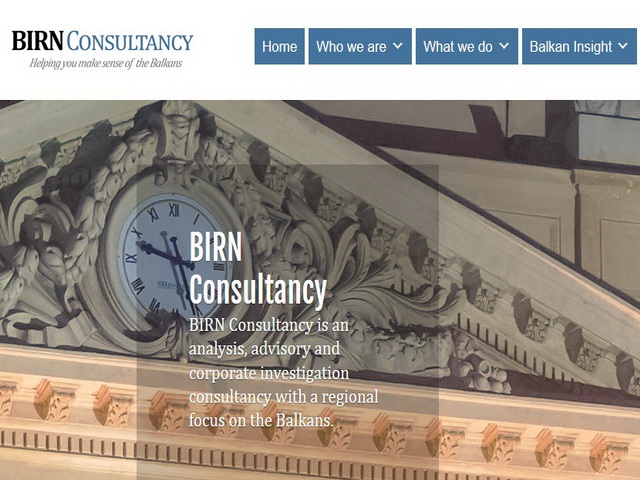
The new website of BIRN Consultancy has been launched as part of the effort to continue developing the consulting arm of BIRN Ltd.

The website seeks to raise the visibility of BIRN Consultancy, as well as to make potential clients aware of the range of services offered by the new consultancy service.

BIRN Consultancy is an independent analysis, advisory and corporate investigation consultancy with a regional focus on the Balkans. Our analysts monitor and examine a wide range of political, economic, security, social and human rights developments within their countries.

This knowledge is then turned into the insights we provide to our clients. Our products range from standardised monitoring of political, economic and security events and trends in the region to more in-depth bespoke reporting tailored to a client’s specific needs.

For more information on BIRN Consultancy, please visit our website

Balkan Insight Stories Feature in Prominent World Media

In recent weeks, some of the most prestigious media around the globe have quoted or republished articles from BIRN’s flagship publication Balkan Insight, reaffirming its position as a source of trusted news from the Balkans for an international audience. 


Photo: ArchDaily.com text 

The New York Times has included several Balkan Insight stories in its overview of European affairs in the last two weeks alone, including a Bulgarian investigation on whether a local arms company broke the embargo on exporting weapons to Syria and two reports about war crimes and transitional justice issues.

Balkan Insight stories are regularly featured in the BBC News website’s section News From Elsewhere section. Most recently highlighted was the article Bulgarians Listen to Classics Thanks to Copyright War, published on January 5, about a dispute over fees with the Bulgarian copyright society that has forced the national radio station to play only music produced before 1945.

Politico.eu also regularly refers to Balkan Insight articles in overviews of European news.

The story about the notorious architectural makeover of Skopje, Architects of Modernist Skopje Decry Retrograde Remodel, published as part of the 2016 Fellowship for Journalistic Excellence, was presented on the ArchDaily website, which attracts 10 million visits every month, on the first day of 2017.

Another controversial urban reconstruction topic from the region, the Belgrade Waterfront project, gained international attention in a Forbes story published in December 2016, which referred to the Balkan Insight report about eviction of the last family living in the area.

Several recent Council of Europe digest reports about corruption also referenced articles published by Balkan Insight. 

Money Buys Media Influence, BIRN Serbia Tells Conference

Buying influence over editorial policy and positive coverage through state advertising is one of the most effective mechanisms of media control in Serbia, Tanja Maksic from BIRN Serbia told a regional conference.

Tanja Maksic told a working group on state advertising at a conference on media freedom and safety of journalists in the Western Balkans on December 6 in Belgrade that influence can be bought through the media in Serbia.

Pressure on standard business models caused as a result of new technology, digitisation, the impact of the Internet, mobile phones and social media has led to the situation where Serbian media increasingly rely on state funds and resources, the working group heard.

Maksic explained that Serbia has a range of ways of distributing money to favoured media.

“Some of them are direct contracts with media companies, advertising by public enterprises, the financing of the public broadcaster, and indirect impact through advertising agencies,” she said.

The recommendations from the working group included: the necessity of additionally regulating the legal framework that governs state funding of the media, using citizens’ money to promote pluralism of content and increasing the influence of independent regulatory bodies.

“It is also very important that independent regulatory bodies, the anti-corruption agency and civil society improve their monitoring system on state money spending during election campaigns due to the fact that this kind of spending is the least transparent,” concluded Maksic.

BIRN BiH Widens Focus, Addresses New Challenges

In its 11th year, the Balkan Investigative Reporting Network Bosnia and Herzegovina (BIRN BiH) began reporting on corruption, organised crime and terrorism, while maintaining a leading role in monitoring war crimes and the judiciary.

Over the past year, BIRN BiH has published a total of 2,258 news articles, reports and analysis pieces, and achieved a record number of republications in other media – more than 12,500.  

In January this year, BIRN BiH began reporting on corruption, organised crime and terrorism.

BIRN BiH used the same methodology it has already used for years when reporting on war crimes, so as well as reports from courtrooms, we have also done analysis and research in order to point out the challenges facing law enforcement agencies and judicial bodies.  

More than 320 articles covering these subjects were published. At the beginning of June this year, we also organised a conference at which analyses of the situation in the field of terrorism, organised crime and corruption were presented.  

Through its work, BIRN BiH showed that institutions dealing with organised crime cases at the state level faced a problem related to the confiscation of illegally-acquired assets and that the Prosecution of Bosnia and Herzegovina targets minor corruption cases.

We published a number of analysis articles and several pieces of research in which we pointed to violations of the law on public procurement in institutions in Bosnia and Herzegovina, violations of regulatory plans when building Arab-funded hotels, as well as problems related to illegal weapons and child trafficking.

Srdjan Blagovcanin of watchdog organisation Transparency International said BIRN BiH has pointed out some pressing problems in society during the past year.

“BIRN is an excellent example of how professional and responsible journalism can play an important role in society in terms of raising and addressing key social issues and, by doing it, making the first step towards resolving those issues,” Blagovcanin said.

A regional conference on terrorism was organised in Sarajevo in the spring, where figures were presented detailing the number of people from Yugoslav countries fighting in the Middle East, as well as information about the challenges facing these countries in fighting radical extremism.  

Continuity in monitoring war crimes

During the past year, BIRN BiH continued monitoring all war crime trials held before the Bosnian state court. As many as 1,037 articles from its courtrooms were published.

A total of 72 analysis articles were published, including 17 analyses of war crime cases completed before the Court of Bosnia and Herzegovina.

Besides the analysis of specific cases, we wrote about problems facing women who had been raped and can never become mothers, the destruction of war crime files in Prijedor, as well as problems facing lawyers, witnesses and defendants who admit their guilt in war-crime cases.

A regional conference on cooperation in war-crime cases, as well as a training session for a group of journalists on reporting from courtrooms and covering transitional justice issues, was held in the autumn.  

Reporting on war crimes cases and on corruption cases at entity courts also continued. A total of 334 articles was published.  

Tarik Crnkic, a prosecutor with the District Prosecution in Eastern Sarajevo, said that BIRN BiH reported from trials in a professional manner.  

“I think BIRN BiH’s reporting is objective and based on legal standards, which enables the general public to be informed about the work on those cases,” Crnkic said.

Besides prosecutions of war crimes in Bosnia and Herzegovina, we continued reporting on trials at the Hague Tribunal, with more than 100 articles published.

The first-instance verdict in the trial of former Republika Srpska President Radovan Karadzic, as well as an interview he gave to BIRN BiH just beforehand, generated the most attention.  

Under the first-instance verdict, Karadzic was sentenced to 40 years in prison for committing genocide and other crimes in Bosnia and Herzegovina. His interview was republished by more than 100 international, regional and local media.  

Monitoring the judiciary

Over the past year, BIRN BiH followed disciplinary proceedings against judges and prosecutors, as well as sessions of the High Judicial and Prosecutorial Council.

We pointed to deficiencies in the system of evaluation of judges and prosecutors, which discourages them from working on complex cases. We also wrote about the suspension of chief prosecutor Goran Salihovic and the selection of a new president of the state court.

In the middle of the year, BIRN BiH launched its new web page: detektor.ba, which offers far more advanced search options than the old domain.  

In the 12 episodes of BIRN BiH’s ‘TV Justice’ magazine programme, which were broadcast by around 20 TV stations in Bosnia and Herzegovina and via satellite, our viewers could watch footage on the disciplinary proceedings against judges and prosecutors, the origins of the Sarajevo Film Festival during the war, women in uniform, Roma at war and in peace, as well as the first TV show in the country dedicated to terrorism.

BIRN BiH’s editors also gave more than 100 statements as commentators to various media.

N1 News TV channel editor Dzejna Habibovic said these statements assisted in deepening public understanding of the issues.

“The topics BIRN covers, such as war crimes, terrorism, are so sensitive, so the professionalism BIRN brings into these stories is so helpful for our audiences”, Habibovic said.

Over the past year, BIRN BiH has cooperated with the following donors: the Norwegian Ministry of Foreign Affairs, the Swiss Feeral Department of Foreign Affairs, the National Endowment for Democracy (NED), the Swedish International Development Cooperation Agency (SIDA), the US Embassy in Sarajevo, Peace Nexus, the Dutch MATRA programme, as well as the Robert Bosch Stiftung via BIRN Hub.

PDK and Nisma fined after complaints from BIRN & Internews Kosova

Kosovo parties reprimanded for violating Kosovo law on elections during Drenas runoff mayoral elections.

Following a complaint by BIRN and Internews Kosova, the Election Complaint and Appeal Panel, PZAP, fined political parties NISMA and the Democratic Party of Kosovo, PDK, for placing posters of their respective Drenas mayoral candidates within 100 meters of polling stations. 

According to Article 36 of the Kosovo Law for General Elections, it is forbidden to place any promotional material within a 100 meter radius of a polling station during elections. 

After approving the complaint of BIRN and Internews Kosova, PZAP fined NISMA and PDK with 3,000 euros. The parties have to pay the fine within 15 days of receiving the decision or they will be reprimanded. 

The posters were detected by BIRN and Internews Kosova on December 18 during the runoff elections for mayor of Drenas. The posters were placed in the vicinity of polling station 0302e at Xheladin Gashi-’Plaku’ school in the village of Komoran.

PZAP justified its decision for fining PDK and NISMA by specifying the violations committed by the poster placement close to the school in Komoran.

“The PZAP took the circumstances under consideration: the nature of the violation and its potential influence in the the election process, the level and weight of the violation. The political subjects participated in the previous elections and it is considered that they were introduced to the obligations and responsibilities during the election campaigning,” informs the PZAP decision.

BIRN and Internews Kosova filed three complaints during the election to the PZAP, all of which were approved.

During the first round of elections in Drenas, BIRN and Internews Kosova submitted five complaints to the PZAP, one of which was approved.

The snap mayoral elections in Drenas were held after former mayor Nexhat Demaku resigned after being found guilty and sentenced to prison for war crimes. 

Balkan Fellowship for Journalistic Excellence – 2016 winners chosen!

Serbeze Haxhiaj was awarded first prize for the 2016 Balkan Fellowship for Journalistic Excellence programme at a closing ceremony in Pristina on Friday.

Serbeze won the prize of 4,000 euros for her story about the challenge facing a new court in protecting witnesses to crimes allegedly committed by former guerrilla fighters often regarded as heroes in Kosovo. 

The second prize of 3,000 euros went to Masenjka Bacic for her article about the threat to abortion rights in Croatia. 

The third prize and 1,000 euros was awarded to Elvis Nabolli for his story about the resilience of the cannabis industry in Albania. 

“Serbeze Haxhiaj has written a powerful and brave story about a controversial topic that Kosovar society has been reluctant to address”, said jury member Kristof Bander. 

Ten talented journalists from Albania, Macedonia, Kosovo, Bulgaria, Romania, Serbia, Croatia and Greece spent more than six months of 2016 pursuing in-depth stories and investigations around this year’s fellowship theme, ‘Trust’. 

The book “Trust: Misplaced. Betrayed. Restored” brings together their work and was presented at the award ceremony in front of 150 guests including media partners from Europe, prominent public figures and more than 50 members of the Fellowship’s alumni network from across the region. 

The jury members who selected the winners were Florian Hassel, Central and Easter Europe correspondent for the German daily newspaper Süddeutsche Zeitung, Remzi Lani, executive director of the Albanian Media Institute, Kristof Bander, of the European Stability Initiative, Milorad Ivanovic, executive editor of the Serbian edition of Newsweek, Elena Panagiotidis, an editor for the Swiss daily newspaper Neue Zürcher Zeitung and Gerfried Sperl, columnist of Austrian daily Der Standard

With the conclusion of this year’s programme, the 10 fellows join the BFJE alumni network, which already consists of more than 80 journalists from 10 Balkan countries who collaborate on stories and promote the highest professional standards.

The Balkan Fellowship for Journalistic Excellence was launched in 2007 to promote high-quality, cross-border reporting. The programme provides fellows with financial and editorial support, enabling them to travel, report and write their stories and develop their journalistic skills. 

A project that promotes the development of robust and responsible press, the Balkan Fellowship for Journalistic Excellence has evolved into a decade-long platform that has helped shaping journalism standards in the Balkans and the very careers of participating reporters. 

The fellowship will issue a call for applications for next year’s programme in January 2017.

Balkan Fellowship for Journalistic Excellence is implemented by the Balkan Investigative Reporting Network, supported by ERSTE Foundation and Open Society Foundations.  


Krypometer, Kosovo’s first fact checker

Kallxo.com launches a new tool to rate the truthfulness of public statements made by high public officials. We called it Krypometer. Here’s why.

Either deliberately or due to ignorance, for the past 17 years multiple presidents, prime ministers, ministers, and politicians have issued false statements in order to achieve their goals or propagate uncertainty. These statements have been discussed and debated in various circles, but less so in the media. 

Until now, this social debate has proceeded without a real measuring tool to clarify the truth for citizens. 

In the past 17 years, there has been no systematic verification of the truthfulness of statements made by individuals who held public office. 

Due to the uncertainty, obscurity, and lack of accountability for public statements, KALLXO.com and Life in Kosovo are launching the first tool that will rate truthfulness–in other words, a fact checker. 

We decided to call our truth-o-meter KRYPOMETËR, which would translate from Albanian as Salt-o-meter. 

“Na krypi tu na rrejt (He salted us!)” is an Albanian idiom used to refer to liars. More specifically, it alludes to a situation in which the level of salt in a dish becomes the measurement of how tolerable the dish is. Various international media have called such tools differently. We have chosen to measure the level of falseness, or truthfulness in statements made by public officials with saltshakers. We will use salt as a popular synonym to the lie. 

The purpose of the Krypometer is to reflect on the truthfulness of a public statements, to scan and inspect the statement of a political figure regarding issues of great local, central, or international importance. 

We will select written and broadcasted speeches, news articles, interviews, press statements, campaign brochures, advertisements, and Facebook posts. Since we cannot select every assertion, we will focus on the ones that are current and important. We will not work only during election campaigns, but at all times. As we have witnessed in the past, it is quite normal for many untruths, especially about the future, to be told during election campaigns. 

Nevertheless, the choice of statements will not be only ours. Citizens including experts, intellectuals, and scientists who are listening to statements, can suggest specific statements to be considered for the Krypometer. 

We aim to create an active citizenry and intellectual class by providing citizens with a platform where they can contradict public statements with facts. 

The statements will be measured by criteria that will be public, and for which we are happy to receive comments, critiques, and suggestions. There are five levels in the truth-o-meter, all denoted by salt. 

A single saltshaker shall be used to denote a statement which is true. All other categories list untruths. So we have four categories for lies, in order to classify half-truths from outright lies. Two saltshakers denote a statement which is selectively true. In other words, a statement that has a few flaws, exaggerations, or bends the truth a bit, but makes no outright lie. 

We also have foreseen a category which in Albanian we called “me kos” (with sour milk) to denote those statements that have serious lapses and/or exaggerations. This category includes statements that might have factual inaccuracies, but not at all costs. A politician can create a false impression by playing with words or using a discourse that means nothing to common people. This will be classified as “half true.”

When a statement is not true, then we will use four salt shakers. A statement is categorized as such because it is an untruth and has factual inaccuracies. Such statements can include data that are technically correct (like: statistical data), but that are used out of context and end up being misleading. 

The fifth category, which we have called ‘pants on fire’ in English, refers to outright lies. This category includes statements that are complete lies – not only are they not true, but they are also ridiculous/unheard of and absurd in their implications. We will use “investigations continue” in cases when we cannot check the statement quickly or when we are dealing with complex cases in which there are good points for both sides of the argument. We will stop our assessment to gather more facts. We will use this forum to illuminate controversial statements that are not easily solved. 

All assessments are open for discussion and criticism from our readership and all stakeholders. At the same time, all assessments can be updated once new facts come to light.

To a large extent, the success of this project also depends on you – our readers and viewers. We shall rely on the public to suggest statements made by politicians, interest groups, and the media so that we can inspect them and see whether they are based on facts. We welcome any comments and suggestions, which can be submitted by using the @krypometer on Facebook and Twitter. The final goal of this project is not to tell someone that they are lying, but to lower the level of deception and manipulation from people who hold power.


KALLXO.com and Jeta ne Kosove are part of the International Fact-Checking Network, IFCN, by the Poynter Institute. In addition to being part of an international network of fact-checkers, we also subscribe to the Ethical Principles that need to be applied when facts are checked. An impartial and transparent verification of facts can become a powerful instrument for accountable journalism.

BIRN Regional Director Gives Media Freedom Warning

Real press freedom ceased to exist in Serbia long ago, BIRN regional director Gordana Igric told Deutsche Welle in an article about attacks on free speech in the Balkans.

Journalists who dare to criticise the government of Serbian Prime Minister Aleksandar Vucic regularly become the target of smear campaigns, Gordana Igric said in the article about attacks on independent journalists and press freedom published by Deutsche Welle on December 2.  

Human Rights Watch backed Igric’s claims with official statistics from the Independent Journalist Association of Serbia (NUNS), the article added.

Figures show that, in the first seven months of this year alone, there were 33 attacks on journalists in Serbia, including physical attacks, threats and intimidation, it said.

“Even Prime Minister Aleksandar Vucic, seen in the West as a reliable partner, is not averse to wild attacks on independent media outlets. He has, for instance, called some online platforms, a number of which received EU prizes for journalistic excellence, ‘scum’,” it continued.

Igric told Deutsche Welle that is one of the reason for the continued problems was the EU and Germany’s “tepid message about the importance of democratic values in Serbia”.

“Investigative journalist networks such as BIRN, CINS and KRIKS have been vehemently attacked by government officials and other media outlets with close government ties. Labels like ‘enemies of the state’ and ‘foreign henchmen’ were almost always part of these defamation campaigns,” the Deutsche Welle article said.

Balkan Fellowship for Journalistic Excellence Stages Awards Event

From December 7-10, Balkan Fellowship for Journalistic Excellence participants will gather in Pristina for the final seminar and awards ceremony to honour journalists who have successfully completed this year’s programme. 

Under the theme of ‘Trust’, journalists from the Balkans have over the last eight months produced a series of in-depth stories which were published in prominent local and international media, and collected in an e-publication that will be showcased at the ceremony.

An international jury of journalists and scholars will announce the three best stories from this year’s collection.

In addition to this year’s fellows, Fellowship media partners from Europe and guests from public life, more than 50 journalists from the region who are members of the programme’s alumni network will gather to celebrate excellence in journalism.

The event will be followed by the Balkan Fellowship for Journalistic Excellence bi-annual alumni meeting, at which peer-to-peer exchange and collaboration will be promoted through debates, case study presentations and pitching for regional journalistic projects that will be supported through the alumni fund.

A project that promotes the development of a robust and responsible press, the Balkan Fellowship for Journalistic Excellence has evolved into a decade-long platform that has helped shape journalistic standards in the Balkans and the careers of participating reporters.

It fosters quality reporting, initiates regional networking among journalists and advances coverage of topics that are central to the region and to the EU. For journalists in the Balkans, the programme serves as unique opportunity for professional development.