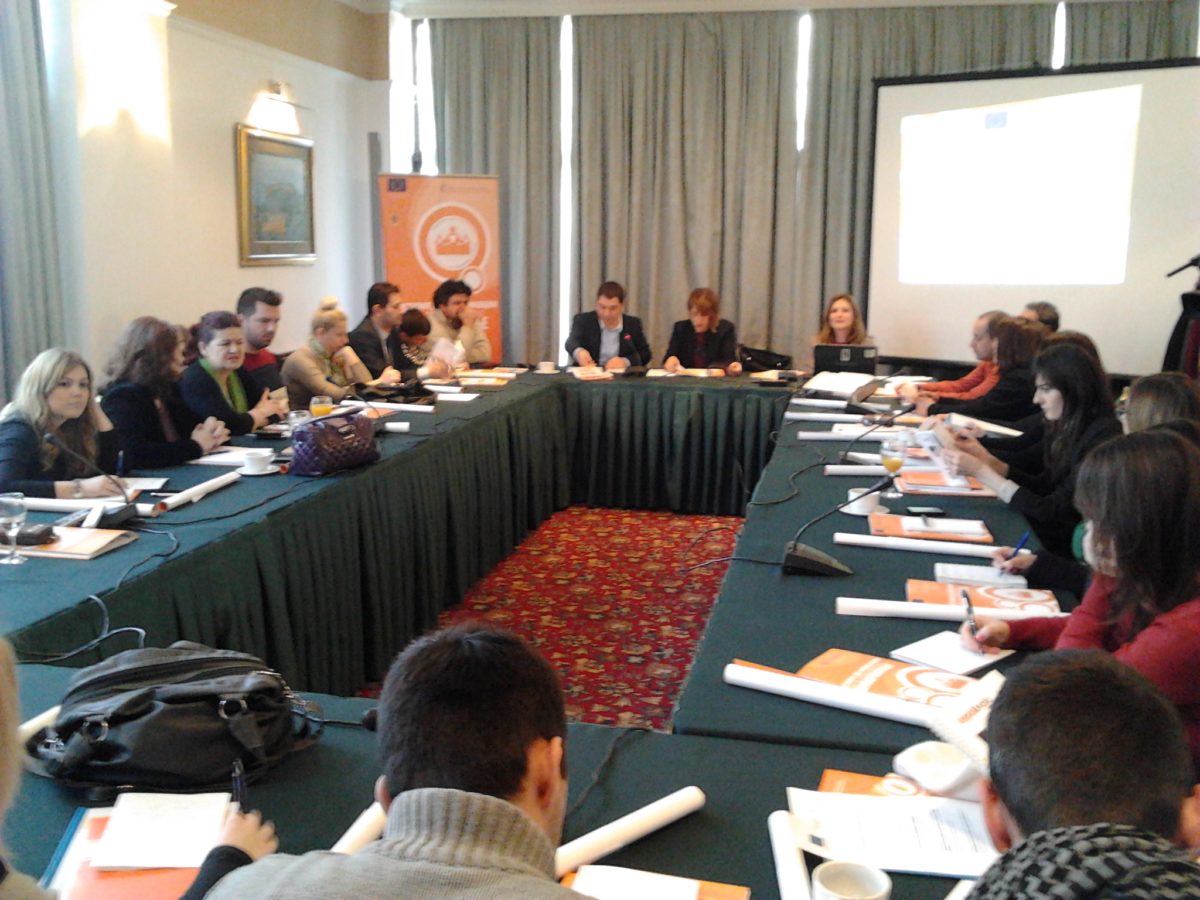
BIRN Kosovo Presents Report on Court Monitoring

The Balkan Investigative Reporting Network (BIRN) in Kosovo published its fifth report on court monitoring for the January-December 2012 period on Wednesday.  The information in the report was the result of monitoring a total of 1,441 court sessions, which resulted in 1,040 verdicts.

BIRN’s main findings are categorised in twelve points which refer to a variety of problems ranging from the monitoring of corruption cases, procedural violations, failure to respect the rights of parties during court hearings, to the use of mobile phones during the trial sessions.

The press conference at which the BIRN report was presented was attended by representatives of several judicial institutions including the Kosovo Judicial Council, the Supreme Court of Kosovo, the State Prosecution, the Ombudsperson, representatives of embassies in Kosovo, representatives from OSCE, EULEX, and civil society.

The head of the Judicial Council of Kosovo, Enver Peci, congratulated BIRN for the work conducted so far, which, he said “represents a target for the fields where the judicial system should be more engaged”.

The  President of the Supreme Court, Fejzullah Hasani, said that BIRN had helped to illuminate errors which legal officials had been unable to investigate. 

“I have read BIRN’s report carefully and with pleasure, and I express congratulations for the realistic findings that are welcome for our work,” said the special prosecutor, Besim Kelmendi.

Diane E. Tourell, legal analyst at the OSCE, also complimented the BIRN report and emphasised that the OSCE echoes the concerns caused by procedural violations and would welcome similarly thorough reports in the future.

Download the full report as a PDF file in English
Download the full report as a PDF file in Albanian


Balkan Job Finder Offers More Posts in 2013

BIRN’s online employment service BalkanJobFinder.com now has more than 1,000 CVs in its talent pool.

The BalkanJobFinder website is full of CVs from highly-skilled professionals from across the Balkans. Jobs are offered all around the region and beyond. At the moment, there are active offers of new posts in the Czech Republic, Bulgaria, Serbia and other countries. Jobs are also offered which allow experts to operate throughout the region without having to base themselves solely in one city. This service is also growing bigger each month and getting more efficient.

All these services can be accessed through the BalkanJobFinder website and its growing social network pages at Facebook, LinkedIn and Twitter. Also, feel free to subscribe to its newsletter.

In a special New Year offer, for every purchase clients make in January, they will get another job post within the same value absolutely free. For further information, please contact the BalkanJobFinder Business Development Manager, Dina Jakovljevic, at [email protected].

BIRN’s Balkan Transitional Justice Team Holds In-House Journalism Training

The Balkan Transitional Justice team held a two-day training and editorial meeting in Belgrade from January 12-13, supported by the United Kingdom’s Foreign and Commonwealth Office.

The session was aimed at enhancing techniques for covering transitional justice issues and developing topics for upcoming cross-regional investigations. The investigations are part of BIRN’s Regional Reporting on Transitional Justice Issues programme. Over the next two years, the organisation’s network of journalists will produce four major investigations on transitional justice issues in the region.

The meeting brought together journalists and other team members from six countries, including BIRN’s reporters, translators, television editor and radio producer. The team also discussed project activities for the forthcoming two years and held a development session intended to boost investigative reporting skills and further improve coverage of transitional justice issues.

Journalists examined strategies for employing social media and online content to enhance and promote investigative work, as well as innovative ways of presenting investigations in multimedia formats to deepen readers’ understanding and gain a wider audience.

The Balkan Transitional Justice journalists were joined at the meeting by the Balkan Insight team of correspondents and editors for a series of joint cross-regional editorial discussions.

BIRN Macedonia Receives USAID Funding

BIRN Macedonia has signed a grant agreement with USAID in Macedonia for a 30-month project aimed at enhancing cooperation between civil society organisations and media and strengthening investigative journalism in the country.

BIRN Macedonia will implement the project in partnership with the Centre for Civil Communications, SCOOP Macedonia, KOD TV magazine and Koha daily newspaper.

In partnership with local media and NGOs, BIRN Macedonia will organise a series of events designed to bridge the gap between civil society organisations and media and foster valuable relationships between NGOs and journalists.

In addition, the project will award grants to journalists for investigative stories, offer mentorship and guidance to journalists in the editorial process and arrange publication for investigative stories on various issues in the country.

The project will run until June 2015.

Balkan Fellowship for Journalistic Excellence Shortlisted for European Press Prize

Balkan Fellowship for Journalistic Excellence programme and its editor Neil Arun have been nominated for the European Press Prize 2012 in the Innovation Award category for the outstanding innovation of the year.

In order to encourage regional networking among journalists and advance balanced coverage on topics that are central to the region as well as to the European Union, the Robert Bosch Stiftung and the ERSTE Foundation, in cooperation with the Balkan Investigative Reporting Network, BIRN, have initiated the Balkan Fellowship for Journalistic Excellence programme in 2007.

Each year, ten Balkan journalists are competitively chosen to receive funding and professional support to conduct their own research project.

Adrian Mogos, a Romanian journalist and Fellowship alumni, has been also nominated in the News Reporting  Award category, for the reporter or specialist expert whose work has made a decisive impact.

Awards will be also made in two further categories – the Editing Award and the Commentator Award.

The idea for the awards was born in 2011 when representatives of seven European media foundations joined forces to launch the European Press Prize in order to reward excellence in journalism across all 47 European countries. They agreed that launching the awards would encourage high-quality, innovative and independent journalism.

Each award carries a prize of 10,000 euros, to be spent wherever possible on a personal project that may in turn enrich the practice of journalism.

The winners will be announced later this month by the jury which is chaired by veteran British journalist and editor Sir Harold Evans, and the awards will be presented on February 26 at the De Balie Debating Centre in Amsterdam.

BIRN Meeting Brings Balkan Journalistic Teams Together

As a result of a new two-year grant from the United Kingdom’s Foreign and Commonwealth Office, BIRN is bringing together its team of journalists from across the Balkans for a two-day training.

At the meeting in Belgrade from January 12-13, the Balkan Transitional Justice team will also develop a series of major cross-regional investigations, discuss project activities for the forthcoming two years and development session aimed at enhancing investigative reporting skills and techniques for covering transitional justice issues.

Those attending will include BIRN’s reporters, translators, television editor and radio producer, and the session will also introduce to the entire team the new English-language editor-in-chief for Balkan Transitional Justice, Matthew Collin.

The Balkan Insight team of correspondents and editors will also be present at the meeting for joint cross-regional editorial discussions.

“This is an important opportunity to get all our journalists together, face to face, and work on strategies and collaborative projects for the future,” said Collin.

“The exchange of ideas should be fascinating and form the basis for some important investigative work,” he said.

The United Kingdom’s Foreign and Commonwealth Office is now the third donor for the Balkan Transitional Justice project, alongside the European Commission and the Federal Department of Foreign Affairs of Switzerland.

Discussion: How a person skipped a trial on murder charges

Justice in Kosovo broadcast a programme about how someone accused of attempted murder was released by the police without charge.

Questions covered included: What happened to farmer Rifat Thaçi on the day he decided to go out for a picnic with his family? Why did the defendant, 72-year-old Ramë Rama, allegedly try to kill Mr. Thaçi? How it is possible that even after such a serious crime, the prosecution released Mr. Rama from detention?

What is the opinion of the parties involved in this process? When the prosecution failed, was the imam of the village successful in resolving the conflict? Finally, what did the chief district prosecutor for Mitrovica say about this decision?

To discuss these and related issues, researcher Petrit Kryeziu interviewed:

  • Rifat Thaçi,
  • Hajrie Thaçi,
  • Izet Hajrizi and
  • Avdyl Ramaj – the injured parties;

  • Fadil Idrizi – the village imam;

  • Shyqyri Syla – chief prosecutor from the District Prosecution in Mitrovica; and

  • Kadri Begolli – acting director of the Office of the Disciplinary Council.

The report started with Mr. Thaçi, who spoke about what happened during a picnic with his family, which turned into a crime scene: when they arrived at the planned place for picnic, they encountered a barrier fence. Mr. Thaçi broke the fence in order to walk across land belonging to his friend, where trouble broke out.

Contrary to Mr. Thaçi, Mr. Rama claims that the fence that was broken was in his land. A fight broke out, which ended when Mr. Rama fired two bullets, injuring Thaçi in the leg and head.

This case was passed on to the judicial bodies in Mitrovica. The suspect was put in detention. The district prosecutor proposed extending detention for two months, but after ten days the same prosecutor asked to substitute house arrest for detention, on the grounds that the parties had settled the dispute between themselves.

Regarding this, Mr. Thaçi said “I don’t know how the prosecutor concluded that we have agreed with Rama. Who said to her that we have agreed? Due to Rama’s release, my family feels victimised again. In order to avoid fights and troubles, we have moved here, to Prishtina!”

Similarly, Mr. Hajrizi said “I don’t know what kind of prosecutor this is, who releases a person who has committed such a crime, and at the same time points out that the families have agreed – which did not happen at all.”

“I have tried to help these two families reach reconciliation. However, after a month, I did not contend with it any longer,” said Mr. Idrizi, a village imam.

Mr. Syla said “there was a technical mistake made by the prosecutor, who asked to substitute the [detention] measure, because the sentence that highlighted the fact that the families had agreed was left in the computer from previous proposals.”

He went on to say that “this mistake is nothing compared to the [other] mistakes that happen due to the working conditions within the prosecutor[’s offices].”

Video: http://www.jetanekosove.com/drejtesia/959/Alb

Discussion: Domestic violence

Justice in Kosovo returned to a previous domestic violence case, and considered the continued failure of judicial institutions to deal with such cases.

Among the questions covered in the debate were:

How did the Kosovo Police react when a victim complained that a gynaecologist performed an abortion at the request of her mother-in-law? How did the gynaecologist, Ramadan Maliqi, respond to the victim’s allegations? Why does the victim complain that police officers have advised her to endure violence?

Why does Ismet Hashani, the Kosovo Police spokesman for the region of Gjilan, hesitate to mention the names of Arbnora Leka and Shaban Hajdari, the police officers who dealt with the victim’s case?

Why did the judge, Emine Salihu, deal with a large number of court cases, including some received later, but kept this case pending? Why has the Centre for Social Work hidden the court case from the victim?

Is it true that Reshat Zeqiri, a social worker, supported the father-in-law and mother-in-law of the victim by allowing them to get custody of a child without the consent of mother?

In order to discuss these issues, journalist Leonora Aliu interviewed the victim of domestic violence, a number of witnesses and the following officials:

  • Ismet Hashani, Kosovo Police spokesman for the region of Gjilan;
  • Fahri Nuhiu, prosecutor in the District Prosecution in Gjilan;
  • Kolë Ramaj, a lawyer; and
  • Mehat Berisha, head of social services at the Centre for Social Work in Gjilan.

M. B. was in the third month of pregnancy, but was also very young when her mother-in-law ordered her to abort the pregnancy, allegedly because M. B. was taking medical drugs, and the child was not expected to be born ‘normal’.

“My mother-in-law and father-in-law did not love me, they would have preferred a bride with Swiss documents, who works there and sends them money. I didn’t even have money for myself,” M. B. told Justice in Kosovo. “I have often asked them why they behaved that way and why they beat me constantly. Their answer was that ‘we don’t want you, and that’s all!’”
One day, the victim’s mother-in-law took her to a gynaecology clinic.

“When we went inside the clinic, the nurse said that she would just examine me, but then she began to kill my baby with her tools,” she explained.

She said that she had started to cry; she didn’t trust the doctor, who was telling her that the child was already dead and must be removed from her womb.

Regardless, she returned to her husband because, as she said, “I was young and I was afraid to tell the truth. Therefore, I returned with the hope that everything was going to be alright.”

The beatings continued even after the victim became pregnant for a second time. “Even after my daughter was born, their violence did not stop,” said M.B.

Due to the continued violence, the victim was forced to go out into the street. “One day, they beat me too much, so I decided to escape from the house. I ran as much as I could, until I met a police patrol in the street. They brought me to the nearest police station and took my statement,” she said.

Arbnora Leka and Shaban Hajdari were the two officers from the police department for domestic violence, who received the victim’s statement on the day her father-in-law had pulled her hair out by the roots. However, the victim’s statement was not enough for them, because, according to her, “they said that I must accept my mother-in-law’s behaviour, because she is older.”

Related to this case, Mr. Hashani denied the accusations against the two police officers: “I cannot believe that this is true. I am very sure that the police did their job properly.”

Meanwhile, when asked about the investigation into the violent abortion carried out by Dr Ramadan Maliqi, Mr. Hashani said that “the doctor told us that he does not register his patients and their cases”.

Mr. Nuhiu said that “on May 24, 2005, a criminal case against Metush Hajdari, the father-in-law of M.B., was raised on charges of causing bodily injury to her. Today, I understood that this case remained unresolved and pending, and that the competent judge has taken a decision to refuse the charges.”

Mr. Ramaj said that “this is a drastic violation of human rights and an abuse of official position by the judge. If the competent judge has resolved new cases and left this one pending, then there is room for doubt that she intentionally didn’t resolve it.”

Moreover, Mr. Berisha admitted that the Centre for Social Work in Gjilan received a request from M.B. to take custody of her child.

Video: http://www.jetanekosove.com/lexo/840/Eng

Discussion: The resignation of the KPI’s director of investigations

Justice in Kosovo broadcast a programme about the resignation of Valdet Hoxha, the former director of investigations at the Kosovo Police Inspectorate.

Among the questions discussed were: Why did Mr. Hoxha resign? What did police chief Fitim Shishani say to Mr. Hoxha about the possibility of a change in his job? What was Mr. Hoxha’s reaction? How did Jetullah Aliu take up the position? What is the relationship between Mr. Shishani and Mr. Aliu? What did Mr. Aliu do before? Was there any political interference in this transfer?

To discuss these and related issues, researcher Petrit Kryeziu interviewed:

  • Fitim Shishani, head of the KPI;
  • Valdet Hoxha, former head of investigations at KPI; and
  • Jetullah Aliu, the current head of investigations at KPI.

The interview started with Mr. Hoxha, who said that he believes his change of position was a form of political revenge, for being a member of the General Council of the Democratic League of Kosovo (LDK) until 2006. He also said, “I have asked Mr. Shishani why I had to leave my position as investigations director. The answer I received was final: the person who shall fill this position is Jetullah Aliu.”

On the other hand, Mr. Shishani said “I have offered Mr. Hoxha a position that was at the same level as his previous one.”

However, he went on to say that the new position is not yet functional, and that “when Valdet Hoxha left the inspectorate, I was in an undesirable situation because I had not found the right person to perform as well as Mr. Hoxha had”.

“I appreciate the work Mr. Hoxha has done, but I think that I will give a greater contribution,” Mr. Aliu said. He then said “my history basically deals with the police. I consider that my knowledge in the investigative field is sufficient.”

He also claimed that he had received positive comments for his commitment in the police inspectorate.
 
Video: http://www.jetanekosove.com/drejtesia/943/Alb

Discussion: The privatisation of NBI Suhareka winery

Justice in Kosovo broadcast a programme about the privatisation process of the NBI Suhareka wine enterprise, including high-profile suspicions about secret deals between businessmen.

Questions covered included:

How much did Suhareka’s mayor, Blerim Kuci, pay for his shares in the enterprise? Why have workers there been striking for three months? Is Mr. Kuci responsible for the destruction of the winery in central Suhareka? Who bought its assets cheap, and why did the Kosovo Privatisation Agency turn a blind eye to the winery’s ‘destruction’? Who has cut down hundreds of hectares of vines in Suhareka, and who plans to build there? Why have Italian businessmen asked for help from the Italian ambassador to Prishtina, and why did conflicts arise between Albanian stakeholders?

To discuss about these and related issues, journalist Kastriot Jahaj interviewed:

  • Blerim Kuçi – mayor of Suhareka municipality;
  • Roberto Migotto – owner of QMI
  • Fazli Morina – former director of production at NBI Suhareka;
  • Malush Sopa – head of the NBI Suhareka workers’ union; and
  • Habib Usaj – former managing director of the enterprise, after privatisation.

NBI Suhareka, which once produced tons of wine and other grape products, has faced constant problems since it was privatised.

Opening the report, Mr. Sopa said “in principle, we all agreed that the enterprise would be privatised. We thought that privatisation would mean that production would increase, but the opposite happened.”

He also said that the privatisation procedures were a problem and that politicians were not interested in improving the enterprise’s performance.

On the other hand, Mr. Kuçi confirmed that there had been an agreement that, following the privatisation of NBI Suhareka, the grape cellar would be destroyed. “This was necessary because the cellar’s location was completely inappropriate,” he claimed.

This particular agreement was formulated in such a way that it ensured the destroyed cellar would belong to Mr. Kuci.

On this point, Mr Kuci said “I am not a shareholder, but we agreed with the company that won the tender that post-privatisation I could acquire certain rights…This agreement was not hidden therefore, and all relevant organs [of the state] were aware of this”.

Mr. Migotto said that the money needed to bid for NBI Suhareka was borrowed. According to him, this does not make Mr. Kuçi a shareholder. “I have taken money from banks and family members.

The Mayor of Suhareka funded this activity to the tune of 450,000 euro… with the one condition that, after privatisation, the property should belong to him. Later, he concluded that in financial accounting, this activity should be listed as a debt.”

Meanwhile, Mr. Morina said that the mayor’s only interest concerns this cellar, which he wants destroyed in order to construct high buildings.

“All of us have been forcibly fired… After a while, they started employing around 40 workers. We have complained to the Kosovo Privatization Agency and the Kosovo Trust Agency, and we have said that the enterprise is being destroyed [and] robbed, and we have submitted all the necessary evidence for this,” Mr. Morina concluded.

According to Mr. Usaj, Blerim Kuci has not had any influence over, or role in, the privatisation process for NBI Suhareka.
 
He also said that he was not aware of the agreement between Mr. Kuci and QMI until February 2008.

Video: http://www.jetanekosove.com/drejtesia/956/Alb