BIRN Serbia holds debate on EU’s 2013 progress report

BIRN Serbia held a debate on Tuesday about whether the government has been successful and efficient in implementing reforms in the context of European Commission’s recently-published 2013 report on Serbia’s progress.

The debate focused on four key areas – the economy, health, education and the fight against corruption – in which BIRN Serbia has been monitoring government policies for the past year and a half.

The speakers were Dragana Zarkovic-Obradovic, director of BIRN Serbia, Jasminka Cekic Markovic, director of the Centre for Education Policies, Predrag Stojicic, director of Serbia on the Move, Kori Udovicki, director of the Centre for Advanced Economic studies and Nemanja Nenadic, programme director for the watchdog organisation Transparency.

More than 40 media, NGO and public administration representatives took part in the conference.

Dragana Zarkovic-Obradovic said that BIRN’s latest research showed that, even though European Commission report was generally considered “historically positive”, the real effects of the government’s reforms only range from semi-successes to failures.

Kori Udovicki stressed that the government’s economic promises were populist and that it is necessary to follow priorities and plan strategically in order to increase productivity.

She said that tightening up financial discipline and the rationalisation of the public sector were the main mechanisms for the recovery of Serbian economy.

Nemanja Nenadic said he believes that the EC report corresponded to real reforms in Serbia, but that it did not cover all the important issues – problems that repeat themselves from year to year, which Serbia has not done enough to solve.

He added that Serbia is entering another pre-election campaign period even though issues that came up during the previous election still haven’t been solved.

All participants in the debate agreed that the EC’s ratings are better than in previous years, but noted that Brussels is never too severe with the authorities.

The debate was part of the BIRN Serbia ‘Accountability Tools for Monitoring Government Performance’ project, which was conducted under the auspices of the British Embassy in Belgrade.
Novi Sad students quiz BIRN on transitional justice

Petar Subotin of the Balkan Investigative Reporting Network gave a lecture on journalism and transitional justice at the Jovan Jovanovic Zmaj high school in Novi Sad on Monday to coincide with the first screening of BIRN’s documentary The Majority Starts Here in the northern Serbian city that evening.  

More than 30 students attended the one-hour lecture and afterwards posed questions about topics like investigative journalism and news writing procedures, but also about transitional justice and reconciliation processes in the Balkans.

Picking up on the topic of BIRN’s film, they were eager to find out if people of their generation in Bosnia and Herzegovina, Croatia, Macedonia, Montenegro and Kosovo knew about the crimes that happened in each country in the region during the 1990s wars.

They were also interested in how the six young people featured in the documentary reacted when faced with difficult situations and tough stories from the conflicts. 

When asked if they would agree to participate in such a project, many said that they would, mostly because they felt that they would not experience any difficulties when sitting at the same table with youngsters from neighbouring countries.

Questions were also asked about studying journalism, whether it was hard to become a good journalist and whether it was difficult to find a proper job outside tabloid newspapers.

The lecture was one of the first steps in a new BIRN initiative to bring transitional justice issues closer to young people.

BIRN Documentary Airs on Al Jazeera Balkans and TV Vijesti

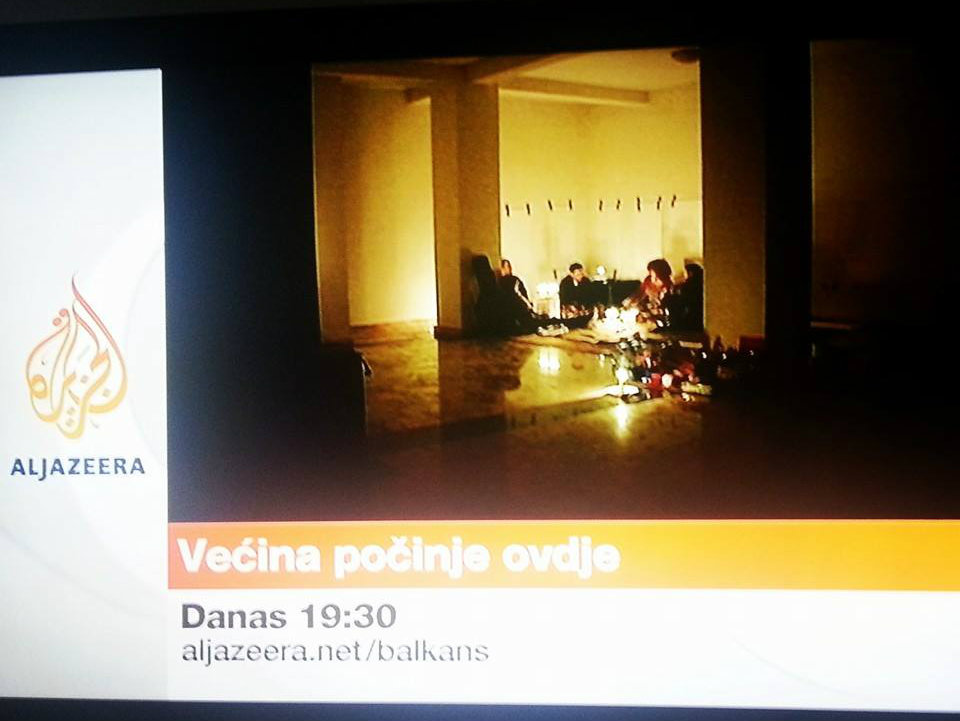
The first episode of BIRN’s documentary series The Majority Starts Here was screened on Al Jazeera Balkans on Sunday evening.

This was followed on Monday evening by a screening on Montenegrin TV channel Vijesti as part of the show ‘Bez Granica’, along with an interview with BIRN regional director Gordana Igric.

BIRN launched its promotion of the documentary last month with a premiere of the full film in Skopje, Macedonia, followed by inaugural screenings in Belgrade, Zagreb, Pristina, Sarajevo and Novi Sad. The film’s premiere in Tuzla is scheduled for Friday, while screenings in Podgorica, Kraljevo and Subotica will follow.

“The film documents the journey of six young people through the region and their encounter with nationalism, ethnic tensions, prejudice – key ingredients in the bloody menu of the Balkan wars,” the head of BIRN Macedonia, Ana Petruseva, told the audience of journalists, diplomatic and NGO representatives before the Skopje premiere.

A three-episode version and six-episode version of the documentary is being aired on TV channels across the Balkans.

In the film, the six young people from six Balkan countries examine how the conflicts of the past have influenced both their present and their prospects for the future.

Along the way, they come face-to-face with some of the ghosts of the past in the shape of impoverished refugees, military veterans and unrepentant nationalists.

They also see how the nationalist ideas that led to war have been reflected in the region’s economy, culture and even architecture, as they muse on how genuine tolerance and reconciliation can develop in places that have endured such divisive violence.

The Majority Starts Here was produced by BIRN and directed by award-winning film-maker Lode Desmet. In 2006, Desmet and BIRN also produced the film Does Anyone Have a Plan?, about the future status of Kosovo.

The documentary is part of BIRN’s Balkan Transitional Justice project, which aims to improve public understanding of transitional justice issues in Bosnia and Herzegovina, Croatia, Kosovo, Macedonia, Montenegro and Serbia.

Find out more at: http://www.balkaninsight.com/en/page/balkan-transitional-justice-movie-home

BIRN Kosovo Journalist Wins Reporting Prize

Kaltrina Rexhepi, a journalist for the Balkan Investigative Reporting Network in Kosovo, has won first prize in awards for reporting on poverty given by the United Nations Kosovo Team and the Association of Professional Journalists of Kosovo.

Rexhepi’s video report, ‘Collective Apartments in Magura Have No Access to Water’,  published on BIRN Kosovo’s online portal, GazetaJNK, explores how 22 families in a public apartment in Magura, a village in the Lipjan municipality, have not had running water suitable for drinking or bathing for the past seven years.

In the report, the Institute of Public Health tells GazetaJNK that the health of the villagers is at risk; however, the authorities have not taken any action to provide them with water.

In 2013, GazetaJNK began publishing video reports in addition to text-based articles.


BIRN Serbia publishes ministries’ 2012 discretionary expenditures

BIRN Serbia has published a database of the discretionary expenditures of the country’s ministries for 2012 on its portal Javno.rs.

The database contains information on how the ministries spent public funds on budget lines 423 and 424, contracted services and specialised services for 2010, 2011 and 2012.

The Serbian government has announced savings in the area of goods and services and discretion rights as one of its planned measures for economic recovery. This measure is intended to deliver savings up to four billion dinars for the state budget.

BIRN’s research has shown that the ministries have increased discretionary expenses during the past three years and paid 53.6 billion dinars in total for various contractual and specialised services.

In 2010, ministries spent 2.6 billion dinars on specialised services and11.6 billion dinars on contracted services.

According to data for 2011, the costs of specialised services were reduced and total expenditures of ministries on these were 1.5 billion dinars, while the costs of contracted services increased by five billion dinars compared to the previous year.

The data that BIRN collected for 2012 showed an opposite trend in the spending of public money on these two budget lines. The ministries spent much more money to pay for specialised services, nearly 19 billion dinars, while on contracted services, they spent only 2.1 billion.

All the information contained in this database was based on requests for access to information of public importance and it took up to six months to collect all the answers and two more months to make easily accessible and searchable.

Javno.rs is an open and fully searchable database containing thousands of documents on public expenditure. The databases that have been created will be supplemented every year while new ones will be developed, covering fields of interest that we assess as murky areas of public expenditure or as potential generators of corruption in Serbia.

For which specific services and with which individuals and legal entities ministries closed contracts worth up to tens of millions of deinars, see the website http://javno.skockajtebudzet.rs/index.php.

The idea for Javno came from BIRN but our many partners helped to implement it, from the British Embassy in Belgrade to IREX.

BIRN Screens Youth and War Film in Novi Sad

After premieres in Skopje, Belgrade, Sarajevo, Zagreb and Pristina, BIRN’s new road-movie documentary The Majority Starts Here was screened in the Serbian city of Novi Sad.

The Balkan Investigative Reporting Network’s new documentary, which follows six young people from six Balkan countries as they travel across the region examining how the conflicts of the past have affected their lives, was screened on Monday in Novi Sad.

BIRN’s regional director Gordana Igric said that the film showed that young people from former Yugoslav countries could still establish friendly relations.

“We were surprised how these young people were not burdened by the war and how they managed to overcome the ethnic differences.  They even played paintball in Kosovo, without any resemblance to the war in the 1990s,” Igric said.

The event was attended by 120 people from including journalists, civil society representatives, students from the media studies department of Novi Sad philosophy faculty and general public.

The film was first shown in Skopje in late September, then in Sarajevo and Belgrade, followed by screenings in Zagreb and Pristina.

A three-episode version of the documentary will also be aired on TV channels across the Balkans.

The documentary is part of BIRN’s Balkan Transitional Justice project, which aims to improve public understanding of transitional justice issues in Bosnia and Herzegovina, Croatia, Kosovo, Macedonia, Montenegro and Serbia.

Travel and Tolerance in Focus at BIRN Zagreb Premiere

Young people who appeared in BIRN’s new documentary The Majority Starts Here spoke at its Croatian premiere about what they learned about the 1990s conflicts on their cross-Balkan journey.

The Balkan Investigative Reporting Network’s new road-movie documentary, which follows six young people from six countries as they travel across the former Yugoslavia examining how the conflicts of the past have affected their lives, had its first Croatian screening in Zagreb on Thursday – the latest in a series of cross-regional premieres.

The screening at the Gric art cinema was followed by a discussion with film’s participants, who during their journey across the region met war veterans, refugees, unrepentant nationalists and people who advocate reconciliation.

Zvonimir Zvonar, the participant from Croatia, said that it was very important for young people to face up to what happened in the recent past.

“I have never before had the opportunity to meet people from other former republics at one place, let alone spend almost a month with them. Besides making new friends, I improved my knowledge of history and learned many new things which I did not even think about before. This documentary allowed me to have an invaluable life experience,” he said.

Simona Milanovic, the participant from Serbia, said that working on the film changed her perception of what was happening in the 1990s in the Balkans.

“I admit I knew very little about the conflicts of the 1990s and I am glad I was able to hear stories firsthand about what really happened,” she said.

“I met people who, unfortunately, had to experience war personally, but what was most important to me is that during the shooting I made friends for life,” she added.

Meanwhile Bardh Skhreli, the participant from Kosovo, said that in order for young people from the Balkans to understand each other and the region in which they live, they need to get to know each other.

“Every young person living in the Balkans should find a little money and time to visit neighbouring countries and experience all the wonderful things the region has to offer,” he said.

“It is important that we meet people, hang around with them and develop friendships. Instead of Brussels, London or some other European city, visit the Balkans and meet people who live around you,” he urged.

Besides Zagreb, the film has also been shown in Belgrade, Sarajevo, Skopje and Pristina, with a further screening in Novi Sad on Monday.

A three-episode version of the documentary will also be aired on TV channels across the Balkans.

The documentary is part of BIRN’s Balkan Transitional Justice project, which aims to improve public understanding of transitional justice issues in Bosnia and Herzegovina, Croatia, Kosovo, Macedonia, Montenegro and Serbia.

BIRN’s ‘Majority Starts Here’ Greeted in Kosovo

BIRN’s new Balkan road-movie documentary, The Majority Starts Here, received a warm welcome at its premiere in Kosovo on Wednesday.

Representatives of local and international institutions, civil society groups and artists applauded the premiere in Kosovo of the film screened at the Faculty of Architecture in Pristina.

Jeta Xharra and Gordana Igric/ Photo: Agim Balaj

“The message of the film is that people still have different perceptions of the conflict and disagree, but can sit together and talk, without using guns to sort out differences,” Gordana Igric, BIRN Regional Director, said, delivering a short introduction to the movie with Jeta Xhara, BIRN Kosovo Director.

“It was quite an achievement to be able to tell the history of recent wars in six different countries in the Balkans in one hour through the eyes of 20-year-old characters,” Xharra said, adding that the film should be shown in schools throughout the region, “so that young people don’t grow up with partial knowledge of what happened in the 1990s.”

The screening met laughter, murmurs and moments of silence as six youngsters described their wartime experiences during the Balkan wars.

During their journey across the region, the six young participants from Bosnia, Croatia, Kosovo, Macedonia, Montenegro and Serbia met war veterans, refugees, unrepentant nationalists and people who advocate reconciliation in an attempt to discover how the Balkan wars had affected their own generation.

The film was first shown in Skopje in Wednesday and on Thursday in Sarajevo and Belgrade, while screenings are set for Zagreb on October 3 and Novi Sad on October 7.

A three-episode version of the documentary will also be aired on TV channels across the Balkans.

The documentary is part of BIRN’s Balkan Transitional Justice project, which aims to improve public understanding of transitional justice issues in Bosnia and Herzegovina, Croatia, Kosovo, Macedonia, Montenegro and Serbia.

BIRN Serbia Continues Post-Election Monitoring

For the past year and a half, BIRN Serbia has been developing mechanisms for qualitative monitoring of government’s policies, mapping trends and reforms in the four areas which citizens singled out as the most important to their personal and social well-being – the economy, the fight against corruption, health and education. Thanks to the continuation of the project ‘Accountability Tools for Monitoring Government Performance’, supported by the British Embassy in Belgrade, BIRN will carry on its watchdog role for another six months.

The long term goal is to positively influence the creation and implementation of public policies in the four designated fields, through the creation of public demand and the engagement of civil society organisations, experts and public administrations, driven by the monitoring results.

Based on the research conducted during the electoral campaign, BIRN came up with a follow-up project, and since September 2012 has set up unique post-election watchdog mechanism, focused on the fulfilment of electoral promises made by politicians.

This mechanism also contributes to tracking general progress on reforms and enabling debate on policy choices made by the government in the four targeted fields. A monitoring matrix, containing several qualitative indicators, will be soon published online and, along with legislative and budgetary tracking and shadow reporting, presents an important tool for voters to make politicians accountable.

The implementation of this project will provide all interested parties with critical and unbiased insights into the progress of reforms and the quality of public policies in the four designated fields, empowering their meaningful participation in public debate. It will also help intensify public discussion and engage all relevant stakeholders over potentially controversial moves by the government. 

BIRN Serbia Wins Regional Journalism Competition

The South East European Media Observatory, a regional partnership of civil society organisations aimed at enhancing media freedom and influencing reforms, has chosen BIRN Serbia to produce a series of investigative articles related to ‘soft censorship’ in the Serbian media sector.

BIRN Serbia will produce stories which tackle the abuse of public money to exert political influence on the media. The stories will focus on the allocation of public funds in the Serbian media sector as a tool to control media outlets.

The stories will show how the misuse of state funds consequently leads to clientelism and soft censorship and is also a potential source of corruption and legal violations. The core story will be related to the situation in the Serbian media sector, while a regional perspective will be provided through an investigation in Croatia, showing a similar trend.

In the light of the Serbia’s new EU integration developments, BIRN Serbia’s work on the issue is anticipated to be a step towards advocating changes to current poor media practices and the adoption of new, European standards in the sector.

The BIRN Serbia proposal was one of six investigative journalism initiatives to receive support from the South East European Media Observatory grant scheme. The independent jury decided to award one project from Albania, Bosnia and Herzegovina, Croatia and Serbia, and two proposals from Macedonia.

The project will last until December 2013, and it is expected that all the stories will be published both on project web site and BIRN’s own sites (regionally on BalkanInsight.com and locally on Skockajtebudzet.rs).