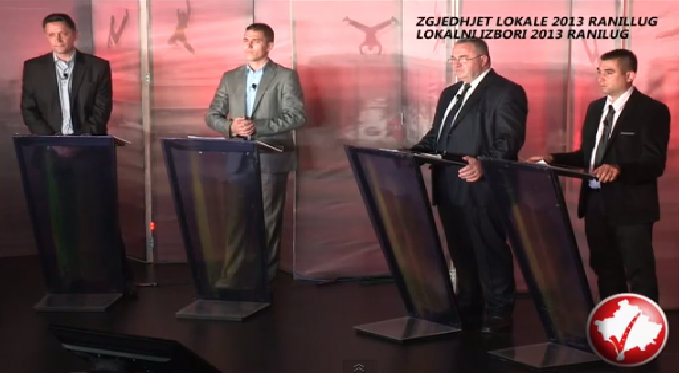
Electoral debate: Ranillug

The current Mayor of Ranilug avoided BIRN’s debate by saying that he is in Greece, while BIRN’s moderator, Ivana Stevanovic, confirmed that the mayor, who was running for Serbian Citizens’ Initiative is in fact in Kosovo.

Perica Andjelkovic, president of the Za Kosovsko Pomoravle party, said that one of his main priorities is to create a society with a good environment for investments and that he would have a particular focus on protecting local products.

On the other hand, the president of Srpska Narodna Partia Kosova, Milan Aritonovic said that the reason he should be elected is because his political party was established in order to promote the youth. He added that his party has brought business owners from Germany and Switzerland who are willing to invest in Ranillug.
He continued criticizing the current government by saying its decisions are having negative effects on citizens on a daily basis.

Igor Mitic, who is running for Social-Demokratia, declared that his party is strong enough both at the local and central level as well and that he has the unconditional support of two ministries of Kosovo’s Government, that of Labor and Social Welfare and that of Sports and Culture. He emphasized that Minister Rasic has made it very clear that there is political will to employ youth and that they won a 72 million euro donation from the EU in the amount of 72 million euro, 80 million euro from the Swiss government and many others.

The candidates noted that many investments have been done in the area of drinking water, but there are still severe water shortages. According to Aritonovic, all pre-school institutions that work under the parallel system of Serbia face a lack of drinking water and are relying on private sources, which he promised to solve if he wins.
Radovic Zokic on the other side promised that every village would have drinking water, same as Igor Mitic but they did not provide concrete or clear plans on how they would achieve this.

In the village of Pancele, the construction of a church had started but due to property rights issues raised by the Privatisation Agency, construction was halted. Candidates promised to expropriate this property in order to have the church built, while Aritonovic proposed to change its designation as a public toilet if an agreement cannot be reached on the original designation.
 
Igor Mitic declared that in order to fix the sidewalks the municipality needs about 300,000 to 400,000 euro, and that the budget would be secured through the integration of Serbian municipalities but that the state of Serbia could invest as well.

Electoral debate: Lipjan

During BIRN’s local elections debate, three out of five candidates seeking the seat of the Mayor did not allow their families to talk about them to BIRN’s  crew. This debate was filmed without audience due to the huge number of people wanting to get in a limited seats building and the lack of possibility to discipline them.

This debate saw only the families of the current Mayor of Lipjan, Shukri Buja, who is running for a third term and Vetevendosje’s candidate, Rabit Konjufca, agreeing to be interviewed about the candidates, while the other three refused to do so. In their first two minutes to present their electoral programmes, all the candidates focused their speeches on strategies for economic development, tourism, agriculture and some also talked about youth.

While PDK’s Shukri Buja said that his priority would be infrastructure, youth and environment, Vetevendosje’s candidate, Rabit Konjufca, promised to create room for diaspora to invest in Kosovo, LDK’s Imri Ahmeti focused on economic development, health, agriculture and education, and Fitim Selimi from the coalition of AAK, LDD and Civic Initiative for Lipjan promised to protect the environment and fight against corruption.  On the other side, Bastri Demiri from the Alliance for Lipjan said that he is in touch with 12 investors who are going to employ 4,500 people in four-year’s time.

This debate was particularly dynamic and heated due to many interesting questions sent by hundreds of citizens to www.kallxo.com and posed by Jeta Xharra.

Shukri Buja tried to justify his unfulfilled promise to build a roundabout, which he had made in previous elections, blaming the minister of infrastructure. LDK’s candidate, Imri Ahmeti said that even that he has lost elections three times already, he was not giving up.

Bastri Demiri,  who left LDK to become an independent before rejoining and leaving the party again to establish the Alliance for Lipjan, said that he acted this way because LDK did not respect his political programme. Fitim Selimi who acted similarly and moved from PDK to run for the coalition of AAK, LDD and Civic Initiative said that he still respects PDK.

Problems of residents of Magure and Medvec village with the drinking water, the increased number of municipal directors, central heating, the lack of a bus station, were among the main problems discussed among the candidates.

Electoral debate: Junik

Junik’s current mayor, AAK’s Agron Kuqi, facing a relative, Nimon Tofaj, of PDK, in his re-election. They would not allow BIRN’s journalists film in their familial environment.  BIRN’s electoral also featured Zenun Shala, from LDK, and Rexhep Pepshi from Vetevendosje.

In the scope of BIRN’s electoral debate with the candidates of Junik in their first two minutes, candidates provided very general promises on how they will improve the current situation of this municipality, which has only six thousand inhabitants and a budget of 1.5 million euro. Nevertheless, the candidates promised solutions in very general terms for the many problems this municipality faces but without going into concrete alternatives on how to provide better living conditions for citizens.

The current mayor was put in an embarrassing position many times, especially when the host, Jeta Xharra posed very specific questions that came in through kalxo.com by Junik’s citizens. He was not able to answer why he has built in the hills of the municipality, which have been declared a national park. Furthermore, he was also asked why he didn’t pay for a 50-cent ticket to watch the football game between Junik and Ferizaj on March 23, 2013.
Other candidates were put in a similar position such as LDK’s Zenun Shala who has not paid the local tax for his business. PDK’s Nimon Tafaj had to explain the fact that his son’s company has won many tenders through his four-year term as vice-president of the municipal assembly, including janitorial and clearing tenders for which they are not specialized.

A heated discussion between the candidates followed on the health situation of Junik’s citizens, including the building of a Family Health Centre, which was built last year but has started to collapse. On the other side, all candidates promised to build a new culture house, but were not able to say where the money would come from.

Electoral debate: Obilic

In the “Life in Kosovo” electoral debate in the Municipality of Obilic, seven candidates running for Mayor have promised to fight pollution, competing with one another over who would plant more trees if elected. Respiratory diseases and cancer are 30 percent more present in Obilic than in other municipalities due to pollution caused by the power plants. Some of the candidates have asked that a portion of the profit generated from the coal be given to the municipality where majority of reserves are located. The audience of about 300 citizens, who took part in the debate, was very noisy, especially when the current Mayor, Mehmet Krasniqi, spoke.

All the candidates running for Mayor of Obilic agreed in one point: that in this municipality it is impossible to breathe freely due to enormous pollution caused by coal mines and the power plants.

In his first two minutes, the Justice Party’s candidate, Xhelal Krasniqi, said the central government should give Obiliq, 2 to 3 million euro a year, out of the tax of 80 million euros that it gains from coal, in order to improve the situation in this municipality where the majority of coal reserves are located. On the other hand, the other candidates promised to reach deals with KEK to improve the environment in Obilic.

The current Mayor, Mehmet Krasniqi, from LDK, Vehbi Sadiku from PDK, Labinot Hashani from Vetevendosje, Xhafer Gashi from AAK, Hilmi Halimi from AKR and Bashkim Klinaku from LB are also running to become Obilic’s mayor.  

Vetevendosje’s candidate, Labinot Hashani, promised that if he gets elected, he will plants 200 trees in a 100-hectare park in Obilic, while Hilmi Halimi of AKR said that this is not enough and at least twice as many should be planted. The Justice Party’s candidate said that every citizen of Obilic should plant a tree for his or her birthday, and this way a green ring around the power plants could be created. A similar promise was made by AKR’s candidate but he did not specify numbers.

Other promises were very general, and revolved around economic development and the improvement of business climate.

As far as the specific questions for the candidates, Krasniqi from LDK was asked why he had signed that decision to place his wife, Xhevahire in the position of principal of a primary school. Krasniqi said he did so in order to promote women to decision-making positions. The AAK candidate was also asked about a conflict of interest case, since he had won a tender to produce unique uniforms for the Kosovo Security Force. Gashi admitted that he got the tender through “friends” but that he would not employ these friends if he gets elected. Jeta Xharra also asked Shukri Klinaku why smoking is allowed in his office even that it forbidden by law, while PDK’s candidate, who has reached retirement age, was asked why he was not creating space for younger generations.

The wives of the candidates spoke about the kinds of food their husbands like, ranging from flija to lazanja. It was also revealed that the candidate of Vetevendosje and his wife met during a protest in Merdare last year. The wife of PDK candidate spoke of love letters and white little lies she told her father in order to meet with him.

Electorla debate: Suhareka

Three MPs were among the six candidates for mayor of Suhareka, who appeared in televised debate held by BIRN Kosovo. MPs Bali Muharremaj, AAK, Rame Vataj, PDK and Sali Asllani from LDK, in the “Life in Kosovo” debate, tried to make a case for their candidacies even though they’ve seldom raised issues and concerns of the Suhareka citizens in the Parliament. Other candidates running for Mayor of Suhareka are Bajram Tershani from the Justice Party, Ibish Ahmeti from Vetevendosje and Nisret Hysenaj, an independent candidate.

The format of BIRN Kosovo’s electoral debates foresaw candidates talking about their programmes with a time-limit of two minutes. They used the time to identify the main problems they will seek to resolve and promising citizens very general solutions to these problems.

Some presented projects without explaining where they money will come from, with some promising to try to engage donors, while others said they would rely on the central government’s budget.

BIRN debates also featured very specific and personalized questions for each candidate, which were generated from BIRN and GAP Institute reports, the  www.kallxo.com platform and social media.

The candidates avoided answering some of these specific questions. The Justice Party candidate, when asked how he would manage to run a municipality when according to a written note by the principal of the school where he teachers English, he is not able even to control 40 pupils in his classroom, he seemed embarrassed. On the other side, Bali Muharremaj from AAK, who previously was Suhareka’s mayor for a year, would not answer why during his short mandate, seven teachers were employed without public competition or input.  

LDK’s candidate, Sali Asllanaj, did not answer when asked why he did not take any disciplinary measures against his cousin Ahmet Asllanaj, when the latter had struck the chief of procurement, Sefer Luzhnica.

Rame Vataj, four years ago, had promised to pave the road in the village of Savroe, which he didn’t do. When asked why, he answered that it was the obligation of the Ministry of Transport and that but that the national highway had “taken” that money.

In the end, the majority of the wives of the candidates said that they are the bosses in the house. They also talked about how close their husbands are to their children and what they prefer to eat.

BIRN Serbia Holds Fifth National Budget Forum

BIRN Serbia and Pro Concept held their fifth national budget forum at the National Assembly in Belgrade on 27 November, where panelists and participants offered their opinions and debated the proposed 2014 budget and the projected outcomes of the Serbian administration’s budgetary policy.

The panelists were finance minister Lazar Krstic, Pavle Petrovic, president of the Fiscal Council of Serbia, and Mihajlo Babin, assistant at Belgrade University’s faculty of economics, finance and administration.

The budget for next year is realistic and represents the first step towards the normalisation of fiscal policy because it does not make deeper cuts than necessary, said finance minister Krstic.

The minister said that a third of the budget will go to public sector employees, who number more than 740,000. He added that the government will propose a review of public administration employment.

Krstic also announced that there will be a reform of pay scales in the public sector, partly because of the budget deficit.

Responding to a suggestion from the Fiscal Council that reforms should be more aggressive when it comes to pensions, Krstic said that it was not politically possible.

Pavle Petrovic pointed to the need for fiscal consolidation, because without it, crisis is certain, he warned. He added that its aim was not to raise economic growth, but to create the conditions in which growth is possible.

”Necessary measures through which the state can affect economic growth include changes in the labour law, which have been announced but have still not been implemented, the shortening of procedures for construction permits, resolving the fate of companies in restructuring, and reforming public enterprises,” said Petrovic.

He said in 2014 alone, 560 million euro will be spent on unsuccessful public companies such as Srbijagas, Galenika, Serbian Railways, and partly on banks.

According to Petrovic, the biggest problem is Srbijagas with debts of over a billion euro, of which 800 million are owed to banks.

He stressed that it was import ant that from the middle of the next year Srbijagas, as a company which should operate with a profit, does not receive any money from the budget and begins paying off some of its debts by itself.

”Next year Srbijagas will cost 150 million euro, which is more than what is given to Serbian Railways, the company with the largest subsidies so far and more than overall government spending on science. Not only that, but it is more than the planned savings of 100 million euro by introducing a solidarity tax on salaries in the public sector,” said Petrovic.

Mihajlo Babin meanwhile pointed to the problem of ineffective financing of the public sector, as well as the problem of using up loans, with $3 billion of loan funds currently untouched.

”The key question is what the loans are used for, whether for structural reforms or not. Loans are not supposed to be taken up for covering liquidity, but to increase development. In the future, we should solve the problem of how to give up on loans that we do not need. It is better to pay the penalty now , rather than  interest later on, or to start efficiently implementing them in certain sectors,” said Babin.

The fifth national budget forum brought together more than 90 representatives of ministries, local government and civil society.

Journalists meet to discuss cross border investigations

Journalists received bespoke investigative training as they prepared major cross-border stories into crime and corruption in the Balkans.

As a part of the project “Paper trail to better government”, BIRN assembled reporters, trainers and technical experts to discuss the investigations which will be published during the next 30 months.

The meeting took place last weekend in Belgrade and gathered reporters from Albania, Kosovo, Bosnia and Herzegovina, Macedonia and Montenegro.

The programme will engage journalists from the region to investigate five important topics relevant to the Balkans and internationally. 

The project is being carried out in cooperation with the Austrian Development Agency.

Jeta Xharra Awarded for Promoting Women

BIRN’s “Life in Kosovo” has been recognized for reporting on women in a TV programme.

Jeta Xharra, director of BIRN Kosovo, won first prize for TV journalism in an award given by UN women and the group Security and Gender Equality.

The award recognized Xharra for programme dedicated to Kosovo film director Blerta Zeqiri. This prize was given at the opening of a 16-day camapaign against gender-based violence, which concludes on December 10.

BIRN Wins Prize for Education Reporting

Bardh Shkreli, a journalist for BIRN Kosovo, has won a third-place award in November from the German Society for International Cooperation, GIZ and the Association of Professional Journalists of Kosovo for education reporting.

Shkreli’s story, “University of Pristina with no invention”, examines why the public university has not patented any innovations since its founding in 1970. The story appeared on BIRN Kosovo’s portal, GazetaJNK.

Romanian Superscrieri 2013 Awards Two Fellows

Romania’s national journalistic competition Superscrieri has given awards to Elena Stancu and Vlad Odobescu, both fellows this year of the Balkan Fellowship for Journalistic Excellence.

In a tough competition involving 222 entries, seven prizewinners were selected.

Stancu won the Special Prize for Coverage of Domestic Violence for an article published in Marie Claire Romania, about a young woman whose mother was a victim of domestic violence.  

Odobescu won third place in the Portrait Category with his article The Return of Marius, a feature report about the reintegration of a former prison convict.

Earlier this year, Stancu was awarded another journalistic grant. She is one of the recipients of the 2013-2014 Rosalynn Carter Fellowships for Mental Health Journalism.

Through this she will receive intensive training from leading mental health and journalism experts and a stipend to report on a mental health topic of her choice.

http://www.cartercenter.org/news/pr/mhj-fellows-2013-2014.html   

She and the Romanian photographer Cosmin Bumbut will work on a multimedia project about the post-traumatic stress disorder in children exposed to family violence. For one year the team will examine the culture of education by violence in the Romanian families and society.