BIRN Cited as Source in International Reports

BIRN and its network members’ publications continue to be quoted and referenced in reports by international organisations around the world.

Balkan Insight articles on human rights, politics, social issues and media were referenced in Amnesty International reports Montenegro: Failure to Implement International Law and Serbia: Still Failing To Deliver On Human Rights in August.

In a report in September 2017 entitled ‘Risks Related to Exports of European Arms’ from the Friedrich Ebert Stiftung publication ‘The Causes of Migration due to “Made in Europe” Policies’, the results of an investigation carried by BIRN and OCCRP, Making a Killing: The 1.2 Billion Euro Arms Pipeline to Middle East, are cited.

Also in September, the McGill International Review, a student-run scholarly journal and daily online publication based in Montreal, examined the “dismal state” of press freedom in Serbia, mentioning smear attacks on BIRN by Serbian political leader Aleksandar Vucic.

The article also said it was “critical” to support organisations that promote and produce “incisive, investigative reporting like the Independent Journalist Association of Serbia (NUNS) or the BIRN”.

In the Freedom House report ‘Nations in Transit 2017 – Albania’, articles published by Reporter.al, BIRN Albania’s publication, are mentioned extensively in relation to elections, public spending and other political affairs.

BIRN Hosts Serbian School Textbooks Debate

The complex procedure for selecting textbooks in Serbian schools must be made simpler and stricter, as currently the risk of corruption is high, a BIRN Serbia debate heard on August 31 in Belgrade.

Aleksandar Pavlovic from the Institute for Philosophy and Social Theory of the University in Belgrade pointed out that the extremely complex procedure of selecting textbooks, which should prevent corruption, gets more complicated each time a new law is adopted.

When it comes to selecting textbooks, everyone involved is dissatisfied, he argued.

“Parents, schools, ministries, private publishers, the Institute for Textbooks… all of them want better and more efficient procedure,” he said.

Irena Fiket, one of the authors of an analysis about the risk of corruption in the process of approval and publication of textbooks in Serbia explained that the complexity of the system can generate corruption.

“One of the analysis’s recommendations is to draw up a separate document in which the entire procedure for the selection and approval of textbooks, with the responsibilities of all actors, would be described in a clear and precise way,” said Fiket.

The current procedures do not solve the problem of corruption, said Eleonora Vlahovic, head of the Centre for Programme and Textbook Development.

Vlahovic added that the issue of conflict of interest is not sufficiently outlined in the Law on Textbooks.

Sinisa Jesic from the Associations of Textbook Publishers said he thinks that the procedures for selecting textbooks must be very simple, but strict.

“When the new law was adopted and when publishers were faced with the fact that not all textbooks would pass, their efforts to show textbooks in schools could have been seen in various ways and interpreted as corruption,” Jesic explained.

Milovan Suvakov, a former assistant minister at the Ministry of Education, said he doesn’t think that everyone is dissatisfied with the current system, however.

“We have actors who are pretending that they are dissatisfied because they are in a perfectly good position, which they managed to preserve in the coming period, and I am primarily referring to publishers,” explained Suvakov.

He argued that one of the biggest problems is lobbying by publishers when new documents are being adopted.

The debate was organised as part of a BIRN Serbia programme supported by the Balkan Trust for Democracy.

BIRN Kosovo’s Justice in Kosovo Show Wins “Best Anti-Corruption Story” Award

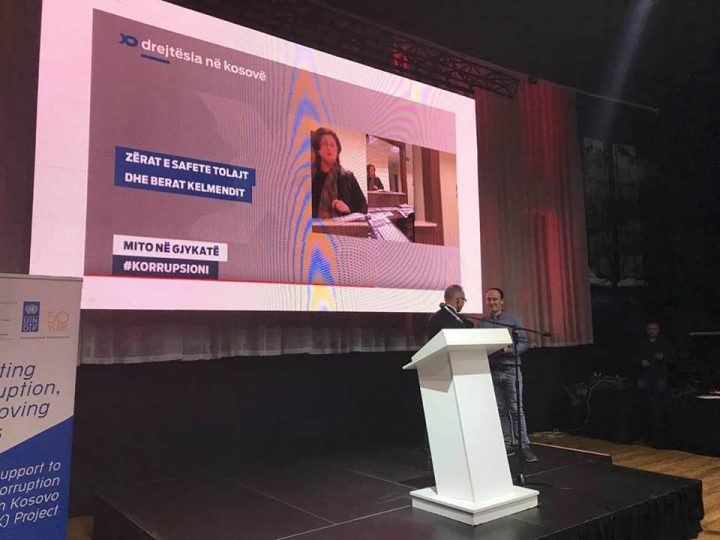
On December 8, the team behind the weekly BIRN Kosovo broadcast show “Justice in Kosovo”, was awarded the prize for “Best Anti-Corruption Story” by the United Nations Development Programme (UNDP Kosovo) and the Association of Journalists of Kosovo. The award was given to the team of Justice in Kosovo who conducted a thorough investigation on an alleged bribery case in the Basic Court of Deçan by its judge. The story, named “Bribery in the Court”, was presented through two episodes in the weekly program “Justice in Kosovo”.

The investigation into the Basic Court of Deçan revealed that Judge Safete Tolaj was involved in bribery. Her son would make efforts to bribe indicted persons, whose cases were being judged by Tolaj. KALLXO.com, BIRN Kosovo’s online anti-corruption platform, received a report from a citizen named Berat Kelmendi, who asserted that he was experiencing longer than usual times to have his case be resolved by judge Tolaj. Tolaj’s son, Fisnik, had then approached Kelmendi to speed up his case in exchange for 20,000 euros. Kelmendi had accepted the offer by secretly recording all instances where they were negotiating money in order to have Judge Tolaj solve the case faster. When Judge Tolaj was interviewed by Justice in Kosovo team, she acted surprised and claimed she was not aware of her son’s actions. However, she and her son were arrested the night before the second episode of Justice in Kosovo was broadcast. Several months after, on October 11, the Department for Heavy Crimes of the Basic Prosecutor’s Office in Peja issued an indictment against judge Tolaj under the charge of abuse of official duty.

Illustrating cases like these with evidence and their impact has resulted in strengthening the cooperation between KALLXO.com and the State Basic Prosecution, as well as the Kosovo Police. Justice in Kosovo and other BIRN Kosovo products will continue to pursue and investigate cases to uncover affairs of corruption and ensure those responsible are held accountable before legal institutions.

BIRN Film on Wartime Home Swaps Gets TV Premiere

BIRN’s new film ‘Your House was My Home’, about how war forced villagers in Serbia and Croatia to exchange homes with each other to save their lives, premieres on Al Jazeera Balkans on Tuesday.

‘Your House was My Home’, which tells how Serbs and Croats from Kula in Croatia and Hrtkovci in Serbia swapped houses and moved to each other’s villages after the outbreak of war in 1991, has its television premiere on Al Jazeera Balkans on Tuesday at 5.05pm local time.

The half-hour documentary follows the stories of two of the villages’ residents – Goran Trlaic, who left Kula for Hrtkovci, and Stjepan Roland, who left Hrtkovci for Kula.

Before the 1990s conflict, Kula was predominantly populated by Serbs, while the majority of the people in Hrtkovci in Serbia.

Since the end of World War II, they had lived peacefully together – until the first multi-party elections in 1990, when nationalists came to power and minorities were not welcome in either republic anymore.

A series of threats and violent incidents started a chain reaction as increasing numbers of inhabitants of Kula and Hrtkovci exchanged properties so they could escape to safety.

This was described by officials as ‘humane relocation’, but it was actually a forced population exchange in the midst of a war.

“There has never been ‘humane relocation’ except in the heads of nationalist leaders and their devastating policies in the 1990s in the former Yugoslavia,” said the film’s director, Janko Baljak.

“Relocations of this kind were carried out forcibly and left unimaginable consequences on the lives of people and on relations between nations who lived in peace and harmony before the war,” he added.

The personal recollections in ‘Your House Was My Home’ show how this forced population exchange had a devastating long-term effect on the lives and relationships of ordinary people from both villages, said Baljak.

“The duty and obligation of engaged documentary film maker is a continuous fight against short-term memory,” he said.

See more information about the film here.

Bosnian Ombudsman Praises BIRN BiH’s ‘Integrity’

The Balkan Investigative Reporting Network in Bosnia and Herzegovina is one of the few examples of high media integrity in the country, says “Special Report on the Situation and Threats Against the Journalists in Bosnia and Herzegovina” presented on August 28 in sarajevo.

Human Rights Ombudsman Jasminka Dzumhur said that the media situation in the country today is much worse than in previous years.

Bosnia and Herzegovina ranked 65th out of 180 countries in terms of media freedom and the safety of journalists last year, compared to 2006 when it held 19th place.

The authorities failed to ensure the safety of journalists, who were exposed to violence, harassment and intimidation, as well as facing unfavourable economic conditions and a lack of workplace rights.

“Attacks on journalists are attacks on democracy,” Dzumhur stressed.

BIRN BiH was mentioned in her report as a positive example of good practices and media integrity, along with the Center for Investigative Reporting, Buka Magazine and Media Center Sarajevo.

The South-East Europe Media Observatory was quoted in the report as saying that “for a number of years, these organisations have been protecting and promoting values of public service in journalism”.

BIRN Summer School Day 4: How to Scale Up Investigation

On the fourth third day of BIRN’s Summer School in Dubrovnik, journalists heard how to pitch stories, structure investigative projects and use open data.

The fourth day of BIRN’s Summer School Master Class of Investigative Journalism in the historic city of Dubrovnik on Thursday started with a session on pitching story ideas, run by Lawrence Marzouk, editor with Balkan Investigative Reporting Network.

Marzouk explained how stories can be pitched to editors without overpromising while bearing in mind the possible angle, sources and the outcomes.

“You need a clear idea; do not spread a lot of different things,“ he said.

Marzouk said journalists should try not promise too much from a story and must be realistic, but their stories have to be fresh and new, workable and possible, to explain why something is important.

“At the beginning, you should at least have a theory in your head, something you would try to prove,“ he said.

Miranda Patrucic, an investigative reporter and regional editor with the Organized Crime and Corruption Reporting Project, continued her lecture on how to “follow the money“.

She explained how to gather publicly available information about companies and how to research their financial statements and assets.

“A financial statement summarizes the revenues, costs and expenses incurred during a specific period of time,“ Patrucic explained.

In the afternoon session, Blake Morrison, lead trainer and investigative projects editor at Reuters, advised journalists on how to pitch stories and structure investigative projects.

“You should always think of how to better communicate the story, to use the audio-video material, the data,” he said.

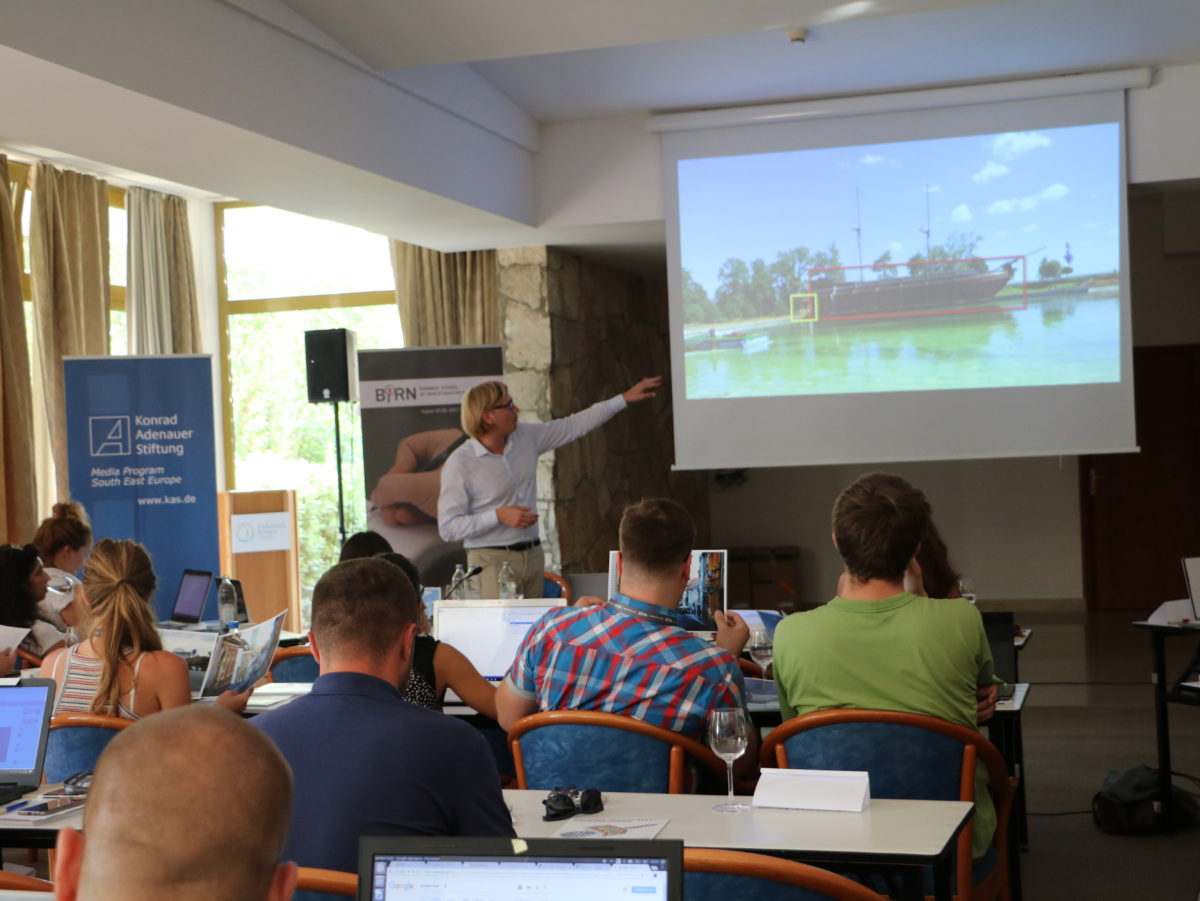
During the last Thursday’s session, BIRN’s Marzouk shed light on a case study about the arms trade from the Balkans and Central Europe to the Middle East.

Journalists heard how to use open data to trace and track the arms trade.

Marzouk explained that, while researching a “controversial industry” like the arms trade, journalists “have to harvest all the possible open source databases” because the industry is highly regulated, meaning that there is a lot of documentation.

During the fourth day, participants at the Summer School also continued to work on their investigation proposals that they will present on Friday.

The eighth BIRN Summer School has brought together young journalists from Albania, Austria, Bosnia and Herzegovina, Bulgaria, Canada, Croatia,  the Czech Republic, Greece, Kosovo, Luxemburg, Macedonia, Montenegro, Romania, Serbia, Slovenia, Ukraine and the United States.

The Summer School is organized in cooperation with the Media Program South East Europe of the Konrad Adenauer- Stiftung, Open Society Foundations and the Austrian Development Agency (ADA), the operational unit of Austrian Development Cooperation with the support of EU..

BIRN Summer School: The Art of Interviews and Tracing Money

On the third day of BIRN’s Summer School, journalists heard how to conduct interviews and investigate offshore industries.

On day three of the BIRN summer school in Dubrovnik, Blake Morrison, the lead trainer and investigative projects editor at Reuters, held a session on the “art of interviewing” and on how to convince difficult sources to talk, describing interviews as a crucial component of the journalistic job.

The task was “how to get the information from the people. And to do it ethically,” he said.

“My philosophy on interviewing is pretty simple… Think of it as a blind date,” he noted,  explaining that the interviewee needs to “be understood.

“It’s very important to be curious. If you don’t understand something, don’t presume, ask,” he continued.

Morrison explained that there are three types of interview: information interviews, which involve collecting information on something; accountability interviews, asking a person to explain his or her acts; and emotional interviews, in which person sheds light on his or her emotional perspective.

Morrison emphasised the need for preparation and gave insight into why some people agree to give an interview: vanity, the need to be understood, self-interest, desperation, guilt and curiosity.

“I really believe as a journalist is that our commitment to honesty is crucial,” Morrison said.

The workshop on data journalism and using advanced internet research continued on Wednesday.

Henk van Ess, who works with a number of European media outlets, as well as Bellingcat, continued his training on data journalism, answering questions from the participants through stories he has covered over the years.

He showed the participants how to use open sources and social media for their investigative stories, showing the example of the work he did in tracing the ISIS executer, Jihadi John.

Miranda Patrucic, an investigative reporter and regional editor with the Organized Crime and Corruption Reporting Project, also held an interactive lecture on how to “follow the money” and how to investigate offshore industry.

She conducted an exercise on tracking money and on shell and shelf companies through various databases, both open-source and paid-for.

“Many of offshore companies have a legitimate purpose in the business word, however, they could be manipulated by criminals to hide their crimes, money laundering,“ Patrucic observed.

The eighth BIRN Summer School has brought together young journalists from Albania, Austria, Bosnia and Herzegovina, Bulgaria, Canada, Croatia,  the Czech Republic, Greece, Kosovo, Luxemburg, Macedonia, Montenegro, Romania, Serbia, Slovenia, Ukraine and the United States.

The Summer School is organized in cooperation with the Media Program South East Europe of the Konrad Adenauer- Stiftung, Open Society Foundations and the Austrian Development Agency (ADA), the operational unit of Austrian Development Cooperation with the support of EU.

BIRN Summer School Day 2: Social Media, Fact-Checking for Investigative Journalists

BIRN’s Summer School continued on Tuesday with sessions exploring data journalism and fact-checking methods. s.

Head trainer and investigative projects editor at Reuters, Blake Morrison, showed BIRN Summer School Master Class of Investigative Journalism how to use a creative approach to fact-checking in Dubrovnik.

An interactive exercise explored the difference between supposition and proof and how to separate fact from suspicion, while determining standards for fact-checking.

Monday’s workshop on data journalism continued into its second day. Christiaan Triebert, a conflict researcher with Bellingcat, led the group. Bellingcat has achieved notoriety for its utilisation of open source information to investigate armed conflicts and corruption, and has won multiple awards.

During the workshop, participants learned about analytical tools required for data journalism, while Triebert explained the process of digital open source investigation, and how it can improve investigative reporting skills.

The middle of the session examined the capacity of geolocation tools to pinpoint exact places and how to use satellite imagery as a fact-checking tool. Triebert explained how advanced internet applications such as Google Maps can bolster research underpinning complex investigative stories.

“But you will still need traditional reporting and journalists on the ground,“ Triebert said.

Henk van Ess, who works with various European media outlets, as well as Bellingcat, also provided data journalism training, answering questions from BIRN Summer School participants about using social media as an investigative tool.

Journalists learned Facebook data mining methods, how to find elusive people through checking secret IDs, and how to discover closed groups or find people working for security agencies. In short, “how to search over two trillion Facebook postings in a clever way,“ he said.

The eighth BIRN Summer School has brought together young journalists from Albania, Austria, Bosnia and Herzegovina, Bulgaria, Canada, Croatia,  the Czech Republic, Greece, Kosovo, Luxemburg, Macedonia, Montenegro, Romania, Serbia, Slovenia, Ukraine and the United States.

The Summer School is organized in cooperation with the Media Program South East Europe of the Konrad Adenauer- Stiftung, Open Society Foundations and the Austrian Development Agency (ADA), the operational unit of Austrian Development Cooperation with the support of USAID Macedonia.

Eighth BIRN Summer School Opens in Croatia

BIRN’s latest Summer School opened on Monday in Dubrovnik with interactive sessions on advanced digital research and use of open data sources.

Some 35 reporters from the Balkans and across the world gathered on Monday in the historic resort city of Dubrovnik in Croatia for the eighth BIRN Summer School Master Class on Investigative Journalism.

After greeting this year’s participants, Blake Morrison, the school’s lead trainer and investigative projects editor at Reuters, held an interactive exercise and discussion about the challenges of investigative reporting. Morrison shared sources and interview techniques and tips on researching complex investigations.

The first day continued with an introductory workshop on data journalism led by Christiaan Triebert, a conflict researcher with Bellingcat, a multi-award winning collective that uses online open source information to investigate armed conflicts and corruption.

During the workshop, participants learnt about the analytical tools needed for data journalism while Triebert explained the process of a digital open source investigation, research and verification, and how to use digital tools to uncover corruption and crime. “There is so much information available online,“ he said.

Henk van Ess, who works with various European media and Bellingcat, meanwhile showed how to go “fast and furious with stuff that seems impossible to validate”.

Van Ess shared plenty of practical tips to validate information from social media and other open sources.

Blake Morrison, the school’s lead trainer and investigative projects editor at Reuters

In the afternoon, the participants were divided up into smaller groups for in-depth sessions with Reuter’s editor Morrison.

The eighth BIRN Summer School has brought together young journalists from Albania, Austria, Bosnia and Herzegovina, Bulgaria, Canada, Croatia,  the Czech Republic, Greece, Kosovo, Luxemburg, Macedonia, Montenegro, Romania, Serbia, Slovenia, Ukraine and the United States.

The Summer School is organized in cooperation with the Media Program South East Europe of the Konrad Adenauer- Stiftung, Open Society Foundations and the Austrian Development Agency (ADA), the operational unit of Austrian Development Cooperation with support of USAID Macedonia.

BIRN BiH Pitches Ideas at Sarajevo Film Festival

The director of BIRN’s Bosnia and Herzegovina office, Mirna Buljugic, took part in the Sarajevo Film Festival’s ‘True Stories Market’ to pitch ideas to film-makers about possible topics for documentary movies on transitional justice topics.

Buljugic presented three pitches as part of the Sarajevo Film Festival’s ‘Dealing with the Past’ programme, all of them based on stories on which BIRN BiH has reported.

“All our pitches are about the war, but all these stories define the lives of the Bosnian people today,” said Buljugic.

The first pitch was for a documentary about Ibro Delic, a Bosniak who joined the infamous ‘El Mujahid’ unit of Middle-Eastern fighters during the Bosnian war, became a member of the Salafi movement, and who in 2013 went to Syria.

Upon his return he was convicted of terrorism, and is currently serving his sentence.

The second story was about Franc Kos, a member of the Croatian Defence Council at the start of the Bosnian war, who then transferred to the Bosnian Army, and finally in 1994 switched to the Bosnian Serb Army and took part in the Srebrenica genocide. He was convicted and is serving his sentence.

The third story was about defectors hiding in Serbia in 1995, when they were arrested and handed over to the Bosnian Serb police.

They were trained for a few months at the Jahorina Training Centre and then sent on their first mission – the Srebrenica attack of 1995. Some took part in the killings and are now serving prison time.

This is the second year in which BIRN has taken part in the ‘True Stories Market’.

Last year, a pitch from BIRN BiH about a Srebrenica man called Ramiz Nukic, who spends his days searching the woods for remains of those killed in the massacres, was picked up by Al Jazeera, which made a documentary movie which was shown at this year’s Sarajevo Film Festival.