BIRN’s Work Presented to Students in Washington

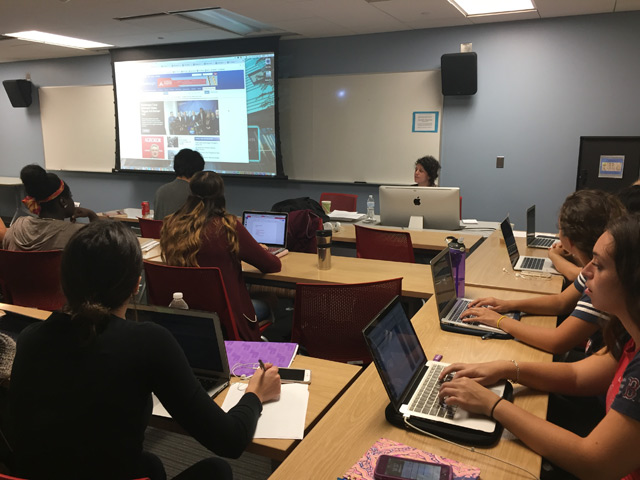
BIRN Programme Manager and investigative reporter Jelena Cosic gave a presentation to students at the American University in Washington DC on October 9 about BIRN’s work and achievements.

During her visit to Washington as part of the Digital Communication Network programme, Cosic was invited by renowned investigative reporter Chuck Lewis and the managing editor of the Investigative Reporting Workshop, Lynne Perri, to talk about BIRN’s investigative projects.

Cosic presented investigations from the Making a Killing series, and spoke about the importance of investigative reporting and BIRN’s work in general.

She held two sessions for students from two different classes, the history of investigative reporting led by Perri and international investigative reporting led by Lewis.

The Digital Communication Network exchange programme is sponsored by the US Department of State and coordinated by World Learning. Cosic is the Serbian representative among 16 media professionals from Eastern Europe and Central Asia.

Internews Kosova and BIRN Kosovo Target Youth with Lectures on Preventing Violent Extremism

On October 3 and 4, 2017, BIRN Kosovo and its partner Internews Kosova organized four lectures for high school students in Kosovo to discuss the ills that ideologies of violent extremism cause.

These lectures were part of a project titled “Expand Youth Participation to Counter Violent Extremism,” given in cooperation between ATRC (Advocacy Training and Research Center) and Internews Kosova.

The lectures tackled a general overview of the current situation and how ideologies of violent extremism have impacted Kosovo’s youth. Two of the lectures were held in Prishtina, while two others were held in Kaçanik and Mitrovica.

Kreshnik Gashi, managing editor of BIRN and Internews Kosova, moderated the discussions and also spoke about how we can prevent the manipulation of youth with violent extremism ideologies on social media networks. Gashi has produced two televised programmes for Justice in Kosovo about the failures of de-radicalization programs in Kosovo and has provided recommendations to relevant institutions on de-radicalization measures.

Along with Gashi, a representative from the Kosovo Police was present to offer his insights on preventing violent extremism. Florim Shatrolli, from the Anti-Corruption Unit, lectured on the role of the Kosovo Police in preventing violent extremism. He explained the need for rapid response and educating the public to report violent extremism cases.

These activities were held with the purpose of urging Kosovo’s youth to work towards their career goals, and not to become influenced by ideologies telling young people to join conflicts in the Middle East.

Preventing violent extremism has been an important topic in Kosovo over the past several years, and BIRN and Internews Kosova remain committed to mitigating the influence of extremism, and educating Kosovo’s youth about countering violent extremism.

Municipalities Uncovered: New BIRN Macedonia Database Published

Ahead of the October 15 local elections, BIRN Macedonia published ‘Municipalities Uncovered’, a database on the promises and accomplishments of mayors in the 80 Macedonian municipalities plus the capital, Skopje, during their current mandate.

The results show that mayors delivered less than half the capital projects they planned during their four years in office.

The BIRN database, published on September 20, gives Macedonians a more accurate understanding of what projects were promised and realised between the last local elections in 2013 and the upcoming vote on October 15.

Many of the current mayors are competing for a new term.

The database aims to remind the politicians about their past promises and help voters identify those that they did not deliver.

The database also analyses the municipal budgets for capital investments as well as their overall budgets from 2013 to 2016.

It shows that over the four-year period, the mayors pledged to spend a total of 762 million euros on such projects but actually invested less than half of that – 336 million euros. This was 46.7 per cent of the initially planned budget for capital investments.

The database presents data on how much the municipalities spent on capital investments per capita ranging from 1,170 euros per capita over this period in Novaci, 673.4 euros in Makedonska Kamenica, to the three rural, mainly ethnic Albanian municipalities, Aracinovo and Saraj, which spent the least money on infrastructure.

Aracinovo holds the worst record, having spent only 24.7 euros per capita.

The local election campaign in Macedonia started on September 25.

A tough political battle is expected, pitting the now governing Social Democrats, SDSM, against the right-wing VMRO DPMNE party, which held power nationally for 11 years and was ousted in May.

Local election debates: From ‘Life in Kosovo’ to ‘Life in Macedonia’

BIRN Kosovo’s team has been organizing election debates for almost a decade now, and this year, a new location will be tackled: BIRN Kosovo Director and debate moderator Jeta Xharra and her team are applying their format to municipal candidate debates in Albanian-majority municipalities in Macedonia.

BIRN is bringing the #DebatPernime (#RealDebate) format for mayoral candidates of seven municipalities in Macedonia—Cair, Saraj, Struga, Tetovo, Gostivar, Kercova, and Debar. By hosting these debates, BIRN Kosovo aims to inform voters about the candidates’ platforms during the days leading up to the municipal elections in Macedonia, set for October 15.

BIRN’s product KALLXO.com, which is a well-trusted online anti-corruption platform, will be used as a tool for citizens of these municipalities to send debate questions and address their concerns regarding the governance of the municipalities they live in. BIRN Kosovo, along with its partners BIRN Macedonia, Portalb, Vistinomer, and Art Channel, have undertaken this approach in order to offer a transparent and accountable governing system in Albanian-majority municipalities.

The #DebatPernime format has proved to be successful in Kosovo, considering the large percentage of politicians who participate in the debates. Through candidate debates, BIRN aims to promote transparency and accountability in municipal governments, and to support public discourse.

During the debates, mayoral candidates will be given the equal opportunity to share their political programmes. All political parties, except for the former ruling VMRO-DMPNE led by ex-prime minister Nikola Gruevski, will participate in BIRN’s electoral debates.

The debates will be held every evening, from October 1-7, in Albanian language, and will stream live on KALLXO.com’s Facebook page and YouTube channel, as well as on the Macedonian TV programme TV Art Channel, which is headquartered in Tetova.

The #DebatPernime format has shown to be successful in viewership and citizens’ trust, as it offers a straight-forward way for municipal candidates to reflect on their development strategies for the municipalities they hope to govern.

Citizens are encouraged to submit questions or concerns through BIRN Kosovo’s anti-corruption platform, on KALLXO.com or through KALLXO.com’s mobile application, and via its Facebook channel.

BIRN Albania Holds Roundtable on Political Party Finances

The Balkan Investigative Reporting Network in Albania held a roundtable discussion in Tirana on September 27 about the transparency of political party finances, with a focus on the campaign finances in the June parliamentary elections.

The roundtable was part of a project entitled ‘Strengthening the Media’s Role in Transparency of Political Party Financing’, supported by the National Democratic Institute, NDI, in Albania and the Rockefeller Brothers Fund.

About 25 journalists, experts, representatives of local NGOs and international organisations participated in the roundtable.

Representatives of local organisations that monitored the June 2017 parliamentary elections shared some of their findings with local journalists and discussed ways in which media could investigative the illicit flow of money to political parties.

The roundtable follows a two-day training session that BIRN Albania held at the end of April in the city of Durres. The training aimed to strengthen the skills of mid-career journalists to look closely at systemic issues of illicit financing of political parties and conflict of interest, with a special focus on the red flags raised by Central Election Commission reports.

After the training session, BIRN Albania opened a call for analytical stories on political party finances, and during the electoral campaign, published one investigation and four in-depth news analyses, strengthening public debate on the issue.

Following the roundtable, BIRN Albania will open a new call for analytical stories by local journalists on the topic of political party financing, looking back at the parliamentary election campaign and campaign finance reports.

Serbian Media Stage Blackout in Defence of Freedom

Around 150 Serbian media outlets and NGOs are temporarily blacking out their websites or going off air on Thursday, in protest against what they see as assaults on the media’s freedom.

About 150 Serbian websites and NGOs have agreed to join a “blackout” campaign on Thursday, called “Stop media darkness”, to protest over what they called the worsening situation of the free media in the country.

“We want to warn the public that freedom of media in our country is running out of breath, and we want to fight together to save it,” a joint press release of the participating organisations – which include BIRN – said.

Media outlets including Balkan Insight as well as NGOs are blacking out their websites for one hour on Thursday while carrying the simple message: “This is how it looks without a free media”. Supporting print media carry a black page.

Just a few major print media outlets joined the campaign, with none of those with state ownership participating.

The dailies Danas and Kurir and the weekly Vreme published messages in support of the campaign on their front pages, while in the daily Blic, owned by Germany’s Ringier Axel Springer, only the independent cartoonist blacked out his cartoon of the day.

Television and radio stations will be air jingles and videos with the campaign message during the day.

The protest follows a recent incident on September 18 when the Defence Minister Aleksandar Vulin’s political party called the editor of the Serbia’s Crime and Corruption Reporting Network, KRIK, Stevan Dojcinovic, a “drug addict” – in apparent retaliation for his published investigation into the minister’s real estate puchases.

Soon after, Vukasin Obradovic, the founder of Vranjske novine and former head of the Serbian journalists’ association, went on hunger strike in protest over his title’s closure and what he called the decline in media freedom in the country.

Media and NGOs say the campaign is designed to remind people that some free media still exist in Serbia. “From here we start,” the joint press release adds.

A progress report published by the European Commission in November 2016 noted that Serbia had made no progress, and had only carried out “some level of preparation”, in terms of supporting freedom of expression.

“The overall environment is not conducive to the full exercise of this right [to media freedom],” the report stated, adding that threats, violence and intimidation against journalists were issues of concern.

The watchdog organisation Freedom House in its latest report said that Prime Minister Aleksandar Vucic and media outlets aligned with him had escalated a drive to portray all investigative and critical media organizations as foreign-backed propagandists seeking to damage the government and destabilize the country.

“Self-censorship was a worsening phenomenon that journalists attributed to concerns about both harassment and economic pressure,” the 2015 report, published last year, said.

It said journalists in Serbia continued to face threats and physical attacks. “Some of the most visible pressure on the media came from Prime Minister Vucic and his allies, who continued to verbally harass critical journalists and outlets”, it said.

The UN Human Rights Committee has also expressed concern about Serbian officials publicly vilifying and intimidating media workers and about the prosecution of journalists and civil society actors for expressing their opinions.

The Serbian state should refrain from prosecuting journalists and human rights activists, should take steps to protect media workers from intimidation and sanction the perpetrators of such offences, the report, published in March, said.
BIRN Kosovo Co-partners with USAID’s New Initiative to Promote Judicial Transparency

On September 28, a new project aiming to promote transparency in Kosovo’s judicial sector was launched.

The project, a partnership between USAID’s Justice System Strengthening Program (JSSP), the Kosovo Judicial Council (KJC), and civil society organizations, such as BIRN Kosovo, Advocacy Center for Democratic Culture (ACDC) and Democracy Plus, aims improve public outreach and communication between the judiciary and the public.

Mark Isom, acting Deputy Mission Director, and Nehat Idrizi, Chair of the KJC, gave introductory remarks at the project’s launch, emphasizing the significance of transparency in fostering accountability in the judicial sector.

Throughout the project’s timeline, partners, including BIRN Kosovo, will closely collaborate with specific courts to inform the wider public on the courts’ activities, and will utilize social media to increase public outreach.

The launching event hosted various civil society organizations, relevant public officials, and media groups who have an interest and stake in contributing to increased transparency and accountability in Kosovo’s justice system.

Kreshnik Gashi from BIRN Kosovo presented BIRN’s role and activities within this initiative.  The new initiative will greatly benefit from BIRN Kosovo’s support, which, as an independent and non-governmental organization, acts as a watchdog in the implementation of the democratic transition processes, including for judicial sector reforms. As an organization that contributes to enhancing the accountability and professionalism of Kosovo’s justice institutions, BIRN will help the JSSP’s team to increase judicial transparency, accountability, and effectiveness, and to widen the public’s understanding of Kosovo’s court system.

BIRN Reporters Trained in Mobile Video Journalism

BIRN Bosnia and Herzegovina and BIRN Serbia journalists, along with colleagues from seven Bosnian newsrooms and students of journalism, attended a training course in mobile video production from September 22 to 24 in Sarajevo.

The training was done by Voice of America (VOA) Broadcasting Board of Governors trainers, organised by BIRN BiH and supported by the US embassy in Sarajevo.

Thirty journalists and students from Bosnia and Herzegovina and Serbia learnt new approaches and developed their skills in video reporting using new technologies that will be in usage in everyday reporting.

The training was intended to improve the quality and quantity of reporting relevant to web and social media audiences and enhance journalists’ ability to tell stories that engage users through text, pictures, videos and livestreaming.

The training continued the cooperation between BIRN BiH and VOA, which started at the begining of 2017.

BIRN BiH will continue to produce short video stories for VOA , and additional training sessions are being planned for the next year.

BIRN Albania Calls for Investigative Reports on Consumer Protection

Following a roundtable discussion between civil society organisations about consumer protection, the Balkan Investigative Reporting Network in Albania (BIRN Albania) is opening a call for investigative stories.

The call is part of the project ‘Exposing Corruption in Albania’, supported by the Open Society Foundation in Albania, OSFA.

Three journalists will be awarded grants to cover their expenses while doing investigations and writing stories on a wide range of consumer protection topics which emerged from a roundtable discussion between journalists and civil society on September 20, 2017 in Tirana.

The journalists will have about three months to dig deeper and research their ideas, and will also have the opportunity to work with experienced editors as mentors to guide them through the process of writing to BIRN’s standards.

The call only applies to journalists from Albania and closed on October 15, 2017.

Click for more information (in Albanian) about the application procedure.

Click here (in Albanian) to download application.

BIRN Cited in Balkan Media Freedom Reports

BIRN is mentioned in two new international reports on media freedom and the difficulties and dangers that journalists in the Balkans are facing in their work.

BIRN Cited in Balkan Media Freedom Reports

BIRN is mentioned in two new international reports on media freedom and the difficulties and dangers that journalists in the Balkans are facing in their work.

Violence against journalists in the Balkans is widespread, with 15 assaults in the first half of 2017, says a new report by Mapping Media Freedom, a project run by Index on Censorship in partnership with the European Federation of Journalists and Reporters Without Borders.

It also mentions BIRN and the lawsuits issued against it for reporting on criminal investigations into the family assets of an Albanian judge.

“During the first quarter of 2017, the MMF database registered several trends that we find to be acute challenges to media freedom,” said Hannah Machlin, project manager at Mapping Media Freedom.

“Some European governments have clearly interfered with media pluralism. Others have harassed, detained and intimidated journalists. All of these actions debase and devalue the work of the press and undermine a basic foundation of democracy,” Machlin added.

In an article entitled Serbia and the EU: Stability over Democracy, published in EU Observer, Steve Crawshaw, senior advocacy adviser at Amnesty International and a board member of BIRN, describes the Serbian mainstream media context as dominated by pro-government voices.

“The state television news and the majority of privately owned channels provide a steady drumbeat of unquestioning support, where little to no criticism of government policies can be heard. Media ownership is often opaque, and demonising alternative voices is routine,” Crawshaw wrote.

“Pro-government headlines accused the Balkan Investigative Reporting Network (BIRN) and KRIK, the Crime and Corruption Reporting Network, of being ‘liars’ and ‘mercenaries’,” he added.

Suggesting that the EU is prioritising stability over democracy or human rights, the article quotes Dragana Zarkovic-Obradovic, the director of BIRN Serbia, who said: “They are allowing [President Aleksandar Vucic] to poison the public – and that will backfire. He is feeding [them] all the worst things, and destabilising the country.”

Crawshaw concludes that “the bottom line remains: human rights and stability are not alternatives but two sides of the same coin – and the rule of law is essential for both. We cannot afford to ignore that simple truth.”