Digital Media Action

BIRN Serbia

The overall objective is to reinforce the role of media in democratic processes in Serbia by enhancing the reach and impact of quality, public-interest oriented journalism that strives to make government more accountable to citizens

Summary

The Digital Media Action project involves independent media through a small grants scheme and innovative training approaches, responding to their needs and motivations, giving them expertise, tools and resources, including the opportunity to publish and efficiently promote and start monetizing their work.

The project will demonstrate the power of quality media and journalism to bring to the public eye sensitive and underreported issues and steer debate about them.

This will have a positive impact on the Serbian public, who will be better informed and thus able to hold authorities accountable, and also on the participating media, as their profile and influence will be strengthened, creating the basis for their future sustainability.

Information Sheet

Main Objective:
The overall objective is to reinforce the role of media in democratic processes in Serbia by enhancing the reach and impact of quality, public-interest oriented journalism that strives to make government more accountable to citizens.

Specific Objectives:

  • Make independent media more financially stable, producing regular, high quality and professional content that meets citizens’ demands
    There is a considerable need and space for improvement in journalistic, technical and managerial terms in order to expand their influence and create the basis for sustainability in a fast-developing digital arena, currently dominated by questionable and highly politicized, externally influenced journalistic standards and practices.
  • Enable citizens to increasingly understand and debate the performance of public institutions, contributing to raising public accountably
    Citizens’ informed decision-making is significantly reduced by the lack of relevant and unbiased information and debate, especially on potentially controversial issues such as the rule of law. This is exacerbated by the political capture of the mainstream media environment, which leaves large parts of the population deprived of reliable information.

Main Activities:

    • Organise and carry out cutting-edge training, online mentorship, provide expert know-how and technical support to selected independent media;
    • Create a basis for sustainable business model development by providing technical solutions and digital services;
    • Strengthen capacities in development of revenue streams;
    • Provide grants for quality journalistic and multimedia production on issues of public concern that would otherwise remain unreported;
    • Provide editorial mentorship to media awarded with small grants;
    • Coordinate content syndication, exchange and promotion for all participating media;
    • Foster public debate and stakeholders’ involvement over the reported issues through debates, conferences, consultations and online campaigns.

    Target Groups:

  • Local media, independent institutions, experts, communities, authorities, general public

Highlights: 

  • News, analysis, investigations
Partners:
Juzne Vesti

BIRN Summer School Puts Focus on ‘Art of Interviews’

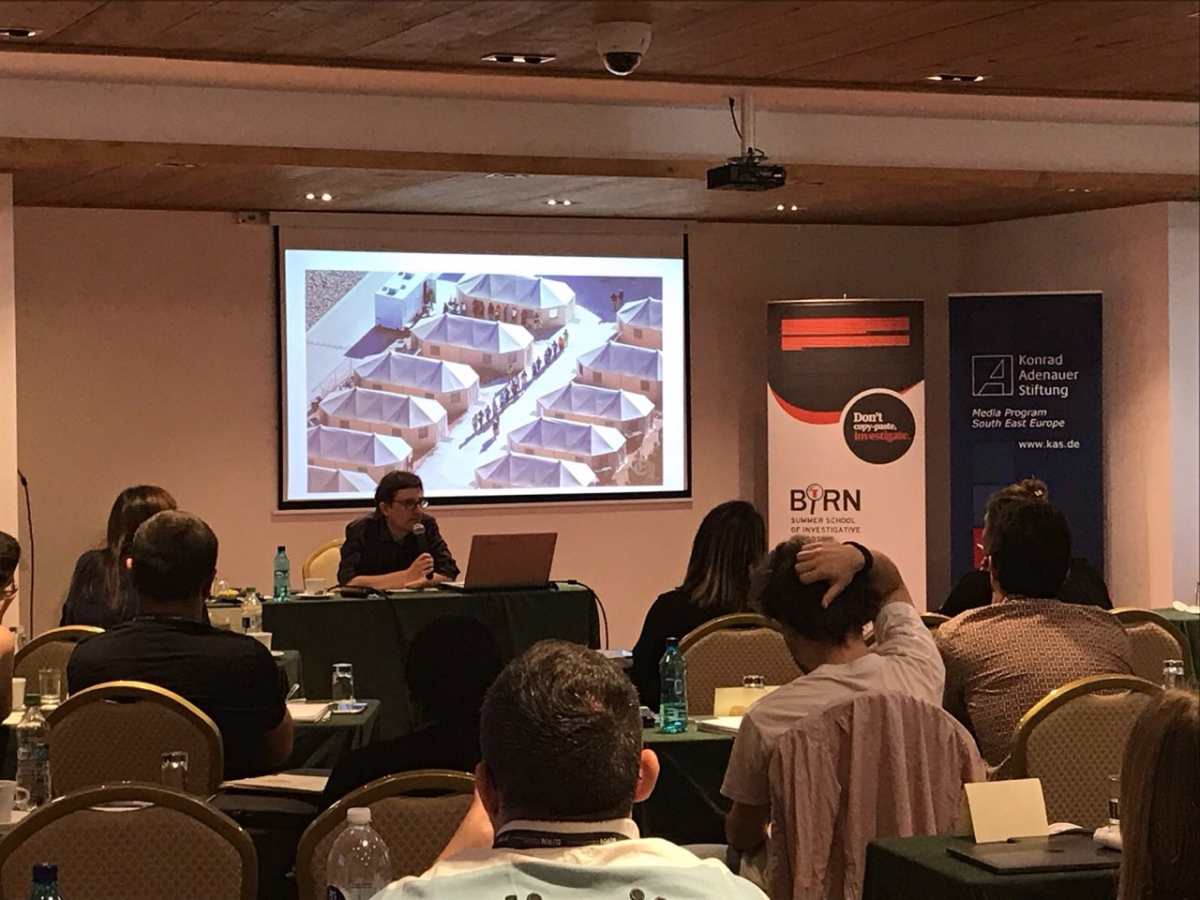
On the third day of the BIRN Summer School in Romania, journalists learned about interviewing techniques, how to use the Paradise Papers in investigations, verifying videos and uses of podcasts.

As BIRN’s summer school continued on Wednesday, lead trainer and Reuters investigative projects editor Blake Morrison held a session on the “art of interviewing” and on how to convince difficult sources to talk, describing interviews as a crucial component of the journalistic job.

“Think of any story as a blind date,” he told participants.

Morrison stressed the need for preparation and gave insight into why some people agree to give an interview – vanity, the need to be understood, self-interest, desperation, guilt and curiosity.

Susanne Reber, co-founder of Reveal podcast and Podcasting Executive Producer for E.W. Scripps National, introduced participants to the art of podcasting and of making stories heard.

BIRN investigations editor Lawrence Marzouk spoke of how to research the arms trade, using open source data.

The financial investigations workshop continued with OCCRP’s Miranda Patrucic explaining the Paradise Papers and how investigative journalists can find leads and data in the leaks.

The geolocation and digital investigations workshop also continued on Wednesday, with Bellingcat’s Christiaan Triebert’s lecturing on how to verify if a photo or a video was taken in a certain location at a given time.

Lead trainer Morrison held a second practical individual session with journalists.

The ninth BIRN Summer School has brought together young journalists from Albania, Bosnia and Herzegovina, Bulgaria, Croatia, Greece, Kosovo, Macedonia, Moldova, Romania, Serbia, Ukraine, the UK, and the United States. For the first time, the Summer School has welcomed journalists from Moldova and Ukraine.

The Summer School is organised in cooperation with the Media Program South East Europe of the Konrad Adenauer- Stiftung, Open Society Foundations, the Austrian Development Agency (ADA), the operational unit of Austrian Development Cooperation, with support from the European Union.

BIRN Summer School Day 2: Fact-Checking, Financial Reports and Metadata analysis

BIRN’s Summer School continued on Tuesday in Poiana Brasov, Romania, with sessions exploring fact-checking strategies, how to mine financial reports and using metadata for investigative stories.

Blake Morrison, investigative projects editor at Reuters, introduced participants at the BIRN Summer School of Investigative Reporting to fact-checking strategies and conducted a hands-on exercise exploring the differences between supposition and proof.

Miranda Patrucic, editor with the Organized Crime and Corruption Reporting Project, explained how to interpret and get the most from financial reports and documents.

In the afternoon, New York Times senior video editor Christoph Koettl looked at how to analyse content and metadata in photos and videos.

Bellingcat’s Christiaan Triebert introduced participants to open-source investigation and verification looking at how the organisation investigated the downing of the passenger plane MH17 over Ukraine and the 2016 failed coup in Turkey.

The ninth BIRN Summer School has brought together young journalists from Albania, Bosnia and Herzegovina, Bulgaria, Croatia, Greece, Kosovo, Macedonia, Moldova, Romania, Serbia, Ukraine, the UK, and the United States.

For the first time, the Summer School has welcomed journalists from Moldova and Ukraine.

The Summer School is organised in cooperation with the Media Program South East Europe of the Konrad Adenauer- Stiftung, Open Society Foundations, the Austrian Development Agency (ADA), the operational unit of Austrian Development Cooperation, with support from the European Union.

Ninth BIRN Summer School Begins in Romania

This year’s Summer School started on Monday in Poiana Brasov, Romania, with lectures and interactive sessions on using satellite imagery and digital research in investigative reporting and on how to push for accountability.

Reporters from the Balkan region and across the world gathered on Monday in the mountain resort of Poiana Brasov, Romania, for the ninth BIRN Summer School of Investigative Reporting.

After greeting participants, Blake Morrison, the school’s lead trainer and investigative projects editor at Reuters, held a lecture and discussion about how to imagine a complex investigative story, as well as how to push for accountability.

Christoph Koettl, senior video journalist at The New York Times, specializing in geospatial and open-source research, also held an introductory session on using digital research and verification in investigative research.

He continued with a lecture on geospatial and satellite imagery used in investigative journalism, followed by an interactive exercise.

In the afternoon, the participants discussed story ideas and were divided up into smaller groups for in-depth sessions with Reuters’ editor Morrison.

The ninth BIRN Summer School has brought together young journalists from Albania, Bosnia and Herzegovina, Bulgaria, Croatia, Greece, Kosovo, Macedonia, Moldova, Romania, Serbia, Ukraine, the UK, and the United States.

For the first time, the Summer School welcomed journalists from Moldova and Ukraine.

The Summer School is organized in cooperation with the Media Program South East Europe of the Konrad Adenauer- Stiftung, Open Society Foundations, the Austrian Development Agency (ADA), the operational unit of Austrian Development Cooperation, with support from the European Union.

BIRN Bosnia Story Presented at Sarajevo Film Festival

BIRN Bosnia and Herzegovina on Monday presented a story to film directors and producers about a boy who was abandoned after his mother survived the Srebrenica genocide as part of the Dealing with the Past programme at the 24th Sarajevo Film Festival.

BIRN Bosnia and Herzegovina’s director Mirna Buljugic briefed the directors and producers on the story about the boy, Amir Secic, whose mother abandoned him four months after the Srebrenica genocide in July 1995.

“His mother was five months pregnant and his father was killed. He was born in November and his mother left him three days later. He stayed at the Home for Children without Parental Care. He was three years old when he saw his mother for the first time,” Buljugic said.

When he was 23, Secic wrote a book called ‘I Was Hardly a Child’ in which he described his life. He dedicated the book to his father Ibrahim Secic, one of more than 7,000 people from Srebrenica who were killed.

Buljugic reflected on some parts of the book in which Secic spoke about how he was given a red bag at the children’s home, which he used to carry with him all the time.

In his book, Secic described the red colour of his bag as “the colour of love, as well as blood, loss and genocide”.

A short video about Secic, who was also present at the event and greeted the participants, was presented to the directors and producers who attended.

The BIRN story is one of the five selected for presentation at this year’s Dealing with the Past programme at the Sarajevo Film Festival, which is supported by the Robert Bosch Stiftung. The five stories are reviewed by interested directors, who then decide which one will be picked up for development as a documentary.

The programme is aimed at connecting filmmakers with organisations dealing with events that happened in the former Yugoslavia.

BIRN Bosnia and Herzegovina has been the festival’s partner in the Dealing with the Past programme since it began.

This year’s festival is taking place from August 10 to 17.

BIRN Albania Documentary Screened in Sarajevo

BIRN Albania’s documentary ‘Free Flow’, which follows the resistance of villagers, activists and civil society to the construction of hydropower plants in Albania, was screened on August 12 in Sarajevo.

The screening, which was hosted by Civil Rights Defenders, aimed to highlight the decade-long struggle of local activists for water, property and environmental rights which were being threatened by energy companies and politicians.

Directed by film-maker Elton Baxhaku, the documentary follows villagers, activists, scientists and artists as they try to draw attention – in court and on the streets – to the threat posed to the environment and the local eco-tourism industry.

After its premiere in Tirana on June 11, BIRN Albania has held several screenings of the documentary in affected areas like the villages of Polis and Valbona, and for a more diverse audience at Dokufest, the international short film and documentary festival in Prizren, Kosovo.

Sunday’s screening in Sarajevo was the sixth screening of the documentary held by BIRN Albania and partners. It was followed by a panel discussion moderated by Ena Bavcic and Vasilika Laci, programme officers of Civil Rights Defenders in Bosnia and Herzegovina and Albania, with the participation of film-maker Elton Baxhaku.

Further screenings will follow in Albania in the autumn.

BIRN Participates in Sarajevo Film Festival Programme

A report by the Balkan Investigative Reporting Network in Bosnia and Herzegovina about a boy who was abandoned after his pregnant mother survived the Srebrenica genocide is one of the five stories being presented at this month’s Dealing with the Past Programme at the 2018 Sarajevo Film Festival.

The five stories are reviewed by interested directors, who then decide which one will be picked up for development as a documentary.

“After the directors watch all five stories on Monday, we will see whose story passes the selection process and becomes material for the making of a serious international documentary,” said BIRN Bosnia and Herzegovina’s director Mirna Buljigic.

BIRN Bosnia and Herzegovina has been a partner in the Sarajevo Film Festival’s Dealing with the Past programme since its inception.

BIRN Albania Publishes Data Journalism Manual

‘Getting Started in Data Journalism’ is a manual published by the Balkan Investigative Reporting Network in Albania which aims to introduce journalists to data-driven reporting techniques that are essential to contemporary investigative journalism.

The manual was authored by BIRN editor Lawrence Marzouk and the investigative journalist Crina Boros.

More information available here.

The whole manual is available here.

BIRN Albania Publishes Data Journalism Manual

‘Getting Started in Data Journalism’ is a manual published by the Balkan Investigative Reporting Network in Albania which aims to introduce journalists to data-driven reporting techniques that are essential to contemporary investigative journalism.

The manual was authored by BIRN editor Lawrence Marzouk and the investigative journalist Crina Boros.

As an editor for BIRN, Marzouk leads a cross-border team of journalists, sending huge volumes of freedom of information requests, scraping data and using traditional reporting methods to delve into high-level corruption in the Balkans and beyond.

Boros is an intrepid investigative journalist who reports on conflicts of interest, vulnerable groups, problematic policies and the use of public funds.

Over the past decade, data journalism has become a buzzword in media circles, grabbing the attention of traditional reporters and appearing on university syllabuses across the world.

Although universally accessible, ‘Getting Started in Data Journalism’ was written with Albanian journalists in mind. Its aim is to help reporters understand the power of harnessing data to deliver impactful story ideas which can hold power to account, expose corruption and highlight wrongdoing.

The manual aims to set reporters on the path of data journalism, but also be useful for the everyday work of journalists in general.

The whole manual is available here.