UN Urged to Probe Hague Tribunal Controversy

Balkan rights activists have asked the UN to investigate alleged political influences on recent Hague Tribunal acquittals after controversial allegations by one of the court’s judges.

Scores of human rights organisations, journalists and legal experts wrote to the United Nations secretary-general Ban Ki-moon on Tuesday calling for a probe into allegations made by a Hague judge in a leaked letter in which he criticised the work of the International Criminal Tribunal for the Former Yugoslavia, ICTY.

“We ask you, due to the absence of [relevant] procedures in the ICTY’s statute, to use your authority and order an immediate and thorough investigation which will determine whether there has been a violation of articles 12 and 13 of the ICTY statute which guarantee the independence of the judges, their impartiality, integrity and high moral virtues,” said the appeal to the UN.

“Without this investigation and the public presentation of the results, suspicion about fairness of the verdicts of the ICTY will permanently mark the work of this important institution of international law,” it continued.

The letter to the UN secretary-general was supported by over 100 non-governmental organisations and individuals in the region including BIRN.

Frederik Harhoff, a Danish judge at the ICTY, a court set up by the UN, became the centre of controversy after his private letter criticising the recent acquittals of Serbian and Croatian wartime commanders was leaked and published by international media earlier this month.

Harhoff wrote that he had heard that the Tribunal’s president Theodor Meron allegedly put pressure on other judges to approve the acquittals in recent months of Croatian generals Ante Gotovina and Mladen Markac, Yugoslav general Momcilo Perisic and Serbian security officials Jovica Stanisic and Franko Simatovic.

The Tribunal’s chief prosecutor, Serge Brammertz said on Monday that his office would not be commenting on the email, but added he was “concerned about destructive elements in the debate that has followed the letter’s publication”.

He added that the Hague court must “make allowance for valid criticism” and use the constructive aspects of the debate generated by the letter as a springboard for strengthening its processes.

“Our key objective is to see the ICTY, through its remaining work, convincingly demonstrate the legitimacy of its processes, the high quality of its verdicts and its capacity to secure justice for victims of the conflicts in the former Yugoslavia,” said the chief prosecutor.

However one lawyer for a Bosniak war crimes convict has already asked for his sentence to be quashed because of the “bias” revealed by Harhoff’s letter.

The lawyer for former Bosnian Army commander Rasim Delic, who was jailed by the Tribunal but died before the end of his sentence, has filed a motion for the verdict to be overturned.

“Judge Harhoff reveals an unacceptable bias towards the conviction of accused people before the ICTY, a bias which could have been a decisive factor in reaching the final decision to convict Rasim Delic,” lawyer Vasvija Vidovic said in the motion.

BIRN launches special focus page on memorialisation

The ‘Conflicting Memories’ focus page presents the results of an investigation into the post-war Balkan monument-building boom, put together by BIRN’s Balkan Transitional Justice team of journalists from seven countries across the region.

The investigation examines how different states and ethnic groups use monuments to promote their own versions of past events, how governments use them to manipulate history for political advantage, and how they are used as a tool for nation-building in the region.

The focus page includes six features and an interactive map – a guide to the number of memorials built across the Balkans, their cost, and which of them have proved the most controversial and unusual – as well as a photo gallery.

All content is presented in Macedonian, Albanian and Bosnian/Croatian/Montenegrin/Serbian as well as in English. 

The focus page was launched ahead of a BIRN debate in Sarajevo which will bring together a panel of experts to discuss memorialisation issues in depth. The event will take place on June 27 at the Historical Museum of Bosnia and Herzegovina.

To find out more: www.balkaninsight.com/en/page/balkan-transitional-justice-memorialisation-conflicting-memories.

BIRN Bosnia Editor Gives Lecture to US Students

BIRN Justice Report’s deputy editor Denis Dzidic gave a lecture on June 21 in Sarajevo about transitional justice in Bosnia and Herzegovina, organised by the European Union Centre Institute for the International Education of Students Abroad.

The lecture was attended by 24 students from the United States who were taking part in the German European Union Centre of IES Abroad summer programme on Bosnia and Turkey.

The students were in Sarajevo from June 15 to 22, where they met with NGO representatives, government officials and international experts to learn about the challenges the country is facing.

In the first session, Dzidic spoke about war crimes trials and reconciliation processes in Bosnia and Herzegovina, and especially the role of media in these processes.

He highlighted the problems with establishing the rule of law in post-conflict Bosnia and Herzegovina and spoke about the changes seen after the departure of the international judges at the Bosnian State Court.

In the second session, Dzidic spoke with a representative of the Ministry for Civil Affairs of Bosnia and Herzegovina about the political, economic and social fabric of the country today.

Five Journalists Selected in Macedonia

A jury has selected five journalists to support writing investigative stories in collaboration with BIRN Macedonia, SCOOP Macedonia and the Center for Civil Communications.  

The Project for investigative journalism and cooperation between media and civil society is part of the USAID Programme for strengthening the independent media in Macedonia.

After receiving about 50 applications, the jury comprising experienced journalists and editors evaluated the applications.

A short list of ten was drawn up before the jury evaluated and chose the top five.

The competition was close and BIRN Macedonia, SCOOP Macedonia and the Center for Civil Communications said they wished to congratulate the winners and thank to all the journalists who applied.

BIRN Macedonia, SCOOP Macedonia and the Center for Civil Communications also reminded all journalists that another call for applications will be opened in September, and encouraged them to apply.

Applications were evaluated on the basis of several criteria, such as relevance, feasibility, originality as well as the experience of the journalist.

Apart from obtaining financial support to research their ideas and cover their expenses, the winners will receive professional support while conducting their investigations.

The winning journalists are as follows: Aleksandar Pisarev, Ubavka Janevska, Miroslava Simonovska, Vlado Apostolov, Mence Atanasova Toci.

Aleksandar Pisarev is an investigative journalist at the Forum Center for Strategic Research and Documentation. Previously he worked for Forum magazine, Kapital magazine and the newspaper Dnevnik

Ubavka Janevska is journalist with more than 20 years experience. Based in Veles she works as a correspondent for the national TV station Channel 5. 

Miroslava Simonovska is a young journalist currently working for the Internet news portal, Plusinfo. She has several years’ experience in the print media and specifies in covering education issues.

Vlado Apostolov is an investigative journalist working for Fokus newspaper with more than 10 years’ experience of the media.

Mence Atanasova-Toci is currently working for the Nova web TV. She has been covering health issues for more than 15 years.

University of Pristina honours US and EU envoys

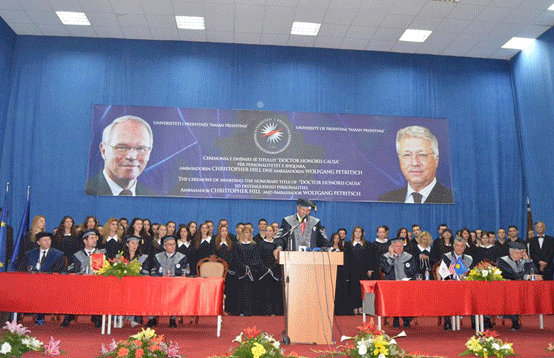
Hasan Pristina University honoured former special envoys Christopher Hill and Wolfgang Petritsch on Wednesday with the title of Doctor Honoris Causa in a ceremony held at the faculty of philology. They were awarded the title for their contribution to the resolution of the Kosovo conflict.

Hill and Petritsch, who worked as the special envoys of the United States and the European Union respectively during attempts to stop the Kosovo conflict in the late 1990s, were honoured for their outstanding contributions to creating conditions for peace, justice, freedom and democracy and increasing opportunities for the development of education, science and academic freedoms in Kosovo.

The rector of Hasan Pristina University, Ibrahim Gashi, opened the ceremony.

“We were lucky to have you and your peoples as our friends during our worst, hardest time,” said Gashi.

Prime Minister Hashim Thaci praised the two former envoys for bringing together the Albanian political spectrum.

“Mr. Hill and Mr. Petritsch stood by Kosovo when Kosovo needed friends the most,” said Thaçi.

The two former envoys also addressed the gathering.

“Kosovo has changed a lot since the time when I was here. You cannot choose your neighbours, but you can live in peace with them,” said Hill.

“The European Union is facing many problems, but Kosovo is moving towards the EU,” said Petritsch.

Petritsch and Hill acted as mediators during the talks between Kosovo Albanians and the Yugoslav authorities at the Rambouillet Conference in 1999 before the NATO bombing campaign ended the conflict.

Petritsch, from Austria, is also a member of BIRN’s Regional Board.

Macedonian Media and NGOs Deem Communication Crucial

Macedonia’s EU integration was subject of a fruitful discussion in which about 20 journalists and NGO representatives participated on June 20 in Skopje.

Several different topics were discussed by the participants who agreed on many matters – but also disagreed on the subject of communication between journalists and civil society organizations.

It was agreed that this communication needed to be a two-way street and that both sides should counsel each other on how to improve their cooperation.

NGOs said that some of the media seemed uninterested in topics they consider important for society and that their research was often not treated and published appropriately.

The journalists for their part told the NGO representatives that they needed quicker reactions from them as topics emerged and a more direct approach to journalists as well as other alternative methods of contact.

The debate was organized as part of the “Project for Investigative Journalism and Cooperation between Media and Civil Society.”

It was the tenth and last of a series of debates organized as part of the project, which is funded by the USAID programme for strengthening the independent media in Macedonia.

The subjects were selected at a meeting between journalists and NGOs in mid-April.

Other topics include ethnic relations, education and youth, human rights, health and rights of patients, cultural policy, environmental issues, good governance, quality of life and marginalized groups.

BIRN holds debate on post-war memorialization

BIRN’s Balkan Transitional Justice team will hold a debate on memorialisation and the findings of a wide-ranging investigation into the post-war Balkan monument-building boom put together by its journalists from seven countries across the region.

Hundreds of monuments and statues have been built since the conflicts in the former Yugoslavia amid a largely unregulated memorialisation spree that has sometimes exacerbated the divisions that led to war in the first place, rather than promoting reconciliation.

The investigation examines how different states and ethnic groups use monuments to promote their own versions of past events, how governments use them to manipulate history for political advantage, and how they are used as a tool for nation-building in the region.

As part of BIRN’s Balkan Transitional Justice project, the BIRN investigation also examines the question of what kind of monuments should be built to promote peace rather than reviving past disputes.

The debate will be held on June 27, 2013, at Historical Museum of Bosnia and Herzegovina in Sarajevo.

Debate will bring together a panel of experts to discuss these issues in depth, such as Ljubinka Petrovic – Ziemer, Programme Manager at forum ZFD, expert group on Bosnia’s Transitional Justice Strategy, historians and NGO representatives.

Dowload full Agenda.

Balkan Insight Media Watch Page Launched

BIRN has launched a special focus page on media in the Balkans – the first of its kind in the region.

All media-related news and analysis from the Balkans are now available on Balkan Insight’s Media Watch Page.

It features a brand-new analysis package on the media situation in Albania, Bosnia and Herzegovina, Macedonia, Kosovo, and Serbia.

It also features a regional analysis on the role of the EU. Some praise the EU for pushing for the adoption of media legislation that meets European standards. But others are more critical, saying that the EU should have been much more proactive in combating growing political pressures on independent media.

The launch comes ahead of the second ‘Speak Up!’ conference on June 20, at which the European Commission will gather hundreds of media experts from all over Europe to discuss media freedom in the Western Balkans and Turkey. 

In its progress reports, the European Commission has repeatedly set out its concerns about restrictions on freedom of expression and the media in the Western Balkans and Turkey, noting that threats to freedom of expression also threaten the foundations on which the “union of values” is built.

In an effort to identify solutions, the European Commission’s ‘Speak Up’ conference is bringing together participants from international, regional and national media organisations, civil society, academia and national administrations.

Public Interest Overcomes Private Interests

The application of the existing Law on Free Access to Information of Bosnia and Herzegovina vary from one institution to another. One third of institutions respond to requests for access to information in accordance with the Law, while some do not respond at all.

When journalists request information, PR officers often ask them: “Why do you need it?; I do not understand what you want to receive from us; We have not received your request; I must ask my boss if I can give you an answer”.

After insisting on getting the information, which lasts for months in some cases, journalists manage to obtain the requested information from institutions, but it does not happen within the legally set deadline of 15 days.

These are some of the results of the application of the Law on Free Access to Information, which were presented at a conference organised by the Ombudsman of Bosnia and Herzegovina with support from the OSCE Mission in BiH.

Although their opinions are not harmonised, the Ombudsman noticed that the right to free access information was violated by the anonymisation of court decisions by the Court of Bosnia and Herzegovina.

As said by judge Hilmo Vucinic, the Court of Bosnia and Herzegovina is exposed to criticism by the media, as well as experts and international officials, for implementing the anonymisation decision, which includes using initials instead of first and last names of indictees.  

Vucinic said that, for this reason the Court embarked on introducing revisions and amendments to its Rulebook on co-operation with the community.

“When the institution estimates that a court decision is of general interest for the public, it will allow its publishing. This means that verdicts of interest for the public and legal practice will be published. This certainly includes war crimes, organised crime, terrorism etc.,” judge Vucinic said.

Personal identification numbers, ID card numbers, drivers’ licence numbers and other documents’ numbers, as well as racial origin, political opinion, membership in a political party, sexual affiliation etc., contained in those verdicts, will not be published.

Vucinic said that the revisions to the Rulebook had still not been adopted, but the Court of Bosnia and Herzegovina would do it in the upcoming period, because it had concluded that “public interest should overcome private interests”.

Anisa Suceska-Vekic, Director of BIRN in Bosnia and Herzegovina, said that verdicts had been anonymised for more than a year and that this had already had a harmful effect when it came to war crimes trials.

A provision, saying that court decisions in cases of general public interest, such as war crimes cases, organiaed crime cases and so on, which, according to an assessment by the relevant public body, were of general public interest, has become an integral part of the proposed revisions and amendments to the Law on Free Access to Information in Bosnia and Herzegovina.

In terms of the proposed changes, a question arose as to whether the public bodies would be able to realistically assess what was of public interest and what was not.

Following a detailed discussion at the conference, it was concluded that it was necessary to strike a balance between the protection of privacy and public interests and the conduct training of information officers.  

“Nobody is against the improvement of the Law on Free Access to Information, if such a need exists. However, we call on the authorities to respect the international standards,” said Jasminka Dzumhur, Ombudsman in Bosnia and Herzegovina.

The conference participants raised a question on publicity of trials for the media. According to the Criminal Code, all trials are public unless a decision is rendered to exclude the public due to protection of witnesses or similar measures.

Representatives of the Court of Bosnia and Herzegovina say that they issue ten-minute audio or video recordings to public in order to prevent witnesses from using statements contained in those recordings to prepare for their own testimonies.

Dzumhur pointed out that trials were public and that, in addition to testifying at trials, witnesses also gave statements during investigations. She said that trial chambers should determine whether a witness had changed his/her statement or not. 

The entire show is available to watch here: http://www.federalna.ba/bhs/vijest/66205/dnevnik-2-13062013

The entire show is available to watch here:

Court Acquits Defendants in BIRN Kosovo Case

A court has acquitted five defendants accused of staging a hate campaign in the media against BIRN director Jeta Xharra.

A mixed panel of Kosovo and EULEX judges found five defendants not guilty of threatening Xharra and violating her rights in May and June 2009.

They were the former mayor of Skenderaj, Sami Lushtaku, the former owner of Infopress, Rexhep Hoti, the former editor-in-chief, Avni Azemi, and two former journalists, Rizah Hajdari and Qani Mehmeti.

In 12 articles published by Infopress, Xharra was called a “Serbian spy”, a “professional bomb”, an “embassy slut” and subjected to other insults, the indictment said.

It said a campaign against Xharra was launched after Radio Television Kosovo, RTK, aired an edition of BIRN’s TV programme, “Jeta ne Kosove” (“Life in Kosovo”,) dealing with alleged mismanagement in Skenderaj/Srbica where Lushtaku was mayor at the time.

The court on Wednesday ruled the articles did not pose a threat to Xharra even if they damaged “her honour and reputation”.

“We did not find that the content of the articles were a coded threat,” Judge Vladimir Micula said.

Referring to threatening emails that Xharra and the BIRN office in Pristina received after the programme was aired, the EULEX judge said that “no link was found between the articles and those acts”.

The prosecution said it was unhappy with the verdict and would appeal. “It is necessary for a democratic society like Kosovo to do everything it can to protect the precious right of freedom of the press and punish those who undermine it,” EULEX prosecutor Maria Bamieh said.

“The threats and the defamation made against her had a clear goal. The accused wanted to scare Jeta Xharra and her team,” she added.

“They wanted to humiliate her and… get a critical and credible journalist off the table who had dared to criticize the political achievements of Mr Lushtaku, a very powerful politician and social figure indeed in Kosovo,” she continued

Xharra said of the verdict that she “never thought it would be easy but we won’t give up”, adding: “I encourage you [in the media] not to give in, to have a better media environment compared to what there is now.”

Xharra has already filed a libel case, seeking compensation from the former defendants.

Arianit Koci, lawyer for Lushtaku, described the verdict as “just and legal”.
“It was a legal and professional battle,” he said. “Our arguments were stronger and it was proven that Sami Lushtaku did not threaten Jeta Xharra.”

The trial started in March.