BIRN Serbia Debates Project Financing

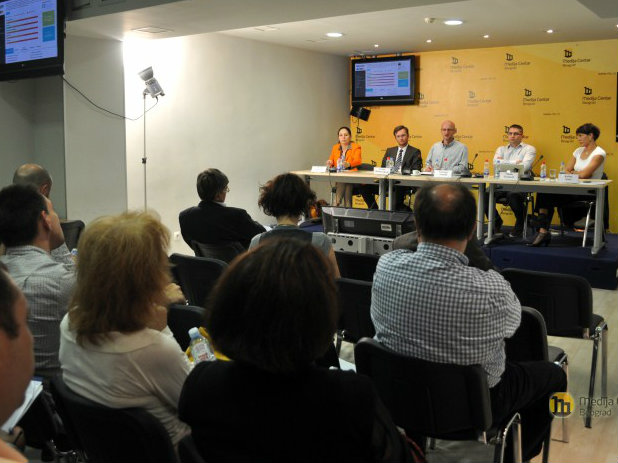
BIRN Serbia held a public debate on the prospects of new models of budgetary financing for the media with NGO and media representatives in Novi Pazar, southwest Serbia.

Guests and panelists of the debate on Friday agreed that the local media face turbulent times next year, when all budgetary supported media will be privatized and local governments will have to get used to allocating budget money exclusively through projects.

Panelists included: Dragan Janjic, NUNS vice-president, Denis Mavric, director of the Regionalna TV Novi Pazar and Tanja Maksic, from BIRN Serbia. The moderator was Slobodan Georgijev, also from BIRN Serbia.

The debate was also a chance for BIRN Serbia to present its report on budgetary financing, looking into practices of 2013. 

The report highlighted several issues that are not in line with good governance principles in terms of allocating budget money.

The main issues are: too much discretionary power is given to local governments to allocate funds; the criteria for grading projects are unclear; project proposals written by media are often substandard; programs produced enjoying budget support, while thematically diverse, routinely lack critical insight into economic, political and social problems.

Panelists at the debate concluded that while the new media laws present a good base for reform of the media sector, closer attention to their execution is needed.

Thirrje për artikuj investigativë në fushën e edukimit

Thirrja organizohet nga Rrjeti Ballkanik për Gazetarinë Investigative në Shqipëri (BIRN Albania), me mbështetjen e Fondacionit Shoqëria e Hapur për Shipërinë, Balkan Trust for Democracy dhe National Endowment for Democracy.2014-10-24

Nëpërmjet këtij konkursi tre (3) gazetarë investigativë do të përzgjidhen për të prodhuar artikuj investigativë në fushën e edukimit, në bashkpunim me shoqërinë civile. Fituesit do të përzgjidhen nga një juri e pavarur e përbërë nga gazetarë me eksperiencë dhe ekspertë në fushën e edukimit.

Aplikantët e përzgjedhur, të cilët do marrin një bursë prej 1,200 USD ($1,080 + $120 taksë të ardhurash personale), do kenë në dispozicion një periudhë dy-mujore për të përfunduar investigimin e tyre dhe përgatitjen e artikullit për publikim.

Kandidatët fitues pritet që të angazhohen dhe të përmbushin të gjitha detyrimet në lidhje me investigimin, siç janë: takimet e shpeshta (javore) me redaktorin, publikimi i tekstit në faqen e BIRN Albania Reporter.al dhe gjithashtu në BalkanInsight.com, si dhe respektimin e standardeve të gazetarisë investigative dhe etikës profesionale.

Kandidatët duhet të formulojnë një propozim të detajuar për konkursin. Propozimet duhet të kenë për qëllim ekspozimin e korrupsionit, abuzimit me pushtetin, pandëshkueshmërisë dhe mungesës së zbatimit të ligjit në fushë e arsimit.

Prioritet në përzgjedhje do i kushtohet propozimeve të cilat përfshijnë një nga temat e mëposhtme, të sygjeruara si prioritare gjatë një tryeze të rrumbullakët midis gazetarëve dhe përfaqësuesve të shoqërisë civile në fushën e edukimit të organizuar nga BIRN Albania:

  • Korrupsioni dhe shkeljet ligjore në arsimin parashkollor dhe/ose parauniversitar;
  • Keqmenaxhimi i fondeve në fushën e arsimit nga institucionet lokale dhe ato qendrore;
  • Mosfunksionimi i mekanizmave publik të monitorimit dhe kontrollit të cilësisë së arsimit në nivele të ndryshme të tij;
  • Mosbarazia në akses dhe cilësi në arsim për grupe të ndryshme vulnerabël (aftësi e kufizuar, komuniteti rom, familje në nevojë, etj);
  • Problematika e burimeve njerëzore në arsim (kualifikimet e stafit arsimor, shpërndarja dhe mënyra e përzgjedhjes);
  • Keqmenaxhimi i buxhetit në arsim për infrastrukturë, materiale didaktike dhe tekste shkollore;
  • Kostot, tarifat studentore dhe menaxhimi i fondeve në arsimin universitar dhe pasuniversitar publik dhe privat;
  • Demokracia dhe vendimmarrja në institucionet e arsimit të lartë publik dhe privat.

Aplikantët mund të dërgojnë më shumë se një aplikim, por vetëm një propozim për kandidat do të përzgjidhet.
Të drejtën për të aplikuar e kanë të gjithë gazetarët në Shqipëri, të punësuar apo në profesion të lirë.

Kandidatëve u kërkohet që bashkë me formularin e plotësuar të aplikimit të dërgojnë një CV, dhe tre shembuj të punës së tyre me email në: [email protected]

Afati i Aplikimit: 31 Tetor, 2014

Kandidatët e përzgjedhur do të njoftohen deri më datë: 5 Nëntor, 2014

BIRN Albania Launches Call for Investigative Reports on Education

The Balkan Investigative Reporting Network in Albania launched a call for investigative stories on October 23rd. 
The call is part of the program ‘Exposing Corruption in Albania,’ supported by th Open Society Foundation in Albania (OSFA), the Balkan Trust for Democracy (BTD) and the National Endowment for Democracy (NED).

In this call that closes on October 31, three journalists will be awarded a grant to cover their expenses while doing the investigation and writing the story on issues related to corruption and impunity in education.

Journalists will have about two months to dig deeper and research their ideas, but also will have the opportunity to work with experienced editors as their mentors to guide them through the process of writing to BIRN standards.

More calls for investigative grants will follow, for a total of 21 stories until December 2016. Topics for investigations of future calls will include: Health, Judiciary, Organized Crime, Local Government and Public Administration.
The call only applies to journalists from Albania.

Click for more information about the application procedure, with details in Albanian.

New Webpage Unmasks Balkans Energy Sector

Power Games, an unprecedented investigation into the murky world of energy deals in the Balkans, has been launched by the Balkan Investigative Reporting Network.


BIRN formed a team of six journalists covering Albania, Bosnia, Kosovo, Montenegro and Serbia in November 2013 to investigate key companies, players and state officials involved in this lucrative, secretive, and critical sector of the economy

The reporters have been working over the past year not only to unravel the intricate links between politics and business in the energy market, but also delve into its inner workings.

The bespoke webpage www.balkaninsight.com/en/page/power-games includes the latest investigations, news, blogs, as well as an interactive in-depth section on how the energy sector really works.

The hard-hitting series of stories already published as part of the Power Games project has generated widespread interest across the region.

The revelations have hit the front pages of Albania’s newspapers, have been aired by leading television stations and have led to calls for a tax investigation to be opened into the family of former prime minister Sali Berisha.

The investigation was also picked up in Bosnia and Herzegovina, Serbia and Kosovo, where it was republished in more than 20 media outlets.

Power Games is part of a project called “A Paper Trail to Better Governance”, financed by Austrian Development Agency to hone investigative journalism in the Balkans, hold officials to account and improve the implementation and use of freedom of information laws.

Lawrence Marzouk, the project editor, said: “The bespoke website which we launch today not only provides a slick forum for our brilliant investigations into the energy sector, but also ensures readers can consult the core, source documents and get a panoramic view of how this critical industry works.

“In the next few months, we will be publishing a range of new material, including interviews, comments and some more groundbreaking investigations.”

BIRN Albania Holds Roundtable on Education

The Balkan Investigative Reporting Network Albania organised a roundtable on October 21st in Tirana, bringing together journalists with civil society organisations working in the field of education.

It was the second in a series of seven roundtables, part of a programme called ‘Exposing Corruption in Albania’, which is financed by the Open Society Foundation in Albania (OSFA),  the Balkan Trust for Democracy (BTD) and the National Endowment for Democracy (NED).

The project aims to expose corruption cases in seven different sectors: the environment, the judiciary, education, public administration, local government, organised crime and health, by bridging the gap between journalists and CSOs, and by providing a solid basis for collaboration in exposing abuses of power.

About 22 representatives of non-governmental organisations and 10 journalists discussed different topics of concern regarding education in Albania, with a special focus on pre-university education.

The representatives of the NGOs listed a number of topics, ranging from access and quality of education for minorities and other marginalised groups, to the recruitment of teachers and the education budget, which merit special attention and coverage from the media.

The topics highlighted by the NGOs will be listed in BIRN Albania’s call for investigative stories in the field of education.

BIRN’s missing persons film gets US premiere

BIRN Bosnia and Herzegovina will hold the US premiere of its latest documentary, ‘Missing You’, on Thursday October 23 at Columbia University in New York.

The movie will be screened for students of human rights and transitional justice and historical dialogue practitioners.

A discussion is planned after the screening because the movie, produced earlier this year, explores the issue of missing persons not only in Bosnia and Herzegovina, but in a global context too. 

The documentary also raises important questions about what the search for missing persons entails for those who have survived, and what it means in terms of the practical challenges and DNA analysis that define these searches on a technical level.

The documentary produced by BIRN Bosnia and Herzegovina was first screened in July in Sarajevo. This is its first US screening. 

BIRN Kosovo Awarded for Investigative Journalism

The German government organization GIZ awarded Gazeta Jeta në Kosovë for investigative journalism about education.

BIRN Kosovo

BIRN Kosovo journalists Merita Krasniqi and Njomza Salihu were awarded third prize in GIZ’s competition for investigative journalism on the education. The prize was administered jointly by the Kosovo Association of Journalists, who monitored the selection process.

The article, titled ”Influential People Win State Scholarships,” showed that thanks to a state agreement with “City College” in Greece, political advisers, relatives of public officials and the PDK deputy Fadil Demaku won scholarships. Krasniqi and Salihu won a 1,000 EURO prize for their story.

Una Hajdari won second prize with her article “Minority disordered educational system” published inthe daily newspaper “Zëri”.

The first prize was given to three journalists of the newspaper “Koha Ditore.” Besnik Krasniqi was awarded for the article “Dodger Professors of UP, Vehbi Kajtazi with “Muj Rugova employed Esat Belajn and Gazmend Maliqi” and Salie Gajtani with the article “Ministry of Education Science and Technology makes a project for text messages at the expense of parents.”

BIRN Serbia holds debate on EU Progress Report

The key conclusion from the debate in Belgrade on Tuesday was that the recently-published EU Progress Report on Serbia was not too hard on the Serbian government, but it does not mention many problems and some of the conclusions and recommendations are identical to the 2013 Progress Report.

In an analysis that was presented at the debate, BIRN Serbia concluded that the report devoted considerable attention to the state of the economy and the rule of law, but topics related to health and education were only sporadically covered.

BIRN Serbia’s analysis pointed out slow and unsufficient reforms in the health and education fields, also highlighting that these sectors will not be too closely monitored by the EU and the majority of decisions will be left in the hands of domestic decision-makers.

The full analysis (in Serbian) is available here http://www.meravlade.rs/wp-content/uploads/2014/10/BIRN-ANALIZA-IZVE%C5%A0TAJA-EK-O-NAPRETKU-SRBIJE-ZA-2014.-GODINU.pdf

Speakers at the event were Goran Radosavljević, professor of public finances at the Faculty of Economy and Finances, Nemanja Nenadić, executive director of Transparency Serbia, Marina Mijatović, director of the NGO Law Scanner and Nikola Jovanović, president of the NGO Habče.

The main message that the European Commission gave the Serbian authorities in the progress report was related to the need for more efforts to ensure fiscal consolidation and acceleration of the necessary structural reforms. The high unemployment rate in Serbia, above 20 per cent, remains one of the crucial problems.

When it comes to corruption, according to the report, “there is a strong political will” to combat graft, but practical measures do not reflect this.

BIRN Documentary Gets US Premiere in New York

BIRN’s documentary The Majority Starts Here was screened for the first time in the United States on Thursday, at Columbia University in New York.

The public screening at the university’s Schemerhorne building was followed by a lively discussion between panellists and the audience about stability in the Balkan region and steps that must be taken in order to foster reconciliation and historical dialogue.

The event was attended by students of human rights, transitional justice and historical dialogue practitioners and professors, as well as consular representatives of Kosovo and Montenegro and the permanent representative of Bosnia and Herzegovina to the UN.

The panel debate after the documentary was moderated by Tanya Domi, Adjunct Professor of International and Public Affairs at Columbia University’s School of International and Public Affairs, while the panelists included Elazar Barkan, Director of the Human Rights Concentration at Columbia’s School of International and Public Affairs, Refik Hodzic, Director of Communications at the Inernational Centre for Transitional Justice, Raba Gjoshi, Director of Youth Initiative for Human Rights Kosovo and Petar Subotin, BIRN Regional Development Officer.

The debate explored questions about the current relations between Kosovo and Serbia in the light of the recent row over incidents at the Serbia-Albania football match. The role and efforts of the European Union in supporting reconciliation processes in the Western Balkans was also questioned. The topic of collective memory in the former Yugoslavia was also brought to the table, as well as the question of whether positive human stories from that era can aid the current situation and lead towards reconciliation.

A conclusion was that a broader space has to be created so that more people can be included in the reconciliation processes. This cross-regional space has to established with the help of states, as governments in the region have to start facing the past immediately, without waiting for pressure from Brussels in order to continue the process.

The panel was organised by Petar Subotin with help from the Institute for the Studies of Human Rights and the Harriman Institute.

BIRN’S next screeening of The Majority Starts Here will be held on November 3 at the National Press Club in Washington DC. For more information, follow this link.

BIRN Albania Launches Reporter.al News Site

Over 40 representatives of the media, non-governmental organisations and partners attended the official launch of BIRN Albania’s news website Reporter.al on October 3.

The guests were greeted by Andi Dobrushi, Executive Director of the Open Society Foundation in Albania (OSFA), and BIRN’s English-language editor Marcus Tanner.

Reporter.al is a general news website designed to promote excellence in journalism, with a particular focus on investigative reporting, with stories that cover the war against corruption and impunity in the country.

The interactive website will publish investigative stories, analyses, reports and blogs, but also features from Albania and the region in the local language.

Through the website, BIRN will expand its reporting from Albania with special projects on media development, culture, elections and human rights.

Since it went live on September 1, the website has received more than 150,000 visitors.

The online publication is supported by the Open Society Foundation in Albania (OSFA), National Endowment for Democracy (NED) and the Balkan Trust for Democracy (BTD).