Drug Trafficking in Kosovo – part 2

On November 22th, Justice in Kosovo broadcast the second part of a story Kosovo drug trafficking. 

The second program is mainly about domestic drug users and the amount of drugs consumed in Kosovo and also the destruction of drugs.

Based on the analysis of the Kosovo Police, there are around 3,000 heroin users in Kosovo. 75 percent of people that use heroin did not start using it in Kosovo; they started consuming heroin while they were living abroad, police said. The number of cocaine, marijuana, and other drug users is increasing and is becoming problematic.

It is estimated that a heroin addict uses 1 gram of heroin per day and 365 grams per year total. When the amount of 365 kilograms is multiplied with the number of consumers (3,000) it is estimated that approximately 1,000 kg of heroin is consumed in Kosovo per year. 1,000 kilograms of heroin is equal to 16 million euros.

Prishtina is the city where the most drugs are consumed. The proof of drug consumption in Prishtina is the amount of remaining drugs left in the abandoned houses in Prishtina.

Justice in Kosovo together with the Kosovo Police recorded many abandoned houses. Almost all of them were full of needles and syringes.

During the program, the police stopped random cars in order to see if they were carrying drugs. The cars stopped by the police, mainly driven by young men, possessed marijuana.
As soon as the drivers saw the police, they tried to hide their drugs.

Finally, according to the Kosovo Police, drugs are also consumed and hidden in the school yards. Police say that consuming drugs near schools is very dangerous because kids sometimes play with the needles and the syringes left by drug users.


International Drug Trafficking in Kosovo 1

On November 17, 2013, Justice in Kosovo broadcast a program on international drug trafficking in Kosovo.  This clip was recorded in cooperation with the Kosovo Police anti-drugs unit.

The program shows exclusive footage on how the police has destroyed the trafficking networks of heroin, cocaine, and marihuana, which are thought to have brought approximately 300 kilograms of drugs into the country.

Kosovo is a transit stop for many drugs on their way to EU countries. Justice in Kosovo team has cooperated with the Kosovo Police for nine months in order to see the activities of the Kosovo Police anti-drug unit.

Kosovo Police data shows that the heroin trafficking starts in Afghanistan, then continues through Turkey and Kosovo and ends up in EU countries. Marijuana is brought from Albania to Kosovo and then continues on to EU countries.
The analysis of the Kosovo Police shows that a portion of drugs remains in Kosovo and it is consumed by domestic (Kosovo) drug users.

During the first six months of the cooperation with Justice in Kosovo, Kosovo Police confiscated 15 kg of heroin, 295 kg of marijuana, 3.5 kg of cocaine, 264 cannabis plants, 26 kg of ecstasy, and 34 grams of other drugs.

In addition, there is an exclusive footage of high-risk police operations conducted while confiscating 120 kilograms of marijuana in Peja, seven kilograms of heroin in the village Shkabaj, 12 kilograms of marijuana in Gjakova, and five kilograms of heroin in Ferizaj.

One of the most important operations was during September 2013 when Kosovo Police confiscated approximately 7 kilograms of heroin.

According to police information, the heroin came from Turkey to the village Shkabaj, near Prishtina. The drug was mixed with other drugs and packaged in the village Shkabaj.
The drug dealers were headed to Albania, but Kosovo Police stopped them near Prishtina. The drugs and the vehicles were confiscated immediately.

There were many operations similar to this one. During the clip, the audience had the chance to see many of the places where drugs are consumed.
Moreover, the program explored the ways of hiding narcotics and the international connections of the trafficking networks that operate in Kosovo.

Interview with Head of Prosecution Sevdije Morina

On June 27, 2014, Justice in Kosovo aired an interview with head of Prosecution Sevdije Morina.


From the beginning of June, the Special Prosecution in Kosovo will be directed by local prosecutors under an almost identical organization.

The special prosecution will continue to have prosecutors from EULEX for at least the next two years.

They will continue to follow and investigate the cases already submitted.

The special prosecution deals with the most difficult cases. With a team of only 12 prosecutors, it is not possible to handle such a caseload over a long period of time.

The 14 departing international prosecutors should be replaced with local personnel in order to retain the same number of prosecutors.

Head prosecutor Sevdije Morina said there are five prosecutors with experience that are ready to work on sensitive cases such as war crimes.

Prosecutors sare are investigating 17 war crime cases, Morina said.

The greatest difficulty faced on these cases is that a long time has passed and they are consequently harder to investigate, Morina said.

War criminals should have been prosecuted immediately after the war and international prosecutors should have taken official evidence. Unfortunately, most of the evidence was taken informally and witnesses are leaving the area in increasing numbers, Morina said.

Of almost equal importance is the task force unit of investigators specialized in sensitive cases of corruption. In this Special Prosecution, there are seven prosecutors, Morina said.”

“We have received many requests from the Basic Court to bring cases and are currently examining which fall under our jurisdiction according to law.

Additionally, we are currently working on 11 terrorism cases,” Morina said.

None of the local prosecutors are working any of the political murder cases but they are investigating narcotic trafficking, collaborating with foreign states such as Germany, Albania, etc.

Working conditions are relatively good for the prosecutors but they require more office space. There is no evidence of any safety concerns and only one prosecutor has requested protection because of his work on the war crime cases , Morina said.


BIRN Documentary Sparks Debate in Washington DC

BIRN’s latest documentary ‘The Majority Starts Here’ was given its Washington DC premiere at the National Press Club on November 3, sparking a debate about transitional justice and reconciliation processes in the Balkans.

The screening of the film, which follows six young people from the Balkans as they travel around the region to survey the legacy of the 1990s conflicts, was facilitated by Myron Belkind, the National Press Club’s president and Molly McCluskey, chair of the National Press Club’s International Correspondents’ Committee.

The event was also attended by Srdjan Darmanovic of the Embassy of Montenegro, Ivana Mangov of the Embassy of Serbia, Adnan Hadrovic of the Embassy of Bosnia and Herzegovina and Janer Rabin Satter of the National Endowment for Democracy, as well as US journalists who have formerly worked in the Balkans.

After the screening, Molly McCluskey was joined by Petar Subotin, BIRN Regional Development Officer, for a discussion.

Questions were raised about current transitional justice processes in the region in light of shared narratives which, judging by the documentary, are clearly missing.

Participants in the debate wanted to know whether is it possible to put current government officials at the same table to come up with joint history books that would bring together younger generations in the Balkans, and whether these shared narratives might be able to bridge the gaps created by the individual histories that each country has shaped in accordance with its political agenda.

The audience was also eager to hear what the film’s young protagonists are doing now, and whether they got along during the documentary shooting despite their different backgrounds.

The overall audience impression was that the documentary was optimistic and offered hope, suggesting that younger generations are key players in the ongoing reconciliation processes and that it is only they who can overcome the legacies of the wars.

BIRN BiH Brings Media and Judiciary Together

The Balkan Investigative Reporting Network Bosnia and Herzegovina started its annual countrywide round of meetings with representatives of the media and judiciary in Zenica on Wednesday.

The meeting brought together journalists and officials from the Cantonal Court, Prosecutor’s Office and Ministry of Internal Affairs.

Journalists who attended the meeting said the biggest obstacle to cooperation with the authorities was not having a spokesperson at the court who is able to provide timely information about trials and trial schedules.

“Although judges hold briefings every week, they should not be the main point of communication for journalists. A spokesperson is needed in order to avoid building personal relationships with judges,” said Elmedin Basic from Nasa rijec.

Recently, Bosnia’s High Judicial and Prosecutorial Council (HJPC) issued a set of guidelines regulating the publishing of indictments and verdicts on the internet. Although the new guidelines that should replace the practice of anonymization are not binding, court secretary Jasminka Ibrakovic said they will be implemented. 

“The court in Zenica plans to adopt the new guidelines into its official rulebook. We hope there will be no resistance to adopting the new rules and regulations at other courts. It is in our interest to maintain open and good relations with the media,” she added.

Another issue raised at the meeting was unavailability of spokespersons after working hours. “Many of them are not ready to release anything to the public until their supervisor approves it,” says Aldina Alimic from the Ministry of Internal Affairs. 

Participants called for more harmonised working practices and a systematic approach to public relations at institutions in the Zenica-Doboj Canton.

In the future period BIRN BiH will hold meetings with representatives in Travnik, Banja Luka, Brcko, and Sarajevo.


Fired Police 0fficers

On November 10, 2013, Justice in Kosovo discussed the case of police officers that were fired in Mitrovica.

Six Kosovo police officers in Mitrovica were accuse of misusing authority and taking bribes. 3 of them were fired even though they were found not guilty. The Internal Disciplinary Commission of Kosovo Police decided to fire them in June 2013 after two years of judicial process. Sergeant Naser Damati and police officers Kemajl Hoti and Halit Fazliu said they will sue their former employer.

Halit Fazliu was one of the six Kosovo Police officials that were accused by the basic prosecution in Mitrovica of misuse of authority and taking bribes. The other accused were Naser Damati, Avni Shyti, Nazmi Potërçoi, Besim Smajli, and Kemajl Hoti.

After the investigations were finished and after a judicial process of two years, the Basic Court of Mitrovica, led by the EULEX judges, announced the verdict on the February 15, 2013. Two of the police officials were found guilty and the rest were found not guilty and were immediately released.

Avni Shyti was sentenced to five months of probation, whereas his colleague Nazmi Potercoi was sentenced to 15 months in prison, also will be put on probation.
The same court found the other four officers not guilty. During the judicial process they were suspended from work and after they were found not guilty, they returned to their position as officials in Kosovo Police.

But Naser Damati, Kemajl Hoti, and Halit Fazliu were fired on July 24 after five months of work.
At that time when Damati was being accused, he received recognition for outstanding work against contraband and for good team management. Damati and his colleagues’ innocence was also confirmed by the European Mission.

“Naser Damati, Halit Fazliu, and Kemajl Hoti were found not guilty. We have no information about why they were fired from their workplace, but for us they are innocent,” said the spokesperson of EULEX, Blerim Krasniqi.

The three fired Kosovo Police officials submitted a complaint to the Kosovo Police General Director’s office, but say that they haven’t received any answer. They doubt that the Kosovo Police General Director will take their complaint into consideration.

Lawyer Behar Ejupi, who is preparing a charge against Kosovo Police for his client sergeant Damti, said that there was a breach in the decision made by the Disciplinary Commission. He explained for Justice in Kosovo that the investigator of the commission for the case, Damati, should have interviewed all the case witnesses. The Disciplinary Commission did not interview any of the witnesses; they just took the witnesses’ declarations from Kosovo Police.


Vesna Bjekic, Longtime Pillar of BIRN, Dies

A stalwart of our organisation since its foundation – and a much loved, respected and valued colleague – passed away on Wednesday.

“Vesna Bjekic was a trustworthy colleague, a dear friend and in a sense our guardian, always ready to remind younger journalists in BIRN about the Milosevic era and about what journalism was like back then, always warning us about the dangers recent history repeating itself. She was our very own institutional memory bank, ever ready with names, dates and explanations,” said Gordana Igric, BIRN’s regional director.

“We will miss her so much. It will be painful for many years to leave the office in the evening without seeing her in her familiar chair, always staying behind to finish the day’s tasks – but I will always try to imagine her as she imagined herself – swimming out to sea, further and further towards the horizon.”

Born in 1952 in Arilje, near Cacak, over the course of a long career in journalism, Vesna worked with Politika, 4 Jul, YU Panorama, Revijalna Stampa, many local Serbian newspapers, and with the Croatian weekly Danas.

In 1992, as Yugoslavia fell apart, unwilling to compromise or bend to any kind of pressures, she lost her job under the regime of Slobodan Milosevic. She was a regular at all the protests in the 1990s against the late former leader of Serbia.

In 1993, she began working as a freelance journalist, and until 2000 was a key member of the regional Alternative Information Network, AIM. At the same time, she became a regular contributor to IWPR’s Balkan Crisis Report, and after a while took up the position of IWPR Serbia Office Manager.

Jovanka Matic, a close friend, said: “She was a journalistic encyclopedia. You could always rely on her memory for a variety of information about events, people and places. Above all she was a person you could rely on, one you know would never let you down. Everything about her personality was grand: curiosity for everything in life, her thoroughness and dedication to her job, her loyalty to her organization, her unselfishness towards her friends, in relationships that had lasted for decades.

“She was a critical and analytical thinker, she differentiated between form and substance, she was relentless in her quest for key information. Never afraid, she knew how to enjoy beauty, travel, books and little things in life. She confronted her personal struggles, whether financial or health-related or other matters, with dignity. She celebrated success in others. She made wonderful cakes even though she couldn’t eat them herself. She was able to recognize the good in people and to be good to people in an unimposing manner.”

During the past ten years, Vesna managed the BIRN Hub / BIRN Ltd. office in Belgrade and coordinated translation and editing for all of BIRN’s reports in Serbian, Bosnian and Croatian.

Through all these years she was a crucial member of the BIRN team and a shining example of dedication, accountability and support. People came and went, the organisation grew several-fold in size and activity, but Vesna was always there, in good times and bad, in crisis and for celebrations, witnessing and taking part in all of our battles and victories.

Often first to come to the office and the last to leave, Vesna was a department of her own, with a phenomenal memory for events in Serbia and the region in the past 30 years. She was always up for a political debate, but also for a good laugh. The only thing she was equally passionate about, apart from her work, was yoga. She would not miss a yoga session for the world.

She was a person to go to for many things, the only one to fully master the intricacies of Serbia’s bureaucracy and administration. She single-handedly organised all of our official and in-house events and orchestrated each migration of our office as the organisation grew bigger in terms of staff and equipment. She was also the only person with the formula to overpower the monster printer that gobbled up everyone else’s prints, and had the best advice on how to eat healthily, lose weight or give up smoking.

The office will never be the same. We will miss her immensely. May she rest in peace.

Project Financing of Media ‘a Challenge’ – BIRN Debate

Project financing is the way best way to distribute budget funds for the media – but the task will be a tough one, a BIRN conference on the New Media Economy heard in Belgrade on October 31.

The debate, which gathered around 40 participants, including media experts, journalists, professional associations, NGOs and representatives from Serbia’s government, followed BIRN Serbia’s presentation of a report on project financing of the media.

“The best way to distribute budget funds is through project financing – but all these projects should be implemented with greater professional standards,” Tanja Maksic, from BIRN Serbia, told the conference.

Project financing of the media means media outlets receiving state funds only via applications for projects under fair and transparent conditions.

Vukasin Obradovic, head of the Independent Journalists’ Association of Serbia, NUNS, said project financing of the media was “a tough task,” especially for local media outlets.

“Local communities first need to make budgets for project financing of the media, form a specific commission and define what the public interest is,” Obradovic said, adding that this would take time.

Participants in the debate also addressed another important point – the privatization of the media, which should be completed by July 1, 2015.

“If media outlets are not privatised by that date, capital will be distributed free of charge to the employees,” Dusan Sutanovac, from Serbia’s Privatization Agency, told the conference.

According to the BIRN Serbia report, media financing through the state budget has so far been implemented in two ways: most of the funds were distributed directly (through public procurement procedures, directly from the budget or through direct contracting), while smaller amount of funds were distributed through open calls for content production.

The new media regulations, however, prescribe significant changes and introduce new practices in budgetary financing of media content under which open-call procedures are the only legal way of financing.

BIRN Serbia also presented analysis of the current practices of open-call procedures, earmarking potential pitfalls – lack of standards and criteria, lack of programme quality and lack of broadcasting possibilities.

The report has been presented at various regional centres in Serbia.

Albanian Press Praises BIRN Expose on Corruption

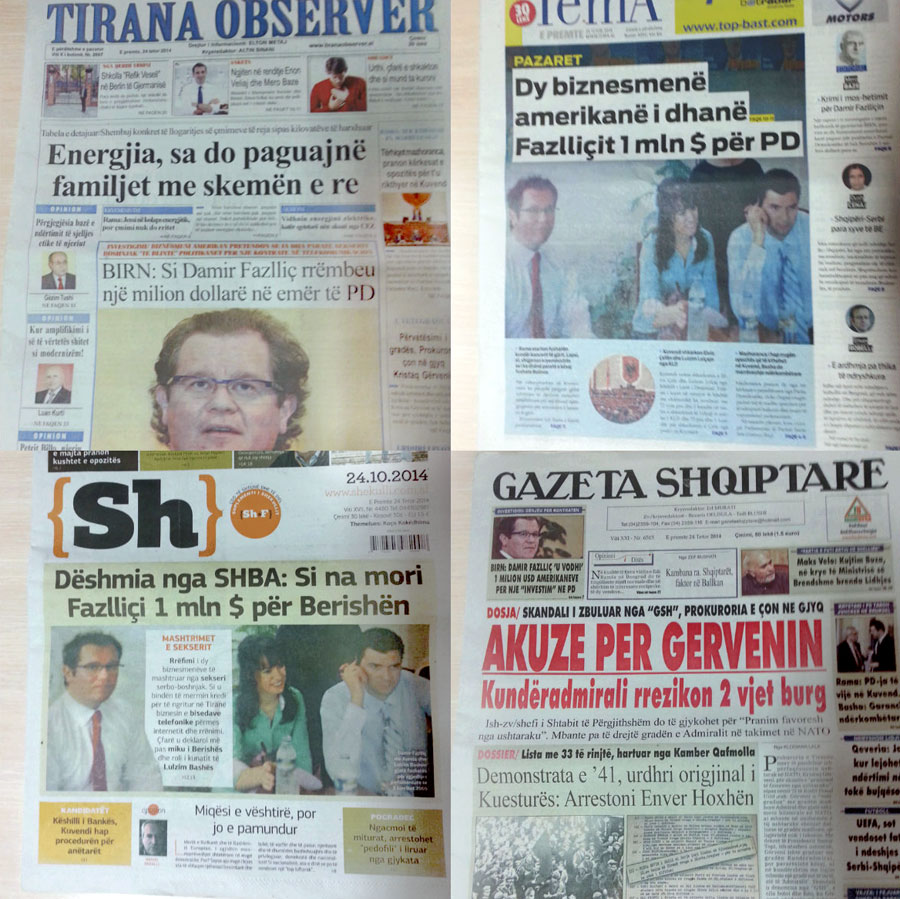
An investigation by BIRN Editor Lawrence Marzouk and local journalists in Albania and Serbia has received widespread republications and praise in the Albanian press and broadcast media.

The investigation ‘Albanian Telecoms Deal Cost ‘$1m to Buy Off Politicians’, Claim US Businessmen,’ uncovers how controversial Bosnian businessman Damir Fazlic, a fixer with powerful friends in Washington DC and the Balkans, requested $1m in ‘investment’ from its US partners for Albania’s Democratic Party, in order to secure a lucrative telecoms contract.

The investigation is part of a series of hard-hitting stories on Fazlic reported in the last few months by Marzouk and his team, focusing on the businessman’s ties to former Albanian Prime Minister Sali Berisha and his family.

The last investigation received dozens of republications in the Albanian online, print and broadcast media and provided food for thought for local political commentators.

In an editorial in the daily Tema on October 23, publisher Mero Baze called for an official investigation by prosecutors based on the latest report published by BIRN.

“The prosecutors cannot turn a blind eye on the declarations made in a prestigious media by two American citizens,” Baze wrote.

“If the prosecutor’s office will not launch a probe…then it’s the prosecutor’s office that should be investigated,” he added.

The investigations on Fazlic are part of a project called “A Paper Trail to Better Governance”, financed by Austrian Development Agency to hone investigative journalism in the Balkans, hold officials to account and improve the implementation and use of freedom of information laws.

The stories published as part of the project have sparked political debate and led to calls for investigations of Albania’s former premier Sali Berisha and his family.

Reacting to a BIRN investigation which revealed how the inner circle around Berisha earned millions of euros from suspect land deals with Fazlic, Albanian Socialist MP Erjon Brace called on tax authorities to launch a probe.

“The tax and money-laundering authorities should verify the transactions of these oligarchs,” Brace wrote on his Facebook page.

“The new evidence is challenging and totally proves the allegations,” he said, referring to BIRN’s report.

BIRN Journalists Wins UNDP Award for Journalism Tackling Poverty

BIRN journalists Nektar Zogjani and Tinka Kurti were awarded the first prize for online investigative journalism about poverty by UNDP and the Journalists Association of Kosovo. 

UNDP Award

Their article “Misery of the Reconciliation Field Camp,” published in the portal Life in Kosovo, reflects the harsh life of the inhabitants of the“Pajtimi” neighborhood located on the outskirts of Prishtina.

Florent Zeqaj of Klan Kosovo won first prize in the TV category for his story “80 year old woman lives alone with her disabled son.” The second prize went to Merita Sekiraca from the TV program “I am Kosovo, too” on RTV 21.

In the category of printed media, the first prize went to Nexhat Toverlani from “Koha Ditore” with the article “The childhood this eleven-year-old is missing” and the second prize went to Saranda Ramaj also from Koha Ditore, with the article “45 former UCK soldiers committed suicide.”

For the best radio story the prize went to Ivan Miljkovic from “Radio 038 of Gracanica with the story “A tale about my mother.”

Xhemail Sllovinja from the newspaper Tribuna took first prize in the photography category.

This is the ninth year UNDP is giving out awards in Kosovo for journalism focused on poverty.