Debate on Environment and Energy in the Republic of Kosovo

On May 29, 2014 “Life in Kosovo” held a debate on environment and energy in the Republic of Kosovo.

Panellists for this debate were: from AKR: Sabit Rastelica, Azra Krasniqi and Fadil Ismajli; from AAK: Magbule Shkodra, Ardian Gjini and Laura Kryeziu; from PDK: Blerim Rexha, Laura Zherka dhe Gani Koci; LDK: Teuta Sahatçija dhe Besa Gaxherri; Vetëvendosje: Agron Dida, Lumnije Morina and Faruk Mujka; and NISMA: Izet Ibrahimi  and Petrit Gashi.

Main issues discussed during this debate included the issue of what would be the amount of MW produced of renewable energy in order to fulfill citizens’ needs by the end of 2020. Based on this concern, candidates for MPs gave their party program on energy: AKR promised that by the end of 2020 the Hydro central in Zhur will produce 128 MW capacity from water recourses while at the end the amount of energy produced will be 640 GW/h, covering 10 percent of Kosovo population.

On the other side AAK said that their hope is in fostering cooperation with Albania, saying that bids for HC in Zhur will be open but this is not their priority since AAK will be more focused on empowering economy; thus help around two thousand hundred households with isolation system. PDK promised that by the end of 2020 around 410 MW will be produced spread in 28 other smaller Hydro Energy projects, where around 700 million Euros will be invested generating 5,500 working places. LDK said that the project in Zhuri will end by the end of 2018 covering 20% of energy produced while the other part will be covered by smaller HC.  Self-Determination Movement emphasized that 50% or renewable energy will come by combining energy systems of Albania and Kosovo.  Similar to other party programs, NISMA  sees the future of energy by finishing the project in Zhuri by the end of 2020, saying that this HC will produce 303MW ; building of 20 mini HC with the capacity of 104 – 200 mw and  usage of urban  waist 0.8-2MW.

The other part of debate was more concentrated in the environmental issues varying from water supply, pollution from old thermo centrals; gravel royalties etc.

Debate on Economy

On June 02, 2014, “Life in Kosovo” held a debate on the economy of the Republic of Kosovo. 

Political party representatives present at the Economy debate were as follows: from AAK: Fehmi Fetahu, Vasilika Zotaj and Shkelzen Jusaj; AKR was represented by: bernard Nikaj, Vileta Gashi and Avni Gashi; PDK: Ramiz Kelmendi, Blerand Stavileci and Margarita Kadriu; LDK: Hykmete Bajrami and Lutfi Zharku; LVV: Dardan Sejdiu, Aida Derguti and Bashkim Nurboja. From Partia e Forte present were: Birol Urcan, Zana Elshani Mullaademi and Valon Badivuku.

LDK member, Mrs. Bajrami made some allegations towards party in power saying that “PDK has not shown that with what criteria will distribute these funds. To get a grant to the Ministry of Agriculture, people from the municipality of Peja paid 500 Euros to make a business plan, and have never seen a list of who received those grants, and those who have never done business plan did not receive grants. ”

AKR representative Mr. Nikaj said that “No agricultural product produced in Kosovo is not freed from taxation agreement with Turkey, for at least 10 years of leather industry is protected, wood processing and all other industries that have the potential to be produced in Kosovo”. Same as Mrs. Bajrami from LDK, Mr. Sejdiu of LVV made allegations towards the party in power by saying that: “To create 137 jobs per day it means that for four years in a row Kosovo should build a factory each day. We have already seen these factories for the last 15 years”.

Debate on Local Products Development

On June 03, 2014 “Life in Kosovo” held a debate on local products development.

Present at this debate were: from AKR – Artan Haziri, Myzejene Selmani, Arbnor Pula;  AAK – Blerim Kuçi, Jeta Rafuna – Hasani, Smajl Latifi; PDK – Blerand Stavileci, Sabedin Kadriu; LDK – Florije Ibishi – Rudniku, Zef Morina, Ardita Rizvanolli; LVV – Dardan Sejdiu, Albana Fetoshi, Salih Salihu; and NISMA – Afërdita Gjonbalaj – Stublla, Milazim Xani, Shukrie Bytyçi.

When asked how will the state support youngsters that are pioneering in the sphere of Internet Technology, party members answered: NISMA: We will give the opportunity to all the young men and women who work on this sphere by helping to digitize the last village with the last technology. We will support each family by offering Internet for free.“

Moreover LVV said that: Kosovo has the most number per capita of engineers for maintenance of networks in Europe and this potential should be used. So, how do I use this potential?-By enabling companies to provide subcontract services to large companies who will also be freed from income tax so that they can reinvest in technology and thus be competitive”. LDK representative highlighted that: “With the increasing quality of education we will train new generations to use computerization system because every enterprise is now digitized and this must be shown. The procurement system, with new generations who know better to use information systems, procurement will be done with electronically tenders”.

Blerand Stavileci from PDK promised that if they rule with the government, during the next mandate “cherry on top” will be establishment of the Ministry of Information and Technology. Other topics related to development of local production included the promises that varied a little from one party program to the other, concentrated mainly in the lowering the fuel prices for agronomy; increased support for local agronomy etc.

Development Fund

On May 01, 2014, “Life in Kosovo” held a debate on promises made about a development fund.

Even though Minister of Finance Besim Beqaj confirmed his presence in the debate, two minutes before the debate a message was sent by Gezim Baxhaku, minister’s advisor, saying that he cannot come.

In absence of Minister Beqaj, “Life in Kosovo” held a debate with: Hykmete Bajrami, MP of LDK; Besnik Bislimi, from Vetevendosje; and Agim Sahiti, a farmer in Kosovo.

This attitude did not surprise the other participants in the debate and they said that the main reason Beqaj did not attend the debate was that he does not have enough facts to defend the “fund”.

Hykmete Bajrami, MP of LDK, who was also part of the debate, said that the failure of minister Beqaj to attend the debate shows that the government is not so interested to support this fund.

According to the other panelist, Besnik Bislimi from Vetevendosje, if the fund had been well-intentioned, Beqaj would immediately come to receive the credits/merits.

MP Hykmete Bajrami also said that the prime minister keeps talking about the development fund, but he has never explained which the criteria for the businesses to apply.

“In the beginning the prime minister said that the fund will be 1 billion Euros, and then he said that the fund will be 1.5 billion Euros, and just recently he raised it again and said that it will be 2 billion euros. We do not even know what is this fund about and the criteria to apply”, Bajrami said.

Farmer Agim Sahiti, also invited in the debate, who has a poultry farm, said that firstly some requirements must be fulfilled and that money should be for business development.

“I use 40 liters of fuel per hour and when there isn’t electricity for 10 hours I use 400 liters, which costs 500 Euros. Therefore, I have higher costs than the businesses that do not lack electricity”, Sahiti said.

Moreover, Besnik Bislimi added that there are some inspectors of the Ministry of Agriculture that give grants for people who do not even have agricultural land; whereas the farmer Sahiti told Bislimi that what he heard is not true.

Debts of Municipalities

On March 27, 2014, “Life in Kosovo” discussed the debts of municipalities, which run in the millions. After the debate “Life in Kosovo” broadcast an investigative report on academic advancement at the University of Prishtina.


What is happening with the inherited debts of municipalities? Why did these debts accumulate? What do the current and the previous local governments say?

To discuss about these issues, “Life in Kosovo” invited: Gazmend Muhaxheri, Mayor of Peja, and Ali Berisha, former mayor of Peja.

The mayor of Peja, Gazmend Muhaxheri, said that he is having problems to implement the projects that he planned because the municipality has many unpaid debts.Muhaxheri inherited a debt of 2 million Euros. During the debate he said that majority of debts were accumulated during the election campaign.

In addition, Ali Berisha, said that it is not true that the Municipality of Peja owes a debt of 2 million Euros.

“Peja is in a better condition if we compare it to other municipalities in relation to debts”, Berisha said.

Meanwhile there are other mayors that are asking from the government to pay the debts of their municipalities.

After the debate “Life in Kosovo broadcast a report on academic advancement at the University of Prishtina. The report is about the advancement of five deans in different faculties.


KALLXO.com Reveals Problems with Matura Exam Process

KALLXO.com presented findings of a monitoring report from the second round of the 2014 National Matura Exam, held on June 28 in Kosovo.

Kallxo.com 

Muhamet Hajrullahu, coordinator of the monitoring process for KALLXO.com, said monitoring teams were sent to 36 centres in 21 municipalities.

“The crew from KALLXO.com revealed various gaps of the process in the centers that were monitored even though security guards were used that day to administrate the process,” Hajrullahu said.

Hajrullahu said there were also problems with the identification of pupils. Discussing concrete findings, Hajrullahu mentioned a case in Podujeve, where the most serious violations happened.

“After the reporting from KALLXO.com on the Podujeva case, the police together with the Ministry of Education, Science and Technology reacted and people who shared copies of the exam through social networks were identified,” he said.

The reporting of KALLXO.com prevented further cheating from takng place.

Hajrullahu said that based on the experience from the monitoring in June, KALLXO.com recommends that the Ministry of Education, Science and Technology take into consideration the following:

1. Written tests should be encouraged as means to assess knowledge throughout the school year.
2. Administration of the testing process should be entirely conducted by teachers.
3. Protocols and responsibilities of officials engaged in test administration processes should be disseminated in clear written form, in a timely manner.
4. Responsibility to participate in and administer the testing process could be regulated contractually with all teachers.

The monitoring teams of KALLXO.com will be in the field on September 6 for the second round of the National Matura Exam.


BIRN Kosovo Director and Legal Advisor Spoke at Doku:Tech

As the internet and technology become more and more important in people’s lives, security looms an ever larger concern. That’s why this year during the documentary film festival Dokufest devoted a separate arena for “Doku:Tech” covering technology, the internet and innovation.

Jeta Xharra

On the first day of the conference, the main panelist was Lee Bryant, a leader of the marketing company Twentieth Century. He spoke about the borderless digital world of information and marketing.

“The digital world has a big challenge in front of her, which is ensuring a free space for everyone that wants to use it. But in the business world this is becoming more impossible every day. This increases the risk that powerful elites are being created who control the digital world,” said Bryant.

Other technology experts like Deanna Zandt talked about love/hate relationships with the internet in a world in which everybody was free. In another panel, Arandel Bojanovic, Altin Ukshini, Bilal Ghalib questioned the role of hackers in internet.

Jeta Xharra, director of Balkan Investigative and Reporting Network (BIRN) in Kosovo, opened the second day. She started her speech presenting the online platform for reporting corruption “KALLXO.com” and the growing need for security.

Talking about her investigative journalism experience, Xharra spoke about the importance of security in reporting big cases like the building of a new power plant that would cost millions of euro and could take people’s lives.

“The more we need security as part of our daily routine, the more it becomes industry perpetuating itself, threatening individuals and societies,” Xharra said. “Good investments do not come while the wrong practice privatizations, corruption and criminality is increasing”, said Jeta Xharra.

Later, another panel discussed the legal framework of data collection for intelligence purposes as well as the limits of personal data protection.

Furthermore, BIRN Legal adviser, Flutura Kusari, made a presentation on personal data protection and also BIRN’s experiences using the right to freedom of information during investigative stories.

BIRN Energy Investigation Makes Waves in Albania

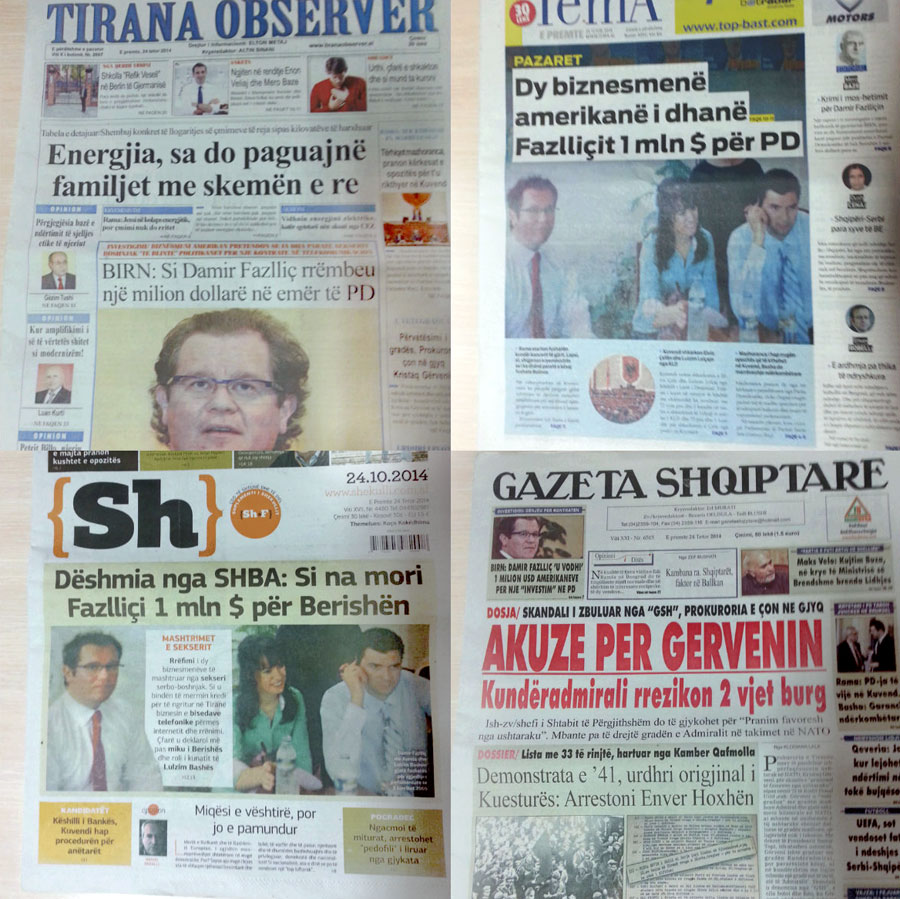
BIRN’s hard-hitting series of investigations into energy deals in Albania has generated widespread interest in the country.

The revelations have hit the front pages of most of the country’s newspapers in recent weeks, have been aired by leading television stations and have led to calls for a tax investigation to be opened into the family of former prime minister Sali Berisha. 

The investigation was also picked up in Bosnia and Herzegovina, Serbia and Kosovo where it was republished in more than 20 media outlets.

The Balkan Investigative Reporting Network has revealed how Berisha’s daughter Argita Malltezi, and her husband and colleague, made huge profits from selling worthless land to Bosnian businessman Damir Fazlic.

Fazlic, a friend and adviser to Berisha, then made millions of euros when the premier designated the land an “energy park”, paving the way for massive investment.

BIRN also traced the origin of the investment to controversial Serbian tycoon Vojin Lazarevic and revealed the extraordinary number of foreign energy investors who employed Malltezi as their solicitor as they attempted to launch businesses in Albania.

Fazlic has denied any wrongdoing while Malltezi and her father have yet to comment.

In an editorial for the newspaper Tema, journalist Mero Baze, a vocal critic of Berisha, lauded BIRN and Lindita Cela, the lead journalist in Albania on the investigations.

The story also sparked a reaction from Erion Brace, Socialist MP and chairman of the Parliamentary Commission on the Economy, who called on the tax authorities to investigate BIRN’s findings.

The stories are the first to be published as part of BIRN’s “Power Games” project, a detailed investigation into the energy sector in the Balkans.

BIRN has spent nine months looking at the key companies, players and state officials involved in this lucrative, secretive and critical sector of the economy.

Power Games is part of “A Paper Trail to Better Governance” project financed by Austrian Development Agency to hone investigative journalism in the Balkans, hold officials to account and improve the implementation and use of freedom of information laws.

BIRN Kosovo Presents Report on Access to Public Documents

Balkan Investigative Reporting Network (BIRN Kosovo) published its report on access to the public documents on Monday. 

 Access to Public Documents

BIRN submitted 125 official requests to access public documents to the majority of public institutions in Kosovo. From these requests 68 were denied, 50 were approved and seven were partially denied. This shows that the institutions fulfilled only 40 per cent of requests.

To launch and discuss the report, BIRN organized a roundtable with representatives of public institutions from the local and central governments.

The report found that the implementation of the law on access to public documents has not improved since the year prior. The report also identified transparent and non-transparent institutions.

The roundtable included:

Zekirja Shabani – Association of Professional Journalists of Kosovo,

Arianit Bytyqi – Prime Minister’s Office,

Fidan Kalaja – Open Government Partnership,

Mentor Hoxhaj – National Agency for Data Protection,

Florent Rrahmani – Office of the President of Republic of Kosovo.

Arianit Bytyqi from the Prime Minister Office congratulated BIRN for the work conducted so far, which, he said “is a great help on going on supporting further more an efficient implementation of the law on access to the public documents”.

Fidan Kalaja said BIRN is supporting his work in Kosovo on the Open Government Partnership, a global initiative to promote government transparency.

Download full report.