Steve Crawshaw

From 2002 to 2023 Steve worked for Human Rights Watch (UK director and UN advocacy director), Amnesty International (international advocacy director and Director of the Office of the Secretary General) and Freedom from Torture (policy and advocacy director).

He is now writing a book on war crimes and international justice, Prosecuting the Powerful (Bridge Street Press/Little, Brown).

Steve worked as a journalist for many years, including for the Independent, which he joined at its launch in 1986. He reported for The Independent on the East European revolutions, the collapse of the Soviet Union, and the Balkan wars.

His previous books include Goodbye to the USSR, Easier Fatherland: Germany and the Twenty-First Century, Small Acts of Resistance (foreword by Václav Havel) and Street Spirit: The Power of Protest and Mischief (foreword by Ai Weiwei).


Tim Judah

Tim is journalist and author and special correspondent for The Economist.

Tim has worked for many major publications and broadcasters, notably writing wartime reportage from Afghanistan to Ukraine for The New York Review of Books.

He is the author of three books on the Balkans—The Serbs: History, Myth and the Destruction of Yugoslavia, Kosovo: War & Revenge and Kosovo: What Everyone Needs to Know. He published a book on the conflict in Ukraine – In Wartime: Stories from Ukraine in 2016.

For much of 2022 and early 2023 he covered the Ukraine war for The New York Review of Books, The Economist and the Financial Times. He was shortlisted for the 2022 Bayeux-Calvedos award for war correspondents.

Per Byman

Per is a Swedish aid worker. Since 2023 he has been working for Caritas Germany as Senior Humanitarian Advisor for Ukraine and Moldova. Previously, he was the Managing Director at NRC Flüchtlingshilfe Deutschland, which he joined in 2018.

Between 2005 and 2012 he worked for the Swedish International Development Cooperation Agency, SIDA, where he served as head of the humanitarian unit responsible for disaster relief. From 1999-2005 Per worked as a program officer for human rights and democracy at Sida’s unit for South Eastern Europe.

Between 1991 and 1997 he worked with humanitarian projects and reconstruction in Bosnia and Herzegovina for the international Caritas network. He holds an MA in German political linguistics (Politolinguistik).


Digging Deeper: A guide for investigative journalists in the Balkans

Digging Deeper is a textbook for investigative journalists and part of the curriculum of the BIRN Summer School of Investigative Reporting.

Digging Deeper is an output of BIRN’s Investigative Reporting Initiative, which is an educational programme that includes cooperation with international universities and local partners with the aim of putting Digging Deeper into commercial use as a curriculum for investigative reporting.

The book was written in cooperation with Sheila Coronel, director of the Stabile Center for Investigative Journalism and professor of professional practice at Columbia University, New York.

In the guide, journalists’ articles, coupled with interesting advice, skills, investigative stories, databases, case studies, exercises and tips and techniques, inspire readers to take up the challenge of a career in investigative journalism.

Digging Deeper showcases interesting investigative stories and individual journalistic successes, as well as providing an overview of investigative techniques. Listings of the various databases available in the Balkan region and tips for practitioners are also useful elements for journalists.

BIRN’s Digging Deeper is part of the curriculum of the BIRN Summer School of Investigative Reporting. BIRN has published two editionsof the book in English, and it has been translated into the languages of the Western Balkans- Serbian, Albanian and Macedonian.

Download the first chapter for free

Balkan Insight

Balkan Insight is BIRN’s flagship English-language website and it provides daily news, as well as analytical insight and investigations, on key issues in ten countries: Albania, Bosnia and Herzegovina, Bulgaria, Croatia, Kosovo, Macedonia, Moldova, Montenegro, Romania and Serbia, with occasional coverage of Turkey and Greece. From 2019, Balkan Insight is extending its coverage on Ukraine, the Czech Republic, Slovakia, Hungary and Poland.

The website has built a reputation as one of the most comprehensive, professional and independent sources of news in English in Southern and Eastern Europe, and has become the news source of choice for policy-makers, corporate management and academic researchers around the world.

It provides a free-to-access daily news service alongside Premium Content, a paid service that offers in-depth analysis, commentary, investigative reports, features, interviews and profiles on the latest political and business headlines.

Balkan Insight draws on BIRN’s pool of professional specialist journalists and editors from across Europe, ensuring high-quality content refined by a team of native English-language editors.

Correspondents address issues including transitional justice, media freedom, foreign influence, radicalisation, corruption and the rule of law, as well as political crises in the region.

In addition to publishing work by our team of correspondents, we annually publish articles from more than 200 local journalists – mostly relying on our wide network of alumni that have participated in the award-winning programs – the Balkan Fellowship for Journalistic Excellence, the Balkan Transitional Justice Initiative and the BIRN Summer School of Investigative Journalism.

Our opinion writers include respected authors and commentators on the region, including international political and government figures.

We also collaborate with a number of media outlets in Europe. Our stories get republished regularly internationally by The Economist, The Independent, Der Standard, Sueddeutsche Zeitung, The Guardian, New Statesman, The Nation, Le Monde and by the BBC, PBS and Al Jazeera.

Locally, our articles often appear in Danas, Vreme, Vjesti, N1, Novosti.hr, Klix.ba, Juzne Vesti, Koha, Mapo.al and many others.

Balkan Insight has been quoted in reports issued by the Council of Europe, the European Parliament, Human Rights Watch, Amnesty International and Freedom House. It is referenced by many academic institutions and their scholars, including those from Columbia University, Oxford University, the London School of Economics, University College London, Yale University and the University of Graz, among others.

Over the years, Balkan Insight investigative teams have been nominated or awarded on numerous occasions, including for the Global Shining Light Award, the European Press Prize, SEEMO Award for Outstanding Merits in Investigative Journalism, the Global Data Journalism Award, Press Freedom Award – A Signal for Europe, as well as numerous national awards for best investigations by independent journalism centres.

Sinisa-Jakov Marusic

Sinisa-Jakov Marusic is a Skopje-based journalist and regular contributor to BIRN’s regional publication, Balkan Insight, and the programme Balkan Transitional Justice.

Since 2007, Sinisa has covered Macedonia’s political, social and economic developments, especially those linked to Macedonian post conflict society and transitional justice.

His articles and analysis also appear in other local and international print and electronic media.

In 2007, Sinisa graduated from the Journalism School at the Macedonian Institute for Media, MIM, in Skopje.

He speaks Macedonian, English and German.

Gordana Igric

Founder of the Balkan Investigative Reporting Network (BIRN) and Regional Network Director until May 2018.

With her Balkan colleagues Gordana helped establish, manage and develop the Balkan Investigative Reporting Network, BIRN. Through her dedication, engagement and careful planning of network establishment, programme objectives and strategies for further development, the organisation has continued to grow since its inception.

Gordana began her career as a journalist in Belgrade in 1981. She reported from Bosnia and Kosovo during the wars that followed the dissolution of the former Yugoslavia. From 1998 to 1999, she worked in the field of human rights as Director of Research for the Humanitarian Law Centre (Belgrade), and Kosovo Researcher for Human Rights Watch (New York).

She has received several journalism awards, including the 1998 Overseas Press Club (USA) Award for Human Rights Reporting and a Human Rights Watch Hellman Hammet award in the same year for her research into war crimes in Foca, Bosnia & Herzegovina.

Gordana was Balkan project manager at the Institute of War and Peace Reporting, IWPR, from 1999 until August 2005, during which time IWPR’s Balkan reporting received numerous press awards and media citations.

Gordana graduated in 1983 from the University of Belgrade’s School of Political Science, Department of Journalism.

Marija Ristic

Marija Ristic was the executive director of Balkan Investigative Reporting Network, a network of seven non-governmental organisations promoting freedom of speech, human rights and democratic values in Southeast and Central Europe. Ristic oversaw the activities and communications within the Network and represented it publicly.

As regional director, Ristic also led the BIRN Hub, which coordinates the BIRN network, dealing with editorial, training, operations and development, as well as developing, fundraising for and coordinating core regional projects. She was also the editor-in-chief for the Network.

Ristic started working for BIRN in 2011 as a journalist, contributing to the regional Balkan Transitional Justice programme. Topics related to war crimes, dealing with the past and human rights have been at the core of her professional development.

In 2015, she produced the award-winning documentary ‘The Unidentified’.

Under her leadership, BIRN won numerous awards, including the European Press Prize, while the Network expended its coverage beyond the Balkans – to Central and South Europe. As a director, Ristic in particular focused on development of digital rights and tech programme, empowerment of local media through capacity building and citizens’ engagement and expansion of human rights focused programmes.

In 2019, Ristic won Press Freedom Award from the Reporters Without Borders.

She graduated magna cum laude from the Geneva Academy for International Humanitarian Law and Human Rights, the University of Geneva and the University of Belgrade. She was a fellow at the Free University Berlin and Columbia University New York and received numerous awards and scholarships from the Konrad Adenauer Stiftung, the OSCE, the Zoran Djindjic Foundation and the Research Council of Norway. She speaks Serbo-Croatian, English and German and lives between Sarajevo, Belgrade and Berlin.

Maida Selmanovic

Maida joined BIRN Hub in January 2008 as a Financial Officer based in Sarajevo. Maida is responsible for cash flow management, monitoring daily financial operations, reviewing financial data and preparing monthly and annual reports as well as accountancy and auditing and overall communication with other departments and the staff of BIRN.

Her educational background is in economics, and she has worked for two and half decades in international commercial business, finance, accounting and administration. She has attended different trainings related to office management, administration and project related courses.

Maida studied at the University of Economic of Tourism in Sarajevo. She speaks Bosnian and English.

New BIRN Board Meets in Belgrade

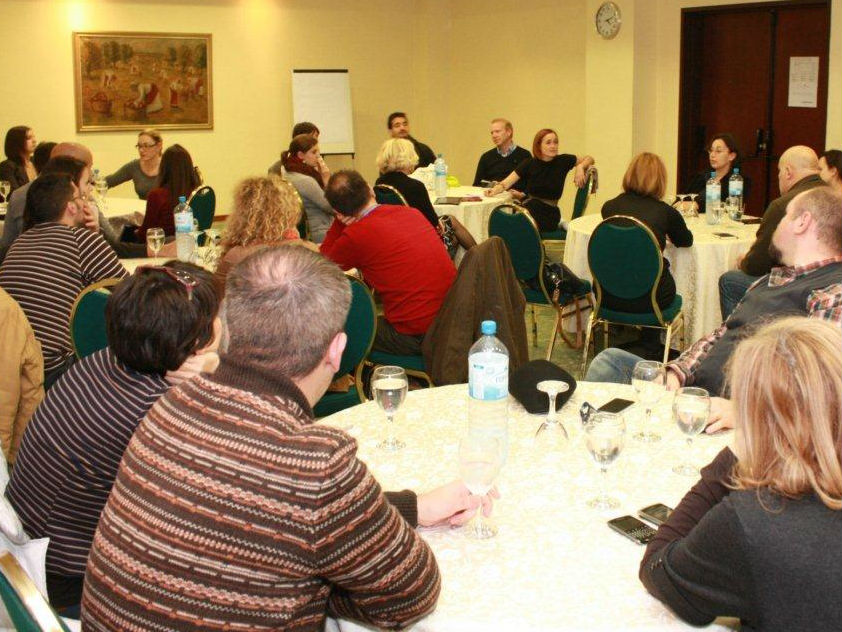
After the election of new Board members in November 2011, BIRN’s new Board and Steering Committee met for the first time in Belgrade from July 6 to July 8.

The new board is composed of Tim Judah, author and Balkan correspondent for the Economist, Wolfgang Petritsch, Austria’s Permanent Representative to the OECD, Steve Crawshaw, international advocacy director at Amnesty International, Stefan Lehne, former Austrian diplomat and visiting scholar at the Carnegie Europe in Brussels, and Per Bymon.

Previously head of Humanitarian Assistance in the Swedish SIDA (Swedish International Development Agency), he is now secretary general of Swedish Radio and Television’s humanitarian foundation, Radiohjälpen.

Ana Petruseva, representative of BIRN members, previously a long-time president of the board, also now joins the board.

The Board was presented with BIRN’s organisational structure, its on-going charitable and commercial programmes, and the organisation’s current success as well as plans for the future.

BIRN’s Statute was put before the members for consideration and, following further input from the team, will be finalised by the end of September.

“It was important for Board members to understand the depth and breadth of what BIRN is, and also to see that each of the local BIRNs can do different things,” Judah, the president of BIRN’s Board, said.

“It was also helpful for people from the local BIRNs to get together and understand what everyone else is doing and share experiences, as well as discuss how to exploit the network’s strength for their mutual benefit,” he added.

BIRN’s staff used the opportunity of the meeting to vote for a new visual identity for the whole organisation, as well as on the new layout of the organisation’s website.

The new visual identity and website will be implemented by the end of the year.

Local BIRN Directors concluded that an internal exchange of personnel should be put into practice, so that BIRN staff members can become better acquainted with their colleagues’ work.

It was also decided that in 2013, the next BIRN annual meeting should be held for the whole organisation.