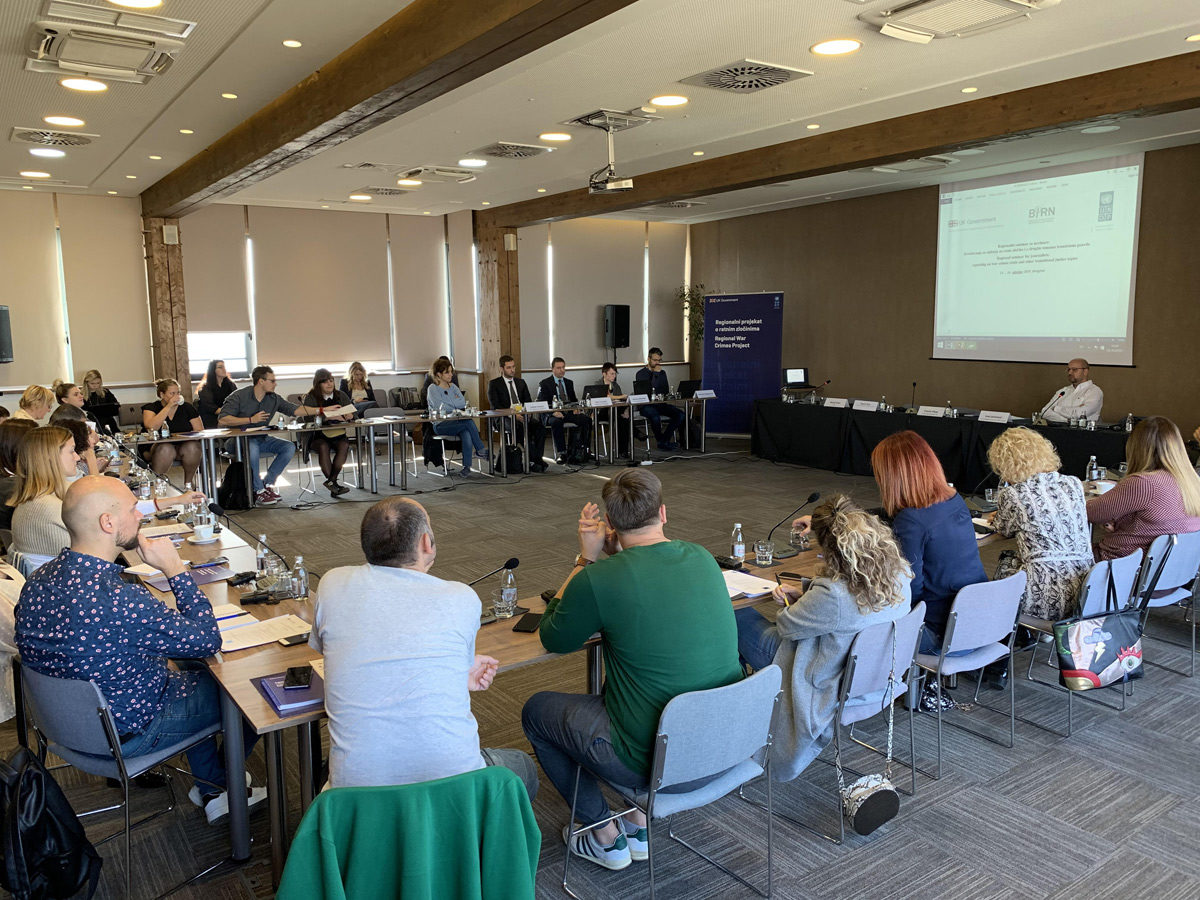
BIRN Trains Journalists in Transitional Justice Reporting

The Balkan Investigative Reporting Network began a three-day course in Belgrade to train journalists from across the former Yugoslavia in reporting on war crimes trials and other transitional justice topics.

The three-day training course on transitional justice reporting, organised by BIRN in cooperation with the United Nations Development Programme, UNDP, started in the Serbian capital Belgrade on Monday.

A total of 25 reporters from various countries across the former Yugoslavia are being trained by journalists with substantial experience in covering war crimes trials and transitional justice topics, and hearing from experts who are directly involved in legal processes, such as prosecutors and court officials.

The participants were addressed at the start of the course by Francine Pickup, the UNDP resident representative in Serbia, who pointed out that there are still hundreds of war crimes cases to be prosecuted in the region and said that the training could help journalists address challenges they might face while reporting on the proceedings.

“We hope that this training will help you in your reporting and that it will give you some advice on how to strengthen your relationships with relevant institutions,” Pickup said.

As well as looking at the essentials of criminal procedures, best practices for reporting on cases and sources of information for journalists, the course also focuses on the role that victims play in war crimes trial processes.

Expert panellists at the course include Ivan Jovanovic from UNDP Regional War Crimes Project, Nemanja Stjepanovic from the International Residual Mechanism for Criminal Tribunals Registry, Bosnia and Herzegovina’s state prosecution spokesperson Boris Grubjesic, Croatian Chief State Attorney’s Office spokesperson Martina Mihordin, and Vasilije Saratlic, deputy war crimes prosecutor and spokesperson at Serbia’s War Crimes Prosecutor’s Office.

BIRN’s Regional Director Marija Ristic said that the idea of the training course was to look beyond the proceedings in war crime trials and use the archives that courts have built up and the legacy of their judgments as story material.

“This job is very rewarding because we are giving a voice to the victims and sometimes, if it was not for us, their stories would never be told,” Ristic said.

After the course, the participants will be required to pitch an in-depth story about transitional justice issues in the Balkans.

From the pitches and general assessments of the participants during the course, BIRN will select ten journalists to participate in a study visit to The Hague that will be held in November.

The journalists who propose the best stories will receive a grant of 1,000 euros from BIRN to further develop their work in cooperation with BIRN’s experienced pool of editors.

The project is being supported by the United Kingdom’s embassy in Belgrade and the European Commission.

UK embassy first secretary Chantel Care said that it is important for journalists to strengthen their networks and partnerships, and told the participants that “you have the opportunity to do that here”.
« of 5 »

Annual and Audit Reports – BIRN Hub

The Annual Reports provide an overview of BIRN Hub’s activities throughout the given year.
The Audit Reports contain data on BIRN’s finances during a year as audited by an external certified auditor.

2023

Audit Report

2022

Audit Report

2021

Audit Report

2020

Annual Report | Audit Report

2019

Annual Report | Audit Report

2018

Annual Report | Audit Report

2017

Annual Report | Audit Report

2016

Annual Report |Audit Report

2015

Audit Report

2014

Audit Report

2013

Audit Report

2012

Audit Report

2011

Audit Report

2010

Audit Report

2009

Audit Report

2007

Audit Report

BIRN Partners with Prague Media Point Conference

BIRN Serbia is a partner in this year’s Prague Media Point conference, an international journalism conference for media professionals, journalists, academics, policy-makers and activists which will be held in the Czech capital from December 5-7.

At the event, BIRN will present its Reporting Democracy programme, as part of a session entitled ‘Leading and impactful investigative journalism in the V4 and Western Balkan countries’.

The principal objective of the Visegrad Fund-supported project is to showcase examples of investigative journalism projects that have overcome challenges posed by globalisation, digitalisation and populism, resulting in shrinking revenue streams and low audience trust.

The goals of the project are to level the playing field for media experts and investigative journalists from the V4 region and the Western Balkans with those in the rest of Europe and around the world in terms of access to relevant information, skill-building and networking.

The project is a collaboration between KEYNOTE (Czechia), Transitions (Czechia), ResPublica (Poland), Denník N/N Press (Slovakia), School of Communications and Media (Slovakia), BIRN Serbia, and the Albanian Media Institute (Albania).

Share Your Views: Democracy Today in Europe’s Ex-Communist Bloc

Thirty years after the fall of the Berlin Wall, what does the state of democracy look like in the former communist states of Central and Southeastern Europe? We want to hear your views.

The fall of the Berlin Wall marked one of the greatest turning points in world history, seen by many as a bright new dawn for Europe and its path towards freedom and unification.

But three decades on from the event that set off the continent’s path to the end of communism, nations are re-erecting metaphorical and literal walls, sowing division again.

Illiberal forces have arisen, populism has spread and nationalism has moved from the fringes to more mainstream political discourse. Brexit, the migrant crisis and the eurozone crisis have all helped propel the wave of radical and populist politics that has found footing in countries across Europe and beyond.

To mark 30 years since the Berlin Wall was torn down on November 9, 1989, we want to hear from those born during that historic year as to how the state of democracy now looks in Europe’s former communist bloc.

Are you from Central or Southeastern Europe? Were you born in or around the year that the Berlin Wall fell?

We’re looking for people who are willing to share their views on camera, to present a picture of the current state of democracy for those raised in the aftermath of the Cold War, and who experienced the sweeping transformations that are still playing out today.

The key things we want to know are:

  • How does democracy look in your country today?
  • Do you think democracy is improving or collapsing in your country?
  • What freedoms do you value in your country today and what liberties do you think are still missing?
  • Are you happy with the state of democracy in your country?

Things to note:

The specific countries to be included are: Poland, Hungary, Slovakia, Czech Republic, Moldova, Romania, Bulgaria, Albania and the former Yugoslav states.

Those selected to take part will be featured in a video package which will be published on BIRN’s online channels, including Balkan Insight.

Participants will need to be available for an on-camera interview that will be scheduled with one of our local journalists between October 15-22, 2019.

How to take part?

To submit your interest in taking part, all you need to do it fill out this form.

We’ll need to receive your application by October 10, 2019.

Winners of EU Investigative Awards in Bosnia and Herzegovina Announced

The three winners of the EU prize in Bosnia and Herzegovina received their awards on Wednesday at the EU Info Center in Sarajevo.

Amarildo Gutic won the first prize for best investigative story in 2018 in Bosnia and Herzegovina for his documentary The State against David, which reconstructs the last hours of the life of David Dragicevic whose unresolved death sparked major tension in the country.

In its summary of the award decision, the jury underlined that the author “transforms one personal and family tragedy into a story which convincingly speaks about pathology of institutions and the entire government”.

Speaking about the challenges of investigative journalism in Bosnia, Gutic said: “The most important thing is that you accept that this is what you are doing and have a newsroom where you can work independently but also as a team.”

Second prize went to Semir Mujkic for his investigative series Corruption in Public Procurements.

“The significance of Mujkic’s investigative series is that it documents the misuse of public procurement through publicly available information,” the jury noted.

Third prize went to Renata Radic Dragic and Mubarek Asani for their piece Veterans against Veterans’ Associations.

The jury, including Davor Glavas, as head of the jury, and members Vildana Selimbegović and Milka Tadic Mijovic, had a hard task evaluating the shortlisted applications.

Khaldoun Sinno, Deputy Head of the EU Delegation to Bosnia and Herzegovina, referred to the freedom of media and well informed public upon which every democratic society depends.

“Freedom of expression and freedom of media are part of fundamental values of the European Union which has been reflected throughout the recently published EC Opinion on BiH’s application for membership. This is a crucial element of BiH’s progress towards the EU and will be closely monitored on a daily basis as BiH progresses towards the EU”, said Sinno adding that only with strong, independent media and protected journalists BiH can progress towards the EU.

Selimbegovic, a prominent Bosnian journalist, emphasized that investigative journalism was especially difficult in Bosnia, as few media outlets could afford that kind of reporting.

“It takes a lot of time and resources for journalist to be dedicated to an investigative story,” Selimbegovic said.

Following the awards ceremony, a panel discussion on investigative journalism took place including Selimbegovic, from Oslobodjenje, journalist Leila Bicakcic, from CIN, Jamila Milovic Halilovic, Head of Communications of EUD/EUSR, and winner of the Best investigative story for 2018 Amarildo Gutic from Zurnal.

The panel discussed the obstacles and challenges of investigative journalism, the lack of resources in news rooms, building cases and finding evidence in the complicated political climate in Bosnia and Herzegovina, and how political pressure affects journalists.

The EU awards have the overall goal of celebrating and promoting outstanding investigative journalism in the Western Balkan countries and Turkey, as well as improving the visibility of quality investigative journalism in these countries among the public.

“As confirmed during the Western Balkans Media Days held in Podgorica from 2 to 4 September, the EU is aware of all the challenges that WB media sector faces and is firmly committed to continue supporting the creation of environment enabling free and democratic societies to fully flourish in this region”, noted Milovic-Halilovic.

The EU award for investigative journalism is awarded through the EU-funded project “Strengthening Quality News and Independent Journalism in the Western Balkans and Turkey” in 2019, 2020, and 2021 in the following EU candidate and potential candidate countries: Albania, Bosnia and Herzegovina, Kosovo, Montenegro, North Macedonia, Serbia and Turkey. It is for investigative stories published between 2018 and 2020. In total, 63 awards will be awarded over the three-year period.

The awards in Bosnia and Herzegovina are coordinated by BIRN Hub, and the regional consortium is led also by the Balkan Investigative Regional Reporting Network, the BIRN Hub.

BIRN Offers Transitional Justice Reporting Training for Journalists

The Balkan Investigative Reporting Network is inviting journalists to apply to attend a three-day training course on reporting about war crimes trials and other transitional justice topics.

BIRN, in cooperation with the United Nations Development Programme, UNDP, is calling for journalists to apply for a three-day course next month on reporting on transitional justice issues such as war crimes trials.

Journalists from former Yugoslav countries who are interested in transitional justice topics are eligible to apply for the training course, which will be held in the Serbian capital Belgrade from October 14-16.

“Transitional justice issues, war crimes, accountability and justice are still very important and sensitive topics in the Balkans and their journalistic coverage demands objective and fact-based reporting,” said BIRN’s regional network director, Marija Ristic.

Participants will have the opportunity to learn from experts on transitional justice topics, including journalists, judicial officials, and representatives of government and civil society.

The working language of the training course will be Bosnian/Croatian/Montenegrin/Serbian. Simultaneous translation will be provided if needed.

After the course, participants will also be required to pitch an in-depth story on transitional justice in the Balkans.

From the pitches and general assessments at the course, BIRN will select 10 journalists to participate a study visit to The Hague that will be held in November.

The journalists who propose the best stories will receive a grant of 1,000 euros from BIRN to further develop them in cooperation with BIRN’s experienced pool of editors.

To apply, journalists should send a CV, letter of motivation, links to or examples of published work, and any other relevant documents to [email protected] with the subject line ‘Application – Training for Journalists’.

The deadline for applications is September 25.

EU Investigative Journalism Award-Winners Named in Serbia

The three winners of the European Union’s investigative journalism prize in Serbia were announced on Tuesday at the EU Info Centre in Belgrade, with judges praising the work for its high quality.

First prize in this year’s EU awards for investigative journalism in Serbia went to Stevan Dojcinovic and Dragana Peco for their investigation into the connections between senior political figures and criminal clans entitled How Serbia’s Health Minister Helped a Criminal Avoid Trial.

Vladimir Kostic and Dina Djordjevic were awarded second prize for their articles entitled Small hydroelectric power plants: the state and companies connected to Vucic’s best man profit most and From Nigerian scheme to clandestine EPS procurement worth milions.

Third prize went to Milos Stanic for the article Toxic Taps: Arsenic in Water Stirs Cancer Fears.

The jury headed by Bojan Pancevski and including Valerie Hopkins and Predrag Blagojevic said they had a hard task evaluating the shortlisted applications due to their high quality.

“The European Union supports pluralism of media, and therein also investigative journalism as important form of reporting and informing citizens on matters of crucial importance,” said Noora Hayrinen, head of the political section at the EU delegation in Serbia.

All of the awarded journalists in Serbia are alumni of the BIRN programme, Balkan Fellowship for Journalistic Excellence (BFJE).

The EU awards have the overall goal of celebrating and promoting outstanding investigative journalists in the Western Balkans and Turkey, as well as improving the visibility of quality investigative journalism among the public in these countries.

The prize for investigative journalism is awarded through an EU-funded project entitled Strengthening Quality News and Independent Journalism in the Western Balkans and Turkey, and applies to EU candidate and potential candidate countries Albania, Bosnia and Herzegovina, Kosovo, Montenegro, North Macedonia, Serbia and Turkey.

The award in Serbia is coordinated by the BIRN Serbia, while the regional consortium is led by the Balkan Investigative Regional Reporting Network’s BIRN Hub.

EU Investigative Journalism Awards in Montenegro Announced

The top three winners out of nine shortlisted applications received their prizes on Monday at the EU Info Center in Podgorica.

Jovan Nikitovic won first prize in this year’s awards for EU investigative journalism in Montenegro, revealed on Monday.

He won with his series of articles on the disappearance, theft, damage or destruction of 14,475 exhibits in the National Museum and other museums in Montenegro.

The jury, comprising Leila Bicakcic as head, Milica Pesic and Dragoljub Dusko Vukovic, evaluated nine shortlisted applications. “There were many great stories and the best one had to be chosen,” Bicakcic said.

After receiving his award, Nikitovic said his work was far from over. “I was confronted with hundreds of pages of information but also hundreds of hours of conversation with numerous interviewees. This is a series of over 40 article, but new documentation is still coming and the dice are still being assembled,” he said.

Second prize went to Maja Boricic for her piece, “Medical Waste in Montenegro – A lurking menace”, and third prize to Dejan Milovac and Lazar Grdinic, for “Citizens’ donations, or black-funds”.

Milka Tadic Mijovic, president of the Center for Investigative Journalism of Montenegro, CIN-CG, the local coordinator of the EU Award, underlined the importance of investigative journalism in the region. “It is not often that we reward colleagues for their contribution to investigative journalism. This is a very broad and complex project spanning several countries,” she said.

“The reason why the EU supported this project is to encourage Western Balkan journalists to work in investigative journalism, because this is the only way to reach free societies,” said Aivo Orav, Head of the EU Delegation to Montenegro.

Marija Ristic, regional director of BIRN, stressed that the EU Awards were “just one of a series of projects to follow over the next three years that will encourage the production of research stories in Western Balkans and Turkey”.

The awards have the overall goal of celebrating and promoting outstanding investigative journalists in the Western Balkans and Turkey, as well as improving the public visibility of quality investigative journalism in these countries.

The award comes via the EU-funded project, “Strengthening Quality News and Independent Journalism in the Western Balkans and Turkey”. It applies to the EU candidate and potential candidate countries of Albania, Bosnia and Herzegovina, Kosovo, Montenegro, North Macedonia, Serbia and Turkey. It covers investigative stories published between 2018 and 2020. In total, 63 awards will be awarded through the three-year period.

While the award in Montenegro is coordinated by the Center for Investigative Journalism of Montenegro, the regional consortium is led by the Balkan Investigative Regional Reporting Network, BIRN Hub.

Winners of EU Awards in Albania Announced

The three winners of the EU investigative journalism prize in Albania were announced on Monday at the EU Info Center in Tirana.

First prize in this year’s EU awards for investigative journalism in Albania went to Esmeralda Keta and Elisa Gjerani for their investigation into one of the country’s most important topics, the poor condition of hospitals and medical care in Albania, entitled “Premature Baby Deaths Rise in Albania’s Cash-starved Hospitals”.

Second prize went to Endrit Habila for his piece, “The Destruction of Valbona”. Third prize went to Ola Mitre for her investigation, “The Hidden Costs of Free Cardio Surgeries in Private Hospitals”.

The jury comprising Mark Marku, head of the jury, and Petrit Collaku, and Samir Kajosevic said they had a hard task evaluating the shortlisted applications.

Luigi Soreca, Head of the EU Delegation to Albania, said investigative journalism was more important than ever in a political climate where democracy was on the defensive.

“Freedom of speech is declining globally, and support for it is weakening, even in mature democracies,” he said.

“Disinformation clearly undermines quality journalism. Investigative journalist are vital in their contribution towards a free and yet accountable society,” he underlined.

The EU awards have the overall goal of celebrating and promoting outstanding investigative journalists in the Western Balkans and Turkey, as well as improving visibility of quality investigative journalism in these countries among the public.

The prize for investigative journalism is awarded through the EU-funded project, “Strengthening Quality News and Independent Journalism in the Western Balkans and Turkey” and applies to the EU candidate and potential candidate countries of Albania, Bosnia and Herzegovina, Kosovo, Montenegro, North Macedonia, Serbia and Turkey. It is for investigative stories published between 2018 and 2020. In total, 63 awards will be given.

The award in Albania is coordinated by the BIRN Albania while the regional consortium is led by Balkan Investigative Regional Reporting Network, BIRN Hub.

Grants for Journalists, Artists, Historians and Activists

The Balkan Investigative Reporting Network is launching a call for small project proposals on exploring archives of the International Criminal Tribunal for the Former Yugoslavia and local courts in ex-Yugoslav countries that dealt with war crimes cases.

Grants are offered to ten journalists, artists, historians and civil society activists to cover topics related to memorialisation of the courts’ archives in order to promote truth, justice, accountability and other topics related to dealing with the past. The selected grantees will be mentored by BIRN staff during the process.

Eligibility

Journalists, artists, historians and civil society activists willing to dig deeper in the archives of the ICTY and national courts from Bosnia and Herzegovina, Croatia, Kosovo, Montenegro, North Macedonia and Serbia.

Funds

10 grants; €2,000 per grantee.

Projects

Small projects on exploring archives of the ICTY and local courts that dealt with war crimes cases in former Yugoslav countries. Your project can be an investigative story, video/short film, courts’ statistics and data visualisation, publication, exhibition, multimedia project, social media campaign or something else that comes to your mind. In short – anything that will creatively use courts’ archives in order to promote truth, justice and accountability in the Balkans. Through your project, you can explore the questions such as criminal justice, victims’ testimonies, missing persons, reparations, lustration, responsibility as well as the other issues related to transitional justice and dealing with the past.

The project’s aim is to promote and disseminate the archive of the international and local courts, in order to build capacities of target groups to use legacies of courts to fight denial and disinformation among Western Balkan societies, thus increasing their intercultural dialogue and prospects for reconciliation.

The grantees will have around six months to dig deeper and research their ideas, and will also have the opportunity to work with experienced editors and mentors to guide them through the process.

All further information regarding application process can be found in our application guidelines.

Apply

To apply, send the following documents to [email protected] with the subject “Balkan Transitional Justice Programme grant application”:

  • Resume (CV)
  • Letter of motivation
  • Completed application form
  • Link to or copy of example of published work
  • Any other relevant documents

Deadline for sending your application is September 30, 2019. Applications received after the deadline will not be considered.

Download


Application form


Application guidelines


The call is a part of the Shaping and promoting the war crime trial narratives in the Western Balkansproject, financed by the Matra Regional Rule of Law Program.