The Open Society Foundation Albania

DONOR
The Open Society Foundation Albania (OSFA) uses monitoring and policy analysis, advocacy, litigation, and grassroots activism to help the country pursue democratization and EU integration.

The foundation works with civil society groups and government agencies to conduct analyses and produce accurate data that will help bring the country in line with EU standards for justice, public administration, anticorruption, governance, and human rights. It also plays a watchdog role by helping civil society organizations and policymakers hold government accountable to meeting its commitments for EU membership.

The foundation helps groups pursue justice by using public interest litigation to address impunity issues that are a significant concern for Albania’s democratic transition. OSFA fosters evidence-based debate by commissioning publicly available research and surveys on governance, social issues, and the economy. Its democracy and justice priorities also include developing partnerships with civil society groups and government allies. By bringing these groups together it address under acknowledged issues such as palliative care and to increase the social, political, and economic participation of marginalized communities such as Roma and people with disabilities.

OSFA funds BIRN Albania’s anti-corruption program, which aims to expose corruption and impunity, through investigative reporting and closer cooperation between journalists and civil society organizations.

The Swedish International Development Cooperation Agency (Sida)

DONOR
The Swedish International Development Cooperation Agency (Sida) is a government agency working on behalf of the Swedish parliament and government, with the mission to reduce poverty in the world. Through their work and in cooperation with others, they contribute to implementing Sweden’s Policy for Global Development (PGU).

They work in order to implement the Swedish development policy that will enable poor people to improve their lives. Another part of their mission is conducting reform cooperation with Eastern Europe, which is financed through a specific appropriation. The third part of their assignment is to distribute humanitarian aid to people in need of assistance.

Sida carries out enhanced development cooperation with a total of 33 countries in Africa, Asia, Europe and Latin America. The selection of cooperation countries is based on political decisions made by the Swedish government.

Sida’s mission is to allocate aid and other funding. Their operations are managed by the government’s guidelines, describing the goals for each year’s operations and the size of the development aid budget.

Three thematic priorities determine the direction of Swedish development cooperation and all interventions should relate to them. Those are democracy and human rights, environment and climate, and gender equality and women’s role in development.

In the period 2015-2019 Sida provides core support to BIRN Hub for implementing cross-regional programmes and enhancing the capacity of the Network.

Web: http://www.sida.se/English/

United States Agency for International Development (USAID)

DONOR
The United States has a long history of extending a helping hand to people overseas struggling to make a better life. It is a history that both reflects the American people’s compassion and support of human dignity as well as advances U.S. foreign policy interests.

In order to support these goals, President John. F. Kennedy created the United States Agency for International Development by executive order in 1961.

U.S. foreign assistance has always had the twofold purpose of furthering America’s interests while improving lives in the developing world. USAID carries out U.S. foreign policy by promoting broad-scale human progress at the same time it expands stable, free societies, creates markets and trade partners for the United States, and fosters good will abroad.

Spending less than 1 percent of the total federal budget, USAID works in over 100 countries to:

  • Promote broadly shared economic prosperity;
  • Strengthen democracy and good governance;
  • Protect human rights;
  • Improve global health,
  • Advance food security and agriculture;
  • Improve environmental sustainability;
  • Further education;
  • Help societies prevent and recover from conflicts; and
  • Provide humanitarian assistance in the wake of natural and man-made disasters.

Web: https://www.usaid.gov/

US Embassy in Albania

DONOR
The US Embassy in Tirana is the official representation of the United States in Albania. It is responsible for developing and maintaining relations between the United States and Albania.

Democracy Commission Small Grants Program

The Democracy Commission Small Grants Program supports initiatives of local non-governmental organizations (NGOs) engaged in building the social and intellectual foundations of democracy, the democratic resolution of problems and the institutionalization of open, pluralistic political processes.

The Program funds projects throughout Albania in a variety of fields, including those related to: rule of law, respect for human rights, participatory governance, women’s empowerment, dispute reconciliation, economic reform, business development, civic education, media training, environmental awareness, anti-trafficking, domestic violence, anti-corruption, etc.

Web: https://al.usembassy.gov/

Project for Exposing Corruption in Albania

BIRN Albania

The project includes cooperation between journalists and CSOS, journalistic training and mentoring, investigative reporting and publishing, media monitoring and debating on the corruption cases in Albania.

Summary

BIRN Serbia is conducting media ownership monitoring in Serbia in order to reveal relevant trends towards concentration, enabling the public to make more educated choices as media consumers. Ideally, greater awareness will result in regulatory countermeasures in the medium term.

Information Sheet

Main Objective:
The overall objective is to foster freedom of information and media pluralism while defending diversity of opinions.
Specific Objectives:
The Media Ownership Monitor (MOM) is a standardized instrument for research and publication, creating and enhancing transparency of national mass media ownership.Ownership shares of media outlets and the respective market shares of their products can be used as indicators of media pluralism in each target country.
Collecting data and updating and classifying them is critical for raising political awareness of this problem, initiating debates and eventually establishing a legal framework to enhance control of this concentration.
This helps promote an independent, efficient and pluralistic media sector, serving as a basis for the realization of the individual fundamental right to freedom of expression and informational self-determination.
In addition, the results of MOM can help strengthen the media literacy of all citizens; their user behaviour is changed when they know – or at least can know – who is behind a TV or radio station, a newspaper or Internet portal.
Main Activities:
– Conducting media ownership monitoring in Serbia- Public policy analysis
Target Groups:
– Legislature (media and anti-trust law, concentration control);- Professional public (media journalists, media studies and research, trade and professional associations, civil society actors);
– Media owners;
– Any media user, general public
Highlights:
Web site with monitoring results
Public policy analysis
Public conference

BIRN Albania Trains Journalists on Crime and Court Reporting

The Balkan Investigative Reporting Network in Albania held a three-day training session on May 19-21 in the city of Durres, which aimed to sharpen the skills of local reporters in court and crime reporting. 

The training was made possible with support from the USAID funded “Justice for all” project.

About 15 journalists from Tirana and across Albania participated in the three days of training, which provided a guide to the court system in Albania, basic methods and techniques of court reporting and the access to court records through the freedom of information law.

The training also focused on the definition of the public interest angle while reporting judicial and criminal cases, protection of sources and whistleblowers and the best practices in the region and internationally on court transparency.

The training aimed to strengthen the skills of mid-career journalists to report from the courts and the prosecutor’s office in Albania as well as from other law-enforcement institutions.

Presentations were given by Dorian Matlija and Irena Dule from the Respublica legal centre in Tirana; BIRN Albania editor Besar Likmeta and Flutura Kusari and Elira Canga – authors of an upcoming guide on crime and court reporting to be published by BIRN Albania.

A special presentation for the attendees was held by the Chief Justice of the Court of Korca, Admir Bilishta, who explained the new role that court press officer will have in granting journalists and the public greater access to documents and verdicts.

The three-day workshop will be followed by on the job training and mentoring for the journalists by BIRN Albania editors, which will commission and publish reports from the judiciary as the country gears to implement a key reform of the justice system.

BIRN Albania Holds Training on Political Party Finances

The Balkan Investigative Reporting Network in Albania held a two-day training session on the April 29-30 in the city of Durres, which aimed to strengthen the media’s role in exposing illicit political party financing. 

The training session was part of a project entitled ‘Strengthening the Media’s Role in Transparency of Political Party Financing’, supported by the National Democratic Institute, NDI, in Albania and the Rockefeller Brothers Fund.

About 25 journalists from Tirana and across Albania participated in the two days of training, which provided a guide to the basic methods and techniques of investigative journalism as well as an overview of political parties’ finances in Albania.

The training aimed to strengthen the skills of mid-career journalists to look closely at systemic issues of illicit financing of political parties and conflict of interest, with a special focus on the red flags raised by Central Election Commission reports.

Presentations were given by political scientist and Tirana University professor Afrim Krasniqi, the head of the Albania Science Institute Aranita Brahaj, the deputy head of the Institute of Authorized Chartered Auditors of Albania, Eleonora Olli, NDI advisor Vildan Plepi and BIRN Albania Editor-in-Chief Besar Likmeta. 

The training will be followed by a call for participating journalists on analytical stories related to political party finances, with a special focus on the June 18 parliamentary elections.

BIRN Albania Presents Report on Local Government Transparency

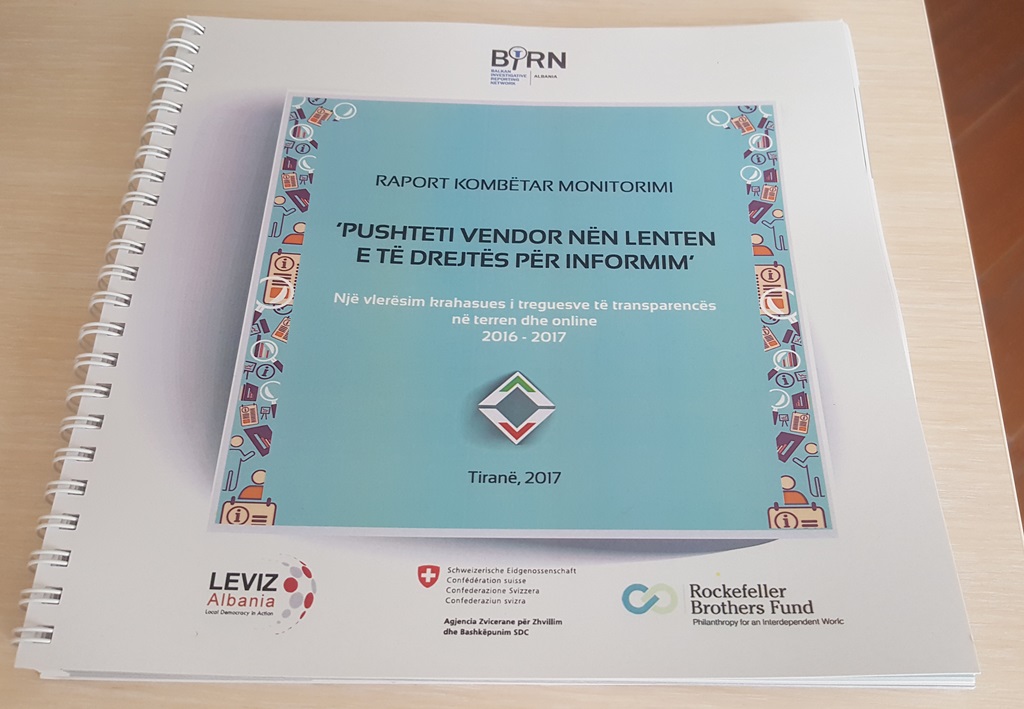
The Balkan Investigative Reporting Network in Albania on April 26 presented its newly published national report, Local Government Under the Lens of Freedom of Information: A Comparative Monitoring of Transparency Indicators Online and On the Ground 2016-2017.

The report was published as part of BIRN Albania’s project Strengthening the Local Partnership between Media and Civil Society.

The project, funded by Leviz Albania and the Rockefeller Brothers Fund, aims to strengthen the public’s pressure mechanisms on local government institutions and increase transparency by strengthening cooperation between journalists, civil society groups and grassroots organisations.

The report contains the results on the transparency of the 61 local government units in Albania, based on 50 indicators, evaluated in both 2016 and 2017, tracing the progress made by local municipalities in the implementation of the freedom of information and public consultation laws.

According to the monitoring data, these indicators were realised by 46 per cent of local municipalities in 2017, with the majority of the municipalities failing to realize half of the monitored indicators.

The figure represents a modest improvement of three per cent from 2016, when the transparency level was 43 per cent.

The new data collected through the report in 2017 shows that as in 2016, local municipalities in Albania are more transparent when it comes to the ‘freedom of information’ and ‘municipal councils’ category/indicator, and less transparent on a national level in ‘financial transparency’ and ‘legislation’.

The monitoring of municipalities for the report was carried out in February 2017 and June 2016 by a network of local journalists across Albania.

Click here for copy of the report in Albanian

Call for Expression of Interest

Strengthening the media’s role in transparency of political party financing.

Durres, April 29-30, 2017

Balkan Investigative Reporting Network, Albania (BIRN Albania), as part of the project ‘Strengthening the media’s role in transparency of political party financing’ supported by the National Democratic Institute in Albania, will organize a two-day training session in investigative journalism techniques that help shed light in the field of political party financing in the country.

BIRN Albania is seeking 15 mid-career journalists from all the regions of Albania to attend the investigative journalism training workshop on April 29th-30th 2017, in Durres.

Introduction to the training:

The training serves to provide a guide to the basic methods and techniques of investigative journalism as well as an overview of the political parties’ finances in Albania. It aims to strengthen the skills and training of mid-career journalists to look closely at systemic issues of illicit financing of political parties and conflict of interest, with a special focus on the red flags raised by the reports filed in the Central Election Commission, CEC.

Who should attend:

The training targets mid-career journalists in Albania who are interested to deepen their knowledge of investigative journalism techniques and political party finances in Albania. Journalists from other regions outside Tirana are encouraged to apply. BIRN Albania will cover travel costs for all journalists participating in the training.

Training objectives:

The outcome for participants will be:

1. Improved understanding of Albania’s political party finances;

2. Improved applied methods and techniques of investigative journalism.

Application procedure:

Interested candidates must send a letter of interest to [email protected]. Applications for this training close on Thursday, April 27th. Successful candidates will be informed shortly thereafter.

Bursaries:

The journalists who take part in the training will participate in a competition from which BIRN Albania through an independent jury will select story ideas for five in-depth analyses related political party finances that will be funded from the project and published with the help of BIRN editors via the online publication Reporter.al.

BIRN Albania Seeks Investigations on Financial Industry

Grants offered for three journalists to uncover corruption and abuse of power stories in the financial industry as well as mentoring by experienced editors.

The Balkan Investigative Reporting Network in Albania launched a call for investigative stories on local government on February 9th.

The call is part of the project “Exposing Corruption in Albania”, while the grants are supported by the National Endowment for Democracy.

Three journalists will be awarded grants to cover their expenses while conducting investigations and writing their stories on the financial industry.

The journalists will have some three months to dig deeper and research their ideas, having the opportunity to work with experienced editors as mentors to guide them through the process of writing in accordance with BIRN standards.

The call only applies to journalists from Albania and closes on February 28th.

Click for more information about the application procedure, with details in Albanian.