After 14 years of supporting journalists across the Balkans, we are now also accepting applications from Visegrad Group countries — Czech Republic, Hungary, Poland and Slovakia.
The Fellowship for Journalistic Excellence provides financial and editorial support to professional journalists who have strong ideas for cross-border stories. This year’s theme is the Rule of Law.
Send us your application with your proposal by March 10.
The Balkan Investigative Reporting Network in Albania, together with the Albanian Center of Quality Journalism, held a workshop on February 6 on political party financing.
The workshop, supported by the British embassy in Tirana through the National Democratic Institute, was attended by 28 journalists and aimed to introduce reporters to best practices on campaign financing and regulation.
The workshop was led by Lolita Cigane, an international expert from Latvia on issues of campaign and political party financing. Cigane has worked on campaign finance reform since 2001, when she was first the project director of a campaign finance monitoring project co-run by Transparency International Latvia and the Soros Foundation Latvia. From 2010-2018 she was a member of Latvia’s parliament.
Cigane presented the Latvian example to the Albanian reporters, explaining how the Baltic country went from an unregulated ‘jungle’ to a well-functioning system of political party campaign financing, and the role that civil society and media played in the process.
The participants then held a brainstorming session for possible investigations into campaign finance issues.
BIRN Kosovo held its first training session with the Auditor General and Head of Department for International Communication and Cooperation in Auditing on February 3 as part of a project aimed at increasing transparency and accountability over the management of public funds.
Supported by the embassy of the Kingdom of the Netherlands in Pristina, the training courses are intended to improve the performance of the Auditor General and National Audit Office staff in reporting and providing information on public spending.
During the training, the executive director of Internews Kosovo and Pproducer and director of the ‘Life in Kosovo’ TV show, Faik Ispahiu, gave insights into how to organise a public presentation, including arranging the space, assigning tasks, preparing speeches, and creating a presentation plan.
The training was followed up with a technical exercise showing how to use a prompter during public appearances.
BIRN Kosovo will provide the Auditor General and the National Audit Office with two further training sessions, aimed at improving the performance of the Auditor General and National Audit Office staff during public appearances and on social media.
The two-year project will be implemented by BIRN, the Center for Investigative Journalism Montenegro, CIN CG, and weekly news magazine Monitor, supported by the EU Delegation in Podgorica.
This project aims to strengthen investigative reporting capacities and public interest in topics related to environmental protection in Montenegro, while increasing the amount of quality media content related to relevant EU negotiation chapters (Chapter 27, as well as 23 and 24).
Its goal is to strengthen participatory democracy and the EU integration process in Montenegro by empowering and stimulating an enabling professional and financial environment for pluralistic media.
It also aims to foster independent and investigative journalism in order to generate quality media content, both for national and local media, in areas related to Montenegro’s European integration process.
“This project comes at the perfect moment for Montenegro, as citizens have finally started waking up and raising their voice against numerous environmental violations,” said Dusica Tomovic, managing editor of BIRN’s regional publication Balkan Insight and organisation’s representative in Montenegro.
Tomovic cited public protests against the cutting down of cypress trees in Bar, the building of an adventure park in a national park in Zabljak and of a mini hydropower plant in Savnik, as well as other environmental problems across the country.
“We believe that citizens were encouraged to act due to numerous previous investigative articles on environment devastation, developed through our previous EU grants, while each protest was widely supported by media,” Tomovic said.
“At the same time, Montenegro opened negotiations under Chapter 27 only half a year ago, in which input related to the environment will be of very high importance for the next EU country report on Montenegro, the future of Montenegro’s accession process, and the wellbeing of all citizens,” she added.
The project will help inform the public about the most important issues related to Montenegro’s further EU integration, but also allow people to get directly involved through a newly-designed web platform that will enable them to become active citizens and amateur journalists (citizen reporters) by reporting on local environmental issues.
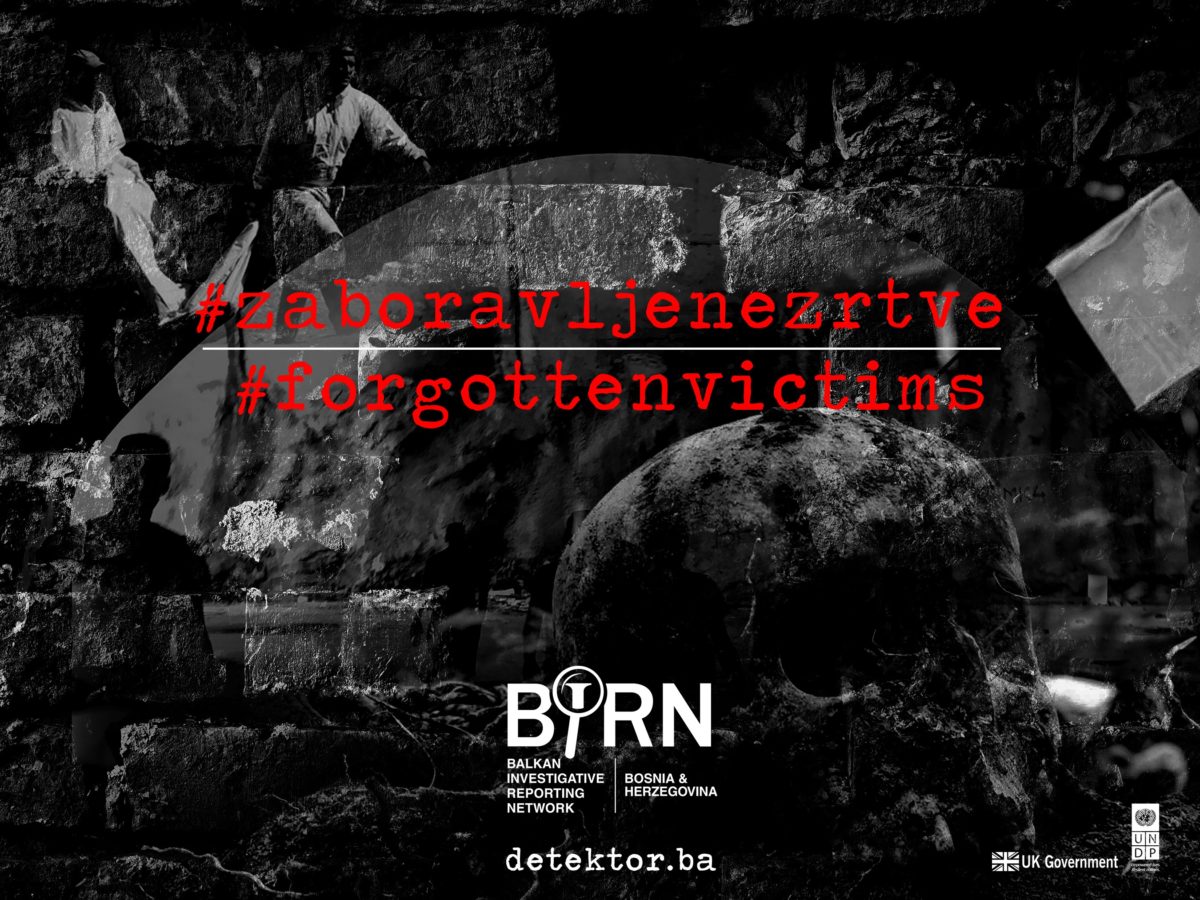
BIRN Bosnia and Herzegovina is launching a campaign entitled ‘Forgotten Victims’, aimed at highlighting the victims of war crimes for which no one has yet been convicted under final verdicts.
BIRN Bosnia and Herzegovina on Monday begins its ‘Forgotten Victims’ campaign, which intends to enable victims of unprosecuted war crimes and their families to speak about what they went through and draw public and judicial attention to violations that have still not been prosecuted.
The project is intended to encourage the opening of investigations and the filing of indictments against suspects.
Denis Dzidic, the director of BIRN Bosnia and Herzegovina, said that there have been fewer and fewer war crimes cases launched in the country in recent years.
“The number of war crimes indictments filed at the state level is in decline each year and witnesses to those events are dying, so it is important to draw attention to crimes for which nobody has been tried as yet, particularly to cases in which suspects live outside Bosnia and Herzegovina and are unavailable to prosecutorial authorities,” Dzidic said.
As part of the project, BIRN Bosnia and Herzegovina will publish ten reports about unprosecuted crimes in ten communities.
A photograph of a war victim and their relatives will also be published each Monday over the course of the next ten months, conveying their personal story and calling on judicial institutions to take action.
Although nearly 25 years have passed since the end of the Bosnian war, many victims have still not had an opportunity to testify in court about what they went through and contribute to bringing those responsible to justice.
So far, around 850 people have been sentenced at the state level in Bosnia and Herzegovina to a total of 2,750 years in prison for wartime crimes.
But the state prosecution still has around 500 pending war crimes cases involving identified perpetrators and as many cases against unidentified ones.
The Forgotten Victims project is supported by the government of the United Kingdom and is being implemented by the United Nations Development Programme, UNDP, as part of its Regional War Crimes Project.
BIRN Kosovo gave a training course for local media in Gjakova/Djakovica and the surrounding area on January 27, focusing on fact-checking standards in journalism.
During the first part of the training, media representatives looked into the importance of facts in research, learning how to employ BIRN’s own fact-checking tool, the ‘Krypometer’ (‘Truth-o-Meter’).
The second section of the seminar continued with training related to ethics in journalism, truthful reporting, privacy, copyright, and resource protection.
During the third section, participants had the opportunity to gain insight into reporting based on whistleblowing, journalistic security, research based on International Fact-Checking Network standards and in-depth research for television.
The training was led by Visar Prebreza, editor at BIRN Kosovo and Labinot Leposhtica, the head of BIRN’s Legal Office.
Local journalists, media correspondents and court monitors working in the municipalities of Gjakova, Istog, Malisheva and Rahovec participated in the training.
The course was organised by the ‘Civil Society Program for Albania and Kosovo’, funded by the Norwegian Ministry of Foreign Affairs and managed by the Kosovo Foundation for Civil Society (KCSF) in partnership with Partners Albania for Change and Development (PA).
BIRN Investigative Resource Desk (B.I.R.D.) is an innovative interactive platform created for journalists who want to keep up-to-date with the fast-changing world of technology without sacrificing their ethics or the standards of professional journalism.
BIRD provides investigative journalists with various types of assistance and a set of tools and resources relating, but not limited, to freedom of information, data access and protection, cyber security and open source datasets. Assistance is free and provided on a needs basis.
An integral part of BIRD is the digital freedom-monitoring database covering the state of digital rights in Southern and Eastern Europe. Recognising the open and global nature of the online arena, the database stresses the importance of a human rights-based approach towards people in the digital environment.
Technical sabotage, stifling freedom of expression and opinion, personal attacks and campaigns of hatred in the digital sphere have all increased as the role of online media, social networks and other platforms has become stronger in Southern and Eastern Europe – societies where traditional media actors are largely controlled and used as political tools.
In this new environment, the role of investigative journalists remains decisive – but how to handle big data, and stay secure and ethical in the open space run by algorithms, is a challenge for all of us. Through BIRD, we want to take an active role in shaping the future of journalism.
Thirteen journalists, activists and researchers will spend the coming months exploring the many facets of radicalisation and media manipulation in the EU and neighbouring states as part of the second generation of Resonant Voices Fellows.
The Resonant Voices Initiative is pleased to announce the new cohort of Resonant Voices Fellows and welcome Filip Balunovic, Valbona Bezati, Saska Cvetanovska, Merxhan Daci, Harun Dinarevic, Vladan Djukanovic, Jelena Djureinovic, Una Hajdari, Andjela Milivojevic, Predrag Momcilovic, Jeton Musliu, Ani Sandu, Fjoralba Sinoruka.
They will join the growing community of researchers, journalists, and activists working to expose and challenge extremist messaging targeting vulnerable audiences in the European Union and its neighbourhood. Fellows’ work also contributes to developing communication strategies as a means to combat these threats.
Similar to the previous year, the competition was fierce, and we received many more high-quality applications than we could support. Selected Fellows will receive funding and professional support from Balkan Investigative Reporting Network editors and experts to conduct in-depth research and investigation.
The ten new fellowships in 2020 are awarded to individuals and teams that will explore audience engagement strategies of media manipulators, trace the origin of far-right memes to discern their international appeal, deconstruct conspiracy theories and analyse the evolution of ideological and political identity of diaspora communities in multiple European countries.
BIRN is proud to announce BIRD, a unique platform that provides investigative journalists with a set of invaluable tech tools and resources, as well as various types of assistance.
The Balkan Investigative Reporting Network (BIRN) launched a cross-border journalism platform on Thursday with the aim of helping journalists all over the globe by providing them with knowledge and assistance necessary in today’s world.
BIRN Investigative Resource Desk (BIRD) is an innovative interactive platform created for professional and citizen journalists who want to keep up-to-date with the fast-changing world of technology without sacrificing their ethics or the standards of professional journalism.
In times of media deterioration, and with new challenges in the digital sphere that are shaping the world, journalism’s ecosystem is changing fast, and in unpredictable ways. The role of journalists across the world has never been more complex.
BIRD is BIRN’s latest move to strengthen journalism in Southeast Europe and beyond. For months, we have worked together with a team of dedicated journalists, editors and developers to create a platform that is easy to use and provides all relevant information in one place.
As we believe that information is power, our vision was to use the potential of the BIRN network and its knowledge base to create something that can be used widely, for free.
Through BIRD, we wanted to offer journalists an easy way to learn and stay on track with the latest developments in the digital sphere. That way, BIRD users will be able to get all the latest updates on the state of digital freedoms, opportunities within the journalism network and beyond, and news covering these topics.
The platform provides investigative journalists with various types of assistance and a set of tools and resources related, but not limited, to freedom of information, data access and protection, cyber-security and open-source datasets.
The assistance of our experts is free and provided on a needs basis.
BIRD also contains various databases and a set of tools that can be used in daily reporting. Currently, the platform offers 20 different publications on topics such as freedom of information, data protection, journalism sustainability, verifying information and many more. And we intend to add more in future.
As part of our drive for openness, we have also established a free, user-friendly, searchable online library of public documents and scraped database. Called BIRN Source, it currently contains almost 1,300,000 documents, files and records. The numbers will soon rise as the database is being updated in real-time.
BIRN Source is designed to be easily searchable and useful to journalists and editors from Southeast Europe, and all over the world. The database offers text recognition in multiple and all-local languages.
We are also proud of BIRD’s How-to’s section. This is where users will be able to read case studies and guides done by some of the most prominent journalism experts, such as Blake Morrison, Frederik Obermaier, Benjamin Strick and others. We believe that the experience they have shared may motivate journalists to implement some of the solutions in their own newsrooms, and come up with new ideas.
Recognising the open and global nature of the online arena, the database stresses the importance of a human rights-based approach towards people in the digital environment.
Together with Share, BIRN journalists will monitor and fact-check cases of digital rights violations across the region as soon as they happen.
The database is searchable by different criteria (date, country, affected party, means of the attack, description, attacker, etc.) and is available in both English and the local languages of the countries where the monitoring is being conducted.
Unique database compiled over months shows how the cash-strapped country spends millions of euros a year on pricey limousines for government officials.
Over 10.6 million KM – equal to 5 million euros – was spent on purchasing 329 official limousines in Bosnia in 2018 whose price averaged 32,000 KM, or about 16,000 euros, a BIRN database reveals. In total, it recorded tenders to procure 1,666 official vehicles, worth about 46 million euros, in 2018.
The BIRN database, which has proved a talking point for the public in Bosnia, shows how Bosnian politicians enjoy overpriced luxury vehicles on a scale without comparison in Europe. It also shows that most of the tenders for the vehicles also had only one bidder, indicating corruption, besides the issue of a serious lack of control of budget spending on cars.
BIRN has meanwhile published dozens of articles of specific cases that have highlighted two important things: first, that there are numerous examples of such overspending, but secondly that stories soon begin to repeat and look the same to the audience, lowering their impact.
By late 2017, BIRN Bosnia was already collecting all tenders related to cars from the public procurement website, the centralized Bosnian government portal where institutions and public companies are obliged to published their tenders. It then published analysis in December showing that around 5 million euros was spent on vehicles in 2017.
After reporting about various violations of public procurement practices, several institutions amended their tender specifications. BIRN then decided it would be more effective to make a complete database, with every tender related to official cars.
It took around six months to work with an IT company to develop the database structure and manually input hundreds of tenders for car purchases and data on more than 3,000 cars into our car registry – where BIRN publish data on existing cars owned by institutions.
In mid-2018, BIRN published the database and the data for first half of that year. After wrapping up the database for whole year, the final figure of more than 93 million Bosnian marks, or more than 46 million euros of total tenders for car purchases in 2018, was a surprise.
The data showed that there is no competition in tenders to buy cars for officials; the vast majority of tenders had only one bidder. It also showed who bought the most expensive cars and how they did it, as well as the preferences in terms of models and brands.
The database also contains a register of vehicles already owned by institutions and public companies, which shows that the average cost per vehicle is around 25,000 euros.
Another important part of the database was a car registry, that now has more than 3,500 cars from numerous government institutions. It is a unique database in Bosnia, as no official data is available in the country on which institutions own what cars, and how much they are worth.