RAE Community Establishes a Radio Station in Gjakova

The Roma Ashkali and Egyptian, RAE, community in Kosovo has a new radio station, with the establishment of Prosperiteti in Gjakova.

BIRN Kosovo played a role in the establishment of Prosperiteti, which will be streamed online, by organising meetings and trainings.

Lendrit Qeli, who runs Prosperiteti and attended BIRN’s training, said the station will benefit the community greatly.

“There will be topics to raise the community awareness in the municipality and at the same time we will do promotions that until now did not have the opportunity to get promoted through other mediums,” Qeli said.

Prosperiteti received donations from the Gjakova municipality and the Italian organisations IPSIA and CELIM MILAN.

Protecting journalists’ sources

The protection of the journalists’ sources is largely weak in Kosovo. To further discuss this issue the “Rubikon” TV programme invited representatives from the Democratic Party of Kosovo, Vetevendosje, media outlets and BIRN. The representative of BIRN was Flutura Kusari.

Considering the difficulties that journalists face because of the absence of the law of protecting the sources of information, BIRN together with ARTICLE 19, a London-based human rights organization, drafted a law that will serve as a protection for these sources.

The draft law was sent to the parliament and BIRN publically asked MPs to adopt the law since it is crucial for freedom of speech and expression.

Kosovo’s transparency problem

Kosovo’s public institutions are largely failing to implement the 2010 law on Access to Public Documents, BIRN Kosovo concluded in a report released June 29.

Report, titled “The State is 30 Per Cent Accessible to Citizens,” is the culmination of a year-and-a-half of monitoring of public institutions to examine the implementation of the law.

Concluding that government institutions respond to only 30 per cent of official requests, the report found that the Prime Minister Office is the least transparent institution. 

Gresa Musliu, a BIRN Kosovo researcher, presenting the report to Kosovo’s media, noted that only 100 of 300 official requests to government institutions received positive responses. In the case of 100 requests to the prime minister’s office, fewer than 30 were responded to.

In one case, when BIRN requested access to spending reports from official trips, the Prime Minister’s office refused on the grounds that the reports could reveal diets, and thus expose confidential health information. As a result, BIRN Kosovo has sued the Prime Minister’s office.

Musliu singled out the Agency for Protection of Personal Data, whose opinion was used to justify the Prime Minister’s Office decision not to disclose the trip reports, as contributing to a lack of government transparency.

“This agency presents risk for transparency, because since the establishment it is allegedly finding reasons to justify the lack of transparence of the legal institutions,” Musliu said.

The least transparent institutions include: the municipality of Prishtina, Kosovo Cadastral Agency, Prosecutorial Council and Judicial Council of Kosovo. While, among the transparent institutions are: Business Registration Agency in Kosovo, the Office of the General Auditor, and the Anti-Corruption Agency.

This report contains an exact template for writing official requests and also specific examples of requests sent by BIRN to the public institutions. Moreover, it provides recommendations for the public institutions and the citizens who want to have access to public documents.


Please see the full report here: PDF

The Freedom of Press in Kosovo

The United Nations General Assembly declared May 3 as the World Press Freedom Day to raise awareness of the importance of freedom of the press. To discuss the freedom of press in Kosovo “Rubikon” TV programme  invited representatives from Association of Professional Journalists in Kosovo, media commission from the parliament, Radio Television of Kosovo, and BIRN – represented by Flutura Kusari.

The main issue discussed was the transparency of institutions on providing public documents. There is not enough transparency of these institutions since there are a lot of barriers to have access on the public documents.

Kusari, legal advisor at BIRN, explained the law on Access to Public Document, adopted by the Assembly on October 7, 2010, which gives full access to public documents.

BIRN has sent official requests to institutions asking for accessibility in the public documents. “The most transparent institution regarding the accessibility to documents is the Kosovo Business Registration Agency, while the least transparent ones are Data Protection Agency and the Prime Minister’s Office,” Kusari said.

Illegal Gravel Exploitation

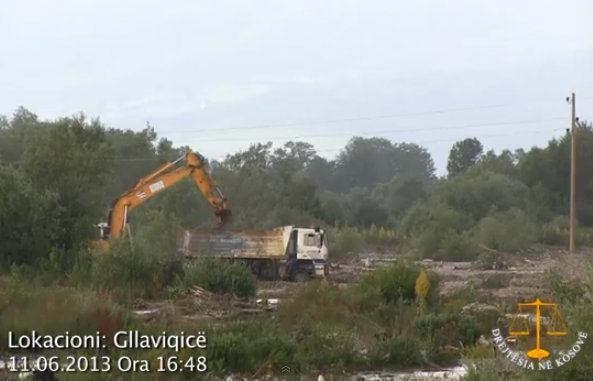
A two-month investigation by BIRN Kosovo’s “Justice in Kosovo” TV programme has found numerous instances of illegal gravel excavation from Kosovo’s rivers.

The June 24 programme also aired exclusive footage of government inspectors from the Independent Commission for Mines and Minerals being attacked during the seizure of an excavator.

“People are following me, and I am scared. I had to take a vacation from the job and I have not left home since then alone,” said inspector Refki Morina, who reported that the threats stopped after the programme aired.

“Justice in Kosovo” found that those taking the gravel were doing so at the expense of the environment.  Furthermore, judicial bodies have failed to prosecute the exploiters, who typically start work at 4 p.m., when inspectors are off-duty.

Live Web Debate on the Amnesty Law

BIRN Kosovo streamed its first live web debate on July 4. The debate on the amnesty law represented a new product for BIRN Kosovo, and it gained the attention of numerous viewers.

The guests were Daut Xhemajli – deputy minister of justice, Albulena Haxhiu – deputy from Vetevendosje, and Florent Spahija – legal advisor in BIRN. Also, prisoners from the prison of Dubrava were a part of the live debate through telephone.

This law has been opposed by some members of the opposition in the parliament, while the government said the law was crucial.

A prisoner from Dubrava said that they want to benefit from the law on amnesty just like the other prisoners from the region. “We are not asking get fully amnestied, but just for an acceptable percentage,” added the prisoner. He also claimed that they had a decent support from the government, but no support at all from the other parties from the opposition.

Fugitives Change their Names

On June 20, “Justice in Kosovo” revealed that fugitives wanted by Interpol had changed their names in Kosovo. The programme found that four fugitives were able to do this because of a lack of coordination among authorities in Kosovo.

For instance, Enver Aliu, wanted on drugs charges, ,successfully changed his identity in the municipality of Vitia. He changed his name even though the persons that are under investigation legally cannot change their name or surname.

He changed his name to Mehmet Mjaku. “Justice in Kosovo” verified this by comparing his personal ID number.

The Police of Kosovo also confirmed that it is the same person. “The person that you are referring to is wanted from the authorities of Macedonia,” said Kosovo police spokesperson Baki Kelani.

There are three similar cases of fugitives that changed their names. Because of these occurrences, the Ministry of Internal Affairs decided in July 2012 that municipalities must require verifications from Kosovo Police when people petition to change names.

Водичот за истражувачко новинарство објавен и на македонски

Водичот за истражувачко новинарство на Балканската истражувачка репортерска мрежа „Под површината“, напишан од професорот на Универзитетот Колумбија во Њујорк, Шила Коронер излезе од печат и на македонски јазик.


Водичот е наменет за истражувачките новинари од Балканот и ќе биде дистрибуиран до сите факултети за новинарство и библиотеките низ земјата, како и до новинарите кои ќе бидат вклучени во различните проекти имплементирани од БИРН Македонија.

Преводот и печатењето на книгата беа овозможени од Фондацијата институт отворено општество Македонија.

„Под површината“ е производ на Иницијативата за истражувачко новинарство на БИРН, образовна програма која вклучува соработка со меѓународни универзитети и локални партнери со цел водичот да биде ставен во комерцијална употреба како учебник за истражувачко новинарство.

Во книгата се сместени новинарски текстови, поврзани со интересни совети, вештини, истражувачки приказни, дата бази, студии на случаи, вежби и техники кои ги инспирираат читателите да го прифатат предизвикот на истражувачкото новинарство.

„Под површината“ е дел од тренинг програмата на Летната школа за истражувачко новинарство на БИРН. БИРН веќе има отпечатено две изданија од водичот на англиски јазик, како и преводи на српски и албански јазик.

Заинтересираните за овој водич за истражувачко новинарство може да ја контактираат канцеларијата на БИРН Македонија на следната електронска адреса: [email protected].

BIRN’s ‘Digging Deeper’ Published in Macedonian

BIRN’s investigative journalism guide “Digging Deeper”, written by Sheila Coronel, director of the Stabile Center for Investigative Journalism and professor at Columbia University, New York, has been published in Macedonian.


The guide for the investigative journalists in Macedonian, entitled “Pod povrshinata”, will be distributed to universities and libraries across Macedonia but also to journalists involved in different projects implemented by BIRN Macedonia. The handbook’s translation and print was funded by the Foundation Open Society Institute Macedonia.

Digging Deeper” is a product of BIRN’s Investigative Reporting Initiative, an educational programme that includes cooperation with international universities and local partners with the aim of putting the guide into commercial use as a curriculum for investigative reporting.

In the guide, journalists’ articles, coupled with interesting advice, skills, investigative stories, databases, case studies, exercises and tips and techniques inspire readers to take up the challenge of a career in investigative journalism.

BIRN’s “Digging Deeper” is part of the curriculum of the BIRN Summer School of Investigative Reporting LINK. BIRN has published two editions of the book in English, which has been translated into Serbian and Albanian as well as Macedonian.

All who are interested in obtaining free copy of this valuable guide for investigative journalists should contact BIRN Macedonia office at this email address: [email protected].

See the full text in Macedonian here.

Thousands Sign Bosnia Petition to Stop Censorship

Close to 3,000 people have signed a petition against the court of Bosnia and Herzegovina’s practice of withholding information from war crime trials.

BIRN BiH launched the petition three weeks ago as a part of its ‘Stop Censorship Over War Crimes’ Campaign. Over the course of six days, people in Sarajevo had the chance to better inform themselves about the issue of the anonymisation of court documents.

“As of last year, we have verdicts for war crimes that literally state ‘F.K. together with S.F. committed a crime in town B., Municipality Z.’, which means that you as a citizen have no idea where this crime happened or who committed it,” said Selma Ucanbarlic, BIRN’s court monitor and Justice Report journalist.

Apart from initials replacing names in verdicts and indictments, the court of BiH releases only 10 minutes of audio-video material from trials, preventing the public from hearing victims’ full testimonies.

“How else as ordinary citizens living here can we know whether someone who killed, robbed, and committed other atrocious crimes is walking among us?” said one Sarajevan after signing the petition.

BIRN’s petition is just one of the activities organised to help raise public awareness about censorship. In the coming weeks, the campaign will continue in other towns, after which the signatures will be submitted to the authorities.