BIRN Albania Self-Censorship Study Discussed in Parliament

The media commission in Albania’s parliament held a hearing on January 25 dedicated to BIRN Albania’s study, A Blind Eye on News: Self-Censorship in the Albanian Media.

The key findings of the study on the frequency, roots and causes of self-censorship in the local media were presented to the commission by BIRN Albania’s editor Besar Likmeta, who underlined that data collected through the survey of 121 journalists and 22 in-depth interviews with key sources suggests that self-censorship is widespread in the Albanian media. 

 “Self-censorship is not a free choice for a journalist and neither represents their natural approach toward news, but rather the result of the influence of a series of interconnected social, economic and political factors that affect the daily practice of news reporting and the quality of the media in general,” Likmeta told the MPs.

The hearing was called by the media commission in order to assess the working conditions, job security and safety of journalists in Albania – issues that are also reflected in the study.

The MPs praised the quality of the report and discussed ways in which the parliamentary commission could be more active in order to improve the working conditions of Albanian journalists. 

They discussed the recommendations produced by the report, centring on ways to improve the implementation of the labour code by media outlets as well as methods to increase transparency and fairness in the distribution of government-sponsored advertising.  

BFJE Alumni Network Expands in 2015

Each year after the Balkan Fellowship for Journalistic Excellence programme ends, the BFJE Alumni Network grows, and in 2015 it produced seven in-depth articles.

This year’s seven in-depth articles were researched and written by nine BFJE Alumni Network journalists from across the region.

Juliana Koleva and Kostas Kallergis investigated Greek and Bulgarian baby-selling routes, Lina Vdovii wrote about Romanian international adoptees who try to find their biological families via social media, Lavdim Hamidi covered the problems of privatization in Kosovo, and Nela Lazarevic wrote a story about Mamula Island in Montenegro, whose future is causing much controversy between locals and the government.

After New Year, more BFJE Alumni Network will be published on Balkan Insight.

Arbana Xharra will publish a story about women from Kosovo who join ISIS, there will be a cross-border investigation by Aleksandar Manasiev and Mirko Rudic about police from Macedonia and Serbia suing their states, and an investigation by Erjona Rusi about children in Albania and Kosovo exposed to porn via social media.

The Alumni Initiative is designed to encourage and support continued cooperation between fellows who have participated in the Balkan Fellowship for Journalistic Excellence, which was established in 2007.

The Alumni Initiative is supported by Open Society Foundation and ERSTE Foundation in cooperation with the Balkan Investigative Reporting Network.

Citizens Choose Favourite Projects in Participatory Budgeting

After proposing and voting on projects, ordinary people in ten participating municipalities have selected the ones that they want to see financed from their municipal budgets.

Ten municipalities taking part in the Participatory Budgeting project have assigned part of their 2016 budget for financing projects that were chosen as the best among the many proposed.

Local people had a chance to nominate projects that they thought would best advance their community, after which the Commission in each municipality selected the best.

Voting took place from November 9 to December 15 2015, after which it was decided which projects would be put into practice.

Each municipality selected one or more projects to finance from their budgets. Some will be setting up gyms in the open air, others constructing lakes, erecting fountains in public places, building playgrounds and much more.

Prior to the adoption of the budget, all the municipalities also held local budget forums where local residents, representatives of the business community and the media, as well as citizens’ associations discussed the 2016 budget.

The project includes ten municipalities – Sombor, Knjazevac, Trstenik, Pancevo, Zrenjanin, Pirot, Ruma, Sabac, Sremska Mitrovica and Vracar.

The aim of the Participatory Budgeting project in the 10 local communities is to introduce the practice of public participation in the decision-making process on local budgets.

“Skopje 2014 Uncovered” Gets Mobile App

BIRN Macedonia has developed an interactive app for Android devices called “Skopje 2014 Uncovered” that allows users to know the cost of buildings and monuments that form part of the government sponsored revamp of the capital.

BIRN’s new app lists all the edifices that are included in the BIRN’s official database of buildings, new facades, sculptures, monuments, fountains and other structures which are components of Skopje’s publicly funded makeover.

Through photographing a specific structure, users can now get its exact cost. By photographing with a wider span, users can find out the cost of each structure in the picture or get the total sum.

To obtain more information, the app “Skopje 2014 Uncovered” also allows connection to BIRN’s database with the same name.

Photographs made through the app can be shared through social networks or sent via messages with one click.

The app is available on Google Play.

BIRN Kosovo Wins Two Anti-Corruption Awards

BIRN’s ‘Justice in Kosovo’ (‘Drejtësia në Kosovë’) TV programme and Life in Kosovo (Jeta në Kosovë) newspaper won awards for anti-corruption investigations on the international day against corruption.

The awards for anti-corruption reporting were presented to BIRN’s journalists on Wednesday by the United Nations Development Programme (UNDP), the Anti-Corruption Agency (ACA) and the Association of Journalists of Kosovo (AJK).

The ‘Justice in Kosovo’ programme team, Kreshnik Gashi, Naim Krasniqi and Behar Mustafa, were awarded for their investigation ‘F2 File’ which began in December 2014.

The investigation showed how the contract of the Ministry of Health become the target of allegations of corruption and forgery over the supply of equipment and medicinal products worth millions of euros.

After the programme was broadcast, the owners of three companies involved in the case were arrested and the Prosecutor’s Office in Pristina opened a criminal investigation.

As a result, the Agency for Medicinal Products and Equipment has cancelled licenses for the Friends company, while the Ministry of Health has suspended its contract with the firm. The Health Inspectorate has also blocked stocks of the company’s medicines.

“It is a motivation for us to go further,” said Kreshnik Gashi, the editor of ‘Justice in Kosovo’.

“It is a concern the fact that corruption is increasing in this country, and the number of investigations into corruption are decreasing, as is shown by the number of applications, because every day the number of journalists who fight corruption is decreasing, and this should be a warning for all of us,” Gashi added.

The newspaper ‘Life in Kosovo’, was awarded for a story entitled “Suspicious Emeritus of UP”, about corruption in the education system.

This story shows how the three professors at the University of Pristina, who hold the title “Professor Emeritus” do not meet even the basic requirements to keep that title.

Zejnel Kelmendi, Faik Brestovci and Mujë Rugova are those who hold this title – two of them were former rectors of UP. They receive the same salary as the regular professors in UP – over 1,429 euros. But several years later, UP had come to the conclusion that they do not meet the basic criteria to get that title. In fact, it is said that neither their files for these titles are listed in the Rectorat.

Balkan Fellowship for Journalistic Excellence Launched in Vienna

Ten fellows from Albania, Bulgaria, Croatia, Greece, Kosovo, Romania and Serbia have come to Vienna to take part in the opening seminar of the ninth Balkan Fellowship for Journalistic Excellence programme.

The fellows came to the Austrian capital to refine the story proposals which formed the basis of their applications for the programme.

The participants are receiving coaching and professional support in planning their research, carrying out their reporting and structuring their stories.

They also participate in story commissioning sessions led by BFJE programme editor Andrew Gray and Balkan Insight Editor in Chief Ana Petruseva.The purpose of these sessions is to brainstorm ideas in order to come up with new angles and sharpen the focus of the stories.

The seminar also includes a photography workshop and a visit to the newsroom of the prominent Austrian daily Der Standard.

The BFJE programme was established in 2007 and provides 10 journalists annually with training and mentoring, as well as the financial resources to travel and carry out research, in order to produce long investigative or analytical stories on topics important to the region’s development. The Balkan Fellowship for Journalistic Excellence is supported by ERSTE Foundation and Open Society Foundations.

Balkan Fellowship for Journalistic Excellence Winners Chosen

Zornitsa Stoilova was awarded first prize for the best story from the 2015 Balkan Fellowship for Journalistic Excellence programme at a closing ceremony in Tirana on Friday.

Zornitsa won the prize of 4,000 euros for her story about support for ISIS among some members of a marginalised Roma community in Bulgaria.

The second prize and 3,000 euros went to Damir Pilic for his article “Red revival: The fall and rise of Karl Marx”.

The third prize and 1,000 euros was awarded to Laura Stefanut for her story about clothing factories industry in Romania and Bulgaria.

Ten talented journalists from Albania, Bulgaria, Croatia, Greece, Kosovo, Romania and Serbia worked for more than six months on in-depth stories and investigations, exploring different aspects of this year’s fellowship theme, ‘Values’.

The Balkan Fellowship for Journalistic Excellence was launched in 2007 to promote high-quality, cross-border reporting. The programme provides fellows with financial and editorial support, allowing them to travel, research and write their stories and develop their journalistic skills. They also have the opportunity to work with colleagues from neighbouring countries to examine how different nations are tackling important social and political topics.

The jury members who selected the winners were Florian Hassel, Balkan correspondent for the German daily newspaper Süddeutsche Zeitung, Remzi Lani, executive director of the Albanian Media Institute, Gerald Knaus, founder and president of the European Stability Initiative, Milorad Ivanovic, executive editor of the Serbian edition of Newsweek, Martin Woker, correspondent of the Swiss daily newspaper Neue Zürcher Zeitung, Gerfried Sperl, columnist for the Austrian daily newspaper Der Standard. Allan Little, the veteran BBC foreign correspondent, was the selection committee’s annual member, serving for a one-year term.

For the first time in the fellowship’s history, the award ceremony was held in Albania, at Tulla Culture Centre in Tirana.

With this year’s programme concluded, fellows are invited to joint the BFJE alumni network, which already consists of more than 70 journalists from 10 Balkan countries who collaborate on stories and promote high professional standards.

The fellowship will issue a call for applications for next year’s programme in January 2016.

Balkan Fellowship for Journalistic Excellence is implemented by the Balkan Investigative Reporting Network, supported by ERSTE Foundation and Open Society Foundations.  

BIRN Albania Launches Video against Self-Censorship

The Balkan Investigative Reporting Network in Albania has released a two-minute video, seeking to raise awareness among the public, media professionals and decision-makers about widespread self-censorship in the media.

The animation, the work of Albanian multimedia artist Gentian Shkurti, is based on BIRN’s recent report “A Blind Eye on News: Self-Censorship in the Albanian Media”, which highlights the frequency, roots and causes of self-censorship. 

The report provides an overview of self-censorship in the Albanian media, based on interviews with media professionals.

This is the first survey of this phenomenon in Albania and the findings aim to raise awareness of the presence and influence of self-censorship on freedom of expression.

The video presents the key findings of the study in an easily digestible format to reach a wider audience.

During the short clip, the public is urged not “turn a blind eye on news” and support journalists and freedom of expression in Albania.

Production of the video was supported by the Swedish International Development Agency, SIDA. 

Fellowship Closing Seminar To Be Held in Tirana

Ten talented journalists from across the region will reunite in Tirana after eight months of hard work to discuss their cross-border stories, produced as part of the Balkan Fellowship for Journalistic Excellence.

The fellows taking part in the ninth year of the programme have travelled across the region and far beyond to gather material for in-depth articles based on the theme of ‘Values’. They have also attended editing sessions in Belgrade and Skopje with BFJE editor Andrew Gray to finalise their texts.

On Friday, December 4th, the fellows will present their stories to members of the programme’s selection committee, who will then vote for the three best articles. The winners will be awarded a cash prize of 4,000 euros for first place, 3,000 euros for second place and 1,000 euros for third place.

The winners will be announced at the Balkan Fellowship for Journalistic Excellence closing event and award ceremony in Tirana on the evening of December 4th.

The Fellowship programme is supported by ERSTE Foundation and Open Society Foundations. It was created to enable journalists to work on projects of their own choice with editorial and professional support to produce in-depth, cross-border stories on topics of importance both inside and outside the region.

BIRN Launches Balkan Extremism Reporting Project

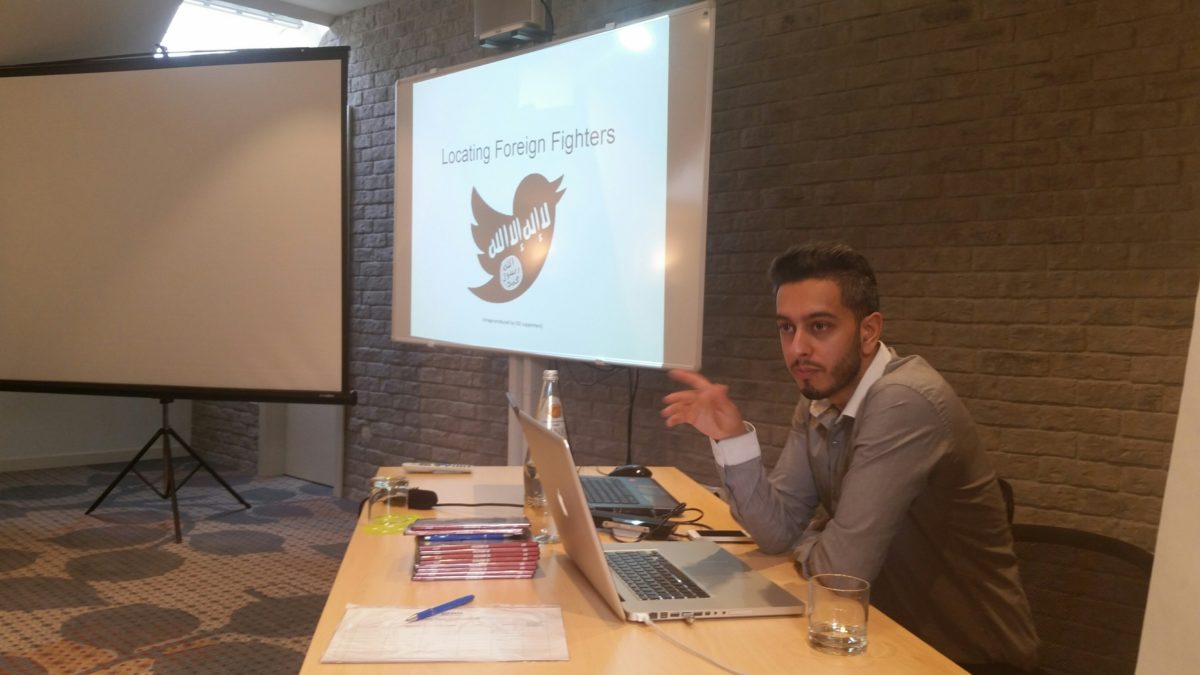
BIRN Hub began a new project focused on online reporting on extremism in the Balkans with two days of training for journalists from across the region.

The two-day training session for 11 journalists from Albania, Bosnia and Herzegovina, Kosovo, Macedonia, Montenegro and Serbia was held in Belgrade from November 21-22 as part of Balkan Investigative Reporting Network’s new project, ‘Strengthening Media Reporting and Public Understanding of Extremism in the Western Balkans’.

The journalists heard lectures from Secunder Kermani, a BBC Newsnight reporter and producer, and Shpend Kursani, a researcher at the Kosovo Centre for Security Policy.

Kermani lectured on various aspects of Islamic theology, and presented an overview of different groups fighting in Syria and Iraq. He also provided journalists with tips on how to avoid the ISIS propaganda machine and how to locate foreign fighters.

Kursani meanwhile presented a report about the causes and consequences of Kosovo citizens’ involvement as foreign fighters in Syria and Iraq.

On the second day, the journalists work on story proposals with head of the project, Marija Ristic, editor Anita Rice and BIRN regional director Gordana Igric.

Besides training, the project involves the continuous production of news, interviews and analysis on a special focus page on the Balkan Insight website entitled ISIS in the Balkans.

The selected 11 journalists will also have continuous on-the-job training and mentoring as a regional journalistic team.

As part of the project, the journalists will produce six in-depth country-based analysis articles and one cross-regional research paper. 

At the end of the project, BIRN will organize a conference with key stakeholders at which they will debate the issue of violent extremism in the Balkans.