BIRN Albania Holds Roundtable on Financial Industry

The Balkan Investigative Reporting Network in Albania held a roundtable on the financial industry, bringing together journalists, civil society organizations and experts. 

BIRN Albania’s roundtable on the financial industry held on February 1st  in Tirana was part of a programme called “Exposing Corruption in Albania”, which is financed by the National Endowment for Democracy, NED.

The project aims to expose corruption in the financial industry by bridging the gap between civil society and investigative journalists, in order to uncover abuses of power, abuse of client trust and abuse of regulations.

About 20 representatives of non-governmental organisations and journalists discussed the topics to be investigated, which ranged from transparency of the financial sector, investment funds’ disclosures with clients and the ability of regulatory institutions to monitor their activities.

Participants at the roundtable also listed questionable loan practices from banks and debt collection services as topics of concern.

The topics highlighted by the NGOs will be listed in BIRN Albania’s upcoming call for investigative stories in the field of financial industry. 

BIRN Film Shows Problems Between Media and Police

The difficult relationships between journalists and the police forces in various countries in the Western Balkans are highlighted in the BIRN Serbia documentary ‘Police and Media’.

The BIRN Serbia documentary ‘Police and Media’ was broadcast on January 23 by the regional television network N1 as part of the Western Balkans Pulse for Police Integrity and Trust project.

The depoliticisation of the police and media is a prerequisite for the solution of this problem, journalists and media experts from Serbia, Bosnia and Herzegovina, Montenegro and Kosovo agreed in the film.

But unlike journalists, representatives of the Montenegrin, Bosnian and Kosovo police believe that police and media enjoy good cooperation. Serbian police did not respond when asked for an interview for the film, however.

Most of BIRN’s interviewees in Serbia said that a selective approach to media, information leaks from investigations and their politicisation, and stigmatisation of certain journalists represents the biggest problems in the relationship between media and police.

Information is leaked to certain media for political purposes, they argued.

The relationship between media and police in Montenegro is similar to Serbia, interviewees said.

Journalists from Podgorica said that there have been some improvements in formal communications between police and media, but certain media are still prioritised.

Journalists from Sarajevo identified information leaks as a problems, but said it is was a lot less widespread than in Serbia.

They said that there are no ‘privileged’ media in Bosnia, and that all of them have same problems, because the information coming from official police channels is the minimum required according to the public’s legal right to information.

In Kosovo, the police force is the youngest state institution is trying to create an image of transparency. Journalists from Kosovo said they do face certain pressures, but they are much less severe than those faced by their counterparts in Serbia and in other countries in the region.

Internet Offers Income Perspectives, BIRN Serbia Debate Hears

People in Serbia are willing to pay for good content on the Internet but there are major issues with clickbait articles, badly-produced news and commercially-led content, a BIRN Serbia debate heard.

A BIRN Serbia debate about the future of media financing entitled ‘How Much Money, So Much Information’ was held on December 22 at the Startit Center in Novi Sad.

Public broadcasting shouldn’t be market-oriented, because that reduces its objectivity, Tatjana Vehovec, executive director of the Center for New Media LIBER, told the debate.

“We need to have services like media research centres. Mass media content begins with headlines like ‘You will not believe what happened’, and a lot of them are clickbait, while BIRN will not achieve anything if it becomes like that,” Vehovec pointed out.

Srdja Andjelic, the creator of the radio programme ‘Mjehur na mrezi’, expressed concern that a lot of people feel they don’t need to get correct information and said that few of them are interested in what will happen to the media.

He also said that people who try to improve the content that Serbian media provides often run into trouble.

“A few of us have always had a problem when we tried to change it,” he explained.

Dasko Milinovic, one of the creators of the online radio show ‘Dasko i Mladja’, said however that the internet offers new possibilities for content creators.

“People are running away from traditional media to the Internet and there is room for everyone,” Milinovic said.

“Mladja and I decided that, since we didn’t have anywhere to broadcast our programme, the best thing was to do something for ourselves. Our goal is to have as many people as possible who will pay to listen to us, so that individual payments don’t have to be huge,” he added.

“We were surprised when we were able to buy equipment and start work using the first payments. We should be thankful for the Internet which provides us with all that space,” said Mladen Urdarevic, the other member of the duo.

Jelena Vasic of the Crime and Corruption Reporting Network (KRIK) said that her outlet gets most of its donations from the diaspora, but a lot of people from Serbia are ready to pay for its content.

“We have a fully developed system of communication with our readers, and from the very beginning, our idea was that if we work for the citizens, then they should be our donors,” said Vasic.


Robert Bierman Becomes New BIRN Board Member

Robert Bierman, a senior executive with blue-chip New York media companies, joined BIRN this month as a new member of its board.

Bierman, who joined the board in January, has expertise in launch, transition, turnaround and growth strategies and has been, amongst other things, the General Manager of Washington Post Live, the Founder/Head of Bloomberg Link, and the Vice President of Live Media at the Fortune|Money Group.

“It was very important, and very difficult, for us to find a person that has strong understanding of both media and business, since it is strategic goal of BIRN to work on strengthening financial sustainability in the coming years,” said BIRN’s regional director, Gordana Igric.

“We are confident that with Robert Bierman as a member of our board, we will find innovative and efficient ways to achieve that,” she added.

Bierman said he was looking forward to helping BIRN to develop its work.

“During its 12-year history, BIRN has championed quality journalism, freedom of expression and public discourse in the Balkan region, under very challenging circumstances. I’m honored to join the board as we look toward the future, extending and sustaining the Network’s important work,” he said.

The other members of the BIRN board are Tim Judah, Per Byman, Wolfgang Petritsch, Steve Crawshaw, Stefan Lehne and Ana Petruseva.

New BIRN Consultancy website launched

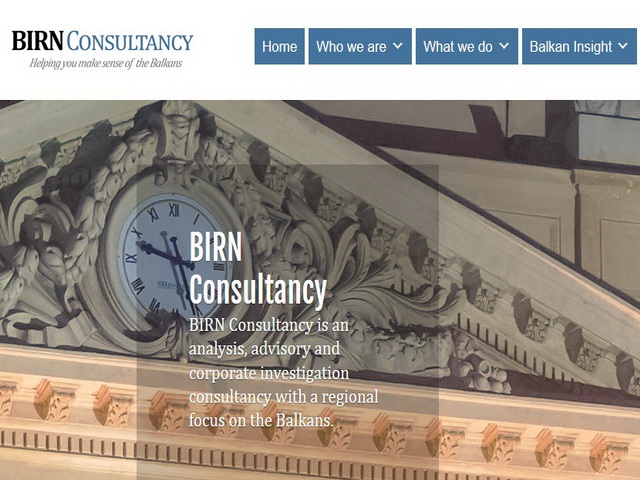
The new website of BIRN Consultancy has been launched as part of the effort to continue developing the consulting arm of BIRN Ltd.

The website seeks to raise the visibility of BIRN Consultancy, as well as to make potential clients aware of the range of services offered by the new consultancy service.

BIRN Consultancy is an independent analysis, advisory and corporate investigation consultancy with a regional focus on the Balkans. Our analysts monitor and examine a wide range of political, economic, security, social and human rights developments within their countries.

This knowledge is then turned into the insights we provide to our clients. Our products range from standardised monitoring of political, economic and security events and trends in the region to more in-depth bespoke reporting tailored to a client’s specific needs.

For more information on BIRN Consultancy, please visit our website

Balkan Insight Stories Feature in Prominent World Media

In recent weeks, some of the most prestigious media around the globe have quoted or republished articles from BIRN’s flagship publication Balkan Insight, reaffirming its position as a source of trusted news from the Balkans for an international audience. 


Photo: ArchDaily.com text 

The New York Times has included several Balkan Insight stories in its overview of European affairs in the last two weeks alone, including a Bulgarian investigation on whether a local arms company broke the embargo on exporting weapons to Syria and two reports about war crimes and transitional justice issues.

Balkan Insight stories are regularly featured in the BBC News website’s section News From Elsewhere section. Most recently highlighted was the article Bulgarians Listen to Classics Thanks to Copyright War, published on January 5, about a dispute over fees with the Bulgarian copyright society that has forced the national radio station to play only music produced before 1945.

Politico.eu also regularly refers to Balkan Insight articles in overviews of European news.

The story about the notorious architectural makeover of Skopje, Architects of Modernist Skopje Decry Retrograde Remodel, published as part of the 2016 Fellowship for Journalistic Excellence, was presented on the ArchDaily website, which attracts 10 million visits every month, on the first day of 2017.

Another controversial urban reconstruction topic from the region, the Belgrade Waterfront project, gained international attention in a Forbes story published in December 2016, which referred to the Balkan Insight report about eviction of the last family living in the area.

Several recent Council of Europe digest reports about corruption also referenced articles published by Balkan Insight. 

Money Buys Media Influence, BIRN Serbia Tells Conference

Buying influence over editorial policy and positive coverage through state advertising is one of the most effective mechanisms of media control in Serbia, Tanja Maksic from BIRN Serbia told a regional conference.

Tanja Maksic told a working group on state advertising at a conference on media freedom and safety of journalists in the Western Balkans on December 6 in Belgrade that influence can be bought through the media in Serbia.

Pressure on standard business models caused as a result of new technology, digitisation, the impact of the Internet, mobile phones and social media has led to the situation where Serbian media increasingly rely on state funds and resources, the working group heard.

Maksic explained that Serbia has a range of ways of distributing money to favoured media.

“Some of them are direct contracts with media companies, advertising by public enterprises, the financing of the public broadcaster, and indirect impact through advertising agencies,” she said.

The recommendations from the working group included: the necessity of additionally regulating the legal framework that governs state funding of the media, using citizens’ money to promote pluralism of content and increasing the influence of independent regulatory bodies.

“It is also very important that independent regulatory bodies, the anti-corruption agency and civil society improve their monitoring system on state money spending during election campaigns due to the fact that this kind of spending is the least transparent,” concluded Maksic.

BIRN BiH Widens Focus, Addresses New Challenges

In its 11th year, the Balkan Investigative Reporting Network Bosnia and Herzegovina (BIRN BiH) began reporting on corruption, organised crime and terrorism, while maintaining a leading role in monitoring war crimes and the judiciary.

Over the past year, BIRN BiH has published a total of 2,258 news articles, reports and analysis pieces, and achieved a record number of republications in other media – more than 12,500.  

In January this year, BIRN BiH began reporting on corruption, organised crime and terrorism.

BIRN BiH used the same methodology it has already used for years when reporting on war crimes, so as well as reports from courtrooms, we have also done analysis and research in order to point out the challenges facing law enforcement agencies and judicial bodies.  

More than 320 articles covering these subjects were published. At the beginning of June this year, we also organised a conference at which analyses of the situation in the field of terrorism, organised crime and corruption were presented.  

Through its work, BIRN BiH showed that institutions dealing with organised crime cases at the state level faced a problem related to the confiscation of illegally-acquired assets and that the Prosecution of Bosnia and Herzegovina targets minor corruption cases.

We published a number of analysis articles and several pieces of research in which we pointed to violations of the law on public procurement in institutions in Bosnia and Herzegovina, violations of regulatory plans when building Arab-funded hotels, as well as problems related to illegal weapons and child trafficking.

Srdjan Blagovcanin of watchdog organisation Transparency International said BIRN BiH has pointed out some pressing problems in society during the past year.

“BIRN is an excellent example of how professional and responsible journalism can play an important role in society in terms of raising and addressing key social issues and, by doing it, making the first step towards resolving those issues,” Blagovcanin said.

A regional conference on terrorism was organised in Sarajevo in the spring, where figures were presented detailing the number of people from Yugoslav countries fighting in the Middle East, as well as information about the challenges facing these countries in fighting radical extremism.  

Continuity in monitoring war crimes

During the past year, BIRN BiH continued monitoring all war crime trials held before the Bosnian state court. As many as 1,037 articles from its courtrooms were published.

A total of 72 analysis articles were published, including 17 analyses of war crime cases completed before the Court of Bosnia and Herzegovina.

Besides the analysis of specific cases, we wrote about problems facing women who had been raped and can never become mothers, the destruction of war crime files in Prijedor, as well as problems facing lawyers, witnesses and defendants who admit their guilt in war-crime cases.

A regional conference on cooperation in war-crime cases, as well as a training session for a group of journalists on reporting from courtrooms and covering transitional justice issues, was held in the autumn.  

Reporting on war crimes cases and on corruption cases at entity courts also continued. A total of 334 articles was published.  

Tarik Crnkic, a prosecutor with the District Prosecution in Eastern Sarajevo, said that BIRN BiH reported from trials in a professional manner.  

“I think BIRN BiH’s reporting is objective and based on legal standards, which enables the general public to be informed about the work on those cases,” Crnkic said.

Besides prosecutions of war crimes in Bosnia and Herzegovina, we continued reporting on trials at the Hague Tribunal, with more than 100 articles published.

The first-instance verdict in the trial of former Republika Srpska President Radovan Karadzic, as well as an interview he gave to BIRN BiH just beforehand, generated the most attention.  

Under the first-instance verdict, Karadzic was sentenced to 40 years in prison for committing genocide and other crimes in Bosnia and Herzegovina. His interview was republished by more than 100 international, regional and local media.  

Monitoring the judiciary

Over the past year, BIRN BiH followed disciplinary proceedings against judges and prosecutors, as well as sessions of the High Judicial and Prosecutorial Council.

We pointed to deficiencies in the system of evaluation of judges and prosecutors, which discourages them from working on complex cases. We also wrote about the suspension of chief prosecutor Goran Salihovic and the selection of a new president of the state court.

In the middle of the year, BIRN BiH launched its new web page: detektor.ba, which offers far more advanced search options than the old domain.  

In the 12 episodes of BIRN BiH’s ‘TV Justice’ magazine programme, which were broadcast by around 20 TV stations in Bosnia and Herzegovina and via satellite, our viewers could watch footage on the disciplinary proceedings against judges and prosecutors, the origins of the Sarajevo Film Festival during the war, women in uniform, Roma at war and in peace, as well as the first TV show in the country dedicated to terrorism.

BIRN BiH’s editors also gave more than 100 statements as commentators to various media.

N1 News TV channel editor Dzejna Habibovic said these statements assisted in deepening public understanding of the issues.

“The topics BIRN covers, such as war crimes, terrorism, are so sensitive, so the professionalism BIRN brings into these stories is so helpful for our audiences”, Habibovic said.

Over the past year, BIRN BiH has cooperated with the following donors: the Norwegian Ministry of Foreign Affairs, the Swiss Feeral Department of Foreign Affairs, the National Endowment for Democracy (NED), the Swedish International Development Cooperation Agency (SIDA), the US Embassy in Sarajevo, Peace Nexus, the Dutch MATRA programme, as well as the Robert Bosch Stiftung via BIRN Hub.

BIRN Kosovo Wins Anti-Corruption Reporting Award

The Association of Journalists in Kosovo in cooperation with United Nations Development Programme and the Kosovo Anti-Corruption Agency awarded BIRN Kosovo for the Best Television Story on Transparency and Anti-Corruption at the Anti-Corruption Journalism Awards on December 9.

The award was given to BIRN Kosovo’s TV programme ‘Justice in Kosovo’ for a story by journalist Naim Krasniqi entitled ‘The Wrong Lunch’.

Krasniqi investigated how a prosecutor named Visar Musa was attending lunches with indicted suspects despite the fact that their cases were yet to finish working their way through the courts.

After the story was aired, the prosecutor tendered his resignation.

The award was presented during Anti-Corruption Week in Kosovo.

PDK and Nisma fined after complaints from BIRN & Internews Kosova

Kosovo parties reprimanded for violating Kosovo law on elections during Drenas runoff mayoral elections.

Following a complaint by BIRN and Internews Kosova, the Election Complaint and Appeal Panel, PZAP, fined political parties NISMA and the Democratic Party of Kosovo, PDK, for placing posters of their respective Drenas mayoral candidates within 100 meters of polling stations. 

According to Article 36 of the Kosovo Law for General Elections, it is forbidden to place any promotional material within a 100 meter radius of a polling station during elections. 

After approving the complaint of BIRN and Internews Kosova, PZAP fined NISMA and PDK with 3,000 euros. The parties have to pay the fine within 15 days of receiving the decision or they will be reprimanded. 

The posters were detected by BIRN and Internews Kosova on December 18 during the runoff elections for mayor of Drenas. The posters were placed in the vicinity of polling station 0302e at Xheladin Gashi-’Plaku’ school in the village of Komoran.

PZAP justified its decision for fining PDK and NISMA by specifying the violations committed by the poster placement close to the school in Komoran.

“The PZAP took the circumstances under consideration: the nature of the violation and its potential influence in the the election process, the level and weight of the violation. The political subjects participated in the previous elections and it is considered that they were introduced to the obligations and responsibilities during the election campaigning,” informs the PZAP decision.

BIRN and Internews Kosova filed three complaints during the election to the PZAP, all of which were approved.

During the first round of elections in Drenas, BIRN and Internews Kosova submitted five complaints to the PZAP, one of which was approved.

The snap mayoral elections in Drenas were held after former mayor Nexhat Demaku resigned after being found guilty and sentenced to prison for war crimes.