On May 5th, 2017, BIRN Kosovo’s television programme Jeta ne Kosove and the anti-corruption platform KALLXO.com were awarded with second place for investigative journalism by the European Union Office in Kosovo.
The investigation that appealed to the five-member jury was “Organized Tax Fraud,” which revealed that over 300 Kosovo businesses were involved in a tax evasion scheme through the use of shell companies.
The three-part, 11-month investigation also revealed that the state prosecutor went after the shell companies, which had homeless and poverty-stricken people listed as owners, instead of the actual companies that benefitted from the scheme. After the affair was reported to the state prosecutor, he decided not to go after the businesses that were involved in tax evasion, and instead went after the vulnerable owners of the shell companies, who were unaware of the situation they were involved in.
Accepting the prize, Faik Ispahiu, the show’s producer and director of KALLXO.com, said that to this day the same prosecutor was handling the case, and instead of being punished, he was being rewarded with a trip to the US. The results of the investigation, Ispahiu said, are still ongoing.
This is the second time that Jeta ne Kosove has been awarded with a prize for investigative journalism by the European Union, after receiving an earlier award for the investigation into the “Stents Affair.” During the ceremony, Luigi Brusa, Head of Cooperation Section of the EU office, said that his organization is pleased to support people who support the principles of the European Union.
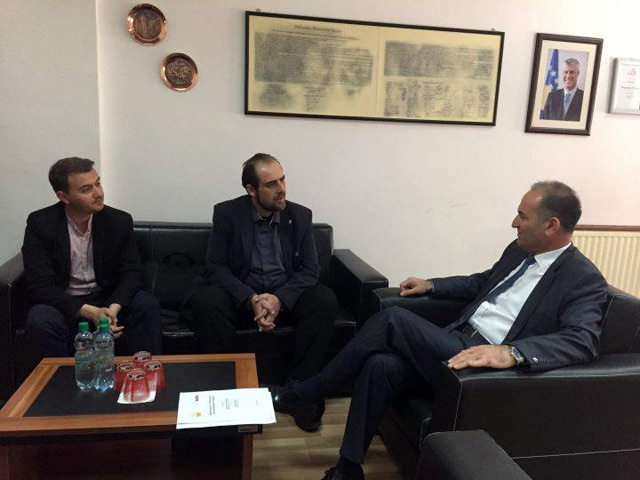
On April 28th, BIRN Kosovo delightfully ended the month of April by hosting two important diplomatic figures in Kosovo, the current U.S Ambassador to Kosovo, Greg Delawie, and Atifete Jahjaga, who served as the fourth president of Kosovo.
In their separate discussions at the BIRN Kosovo office, Delawie and Jahjaga each emphasized that producing in-depth analytical and investigative journalism on complex political, economic and social issues in Kosovo is an absolute necessity. They declared their appreciation for BIRN’s commitment to fighting endemic corruptive behavior in the country. They also applauded BIRN’s success in conducting the annual report on the monitoring of Kosovo’s courts, in which BIRN Kosovo and Internews Kosova monitors tackled challenges and shortcomings in the justice system.
U.S. Ambassador Delawie expressed his concerns about the imbalanced judicial system in Kosovo, emphasizing the need to combat the partiality and injustices within the system. He went on to congratulate BIRN’s efforts to continuously conduct analysis on corruption within the judicial system in order to assess its performance in respecting legislation and adhering to work ethics and procedural regulations. The Ambassador said that BIRN Kosovo, by producing top-quality, timely, and relevant coverage, is a trendsetter in Kosovo’s media landscape.
Similarly, Jahjaga voiced her concern that Kosovo’s justice institutions infrequently address high-profile corruption cases and instead focus on processing petty corruptive cases, for which soft sentences are often delivered. She congratulated BIRN’s efforts to focus on the treatment of corruption charges, analyzing the problems and obstacles faced in the war against corruption. Jahjaga, the first woman to be president in Kosovo, said that though she is keeping her options open regarding her future plans, there is one particular issue she is certain about: she will continue to work for the survivors of wartime sexual violence, which during her five-year mandate remained one of her main priorities.
On May 8th, 2017, BIRN and Internews Kosova marked a decade of monitoring Kosovo’s judicial system with the launch of the 2016 Court Monitoring Report. This project has been implemented for ten years now, and each year it has provided an overview of the situation in Kosovo’s justice system and has offered recommendations on how to increase transparency and accountability at all levels of the system.
This year’s report reflects the monitoring of 600 court hearings across 26 courts in the country throughout 2016, including basic courts, the Supreme Court, and the Court of Appeal. Panel participants included BIRN Kosovo Director Jeta Xharra, Internews Kosova Executive Director Faik Ispahiu, Chief Prosecutor Aleksandër Lumezi, as well as representatives from the Supreme Court, the Prosecutorial Council, and the Judicial Council.
The author of the report, Petrit Kryeziu, summarized the report’s main findings, including delays on filing criminal charges from the police and the prosecution, failures to justify decisions on pre-detention, and flaws in the strategy for detaining suspects awaiting trial. One of the report’s general recommendations is that Kosovo courts need to work harder on improving the way they treat pre-detention cases. Another recommendation is that the Ministry of Justice needs to consider strengthening the option for alternative sentences, such as referring appropriate cases to mediation.
The report also revealed concrete examples of procedural violations in the judicial system during 2016. These violations included cases in which the defendant’s right to be informed in the native language was denied, unnecessary postponements of court hearings, and lack of court order during trials.
Internews Kosova’s Executive Director Faik Ispahiu expressed gratitude to the entire team who contributed to the making of this project and emphasized that there have been over 50 monitors who worked on this project, some of which are now prosecutors, judges and lawyers. BIRN Kosovo’s Director Jeta Xharra added that despite the fact that the findings indicate room for courts to increase transparency, the ten-year collaboration shows that there is no rivalry between monitors and employees within the justice system.
Kosovo’s Chief Prosecutor Aleksandër Lumezi stated that he appreciates the findings and recommendations of the report and expressed his readiness to cooperate with the media. He emphasized that the flaws in the system will be improved upon and organized crime and corruption will be properly fought only through cooperation.
On April 24th, BIRN signed a cooperation agreement with the University of Prizren “Ukshin Hoti” in Kosovo on providing students with the opportunity to jumpstart their careers by embarking on professional internships at KALLXO.com, the anti-corruption platform.
BIRN has also offered numerous internship opportunities to the students of University of Prishtina, helping to advance students’ professional careers. Dozens of law and journalism students were provided with opportunities to pursue professional experience at KALLXO.com, with a focus on training students and helping them to produce in-depth analytical and investigative journalism on complex political, economic, and social themes.
Through the cooperation agreement, law students will particularly benefit from such practical experience, during which they will be exposed to BIRN Kosovo’s methods of professional reporting, established to foster change in society while upholding accuracy, fairness and balance.
Since BIRN is engaged in court monitoring, which aims to reduce wrongdoings spotted within the judicial system, the students will be familiarized with the methods used to identify irregularities. According to the University’s rector, interning at KALLXO.com—as a bona fide source of objective, unbiased, and accurate information—provides an excellent opportunity for building the students’ personal and professional skills.
BIRN also strongly believes that these internships will equip students with the necessary skills to develop investigative, impartial, unbiased and publicly beneficial reporting in Kosovo. As BIRN is widely known for offering meaningful exposure to on-the-ground work experience, it plans to also provide students from other public universities across the country with similar internship opportunities, in order to expand students’ knowledge of the necessary skills to flourish in a diverse and multicultural work environment.
Mirna Buljugic, the director of the Balkan Investigative Reporting Network in Bosnia and Herzegovina (BIRN BiH), participated in the ODIHR Trial Monitoring annual meeting in Skopje, Macedonia, at the end of April 2017.
The objective of the meeting was to share good practice and talk about challenges to trial monitoring around the world.
Buljugic presented BIRN BiH’s work at a session entitled Access to Information, talking about challenges journalists in Bosnia and Herzegovina are facing trying to access audio and video material from court hearings, court files (indictments and verdicts) and interviews with legal professionals.
BIRN BiH’s campaign ‘Stop Censorship on War Crimes’ was shared as an example of good advocacy campaign that successfully encouraged people to put pressure on judicial institutions to change practices and rules forbidding the public from getting relevant information on war crime trials.
At least one story promises to read like a crime thriller. Others will delve deep into corruption, public health and human rights. All involve meticulous research and the highest standards of cross-border reporting.
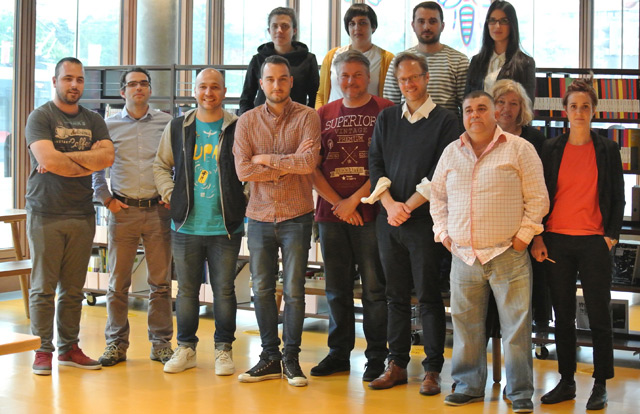
In its eleventh year, the programme kicked off with an opening seminar in Vienna for 10 new fellows from across the Balkan region.
Chosen from more than 130 applications, the fellows are from Bosnia, Bulgaria, Croatia, Greece, Kosovo, Macedonia, Montenegro, Romania and Serbia.
This year’s theme is change, giving the mid-career journalists broad scope to tackle issues ranging from the rise of populism and historical revisionism to Europe’s refugee and migrant crisis.
“I already had a look at the topics that you have proposed and I’m really glad to see that you indeed have taken several of the most pressing topics that the Balkans have,” Ulrike Lunacek, Austrian MEP and vice-president of the European Parliament, told fellows in a video message made for the seminar.
“It’s about environmental issues, family issues, women’s rights, LGBTi, refugee discrimination issues, but it’s also about rising nationalism.”
Ulrike Lunacek, Vice-President of the European Parliament welcoming 2017 fellows
At the ERSTE Foundation’s gleaming new headquarters, participants received practical tips on international standards in researching, reporting and structuring long-form stories that will be published at the end of the year in local languages as well as English and German.
A key goal was to refine story proposals based on initial applications. Individual editorial sessions were led by BFJE programme Editor Timothy Large, Balkan Insight Editor-in-Chief Gordana Igric and BFJE Programme Manager Dragana Zarkovic. The aim was to help fellows sharpen the focus of their stories and develop research and travel plans.
Timothy Large takes over as BFJE editor from Matt Robinson, now Reuters special correspondent for Central and Eastern Europe. Timothy was previously director of media development at the Thomson Reuters Foundation and editor-in-chief of global news services for the philanthropic arm of Reuters. Over coming months, he will work closely with fellows as they research, report and write their stories.
The seminar also included a visit to the newsroom of the Austrian daily derStandard, media partner of the programme; a multimedia and mobile journalism workshop run by Gunther Müller and David Klein from Forum Journalismus und Medien; and a presentation on press freedom, defamation and journalists’ legal rights by Barbara Trionfri, executive director of the International Press Institute.
The Annual Report presents the entire range of BIRN’s activities across the region from the perspectives of visibility, reach and impact.
In 2016, members of the BIRN network operated in a challenging environment which was marked by authoritarian tendencies among political elites, political turmoil, economic difficulties and deteriorating media freedoms. Political and financial pressure on the media, the refugee crisis, the long-term economic crisis and accompanying high unemployment, and high levels of corruption are just some problems that countries in the region have experienced.
Through investigative, analytical and specialised coverage of underreported topics such as war crimes cases, the flow of public money, cases of potential or verified corruption, problems within justice systems, media freedoms and ethics, and security issues etc., BIRN continued to play an important role in providing people in the Balkans with access to accurate information.
The Annual Report presents the entire range of BIRN’s activities across the region from the perspectives of visibility, reach and impact.
In this way, we show the scope and significance of the Network’s endeavours: for audiences in the countries of the region and beyond, media professionals, academics, policy makers (in the region and in international organisations), for the civil society sector, and for vulnerable groups. BIRN journalists and film-makers have also received awards for their work in their respective countries and internationally, and the report provides information about this.
The Balkan Investigative Reporting Network in Albania held a two-day training session on the April 29-30 in the city of Durres, which aimed to strengthen the media’s role in exposing illicit political party financing.
The training session was part of a project entitled ‘Strengthening the Media’s Role in Transparency of Political Party Financing’, supported by the National Democratic Institute, NDI, in Albania and the Rockefeller Brothers Fund.
About 25 journalists from Tirana and across Albania participated in the two days of training, which provided a guide to the basic methods and techniques of investigative journalism as well as an overview of political parties’ finances in Albania.
The training aimed to strengthen the skills of mid-career journalists to look closely at systemic issues of illicit financing of political parties and conflict of interest, with a special focus on the red flags raised by Central Election Commission reports.
Presentations were given by political scientist and Tirana University professor Afrim Krasniqi, the head of the Albania Science Institute Aranita Brahaj, the deputy head of the Institute of Authorized Chartered Auditors of Albania, Eleonora Olli, NDI advisor Vildan Plepi and BIRN Albania Editor-in-Chief Besar Likmeta.
The training will be followed by a call for participating journalists on analytical stories related to political party finances, with a special focus on the June 18 parliamentary elections.
This year’s BIRN Summer School will be held in the stunning Croatian coastal city of Dubrovnik from August 20-26.
The summer school will bring together some of the world’s best journalists and trainers for a six-day programme.
Reporters will have the opportunities to learn cutting-edge investigative skills and enjoy the delights of the Adriatic Sea.
Reuters editor Blake Morrison, three times a finalist for the Pulitzer investigative award, has been appointed lead trainer.
He will be joined by multiple-award-winning reporter/editor Miranda Patrucic from the Organized Crime and Corruption Reporting Project and Henk van Ess, an expert in Open Source Investigative Journalism, plus others.
During the sessions, journalists will learn how to dig for data, convince difficult sources to talk, transform their research into sparking prose and harness the power of video.
All participants will have the opportunity to apply for the Investigative Story Fund andthe three best story ideas will be awarded with funding ranging from 1,000 to 3,000 euros.
The location isMlini, a pretty fishing village located 10 kilometres south of Dubrovnik, the so-called ‘Pearl of the Adriatic’.
It offers a quiet setting with stunning beaches and excellent seafood, while Dubrovnik itself is internationally renowned for its fascinating history and breathtaking architecture.
Participants will have the chance to enjoy the idyllic surroundings while honing their investigative journalism skills.
Three BIRN stories have been named as finalists for this year’s Investigative award by Independent Journalistic Association of Serbia in the categories for electronic [TV and radio], print and on-line media.
The jury, composed of Danica Vucenic, journalist from Insajder, Milorad Ivanovic, editor-in-chief of Newsweek Serbia, Predrag Blagojevic, editor-in-chief of online portal Juzne vesti and Pedja Obradovic, producer at TV N1, chose the following BIRN stories:
BIRN Serbia journalist Jelena Veljkovic wrote on how Serbia’s Property Directorate claimed not to know that an exclusive restaurant had been opened in a part of the Belgrade Cooperative building, which the directorate leased to the “Belgrade on water company, refusing to answer whether it believed this use of public property was in accordance with the law.
The article was published in the weekly Vreme.
“Flatland without Birds?”, a documentary about illegal hunting in Serbia is nominated for the electronic media category.
The film, by journalist Dragan Gmizic, co-produced by BIRN Serbia and Greenfield Productions, examines how hunting rare turtle doves and quail is organised in Serbia and asks how and whether it can be controlled. The documentary was aired on TV N1, TV CG and Al Jazeera Balkans.
The story revealed how thousands of assault rifles, mortar shells, rocket launchers, anti-tank weapons, and heavy machine guns have poured into the Middle East from Bosnia, Bulgaria, Croatia, the Czech Republic, Montenegro, Romania, Serbia and Slovakia. The same story is also among three finalists for the Czech Journalism Prize, the best-known Czech media award.
This year, 75 journalists applied for the award given by the Independent Journalists Association of Serbia, NUNS, and the US embassy in Serbia.
The award ceremony will take place at the Faculty of Dramatic Arts in Belgrade on May 10 at 5.30pm.
BIRN journalists have won this prize for the last four years.





.jpg)