BIRN Albania Publishes Report on Local Mayors’ Assets

The Balkan Investigative Reporting Network in Albania has published a report entitled ‘Analysis of the System of Asset Declarations of Mayors in Albania’, which evaluates the wealth of the heads of local government units in the country as well as the integrity of the asset declaration system.

The asset declarations of serving mayors were analysed with the help of three financial experts, who recorded and categorised in a database all the data declared by heads of municipalities in their annual asset disclosures.

The experts analysed the information using a plausibility check, a method of scrutiny used by Albania’s High Inspectorate of Declaration and Audit of Assets and Conflicts of Interest, HIDAACI, to investigate the wealth of public officials.

The goal of the report is to identify key trends contributing to the enrichment of the 61 heads of local municipalities in Albania.

The study sheds light not only on how mayors in Albania have accumulated wealth but also on key practices which obscure the origins of their money.

These include dividends from businesses, debts owed by family members, real estate transactions and cash kept outside the banking system.

To download a copy of the report in Albanian, click here.

BIRN: Stop Targeting Slobodan Georgiev

BIRN calls on all relevant institutions, especially the Serbian Interior Ministry and the Prosecutor’s Office, to react urgently to the latest attacks on our editor Slobodan Georgiev.

A day after BIRN published photographs pointing to a connection between Andrej Vucic, the brother of the Serbian President, and Zvonko Veselinovic, a notorious businessman from Kosovo, a campaign started on social networks, attacking and threatening both Georgiev and the investigative portals BIRN, CINS and KRIK.

A video recording, available on Twitter from last night, describes Georgiev as a “foreign mercenary”, a “traitor” and as an associate of Albanian and Kosovo politicians.

The footage uses cover pages of the pro-government tabloid Informer, which refer to the “lucrative jobs” BIRN has done for foreign donors. Such slurs have been disproven in court. The same clip also targets CINS and KRIK media outlets.

The background tone of the recording is the alarm siren used during the NATO bombing of Serbia in 1999.

The release of the video has attracted numerous comments that contained insults and threats, some of which have been removed in the meantime.

As has happened before, instead of the dealing with the results and evidence presented by investigative media centres, raising awareness about threats to the rule of law, the fight against the corruption and the work of institutions, attention is being directed to editors and journalists who then become targets of attacks.

This spread of lies and misinformation is creating additional pressure on all journalists who want to work independently and professionally and critically report on the activities of the authorities. It is making them targets.

BIRN would remind the public and the relevant institutions that its editorial team has been almost constantly targeted by pro-regime media and ruling party bots on social networks since 2014.

We point out also that the attacks on Georgiev and BIRN have been reported to the authorities many times – without any concrete action being taken.

BIRN Kosovo Reports on Public Institutions’ Recruitment Process Problems

BIRN Kosovo has published a monitoring report entitled ‘Carving up the Pie’, produced as a part of the Monitoring of Recruitment Processes of Senior Managing Positions project that BIRN is implementing in cooperation with the British Embassy in Kosovo.

The report finds that Kosovo institutions have failed in implementing an agreement signed with the British Embassy by appointing people to senior positions who did not meet criteria set by an assessment by British experts.

Last year, Kosovo Prime Minister Ramush Haradinaj and parliament speaker Kadri Veseli signed a number of memoranda of cooperation with the British Embassy in Pristina on the provision of assistance to institutions in recruitments for senior management positions.

The purpose was to support joint efforts to ensure independence, meritocracy and professionalism in the process of recruitment for senior management positions in the civil service and on the boards of public enterprises.

BIRN Kosovo’s monitoring report contains details of specific vacancies, indicating violations and interference that took place to appoint people who did not meet the criteria.

In some cases, BIRN was not allowed to monitor important vacancies for positions in Kosovo institutions. The government did not allow BIRN to monitor vacancies for positions on the boards of 14 public enterprises.

Report in English
Report in Albanian
Report in Serbian

Resonant Voices Workshop Held in Berlin

Selected Resonant Voices Fellows attended a workshop in Berlin on March 25-29, 2019, marking the official start of this year’s Fellowship program. The fellows will produce compelling content that pushes back against a polarising, inflammatory, and radicalising discourse.

In Berlin, the fellows received comprehensive training in reporting, writing and structuring skills and worked with BIRN editors on developing their story ideas. The workshop lasted four days and, besides work with editors, included visits to a number of organisations and meetings with relevant stakeholders in the area of migration, integration and radicalisation. The fellows were introduced to the work of local organisations such as Disruption Network Lab and Mediendienst Integration, which deal with issues relevant to the their reporting projects.

Going forward, the fellows will be mentored by designated editors and visual communications mentors in order to benefit from their practical experience and produce stories of the highest quality.

Click on the links below for videos where you can find out more about the in-depth stories the RVI fellows are working on:

Learn more about the Resonant Voices Initiative and follow the work of the RVI Fellows.

Herceg Novi to Host BIRN’s Investigative Journalism School

Herceg Novi and its stunning coastline will be the setting for the BIRN Summer School of Investigative Reporting in 2019.

The school brings together some of the world’s best journalists and trainers for six-days in the Bay of Kotor, known as the southern-most fjord in Europe.

Between August 18 and 25, reporters will have the opportunities to learn cutting-edge investigation skills while enjoying the delights of Adriatic Sea.

Successful applicants will be provided with excellent possibilities for networking – and the possibility of getting a grant for a story idea.

The lead trainer on the course in Montenegro is one of the best investigative editors in the US, Reuters’ Blake Morrison, a three-times finalist for the Pulitzer investigative award.

As part of the school, you will learn how to dig for data, convince difficult sources to talk, transform your research into sparking prose and harness the power of videos.

Who the Summer School is for:

The training course is suitable for both investigative journalists with a few years’ experience as well as those who are more skilled.

We encourage application from experienced journalists that want to learn new trends and work with a new generation of reporters, as well as editors interested in encouraging investigative reporting in their media outlets.

Investigative Story Fund:

The 30 reporters selected to take part, of which 20 will hail from the Balkans, will work together in groups throughout the week to develop an idea for a hard-hitting investigation, which will be presented to a panel of judges on the final day.

The three best story ideas will be awarded with funds and editorial support. 

Montenegrin coast:

Known as the southern-most fjord in Europe, the Bay of Kotor boasts a landscape that you won’t easily forget. The Iberostar Herceg Novi hotel is at the entrance to the bay, surrounded by forested mountains and a crystal blue sea, to which you have direct access.

On the opposite side of the bay you can admire Herceg Novi, the city that gives its name to the hotel and that has a history dating back over six centuries.

In a secluded location away from the hustle and bustle but well connected with the airports of Dubrovnik (26km) and Tivat (30km), the hotel is just a few kilometres from the popular tourist spots such as Kotor, Perast and Herceg Novi.

Participants will have the chance to enjoy the idyllic surroundings while honing their investigative journalism skills.

Apply here!
BIRN Serbia Journalists up for Annual Investigative Award

A series of articles by BIRN Serbia reporters, investigating illegal construction at Mt Golija and the illegal engagement of ruling party officials at the Cuprija Medical School, have been nominated for the annual Prize for Investigative Journalism.

Jelena Veljkovic and Ana Curic were nominated for the annual investigative journalism award in the category of online media.

The awards are given out by the Independent Association of Journalists in Serbia with the support of the US embassy in Belgrade.

Veljkovic has been nominated for the series of research articles on the illegal construction on Mt Golija, behind which stands Zarko Veselinovic, brother of the controversial businessman from northern Kosovo, Zvonko Veselinovic.

Curic was nominated for the series of articles on the illegal engagement of Serbian Progressive Party officials at the Medical School in Cuprija.

Apart from BIRN, in the category of online media, the Crime and Corruption Reporting Network and the portal Juzne vesti are also on the shortlist.

The awards ceremony will be held on May 7 at 6pm at the Faculty of Dramatic Arts in Belgrade.

BIRN Serbia and Partners Launch ‘Dr Spin’ Campaign

BIRN Serbia, the Slavko Curuvija Foundation and the Independent Journalism Association of Serbia (IJAS) have launched the ‘Dr Spin’ campaign on control of the media in Serbia as part of ‘Public Money for Public Interest’ project.

‘Dr Spin’ is a series of ten animated episodes that give the answer to an important question – what does every dictator need to know if he or she wants to suppress the freedom of the media?

In the first ‘lesson’, the character of Dr Spin, who was created by Ilir Gasi, explains why it’s better to have subservient rather than independent media.

New episodes will be posted online every Tuesday on Dr Spin’s Facebook, Twitter and YouTube accounts.

The episodes will also be broadcast on cable TV N1, as well as on local RTV Sabac and TV Forum from Prijepolje.

BFJE Fellows Selected for 2019

Ten journalists from across southeast Europe have been chosen for this year’s Balkan Fellowship for Journalistic Excellence. Over coming months, they will tackle in-depth features and investigations on the topic of FREEDOM.

Now in its 13th year, the BFJE programme gives mid-career journalists the funding and editorial support to dig into complex issues of local and international significance.

This year’s participants were competitively selected from more than 80 applications. An independent committee comprising seven senior European media figures evaluated proposals based on relevance, feasibility and originality, as well as candidates’ professional qualifications and motivation.

The journalists come from Bosnia and Herzegovina, Bulgaria, Croatia, Greece, Kosovo, North Macedonia, Romania and Serbia.

The fellowship programme will kick off with an introductory seminar in Belgrade in late April. In addition to receiving funds for research, the journalists will get mentoring from seasoned international editors as they conduct reporting trips to countries in the region and the European Union. The programme will conclude in December with an award ceremony.

Here are the fellows for 2019:

  1. Angel Petrov (Bulgaria)
  2. Ani Sandu (Romania)
  3. Dina Djordjevic (Serbia)
  4. Jelena Prtoric (Croatia)
  5. Katerina Topalova-Dejanovska (North Macedonia)
  6. Kostas Zafeiropoulos (Greece)
  7. Milena Mitrovic (Bosnia and Herzegovina)
  8. Stavros Malichudis (Greece)
  9. Shkumbin Ahmetxhekaj (Kosovo)
  10. Vedrana Simicevic (Croatia)

BIRN Serbia Holds Training for Online Journalists and Editors

BIRN Serbia organised a two-day training course on media and security in the digital environment for online journalists and editors on April 1 and 2 in Belgrade.

Participants learned how to overcome security challenges and risks, and got introduced to digital tools that can help them in their work.

During the first day, Bojan Elek from the Belgrade Centre for Security Policy presented information on the security situation in Serbia, as well as potential sources for researching security which could be helpful to journalists.

After that, Drew Sullivan and Pavla Holcova from the Organized Crime and Corruption Reporting Project shared tips and tricks on how to evaluate and overcome the security risks that journalists face.

On the second day, Andy Black, a digital specialist, gave insights into how online media can survive in the digital jungle.

He presented to journalists and editors a series of digital tools to help them listen to and improve communication with their audience, as well as to raise the visibility of their content.

BIRN Albania Wins Award for Investigative Journalism

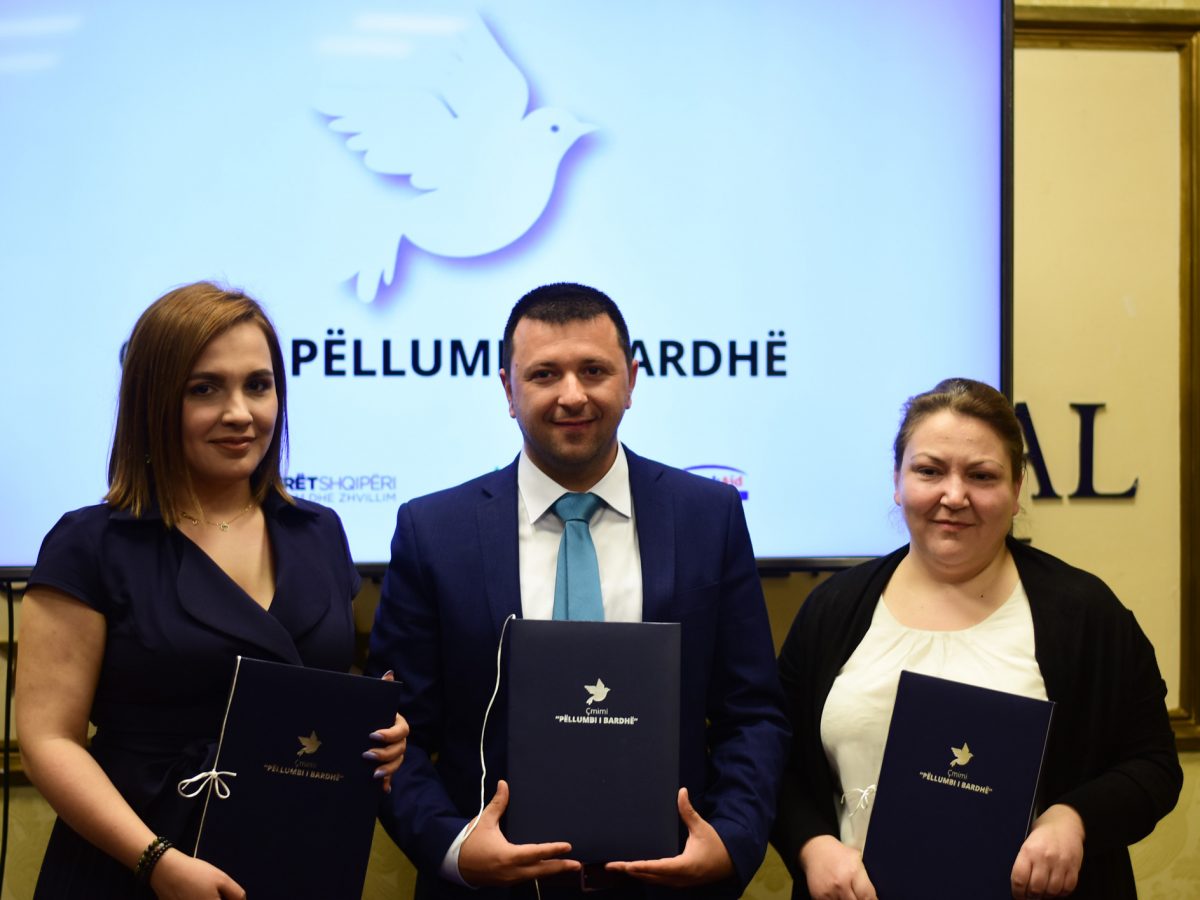
The Balkan Investigative Reporting Network in Albania was given the White Dove award by Partners Albania for Change and Development for its investigative reporting.

The award was presented to BIRN Albania at a ceremony on April 2 by Partners Albania for Change and Development, a domestic organisation focused on strengthening democracy and democratic development.

Partners Albania gave BIRN the award “for the civil courage, professionalism and objectivity shown with investigative reports with a wide public impact”.

At the award ceremony, BIRN Albania executive director, Kristina Voko, thanked Partners Albania for the award, which she dedicated to BIRN’s staff and the many journalists with which the organisation works.

“This award would not be possible without the tireless work of our staff journalists and local reporters and the close cooperation between journalists and civil society,” Voko said.

Apart from BIRN, the Albanian Institute of Science, AIS, and the environmental organization Eco Albania were also recognised for their positive impact on democracy and transparency in the country.