BIRN in Consortium to Assist Public Service Media

BIRN is a part of a consortium led by the International Federation of Journalists (IFJ) that will implement a project entitled ‘Technical Assistance to Public Service Media in the Western Balkans’, supported by EU funding.

The European Broadcasting Union (EBU), Austrian public broadcaster ORF and the Office of the Eurovision News Exchange for South-East Europe (ERNO) are the other members of the consortium.

The project is being implemented because public service media in the Western Balkans are at a crossroads. They urgently need to embrace an audacious reform agenda and adapt to a rapidly changing media environment or they run the risk of becoming irrelevant.

The project aims to revitalise the region’s public broadcasting sector and bring new confidence to the key stakeholders involved.

It is responding to the stark imperative to rebuild public trust in institutions which are still highly vulnerable to political interference and which appear to be increasingly disconnected from their audiences.

The project has three specific objectives; firstly, it aims to reestablish European standards and promote best practice at the six public service media organisations in Albania, Bosnia and Herzegovina, Kosovo, Macedonia, Montenegro and Serbia, with a particular focus on helping them to achieve financial autonomy from the state and greater accountability to the public.

It will work to seek consensus on the principles and practice for sustainable funding models as well as securing agreement on fair, transparent and accountable procedures for electing the members of governing bodies.

The project will also work to generate synergies between the six broadcasters by initiating a new phase in ongoing reform processes and helping to formulate long-term strategies.

As a part of this, the programme will facilitate the improved implementation of editorial policies and complaints mechanisms, which in some cases exist on paper only.

It will also support efforts to establish integrated newsrooms, to streamline newsgathering and production processes.

A further aspect of the project will is to continue work in the field of management reform, developing long-term strategies and mentoring their roll-out across multiple departments.

This will be complemented by an initiative to equip regulators with the skills to conduct or commission reliable surveys which will give programme-makers a better insight into audience needs.

The third objective of the technical assistance programme is to expand cooperation in programme-making between the six public service media organisations, ensuring that they can pool resources and share audiovisual materials in a more effective way.

This will be achieved by building the capacity necessary to produce in-depth investigative reports as well as high-quality programming for children and young people.

The project will also seek to introduce new interactive formats which optimise the potential for audience engagement.

In addition to this, a regional platform will be created for sharing archive material between the  broadcasters, enriching factual programming and encouraging further collaboration.

The training programme led by BIRN will address some of the shortcomings inherent in mainstream media across the Western Balkans – low levels of professional skills, an absence of continued mid-career training, and indirect or direct outside influence which prevents the broadcasting of stories which conflict with the interests of local power-brokers.

Belgrade Insight Hosts Stand at Belgrade Book Fair

Belgrade Insight, BIRN’s English-language newspaper, made its first appearance at the Belgrade Book Fair as part of a specialist media expo.

The expo, called Media Market, was dubbed the largest regional media event, hosting some of the leading Serbian media outlets, and according to the organisers, attracting over 150,000 visitors.

During the five-day event, the Belgrade Insight stand in Hall III of the Belgrade Fair provided a unique platform for both leading and aspiring Serbian investigative journalists to share their findings and communicate their message to the largest possible audience.

The highlight of this part of the event was the debate between BIRN’s Slobodan Georgiev and Vladimir Kostic, whose investigation into a Serbian Progressive Party financing scheme and the story which resulted from it remain a focus for independent media outlets in the country.

‘Breaking the atmosphere of fear’

“I think it is a great new opportunity for us to share and keep our stories alive longer, but also to reach people that otherwise would miss them due to the closure of the mainstream media to investigative journalism topics,” said Kostic.

“It is, I believe, crucially important to take part in events such as this one or create new ones, as they are the best possible tool for breaking the atmosphere of fear and silence. At the same time, they are also a way to create preconditions for people who have been witnesses to corruption to come forward and speak with us,” he added.

Making a step forward

“We should make the step forward and communicate our message directly to the people, and I think this is the good way to do it,” Stevan Dojcinovic, head of KRIK, the Network for Research of Crime and Corruption, told BIRN while visiting the Belgrade Insight stand, and before taking part in a debate about the pressure on investigative journalism in Serbia, on the Danas newspaper stand.

As promoting investigative journalism, Belgrade Insight reached the largest possible audience by hosting prominent writers, musicians, artists and sports personalities on its stand.

Among them were TV host Zoran Kesic, writer Ivan Tokin, former national basketball team player Dejan Koturovic, and rock musician Petar Jelic.

On Saturday, the day before the event concluded, regional pop star Ida Prester held an ‘unplugged’ mini-concert on the Belgrade Insight stand.

BIRN Publishes Kosovo War Crimes Court E-Book

The Balkan Investigative Reporting Network has published an e-book about the Kosovo Specialist Chambers, aiming to increase understanding about the newly-established court that will try ex-guerrillas for crimes during and after the war.

BIRN’s e-book, entitled ‘Kosovo Specialist Chambers: From Investigations to Indictments, published on October 31, includes expert analysis, interviews and archive reports that trace the history of the Kosovo Specialist Chambers from the initial Council of Europe investigation into wartime and post-war crimes by Kosovo Liberation Army fighters to the establishment of the new court to try them in The Hague.

Ahead of the first indictments, BIRN compiled its extensive archive on the subject into a comprehensive guide to how the court will work, what are its main challenges and what the key players have to say about the allegations and the forthcoming prosecutions.

The e-book can be downloaded free of charge in English, Albanian, Serbian and Macedonian.

“The establishment of the Kosovo Specialist Chambers has been marked by controversy – the court is seen as biased in Kosovo because it targets one ethnic group, while in Serbia it has been greeted as the last hope for justice for Kosovo’s Serbs. In this heated environment, we believe that this e-book can be a valuable tool for everyone who has been following this tortuous road towards justice,” said the book’s editor, Marija Ristic, director of BIRN’s Balkan Transitional Justice programme.

“We also hope that it will contribute a better understanding of the complex issues involved in bringing people to justice for the crimes of the wartime past – one of the core values of BIRN’s work in the area of transitional justice,” she added.

Although based in The Hague, the Specialist Chambers is legally part of Kosovo’s judicial system, but independent from the Kosovo judiciary and staffed by internationals, while all decisions and appointments related to the court will be made by the European Union.

The Specialist Chambers will have jurisdiction over crimes that occurred between January 1, 1998 until December 31, 2000, and that either were committed or commenced in Kosovo, meaning it can also prosecute crimes committed in Albania, as many of the prisoners who were taken away by the Kosovo Liberation Army were detained in camps in northern Albania.

It will hear cases arising from the EU Special Investigative Task Force report which said that unnamed KLA officials would face indictments for a “campaign of persecution” against Serbs, Roma and Kosovo Albanians believed to be collaborators with the Belgrade regime.

The alleged crimes include killings, abductions, illegal detentions and sexual violence

The SITF report was commissioned after the Council of Europe published an inquiry in 2011 which alleged that some senior Kosovo officials, including current President Hashim Thaci, were responsible for various human rights abuses.

Thaci strongly denied the allegations, and since he become president in February this year, he has publicly supported the establishment of the new court.

For the past 17 years since the war ended, the international community has been administrating justice in Kosovo, but its results have been poor – fewer than 20 final verdicts in war crimes cases. Serbia has prosecuted seven cases related to the Kosovo war.

However, it was believed that the Kosovo prosecution couldn’t handle sensitive cases against high officials, which was one of the reasons why the international community decided to establish the new court.

To download the e-book, click here.

To download the pdf versions, click here.

In order to access the e-book, you may need to download an e-book reader.
Here is our suggestion:
https://fbreader.org

BIRN Newspaper Makes Inaugural Appearance at Belgrade Book Fair

BIRN’s English-language newspaper Belgrade Insight has made its first appearance at the Belgrade Book Fair in the Serbian capital this week, joining the many other media outlets exhibiting as part of the event’s Media Market.

Belgrade Insight will host an array of famous faces, including local Serbian writers, artists and musicians, during its first appearance at the 3rd annual Media Expo, taking place in Hall 3 at the Belgrade Fair from October 25-29.

The opening day of the expo saw Belgrade-based artist Aleksandar Denic create a painting live at the newspaper’s exhibit, and author Ivan Tokin drop by for an interview, while the former director of the Nikola Tesla Museum, Vladimir Jelenkovic, will sit down for a chat on Thursday.

The five-day programme also includes a live discussion at 1pm on Saturday between BIRN editor Slobodan Georgiev and journalist Vladimir Kostic, whose recent investigation produced as part of the Balkan Fellowship for Journalistic Excellence that has raised new questions about the financing of political parties in Serbia, particularly those going to the ruling Progressive Party.

This will be followed by an acoustic performance by regional pop start Ida Prester.

On Sunday, the closing day of the fair, Belgrade Insight columnist Srdjan Garcevic will be on site to talk to visitors about the hidden side of the Serbian capital, a topic he regularly covers for the paper and on his personal blog, the Nutshell Times.

Belgrade Insight is a bi-weekly newspaper printed by BIRN featuring news, analysis and lifestyle stories about the Serbian capital.

You can also follow Belgrade Insight on Facebook and Twitter.


BELGRADE INSIGHT’s FULL PROGRAMME: 

WEDNESDAY, 25 October:

Artist Aleksandar Denic will make a picture on the spot, at 13:00

Writer Ivan Tokin at 15:00

THURSDAY, 26 October: No programme planned

FRIDAY, 27 October:

Interview with former Director of Nikola Tesla Museum, Vladimir Jelenkovic at 15:00

SATURDAY, 28 October:

Slobodan Georgiev and Vladimir Kostic on Party Games: Hide and Seek with Election Cash at 13:00

Ida Prester performance at 15:00

SUNDAY, 29 October:

Srdjan Garcevic: Hidden Belgrade Promotion at 17:00

Fourth Political Trends and Dynamics Briefing Published

The fourth issue of the Political Trends and Dynamics briefing, produced jointly by the Friedrich Ebert Stiftung South East Europe and BIRN Consultancy, has been published.

The latest briefing provides an overview of the latest political, economic, societal and security trends and news from South-East Europe during August and September, which, despite the summer holiday season, proved to be a dynamic period.


The publication also includes insightful commentary from selected authors, as well as an interview with Macedonian Prime Minister Zoran Zaev and the country’s Defence Minister, Radmila Shekerinska Jankovska.


The Political Trends and Dynamics briefing is part of a recent partnership between Friedrich Ebert Stiftung South East Europe and BIRN Consultancy , which will form a core part of FES SOE’s bi-monthly publication ‘Political Trends and Dynamics in South East Europe’.


The August/September issue of the publication can be accessed here: http://library.fes.de/pdf-files/bueros/sarajevo/12902/2017-08-09.pdf

BIRN Serbia Hosts State Media Financing Debate

BIRN Serbia, together with The Independent Journalists’ Association of Serbia (IJAS) and the Slavko Curuvija Foundation organised a debate on October 20 about models and transparency of state media financing.

The debate was moderated by BIRN Serbia’s Editor Slobodan Georgiev and hosted Slavisa Lekic, IJAS’s president, Nedim Sejdinovic from the Independent Journalists’ Association of Vojvodina, Milorad Tadic from the Association of Independent Electronic Media, Dalila Ljubicic from the Media Association and Milos Stojkovic, a legal consultant.

The panellists spoke about the importance of the better regulation of project-based co-funding in the media sector and offered proposals for a new media strategy.

Media content that is created in the public interest needs to be better defined in the new media strategy, they agreed.

They also said that it is important to improve work of the expert commissions for allocating funds by defining the term ‘media expert’.

Talking about the regulatory body for electronic media, the panellists pointed out that it is necessary to minimise or completely eliminate the influence of the executive and legislative authority when members of the regulatory body for electronic media’s council is being elected.

The debate was organized as part of a Public Money for the Public Interest project that BIRN Serbia is implementing with the Independent Journalists’ Association of Serbia and the Slavko Curuvija Foundation.

BIRN Wins 2017 Kosovo Journalism Poverty Prize

A story about women raped during the Kosovo war and their struggle for justice has been awarded the 2017 Journalism Poverty Prize in Kosovo.

Pristina-based journalist Serbeze Haxhiaj was awarded on Friday for her story ‘The Enduring Agony of Wartime Rape in Kosovo’, published on BIRN’s flagship website Balkan Insight.

The story explores how women who have been raped and tortured during the Kosovo war are not applying for reparation schemes due to the stigma of rape that is still persistent in Kosovo society almost 20 years after the war.

The article was published as part of BIRN’s Transitional Justice Programme, which has been covering stories daily since 2012 related to dealing with the past in the former Yugoslavia, with focus on criminal justice efforts, victims’ rights, memorialisation and institutional reform.

The Kosovo Journalism Poverty Prize was awarded for the 12th time by the United Nations Kosovo Team and the Association of Kosovo Journalists to mark the International Day for the Eradication of Poverty and promote and increase the debate around the issues and causes of poverty in Kosovo.

BIRN’s Weapons Investigation Wins Online Poll

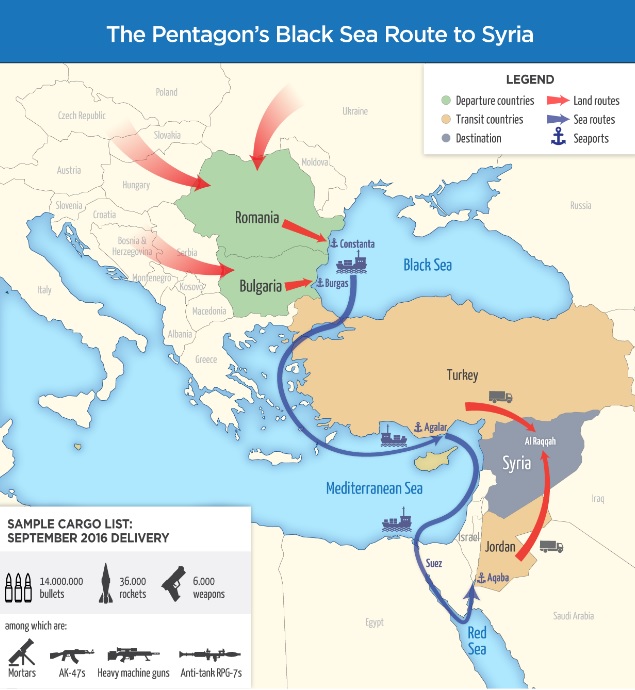
The Balkan Investigative Reporting Network’s investigative story The Pentagon’s $2.2 Billion Soviet Arms Pipeline Flooding Syria has been selected as the best article by voters in a Forum on the Arms Trade online poll recognising exemplary reporting in articles published from July 1 to September 30, the organisers announced on Wednesday.

The authors of the investigation are Ivan Angelovski and Lawrence Marzouk, and the story is a part of wider research by BIRN and the Organized Crime and Corruption Reporting Project, OCCRP on the arms trade.

“The type of deep dive investigative reporting that Ivan Angelovski and Lawrence Marzouk have done here is difficult and extremely valuable. Drawing attention to how the arms trade is conducted, with specific identification of international actors who often bend if not outright skirt the rules, reminds us that diligence is needed at all levels,” said Jeff Abramson, an arms trade expert and senior fellow at the Arms Control Association.

“As the Trump administration moves forward with new arms sales and security assistance, their findings serve as examples of how to examine whether it proceeds responsibly,” Abramson added.

Eleven articles were nominated by experts chosen by the Forum on the Arms Trade for being examples of exemplary journalism that uncovers new information and/or expertly explains issues related to the arms trade, security assistance and weapons use that were published in the fourth quarter of 2017.

Angelovski and Marzouk’s story traced programmes to arm Syrian rebels, aided by questionable use of end-user certificates and what they called “misleading” legal documents.

They identified the supply of AK-47s, rocket-propelled grenades and other weapons, often from the Balkans, eastern Europe and former Soviet Union factories and inventories, as being led by the US military’s Special Operations Command, SOCOM, as well as the Picatinny Arsenal in New Jersey.

When asked about why they felt it important to report on apparent abuses within the system for conducting arms transfers, Angelovski and Marzouk told the Forum on the Arms Trade: “The rules are supposed to prevent weapons ending up with terrorists, criminals and rogue states. Countries which have signed up to these rules should abide by them. Breaches of these rules presents a real, current risk to the world, but more troubling is the long-term impact if the whole system is undermined.”

“There’s actually a lot of quality reporting on arms trade, security assistance and weapons use. All the articles that were nominated for exemplary reporting, as well as previous winners and nominees, are great examples of quality reporting,” Angelovski and Marzouk added.

“However, there is not enough media awareness of the issue, partly as it requires some specialist knowledge to begin to find interesting stories and understand their importance. Few journalists have this know-how or the time to learn,” they said.

BIRN Hub Explores Media Development Opportunities in Moldova

BIRN Hub representatives discussed media development and capacity development opportunities and partnerships on October 4 and 5 with journalists, media organisations, donors and international organisations in Chisinau, Moldova.

The media organisations included the Centre for Independent Journalism, The Association of Independent Media, the Higher School of Journalism and the Centre for Journalistic Investigations.

“With some of the Balkan countries having been through similar transitions, BIRN Hub believes that Moldova can be seen in this context in cultural terms too, not just in terms of the former Soviet space”, Petar Subotin, BIRN Regional Development Officer explained.

Moldova has been going through important political, geopolitical and social developments over the past decade, which need to be properly understood by an international audience in a regional context.

The country is on a path towards EU accession, but it is also troubled by a frozen conflict with the separatist authorities in Transnistria and faces large-scale youth migration, while media freedom is under increasing threat.

Moldova is under-reported in the international English-language media and BIRN, by partnering with local media organisations and supporting in-depth and investigative reporting, wants to give it more coverage, and to allow international and regional audiences to understand the country’s dynamics.

Indictment Raised Against Judge Involved in Bribery

An indictment was raised against a judge in Decan on October 11 following a BIRN and Internews Kosova investigation into an alleged bribery case.

On January 15, 2017, BIRN’s televised programme Justice in Kosovo and the anti-corruption platform KALLXO.com published an investigation on alleged criminal offences that took place at the Deçan Municipality Basic Court. The investigation included research by KALLXO.com’s team, which presented sufficient evidence that Judge Safete Tolaj was involved in an act of bribery. As a result of the research, Justice in Kosovo published a video reportage that detailed how the situation developed. After the show’s publication, measures were taken by the relevant rule of law institutions, leading to judge Tolaj’s dismissal.

A Kosovo citizen, Berat Kelmendi, reported the case to KALLXO.com through an online report. Kelmendi reported the case after experiencing longer than usual resolution times regarding a case at the Deçan Basic Court. As the court proceedings were ongoing, the judge’s son, Fisnik Tolaj, approached Kelmendi and offered to speed up his case in exchange for 20,000 euros. Kelmendi secretly recorded all of the bribery negotiation talks. Justice in Kosovo and KALLXO.com, after hearing Kelmendi’s story, gathered sufficient material to produce a show on the matter.

Rule of law institutions, sixteen hours after the first part of the story was published, initiated an investigation. The State Basic Prosecution invited KALLXO.com to cooperate. According to the prosecution, investigation into corruption suspicions began in January 2017, and Tolaj was charged with abuse of office and other criminal offenses. Tolaj’s son was also charged with fraud, exertion of influence, forgery, and other criminal offenses, including illegal possession and use of weapons. In the aftermath of ten-month period, on October 11, KALLXO.com reported that an indictment was raised against Judge Safete Tolaj. The department for Heavy Crimes of the Basic Prosecutor’s Office in Peja raised an indictment against the judge under the charge of misuse of official duty or official authority. In order to fight corruption and organized crime, Justice in Kosovo and KALLXO.com will continue to follow similar cases.