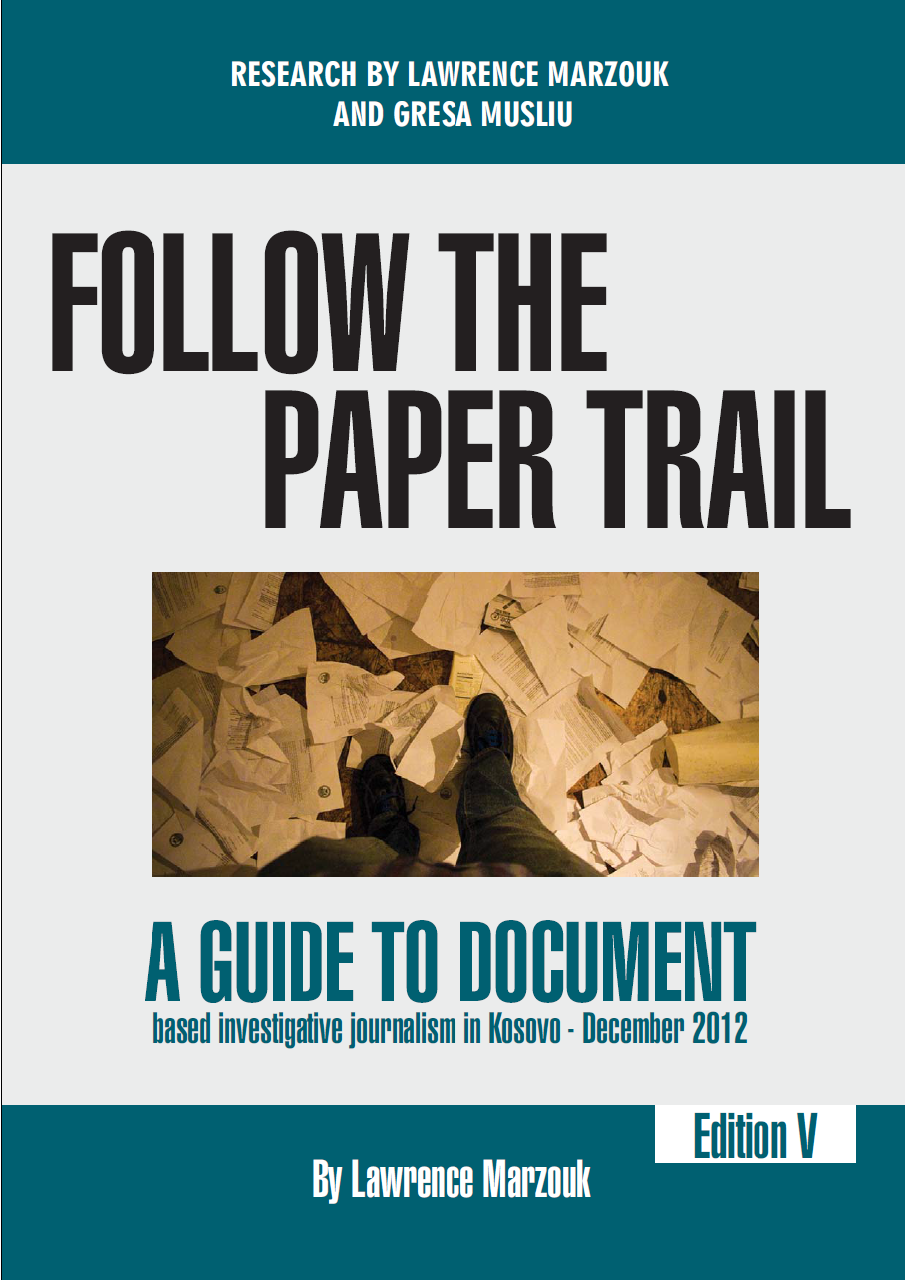
Follow the Paper Trail

Follow the Paper Trail, a guide to document-based journalism in Kosovo, explains relevant laws, access to public documents, how to publish safely, where to find databases on investigative journalism, and how to locate documents online through various search engines.

Download the Guide: English
| Albanian

FollowFor those wanting to uncover wrongdoing, knowing how to follow the paper trail is crucial, and this means a strong grasp of relevant media laws, a host of web-based skills and the ability to manage large quantities of documents.

Journalists must know how to prize documents from secretive institutions using ,Right to Know” laws but also find key reports which are already in the public do-main, many online. An in-depth knowledge of Google and other online search tools is also essential.

Reporters who cannot follow the paper trail across borders will soon find they are hitting brick walls in their quest for truth.

BIRN at CEAS International Conference on Security and Defense

BIRN Director Gordana Igric took part in a Centre for Euro-Atlantic Studies conference entitled ‘Serbia, the Western Balkans and the EU: What Do We Have in Common in the Areas of Security and Defence and How to Make the Most of it for Stability and Progress in the Region’ on January 29 in Belgrade, on a panel dedicated to the challenges facing transitional justice in Serbia and the Balkans region.

Together with Sandra Orlovic from the Humanitarian Law Centre, retired Serbian Army military prosecutor Lakic Djorovic, Dragan Popovic from the Policy Centre and publicist Zoran Janjic, Igric discussed the impact of security sector reforms on transitional justice.

BIRN at CEAS Conference on Defense and Security in Belgrade, 2013All the participants agreed that Serbian society has failed to accept its responsibility for the crimes committed in the 1990s, and considered it unlikely that the Serbian government will raise new indictments for war crimes given that the great number of its members were part of the 1990s war machine. Orlovic said that the security sector reforms appear to be nominal because reform of the security sector’s personnel has failed – a fact that has direct implications on transitional justice processes.

The presence of compromised personnel at the security sector directly contributes to a climate of impunity, she said. Orlovic added that is unlikely that security sector reform will ever achieve its goal of re-establishing citizens’ trust if people who took part in the 1990s conflicts are still part of the sector.

Igric said that all ex-Yugoslav countries have developed their own war narratives which, through the media, have entered their education systems. Each country has declared the conflict to have been defensive and has no will to prosecute the perpetrators, while Serbia acknowledges only the NATO bombing as a genuine war. She added that the opening of secret files should lie at the core of security sector reform.

The Centre for Euro-Atlantic Studies, CEAS, is an independent, non-religious, socially-oriented left-liberal think-tank founded in 2007 in Belgrade. With its research work, CEAS generates precise analysis of Serbia’s foreign, security and defense policies.

Apply Now for the 2013 Fellowship

Your chance to investigate cross-border stories with funded research, travel expenses, one-to-one mentoring and the potential for publication in the regional and international media.

Experienced journalists across the Balkans are invited to apply for the seventh annual Balkan Fellowship for Journalistic Excellence.

To apply, read or download the following:

For this year’s programme, we encourage applicants to consider the theme of Integrity. We expect the best proposals to put some of the broad ideas evoked by the theme into sharp focus.

We also expect applicants to reflect on the role society plays in their stories. It is ultimately the relationships between people that makes politics and other processes interesting.

Ensure you think about your story’s significance not just in your home country, but also in at least one other regional state and within the European Union. Choose phenomena that are relevant and current.

Journalists selected for the fellowship by our independent committee will receive a €2,000 bursary and up to another €2,000 for travel expenses. They will also be expected to participate in career development seminars in Vienna and the region.

Completed articles will be published in English and other languages in the regional and international media.

In addition, the top three articles, again judged by an independent committee, will attract awards of €4,000, €3,000 and €1,000.

Journalists who have taken part in the fellowship say it has developed their skills and extended their expertise to other countries.

“I am grateful that the fellowship programme allowed me to carry out an in-depth investigation on a subject matter I had been researching for a long time,” says 2012 Fellowship winner, Sorana Stanescu. “The best part was the opportunity to work with a very scrupulous editor, an experience you rarely get in the Romanian media and that can only enhance one’s storytelling.”

The fellowship programme aims to develop and support Balkan journalists reporting on complex reform issues. It was established by the Robert Bosch Stiftung and ERSTE Foundation in cooperation with the Balkan Investigative Reporting Network.

Fellowship Stories Available in Single Publication

The stories produced by the ten journalists who participated in the 2012 Balkan Fellowship for Journalistic Excellence are now available in the online publication, Communities – The New Ties Reshaping the Balkans.

The publication provides a snapshot of the past year in south-eastern Europe, capturing some important truths behind the news.

Original research by the journalists focused on issues ranging from religious radicalism, the exploitation of migrant workers in the EU, football hooliganism, environmental activism, bad privatisation deals, and the exclusion of youth from a politicised job market. The stories were grouped under the annual theme, Communities.

The journalists were selected through open competition to receive funding and professional support that would help them conduct cross-border research into a topic of regional and EU significance.

The stories produced under the programme were re-published by prominent outlets in the region,as well as by international media including The Guardian, The New Statesman, The Atlantic, The Christian Science Monitor, Der Standard, Neue Zürcher Zeitung, The Huffington Post and the EU Observer.

The work of the fellowship and of its editor, Neil Arun, has been shortlisted for the 2013 European Press Prize in Amsterdam.

One of the participating journalists, Eldin Hadzovic, has also received an award from UNICEF for his fellowship story which examined the failure of Bosnia’s orphanage system.

“The publication of the fellows’ articles in the most important media in the region and internationally is clear proof that this project is a worthy venture,” said Remzi Lami, the director of the Albanian Media Institute and a member of the programme’s selection committee.

The 10 articles from 2012 were re-published by more than 400 outlets, supporting the fellowship’s ultimate goal – to promote and reward excellence in journalism.

The new cycle of the programme will be launched on January 28, when journalists will be invited to submit applications under the annual topic for 2013, Integrity.
BIRN BiH on Bosnian state television

BIRN BiH deputy editor Denis Dzidic was a guest speaker on Tuesday on Bosnian state television’s evening news show, discussing the pace of war crimes prosecutions in the country.

Dzidic talked about the Bosnian state prosecutor’s recent decision to halt an investigation into more than 400 people suspected of crimes against Bosnian Serbs in the neighbourhoods of Hadzici, Igman and Hrasnica around the capital Sarajevo during the 1990s conflict.

He also highlighted how many war crimes investigations are still being conducted by the state, and spoke about the challenges that newly-appointed chief prosecutor Goran Salihovic is facing in order to prioritise work on war crimes cases.

During the show, there was also a discussion about the reasons why war crimes prosecutions in Bosnia and Herzegovina last for several years.

You can watch the entire news programme by following this link: http://www.bhrt.ba/video/?id=777777918&v=dnevnikdva22012013.flv

BIRN Serbia launches campaign to promote EU values

BIRN Serbia begins its new campaign titled “Europe, It is You” in February in 25 municipalities and cities across south-east and south-west Serbia. The campaign is part of an EU Progress programme to find the best idea for the promotion of EU values in that part of the country.

BIRN Serbia and its local partners will organise several different programmes until June 2013 with the help of the EU Commission Office in Belgrade and the European Integration Office in Serbia.

The “Europe, It is You” campaign aims to promote the process of joining the EU and present positive examples from Serbia showing a series of EU values that have already been put into practice.

By connecting local media, local administrations and various other groups, BIRN Serbia will bring together all stakeholders to improve conditions in these areas of Serbia.

Anyone interested will be able to follow work of the campaign online and can also contribute by posting their own video clips or impressions of the campaign on a specially-designed web page.  There will also be several training activities and street actions.

The campaign’s keynote event will take place on Europe Day on May 9th, when synchronised street actions will be held in five cities in the region.

BIRN Kosovo Presents Report on Court Monitoring

The Balkan Investigative Reporting Network (BIRN) in Kosovo published its fifth report on court monitoring for the January-December 2012 period on Wednesday.  The information in the report was the result of monitoring a total of 1,441 court sessions, which resulted in 1,040 verdicts.

BIRN’s main findings are categorised in twelve points which refer to a variety of problems ranging from the monitoring of corruption cases, procedural violations, failure to respect the rights of parties during court hearings, to the use of mobile phones during the trial sessions.

The press conference at which the BIRN report was presented was attended by representatives of several judicial institutions including the Kosovo Judicial Council, the Supreme Court of Kosovo, the State Prosecution, the Ombudsperson, representatives of embassies in Kosovo, representatives from OSCE, EULEX, and civil society.

The head of the Judicial Council of Kosovo, Enver Peci, congratulated BIRN for the work conducted so far, which, he said “represents a target for the fields where the judicial system should be more engaged”.

The  President of the Supreme Court, Fejzullah Hasani, said that BIRN had helped to illuminate errors which legal officials had been unable to investigate. 

“I have read BIRN’s report carefully and with pleasure, and I express congratulations for the realistic findings that are welcome for our work,” said the special prosecutor, Besim Kelmendi.

Diane E. Tourell, legal analyst at the OSCE, also complimented the BIRN report and emphasised that the OSCE echoes the concerns caused by procedural violations and would welcome similarly thorough reports in the future.

Download the full report as a PDF file in English
Download the full report as a PDF file in Albanian


Balkan Job Finder Offers More Posts in 2013

BIRN’s online employment service BalkanJobFinder.com now has more than 1,000 CVs in its talent pool.

The BalkanJobFinder website is full of CVs from highly-skilled professionals from across the Balkans. Jobs are offered all around the region and beyond. At the moment, there are active offers of new posts in the Czech Republic, Bulgaria, Serbia and other countries. Jobs are also offered which allow experts to operate throughout the region without having to base themselves solely in one city. This service is also growing bigger each month and getting more efficient.

All these services can be accessed through the BalkanJobFinder website and its growing social network pages at Facebook, LinkedIn and Twitter. Also, feel free to subscribe to its newsletter.

In a special New Year offer, for every purchase clients make in January, they will get another job post within the same value absolutely free. For further information, please contact the BalkanJobFinder Business Development Manager, Dina Jakovljevic, at [email protected].

BIRN’s Balkan Transitional Justice Team Holds In-House Journalism Training

The Balkan Transitional Justice team held a two-day training and editorial meeting in Belgrade from January 12-13, supported by the United Kingdom’s Foreign and Commonwealth Office.

The session was aimed at enhancing techniques for covering transitional justice issues and developing topics for upcoming cross-regional investigations. The investigations are part of BIRN’s Regional Reporting on Transitional Justice Issues programme. Over the next two years, the organisation’s network of journalists will produce four major investigations on transitional justice issues in the region.

The meeting brought together journalists and other team members from six countries, including BIRN’s reporters, translators, television editor and radio producer. The team also discussed project activities for the forthcoming two years and held a development session intended to boost investigative reporting skills and further improve coverage of transitional justice issues.

Journalists examined strategies for employing social media and online content to enhance and promote investigative work, as well as innovative ways of presenting investigations in multimedia formats to deepen readers’ understanding and gain a wider audience.

The Balkan Transitional Justice journalists were joined at the meeting by the Balkan Insight team of correspondents and editors for a series of joint cross-regional editorial discussions.

BIRN Macedonia Receives USAID Funding

BIRN Macedonia has signed a grant agreement with USAID in Macedonia for a 30-month project aimed at enhancing cooperation between civil society organisations and media and strengthening investigative journalism in the country.

BIRN Macedonia will implement the project in partnership with the Centre for Civil Communications, SCOOP Macedonia, KOD TV magazine and Koha daily newspaper.

In partnership with local media and NGOs, BIRN Macedonia will organise a series of events designed to bridge the gap between civil society organisations and media and foster valuable relationships between NGOs and journalists.

In addition, the project will award grants to journalists for investigative stories, offer mentorship and guidance to journalists in the editorial process and arrange publication for investigative stories on various issues in the country.

The project will run until June 2015.