BIRN Serbia Launches ‘Info-Hub’ to Aid Civil Society

New website will contain documents relevant to budget spending in the media and hopefully serve as a valuable resource for the media, civil society and other stakeholders interested in use of public money.

BIRN Serbia, the Independent Journalists’Association of Serbia and Slavko Curuvija Foundation launched new website – kazitrazi.rs, as part of the joint project Public Money for the Public Interest.

All materials created within the project, such as handouts, manuals, case studies, multimedia, articles, etc, will be available on this website.

The info-hub will also contain documents relevant to budgetary spending in the media sector, data collected by the Research Team and reports produced over the course of the project.

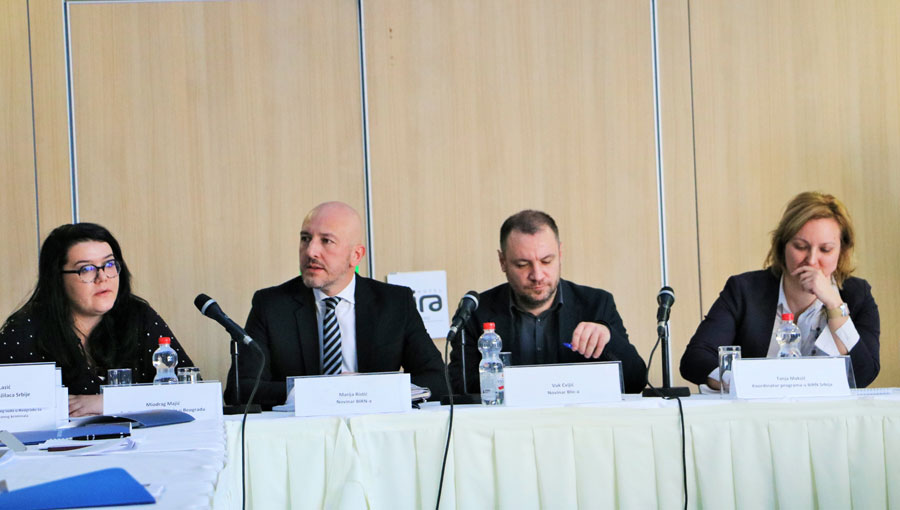
“Tracing public money in Serbian media sector is of special importance as this money, for most of the local media, is the main source of survival,” said Tanja Maksic, program coordinator of BIRN Serbia.

“Partisan and non-transparent allocation leads to corrupt practices and abuse of public funds. In the long run, it diminishes fair competition and pushes media towards propaganda, rather than reporting in the public interest,” she added.

“That is why it is highly important to have effective monitoring tools as well as to engage the broader civil society community in this issue.”

The info-hub is envisaged as a resource center for all interested stakeholders, particularly in civil society, and as a unique platform where all relevant data can be easily accessed.

The website will be updated regularly through the duration of the entire project and will hopefully serve as valuable information source for all stakeholders interested in this topic.

Revealing Corruption Remains Challenge for Balkan Media

Reporters on corruption and organised crime in the Balkans are subject to a range of different pressures and challenges – as our comparison of reporting on such cases in Bosnia, Kosovo and Serbia shows.

Organised crime and corruption are among the key challenges facing the societies of the Western Balkans, with corruption in particular being a key grievance for ordinary citizens and voters.

As in any democracy, the media play a crucial role when it comes to informing the public on these subjects and shaping public debates.

The extent to which the media are able to do so objectively and independently will help the public to both better understand the scale of the problem and assess what their elected representatives and institutions, tasked with upholding the rule of law, are doing to combat organised crime and corruption.

During 2017, BIRN conducted a regional study that examined how the media report on organised crime and corruption in Bosnia and Herzegovina, Kosovo and Serbia.

Aside from the looking at how media report on the topic, the study also sought to unpack why media report on organised crime and corruption in the way they do.

Specifically, our study sought to identify the challenges and constraints faced by media organisations across the region when it comes to reporting on organised crime and corruption.

Clik here for full article.

Click here for photo gallery.

BIRN Hosts Panel Discussion on Media Reporting of Corruption in Serbia

On the eve of International Anti-Corruption Day, BIRN held a panel discussion in the Serbian capital as part of a conference organised jointly with the CEPRIS on the role of the media and prosecution in fighting organized crime and corruption in this Balkan country.

More than 60 representatives of the judicary, NGOs and media in Serbia gathered in Belgrade ahead of International Anti-Corruption Day for a conference jointly organised by BIRN on the role of the prosecution and media reporting in the fight against organized crime and corruption.

The conference, which took place on December 8, was co-organised by the Center for Judicial Research (CEPRIS), the Center for Democratic Transition from Montenegro and the Croatian Legal Center, with support from the European Fund for the Balkans (EFB) and the German Embassy in Belgrade.

During the event, debates were held on the election and position of prosecutors and deputies in charge of combatting organized crime and corruption in Serbia and the region, as well as access to information and media reporting on investigative and judicials proceedings in this sector and problems facing the Public Prosecutor’s Office.

For BIRN’s panel discussion on the day, representatives of the NGO presented the main findings of its Serbian country report on media coverage on organized crime and corruption.

The report was produced as part of BIRN’s project titled “Exercising the Freedom of Expression and Openness of State Institutions in Bosnia and Herzegovina, Kosovo and Serbia,” an endeavor supported by the German Foreign Office Stability Pact funds.

This regional study on how media report on organized crime and corruption investigations and court processes in Bosnia and Herzegovina, Kosovo and Serbia began in March 2017, with the final outcomes to be presented at a regional conference in Bosnia’s capital, Sarajevo, in January 2018.

BIRN Serbia Holds Media Content Financing Debate

There is a problem with official financing of media content on the local level because of lack of transparency and allegedly favouritism displayed tender commission members who evaluate the projects, a BIRN Serbia debate heard on December 13.

The debate in Novi Sad was moderated by Nedim Sejdinovic from the Independent Journalists’ Association of Vojvodina (IJAV), and the panel included Tanja Maksic from BIRN Serbia, journalist Denis Kolundzija, legal consultant Milos Stojkovic, and Dubravka Valic Nedeljkovic from the Novi Sad School of Journalism (NSSJ).

It was organised as part of the Public Money for the Public Interest project that BIRN Serbia is implementing with the Independent Journalists’ Association of Serbia (IJAS) and the Slavko Curuvija Foundation (SCF).

The aim of the debate was to present information gathered by BIRN, IJAV, SCF, IJAS and NNSJ about the deficiencies of the project-based co-funding system, as well as to propose possible improvements to address these problems.

The panelists said that there was what they described as political control of state funding allocations to local media, and that certain media were being favoured above others.

But there is rarely money for sensitive and marginalised groups, they agreed.

“A large amount of public money is allocated to the media through non-transparent individual income processes, which according to the law is provided for in emergency cases, but reality shows that rarely are these projects urgent interventions,” Valic Nedeljkovic said.

The idea of project-based co-funding is good, and should not be discarded despite its problems and misuses, the panelists said.

“The alternative is that state absolutely stops having a financial impact on the media sphere, which is not possible, or to going a step back and letting local governments distribute money without any public participation,” Sejdinovic said.

BIRN Serbia and Juzne vesti Train Local Journalists

BIRN Serbia and website Juzne vesti organized a two-day training course for journalist working for local websites.

The training course was held as part of Digital Media Action for Freedom of Expression in Serbia project for journalists from local websites Danas, Maglocistac, Pressek, Forum Info and Bujanovacke.

During the two day, participants had the opportunity to learn how to write for online media, how to pick the right topics and how to find the most interesting ways to present their stories.

BIRN Serbia and Juzne vesti editors gave mentoring support to journalists working on investigations, and future cooperation between the participants was agreed.

BIRN Serbia and Juzne vesti are jointly implementingthe Digital Media Action for Freedom of Expression in Serbia Programme.

The programme offers website optimisation, editorial standardisation, training in investigative and analytical journalism, mentoring support for journalists, the development of public and social network profiles, and content exchange and cooperation on the local and national levels.

The programme continues for six months and includes four local websites in Serbia – Maglocistac, Pressek, Forum Info and Bujanovacke.

BIRN Serbia Hosts Cultural Event on Social Media Impact

BIRN Serbia and Our Endowment: Civil Society House organised a cultural evening in Kragujevac to examine how social media influences and changes people’s lives.

The event on November 20 began with the one-person play ‘Laura, Please’ performed by young actor Nikola Rakocevic, before a public debate about social media’s impact on everyday life.

‘Laura, Please’, produced by group Laura2000, deals with the issues of loneliness and love in the digital age.

After the play, BIRN editor Slobodan Georgiev, radio journalist Miroslav Miletic and marketing and IT expert Anita Pratljacic debated the role of modern technology in society and how traditional media needs to change.

The panelists agreed that there is no place for dialogue in traditional media, and that’s why discussion have thrived on Facebook and Twitter.

For a lot of people Facebook is the internet, and journalists should adapt to that fact, they said.

“Bearing in mind the expansion of fake news, people should be very careful when consuming news on the internet. People need to start checking information that is provided to them,” Georgiev warned.

Pratljacic explained that that traditional media didn’t find the way to adapt to new trends and technologies.

“Although social networks have their bad sides, they can also be the trigger for some good things. They are the place where people communicate and organise in order to bring change to their communities,” she said.

The event, the first of many that will be held all over the Serbia, was supported by Interaktiv and pressek.rs, local organisations from Kragujevac.

BIRN Serbia Hosts New Government Media Strategy Debate

BIRN Serbia, the Independent Journalists’ Association of Serbia and the Slavko Curuvija Foundation organised a debate on November 23 about the Ministry of Culture and Information’s new media strategy.

The debate in Belgrade brought together nearly 30 NGO and media representatives from the local and national levels.

After a delay of a year, the Ministry of Culture and Information has begun work on the media strategy, which should frame and strategically position the development of the Serbian media sector in the upcoming five years.

In the summer of 2017, the ministry assembled a working group to draft a proposal which could be publicly presented and discussed, before being adopted by the government.

But the working group has been dogged by controversy, recently culminating with four of its members quitting.

All the participants at the debate in Belgrade agreed that the new strategy must be fair across the media when it comes to awardeing financing.

Representatives of the media and journalists’ associations should be involved in the preparation of the new media strategy, the participants also said.

They argued that the existing media legislation is not bad, but the problem is the way in which it is used.

Tanja Maksic from BIRN Serbia said that the most important thing is that the Regulatory Body for Electronic Media (REM) must be an independent body.

“People who sit on the REM Council should be professionals. Political and state bodies should be excluded from proposing candidates for the Council,” Maksic said.

She also said that the new media strategy must ensure pluralism and a stable way of financing public media services.

Maksic argued that the strategy should envisage the creation of the state media financing registry and regulate public funds for the media as a free market development guarantor.

The debate was organized as part of the Public Money for the Public Interest project that BIRN Serbia is implementing with the Independent Journalists’ Association of Serbia and the Slavko Curuvija Foundation.

UNDP

DONOR
UNDP works in some 170 countries and territories, helping to achieve the eradication of poverty, and the reduction of inequalities and exclusion.

The organisation helps countries to develop policies, leadership skills, partnering abilities, institutional capabilities and build resilience in order to sustain development results.

UNDP provides technical advice and assistance for sustainable human development and supports Serbia in joining the European Union. UNDP operates in Serbia since 1952 through the Country Office in Belgrade.

UNDP objectives are outlined in the Country Programme Document (CPD 2016-2020), rooted in the overarching goals of the United Nations Development Partnership Framework, which centers the work of the entire UN Country Team in Serbia on supporting Serbia to achieve goals in the areas of:

  • Governance and Rule of Law
  • Social and Human Resources Development
  • Economic Development
  • Growth
  • Employment
  • Environment
  • Climate Change and
  • Resilient Communities and Culture and Development

Web: http://www.rs.undp.org/content/serbia/en/home/

The Office for Cooperation with Civil Society

DONOR
The Office for Cooperation with Civil Society was established in 2011 by the Government of the Republic of Serbia. After years of advocacy by civil society, the Office has been established as an institutional mechanism to support the development of a dialogue between the Serbian Government and CSO’s.

The importance and role of the Office for Cooperation with Civil Society is reflected in the coordination of Government and CSO’s mutual cooperation, regarding the process of creating and establishing accurate standards and procedures for including the CSO’s at all levels of decision making process.
According to its mandate, Office should provide the support to the CSO’s in the process of the defining and implementing legislative procedures altogether with public policies, and thereby contributing to a positive pressure on the governmental institutions.

Office for Cooperation with Civil Society should play an active role in creating and establishing a cooperation platform in the Western Balkans regarding overall linking in the successful implementation of political, social and economic reforms in the region.

Web: http://www.civilnodrustvo.gov.rs/home/home.1.html

Freedom House

DONOR
Freedom House is an independent watchdog organisation dedicated to the expansion of freedom and democracy around the world. Founded in 1941, Freedom House was the first American organisation to champion the advancement of freedom globally.

The organisation analyses the challenges to freedom, advocates for greater political rights and civil liberties, and supports frontline activists to defend human rights and promote democratic change.

Freedom House acts as a catalyst for greater political rights and civil liberties through a combination of analysis, advocacy, and action.

In addition, Freedom House empowers frontline human rights defenders and civic activists to uphold fundamental rights and to advance democratic change.

Web: https://freedomhouse.org/