BIRN Kosovo Co-partners with USAID’s New Initiative to Promote Judicial Transparency

On September 28, a new project aiming to promote transparency in Kosovo’s judicial sector was launched.

The project, a partnership between USAID’s Justice System Strengthening Program (JSSP), the Kosovo Judicial Council (KJC), and civil society organizations, such as BIRN Kosovo, Advocacy Center for Democratic Culture (ACDC) and Democracy Plus, aims improve public outreach and communication between the judiciary and the public.

Mark Isom, acting Deputy Mission Director, and Nehat Idrizi, Chair of the KJC, gave introductory remarks at the project’s launch, emphasizing the significance of transparency in fostering accountability in the judicial sector.

Throughout the project’s timeline, partners, including BIRN Kosovo, will closely collaborate with specific courts to inform the wider public on the courts’ activities, and will utilize social media to increase public outreach.

The launching event hosted various civil society organizations, relevant public officials, and media groups who have an interest and stake in contributing to increased transparency and accountability in Kosovo’s justice system.

Kreshnik Gashi from BIRN Kosovo presented BIRN’s role and activities within this initiative.  The new initiative will greatly benefit from BIRN Kosovo’s support, which, as an independent and non-governmental organization, acts as a watchdog in the implementation of the democratic transition processes, including for judicial sector reforms. As an organization that contributes to enhancing the accountability and professionalism of Kosovo’s justice institutions, BIRN will help the JSSP’s team to increase judicial transparency, accountability, and effectiveness, and to widen the public’s understanding of Kosovo’s court system.

BIRN Produces Mayoral Debates for Kosovo’s Upcoming Municipal Elections

BIRN Kosovo, in collaboration with Internews Kosova, has been producing and airing mayoral candidate debates prior to Kosovo’s upcoming municipal elections, set for October 22.

The debates, which are broadcasted every evening on RTV 21, aim to bring the audience face-to-face with mayoral candidates, giving people a chance to hear their political platforms, promises, and how they plan to implement their agendas.

BIRN’s debate model #DebatPernime (#RealDebate) aims to raise citizen awareness about the candidates, and also to serve as a platform for revisiting promises after mayors are elected. BIRN will conduct a mid-mandate fact-check of the assurances made during the debates so that the public can know the extent to which their representatives are keeping their promises.

The pre-elections debates host mayoral candidates from all parties, whom are encouraged to invite their supporters to participate and cheer for their desired politicians as live audience members during the debate. Citizens all over Kosovo are also encouraged to submit debate questions and concerns through BIRN’s anti-corruption platform KALLXO.com, and on KALLXO.com’s Facebook channel.

BIRN Kosovo’s Justice in Kosovo Show Wins “Best Anti-Corruption Story” Award

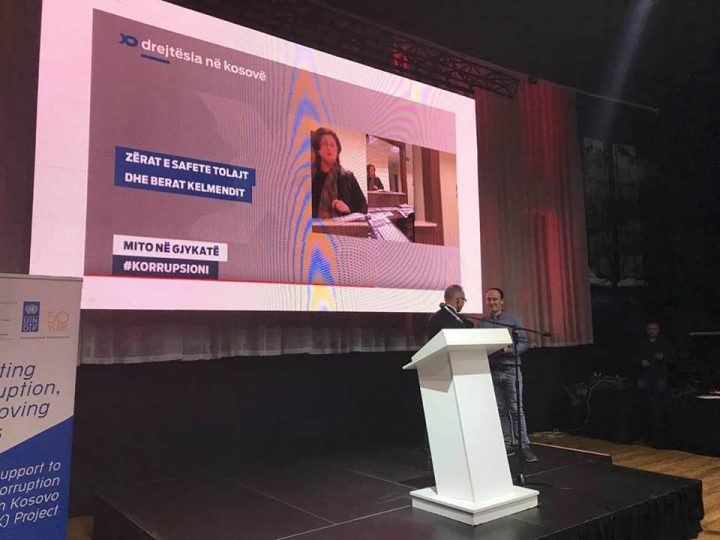
On December 8, the team behind the weekly BIRN Kosovo broadcast show “Justice in Kosovo”, was awarded the prize for “Best Anti-Corruption Story” by the United Nations Development Programme (UNDP Kosovo) and the Association of Journalists of Kosovo. The award was given to the team of Justice in Kosovo who conducted a thorough investigation on an alleged bribery case in the Basic Court of Deçan by its judge. The story, named “Bribery in the Court”, was presented through two episodes in the weekly program “Justice in Kosovo”.

The investigation into the Basic Court of Deçan revealed that Judge Safete Tolaj was involved in bribery. Her son would make efforts to bribe indicted persons, whose cases were being judged by Tolaj. KALLXO.com, BIRN Kosovo’s online anti-corruption platform, received a report from a citizen named Berat Kelmendi, who asserted that he was experiencing longer than usual times to have his case be resolved by judge Tolaj. Tolaj’s son, Fisnik, had then approached Kelmendi to speed up his case in exchange for 20,000 euros. Kelmendi had accepted the offer by secretly recording all instances where they were negotiating money in order to have Judge Tolaj solve the case faster. When Judge Tolaj was interviewed by Justice in Kosovo team, she acted surprised and claimed she was not aware of her son’s actions. However, she and her son were arrested the night before the second episode of Justice in Kosovo was broadcast. Several months after, on October 11, the Department for Heavy Crimes of the Basic Prosecutor’s Office in Peja issued an indictment against judge Tolaj under the charge of abuse of official duty.

Illustrating cases like these with evidence and their impact has resulted in strengthening the cooperation between KALLXO.com and the State Basic Prosecution, as well as the Kosovo Police. Justice in Kosovo and other BIRN Kosovo products will continue to pursue and investigate cases to uncover affairs of corruption and ensure those responsible are held accountable before legal institutions.

BIRN Articles Quoted in International Reports

Articles and reports published by BIRN in recent months have been quoted and referenced in various European publications about media, minorities, democratisation, foreign fighters and radicalisation.

BIRN is quoted in the ‘Reporting Crisis in South East Europe: Case Studies in Six SEE Countries’ report series by the South East European Network for Professionalisation of Media, published in August 2017, for its media monitoring on issues like censorship and self-censorship, and also mentioned for its investigative reporting achievements.

BIRN is also quoted in ‘Building Democracy in the Yugoslav Successor States:  Accomplishments, Setbacks, and Challenges since 1990’, edited by Sabrina P. Ramet, Christine M. Hassenstab, and Ola Listhaug from the Norwegian University of Science and Technology in Trondheim and published by Cambridge University Press in May 2017.

Around 20 different articles published by BIRN’s regional publication Balkan Insight over the last five years are quoted in the book.

The report ‘Radicalization and Foreign Fighters in the Kosovo Context – An analysis of international media coverage of the phenomena’, published in June 2017, quotes Balkan Insight and Prishtina Insight articles about the role of online propaganda in Balkan jihadi environments and recruitment, and court cases against Kosovo terror suspects.

“Since 2014, the high proportion of foreign fighters from Kosovo and challenges related to radicalisation have been extensively covered by international English-language print and online media,” the Norwegian Institute of International Affairs says in the publication.

The European Commission against Racism and Intolerance (ECRI), established by the Council of Europe, an independent human rights monitoring body specialised in questions relating to racism and intolerance, published a report about minority rights in Serbia in May, which quoted a number of Balkan Insight articles from recent years.

BIRN and Kosovo Women’s Network to Monitor Gender-Based Violence

July 2017 marks the beginning of a new initiative to monitor gender-based violence cases in Kosovo. BIRN and Kosovo Women’s Network officially joined forces on July 21st, when representatives from KWN offered a training for BIRN monitors on the best practices for monitoring how gender-based violence is treated in Kosovo. Special focus will be given to domestic and sexual violence against women and girls.

The overall objective of the project is to ensure justice, protection, and rehabilitation for the victims of gender-based violence. Bearing in mind that in Kosovo, women and girls are significantly more affected by different forms of violence just because of their gender, BIRN and KWN will work on mitigating gender-based violence and make up for the poor performance of institutions that are accountable for them.

This project was inspired by the latest findings on the status of gender-based violence in Kosovo conducted by KWN. The latest investigations conducted by BIRN reveal that local institutions have failed to properly offer their services in sensitive cases such as gender-based violence, resulting in women who are victims of such acts receiving little or no support at all from responsible actors. Hence, in order to support victims, BIRN and KWN will begin regularly monitoring these cases to prevent the relevant institutions from manipulating and mistreating them.. The institutions that will be monitored as part of this project include courts, prosecutions, the Kosovo Police, social work centres, and other relevant institutions that exist to properly treat cases of gender-based violence.

The aim of the project is to increase accountability of these institutions while treating cases that include gender-based violence, as well as to increase the awareness of citizens and institutional representatives on the importance of reporting and offering support to victims. Parallel to the implementation of the project, both networks openly invite all citizens to report institutional breaches they run into, or have previously witnessed, if an institution has disregarded or mistreated cases related to gender-based violence. The project is supported by the Austrian Development Agency.

BIRN Investigation Shortlisted for International Prize

An investigation by Balkan Investigative Reporting Network has been shortlisted for the prestigious Global Shining Light Award.

The story “Making a Killing” was jointly produced with the Organized Crime and Corruption Reporting Project and uncovered how billions of euros of arms from the Balkans and Eastern Europe are illegally ending up with Syrian rebels, including the Islamic State.

The award is sponsored by the Global Investigative Journalism Network, GIJN, an association of 155 non-profit organisations in 68 countries.

An international panel of judges selected the finalists from 211 projects, submitted by journalists in 67 countries.

The winners will be announced at the 2017 Global Investigative Journalism Conference in Johannesburg in November.

In an announcement, the GIJN described the 12 shorted listed stories as “extraordinary investigative projects from around the world”.

The story was produced as part of “A Paper Trail to Better Governance” project supported by the Austrian Development Agency to promote rule of law, accountability and transparency in six South-Eastern Europe countries.

Pressure Rises on Journalists in the Balkans

Weakening EU and US influence in the Balkans and increased Russian influence, as well as growing political and economic pressures on journalists, have created a harsher environment for Balkan media, BIRN’s biennial meeting heard.

At the biennial meeting of the Balkan Investigative Reporting Network on Saturday, Ana Petruseva, director of BIRN Macedonia, said the situation facing the media in the Balkans “seems to be going from bad to worse”.

In addition to the usual political and financial pressures, she said, the media is seeing new types of pressure – the labelling of reporters and media outlets as spies and foreign mercenaries, as well as the opening of a large number of fake news websites.

Petruseva said the flood of fake news was “creating a media noise” in which it is becoming difficult for the public to distinguish between real and fake information, as a result of which confidence in the media in general is declining.

“People are losing trust in the media, and start to see everything as propaganda and promotion,” Petruseva said at the BIRN meeting on Saturday in Kopaonik, Serbia, referring to the new challenges facing the Balkan media.

Wolfgang Petritsch, a BIRN Board member and the president of the Austrian Marshall Plan Foundation, warned the Balkan countries not to always count on EU support, as many in Brussels saw “stability as the priority” over reforms.

“The EU position has weakened owing to its internal problems. As long as it does not finish the process of internal reforms, there will be no strong EU role in the region,” he said, noting that while the promise of EU enlargement is fading, authoritarian regimes in the region are strengthening.

“Since no system has been established of how to handle enlargement, the situation will remain in the ‘twilight zone’,” Petritsch said.

Political analyst for The Economist and Balkan expert Tim Judah said the policy of “stabilitocracy”, whereby the EU and the US appear to tolerate authoritarian Balkan leaders who deliver stability, is essentially a pragmatic response.

“It means dealing with the leaders that we have, and dealing with the Balkans in the way that they are,” he said.

Judah said that while Western influence had decreased, Russian influence had grown, but that Moscow saw setbacks in recent months – giving the example of Macedonia, where Prime Minister Nikola Gruevski has been ousted, and Montenegro, which joined NATO on June 5 despite Russian opposition.

“What is Russia’s interest? It is simple, they want to create within the region pro-Russian or neutral territories,” Judah said.

BIRN Board member and visiting scholar at Carnegie Europe Stefan Lehne said the Balkan countries could move closer towards EU membership in different ways.

“Parallel to the very, very slow and very boring and complicated enlargement process there could be some process of horizontal enlargement. The Balkans countries should not join only country by country, but policy by policy,” Lehne said, listing Balkan countries’ participation in the Energy Community as an example of this.

BIRN board member and media expert Robert Bierman spoke of the recent experience of the media in the United States, where the administration of President Donald Trump has been targeting the press.

“Any weakness in the media will be pointed at. It doesn’t matter if two things are wrong and 98 are right, those two things become the most important in the world. It doesn’t matter that the administration is doing 98 things wrong and two things right,” Bierman said.

However, he added more optimistically that Americans appear more ready now to pay for editorial content, adding that the media are also continuing to do their job.

Before the panel, BIRN Regional Director Gordana Igric presented the results of the BIRN network’s projects in the last year, noting that the network had directly reached over five million people.

“In the past year, this number increased by over half a million people,” Igric said, adding that milestone stories had tackled such major issues as corruption, problems with public procurements and concessions. As a result of these investigations, officials have been removed and criminal charges filed.

Igric said that BIRN currently operates 16 websites in various languages, and has produced over 100 TV reports and films and held 50 training courses during the past year.

According to Igric, BIRN’s articles have been republished or cited in many respected foreign media, including The Guardian, the BBC, and Bloomberg. BIRN has also been very active in advocating the prosecution of war crimes and in participative budgeting activities.

The biennial BIRN network meeting continues until June 10 on Mount Kopaonik in Serbia.

BIRN – Regional Network Director

Outstanding individual sought for this exciting post, heading up the work of the Balkan Investigative Reporting Regional Network, BIRN Hub, the unique media development and human rights organisation in the Balkans. BIRN’s hard-hitting reporting and analysis has gained an unparalleled reputation in the 12 years since it was founded.

This post gives an opportunity to develop the network’s work at a time of key challenges in the Balkan region. The successful candidate will play a defining role in driving BIRN’s work over the coming years, develop and implement new strategies and extend and build partnerships across the region and internationally.

1.     WHO WE ARE?

The BIRN Network is a close-knit family of non-governmental, non-profit organisations, promoting freedom of speech, human rights and democratic values with a presence across the Balkans. Tacking key issues of the region BIRN implements a range of programmes and projects. They focus on journalist training, publishing, broadcasting, media-monitoring, advocacy and debate, working with civil society organisations and creating public archives and databases.

We have country-based organisations in Albania, Bosnia and Herzegovina, Kosovo, Macedonia, Romania and Serbia, while BIRN Hub acts as our umbrella organisation. It is a non-governmental, non-profit independent organisation registered in Bosnia and Herzegovina whose job is to act as the secretariat of BIRN’s individual country-based organisations.

Additionally, BIRN Hub manages the majority of the network’s regional programmes which are implemented in cooperation with our country-based or other organisations, journalists and consultants. The work of BIRN Hub includes capacity-building of the network, the quality control of editorial output and the management of websites at the regional level. It also includes journalist training and editorial production, implemented through several programmes.

Our network of journalists and editors also includes Montenegro, Croatia, Bulgaria, Greece, and beyond. We have a wide media presence; online, on social media, in print, television, radio. Balkan Insight is our flagship website.

 2.     WHAT DO WE SEEK?

A BIRN Regional Director (BIRN Hub), will have the following responsibilities:

  • Ensuring fiscal and legal compliance in the work of BIRN Hub, under the respective laws of Bosnia and Herzegovina
  • Ensuring the smooth operation of all projects and programmes implemented by the network
  • Ensuring compliance with donor requirements for projects and programmes implemented by BIRN Hub as the lead partner
  • Ensuring proper and timely staffing of the organisation
  • Leading and motivating employees and effectively managing the human resources of  BIRN Hub
  • Ensuring the effective administration of BIRN Hub operations including the efficient completion of all BIRN Hub’s duties as the network’s secretariat
  • Ensuring an exchange of information and decision-making processes within and between BIRN Hub, the BIRN network, the Steering Committee and Assembly, in compliance with Network Rules and Regulations, the BIRN Network Cooperation Agreement, BIRN Hub’s Statute and all legal provisions
  • Ensure Network Rules and Regulations are implemented and the values of the network are respected and maintained throughout across the BIRN family
  • Ensuring maintenance, smooth operations and regional cooperation within the BIRN network, in compliance with the Network Rules and Regulations
  • Ensuring the BIRN network’s compliance with international standards of journalism, libel laws, professionalism and objectivity
  • Leading the BIRN network’s fundraising activities with a specific focus on regional programmes and deepening cooperation within the network, including the design of programmes and projects, representation of BIRN Network in public and donor relations
  • Represent BIRN Hub and BIRN network in public, (including events, public appearances and donor conferences,) with the aim of furthering the network’s mission

3.     WHAT ARE WE LOOKING FOR?

  • An excellent understanding of Balkan politics, society, and interethnic relations, plus a strong editorial background
  • Strong media development experience and knowledge of international journalistic standards
  • Commitment, drive and passion for human rights and media freedom
  • At least five years of executive experience in the non-profit sector
  • A proven track record in fundraising and an understanding donor relations unique to the non-profit sector
  • A solid understanding of financial cycles, including budget preparation, analysis, financially-informed decision-making and reporting
  • Strong organisational skills, including planning, delegating, programme development and task facilitation
  • Strong leadership and interpersonal skills and a demonstrated ability to oversee and collaborate with staff of different backgrounds
  • Public appearance, diplomacy and speaking skills and excellence in conveying messages, including the vision of BIRN’s strategic future to staff, the Board, donors and public
  • Excellent English speaking and writing skills and knowledge of at least one language of the Balkans

4.     WHAT ARE WE OFFERING?

  • An opportunity to work with a motivated, diverse team of professionals and to pursue the BIRN’s mission
  • A 4-year contract (renewable) and a competitive salary package, after a 3-month probation period
  • Working from one of our offices in the Balkans with the opportunity of frequent travel around the region

Eligible candidates are invited to send an application including a CV, motivation letter and supplementary documentation to support their candidacy to [email protected], no later than August 1, 2017.

The short-listed candidates will be invited to an interview by the 15th of August 2017. The successful candidate is expected to start with the 1st of October 2017.

BIRN Wins Four EU Investigative Journalism Awards

The 2017 regional scheme of the EU awarding investigative journalism in the Western Balkans and Turkey, for the best investigative stories published in 2016, has come to an end.

The three-year award scheme established by the European Commission following the EU Enlargement strategy, aimed at monitoring the reform processes and keeping alive the historic momentum towards EU accession, has thus been concluded.

This year, BIRN won four awards, in KosovoSerbiaMacedonia, and Albania.

The outcome of the three-year scheme, implemented in 2015, 2016 and 2017, has been 64 awards for investigative stories produced by 88 journalists across the region.

The winning stories were selected from a total of 679 nominations.

The organisers noted the prominent place BIRN won for itself over the three years of the award scheme.

“Balkan Investigative Journalism Network (BIRN) and centers for investigative journalism (CIN) operating in several countries of the region were featured prominently among the awarded investigative stories (receiving a total of 18 out of 64 prizes awarded). It points to the role of independent, non-profit investigative journalism centers and networks in production of quality investigative journalism in the region”, the organisers wrote in the press release.

Austrian Development Agency (ADA)

DONOR
Austrian Development Agency, ADA, implements the Austrian Development Cooperation’s bilateral programmes and projects, which support countries in Africa, Asia, Central America and Southeastern and Eastern Europe as they work to obtain sustainable social, economic and democratic development.

In Southeast Europe, the ADA aims to promote private sector development to generate employment and income.

It works to harness synergies with the Austrian private sector and industry, and devotes particular attention to mobilising youth.

The agency’s projects assist in modernising the educational systems, bringing higher education and vocational training into line with European standards and labour market requirements.

In addition, the ADA is committed to advancing rule of law and civil society as well as measures to combat human trafficking.

The Austrian Development Agency is a donor to the Paper Trail for Better Governance programme.

Web: https://www.entwicklung.at/en/