ICTJ Praises BIRN’s Work on Al Jazeera

Refik Hodzic, director of the International Center for Transitional Justice ICTJ, recognized the importance on BIRN’s specialized reporting on transitional justice issues on Al Jazeera Balkans’ current affairs TV show, Kontekst, on April 15.

The topic of the show was the importance of the International Criminal Tribunal for former Yugoslavia, ICTY.

Hodzic said the key problem that the Tribunal faced was the political context in which the Tribunal operated. Detailed reporting on ICTY trials conducted by the SENSE Agency and, in recent years, by BIRN – Balkan Insight, with support from civil society, was evolving in a political context that was hostile towards the work of Tribunal. Politicians who influenced public opinion, and the media under their control, were continuously working against the facts established by the Tribunal, he said. 

Other guests on the show were Natasa Kandic, founder of the Humanitarian Law Center and Anto Nobilo, the lawyer.

Kontekst is a daily programme aired by the Balkans branch of the international Al Jazeera news network. It was launched in 2011. The April 15 edition can be seen by following this link: http://balkans.aljazeera.net/video/kontekst-znacaj-tribunala-u-hagu.

BIRN Fellowship Participant Wins European Reporting Prize

Sorana Stanescu, one of the alumni from last year’s Balkan Fellowship for Journalistic Excellence programme, has won the 2013 Academic Association for Contemporary European Studies, UACES award for her article ‘Cheap and Far from Free’.

The article was researched and written as a result of the Fellowship programme and was published by the New Statesman news magazine in Britain and by Balkan Insight.   

The UACES Prize honours excellence in reporting on the European Union in the English-speaking media.

Stanescu’s winning story was about the job restrictions that have left migrant construction workers from Romania and Bulgaria underpaid and vulnerable to exploitation in the UK.

The article came as result of four months’ work with the Balkan Fellowship for Journalistic Excellence. Stanescu also won the Fellowship programme’s first prize for the same story. 

The prize ceremony will take place on May 13 at 17.30 at the Smith Square Conference Centre in London. Stanescu and the editor of the Balkan Fellowship programme, Neil Arun, will attend the event.

The fellowship programme aims to develop and support Balkan journalists reporting on complex reform issues. It was established by the Robert Bosch Stiftung and ERSTE Foundation in cooperation with the Balkan Investigative Reporting Network.

Swiss Cultural Programme Portrays the Change

A conference marking the end of the Swiss Cultural Programme in the western Balkans opened in Sarajevo in the presence of more than 100 artists, journalists and representatives of cultural organisations.
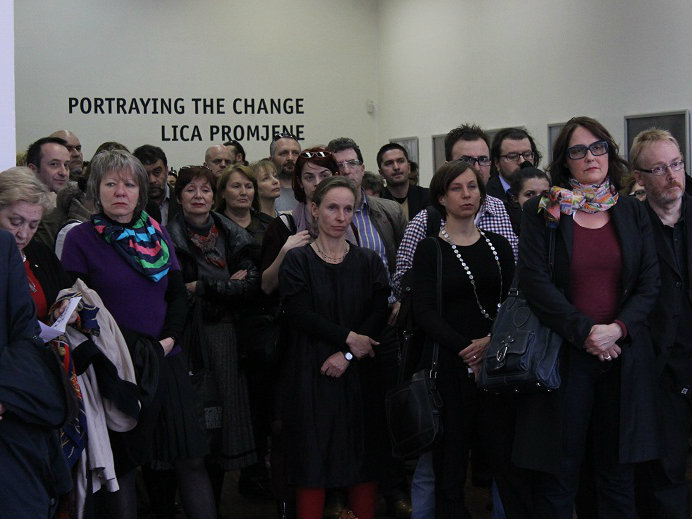
Lica promene - Sarajevo ultural conference

The two-day conference opened on April 11 at the crowded BiH Art Gallery with the exhibition ‘Portraying the Change’ which featured the work of professional photographers Dragi Nedelcevski (Macedonia), Jetmir Idrizi (Kosovo), Lazar Pejovic (Montenegro) and Amir Kapetanovic (Bosnia and Herzegovina).

Both the exhibition and the final conference, which was organised to summarise the programme’s projects, was opened by Switzerland’s ambassador to BiH, Andre Schaller, who stressed the importance of cultural cooperation.

“Art is understandable despite differences in languages – it goes directly to our heart. This is the key to success in Switzerland, that we see each other’s cultures as riches,” he said.

The Swiss Culture Programme is run by Pro Helvetia, the Swiss arts council. Over 15 years, Switzerland has invested 22 million Swiss francs into cultural and artistic initiatives in nine countries with the aim of reviving cultural landscapes and supporting overall democratic processes. Hundreds of organisations and thousands of artists have been involved in over 3,000 cultural initiatives and projects in south-east Europe during this period.

BiH’s deputy minister for civil affairs, Denisa Sarajlic-Maglic, thanked the Swiss government for fostering cross-border cultural cooperation.

“The Swiss Cultural Programme helped forge lasting partnerships between cultural institutions, artists and local communities,” she said.

Sarajlic-Maglic added that culture, “as mean of capturing social realities and reacting to social realities, is a much-needed tool, on our way to create a society that will accept the idea of social diversity”.

The assistant director-general of the Swiss Development Cooperation, Kurt Kunz, said that the main indicator of the programme’s success was that the networks and contacts that were established have laid the groundwork for the future.

“We wanted to support innovative artistic creativity, independent production, respect for minorities and freedom of expression. Bridges have been built with several regional networks and regional cooperation projects,” Kunz concluded.

Besides the presentations and debates, the conference incudes two exhibitions by Balkan artists Alban Muja (Kosovo) and Dragi Nedelcevski (Macedonia), as well as other cultural events such as contemporary dance and film screenings.

Among a series of successful cultural initiatives and art projects, the SCP has supported the three-year Balkan Initiative for Cultural Cooperation Exchange and Development, BICCED, which promotes analytical and investigative journalism in the area of culture and the spreading of information about cultural issues across Balkan borders, organised by the Balkan Investigative Reporting Network, BIRN, and SeeCult.org.

Final Event Marks Closure of Swiss Cultural Programme

The Swiss Cultural Programme in the western Balkans, which has invested millions in the regional cultural scene, will mark its closure in Sarajevo with discussions, art exhibitions and awards for best practice.

On April 11-12, a final event will be staged in collaboration with the Embassy of Switzerland in Bosnia and Herzogovina and the Swiss Development Cooperation Office.

Among a series of successful cultural initiatives and art projects, SCP has supported the three-year Balkan Initiative for Cultural Cooperation Exchange and Development, BICCED, which promotes analytical and investigative journalism in the area of culture and the spreading of information about cultural issues across Balkan borders, organised by the Balkan Investigative Reporting Network, BIRN, and SeeCult.org.

The final event, which will bring together more than 100 regional and international cultural practitioners, activists, artists, academics and supporters, will be an opportunity to re-emphasise the importance of culture in social developments.

Over the course of 15 years, Switzerland has invested 22 million Swiss francs in cultural and artistic initiatives in nine countries, with the aim of reviving their cultural landscapes and supporting overall democratic processes.

Hundreds of organisations and thousands of artists have been involved in over 3,000 cultural initiatives and projects in south-east Europe over this period. 

As a result of collaborations between cultural practitioners within local, national, and regional initiatives, creative potential has been boosted and platforms supported across the region.

The two-day final programme commences with the opening of a photography exhibition called ‘Portraying the Change’, which documents the work of the Swiss Cultural Programme through individual portraits and testimonies. The exhibition will be opened on April 11, 2013 by HE André Schaller, Switzerland’s ambassador to Sarajevo.

The presentation of the programme’s achievements will be followed by a promotion for the four organisations which received the SCP Award. These organisations have been awarded for best practice development and excellence in their respective fields.

During the second day, participants will discuss priorities and challenges for the independent cultural sector, as well as future international funding opportunities for the region.

The artistic programme accompanying the final event will reflect a range of SCP contributions to different artistic fields (photography, visual arts, theatre, and contemporary dance) as well as offering the Sarajevo audience premieres of productions from countries across the region.

Al Jazeera Balkans Hosts Balkan Insight Managing Editor

Ana Petruseva, BIRN Macedonia director and Balkan Insight managing editor, took part in Al Jazeera Balkans’ current affairs TV show ‘Kontekst’ on April 4.

The topic of the programme was the upcoming second round of the local elections in Macedonia. Another guest on the show was Macedonian political analyst and professor at Skopje University of Political Science, Vladimir Bozinovski.

‘Kontekst’ is a daily programme aired by the Balkans branch of the international Al Jazeera news network, which was launched in 2011. The April 4 edition can be seen by following this link:

BIRN Fellowship Alumnus Wins Journalism Prize

Stevan Dojcinovic, editor of the Centre for Investigative Journalism Serbia and an alumnus of the Balkan Fellowship for Journalism Excellence, has won the 2012 Jug Grizelj award for investigative journalism.

Stevan Dojcinovic

Dojcinovic won with a series of articles on organised crime and corruption in Serbia and the Balkans region which were published by several newspapers and magazines.

The members of the jury were Antonela Riha, Filip Svarm, Vukasin Obradovic and Velimir Curguz Kazimir.

The awards ceremony will take place on April 5 at the Media Centre in Belgrade.

The annual prize has been awarded for achievements in investigative journalism from 1991 onwards, in memory of journalist Jug Grizelj.

Several journalists set up a fund in the early 1990s to preserve Grizelj’s memory and encourage investigative reporting.

Dojcinovic is took part in the Balkan Fellowship for Journalistic Excellence programme in 2011 and won third prize for his story on dubious privatisations in Serbia, entitled Serbian Privatisation: Criminals Still Cash In.

Fellows for 2013 selected

The jury in the Balkan Fellowship for Journalistic Excellence has selected 10 participants for this year’s programme.

The fellows were drawn from more than 100 applicants. The competition for the top places was once again extremely close, and the quality of shortlisted entries was very high.

BIRN would like to congratulate the winners, and to thank all who applied this year. BIRN would also like to encourage candidates who were not successful to consider applying again next year.

The journalists were selected through open competition to receive funding and professional support that would help them conduct cross-border research into a topic of regional and EU significance. Participants in the programme are selected based on the relevance, feasibility and originality of their proposals, as well as their professional qualifications, motivation and journalistic approach.

The Selection Committee is comprised of seven prominent media figures from the Balkans and Europe. Each year, committee members read, evaluate and select story proposals for the fellowship.

Alongside six permanent committee members, an expert in the fellowship investigation topic is appointed as an annual member, and this year it was Paul Lewis, award-Winning UK journalist and special projects editor at the British daily newspaper The Guardian.

Here are the fellows for 2013, listed alphabetically by surname:

Dino Jahic, Bosnia and Herzegovina

Meri Jordanovska, Macedonia

Hana Marku, Kosovo

Marija Milosevic, Serbia

Vlad Odobescu, Romania

Goran Rizaov, Macedonia

Mirko Rudic, Serbia

Erjona Rusi, Albania

Melisa Skender, Croatia

Elena Stancu, Romania

Suddeutsche Zeitung’s Balkans correspondent joins Fellowship committee

The award-winning German journalist Florian Hassel will be representing Suddeutsche Zeitung on the selection committee of the Balkan Fellowship for Journalistic Excellence this year. The respected German newspaper has been the Fellowship’s media partner since the establishment of the programme in 2007. Hassel will replace his colleague Christiane Schloetzer, who was a member of the jury for six years until she took up a new post in Turkey in late 2012.

Florian Hassel‘s journalistic carrier started back in 1986, and since then he has written for a number of leading German papers, such as Die Welt, Frankfurter Rundschau, Die Zeit, Stern, following domestic affairs and working as Moscow correspondent. He also worked as a correspondent from Germany for the Austrian news magazine Profil.

In 2002, Hassel was awarded the Wächterpreis der Tagespresse (German newspaper investigative reporting prize) for a series of investigative reports on the war in Chechnya, while in 2011 he won the Ernst-Schneider-Preis (the most prominent German prize for economic reporting) for a series of reports on the debt crisis in Greece in Welt am Sonntag.

Since January 2013 he has been the Balkans correspondent for Suddeutsche Zeitung.

 The Balkan Fellowship for Journalistic Excellence is an annual bursary for cross-border investigative and long-form reporting. Ten journalists are picked by the Fellowship’s selection committee each year to receive funding, training and professional support to conduct fresh, in-depth investigations. The independent selection committee is made up of regional and international journalists, editors and prominent Balkan experts. It consists of six permanent and one annual member, selected in accordance with the annual topic. This year’s Fellowship programme topic is Integrity.

You can find out more about the project on its website: http://fellowship.birn.eu.com/en/page/home

Award-Winning UK journalist Joins Fellowship Jury

Paul Lewis, special projects editor at the British daily newspaper The Guardian, has joined the annual jury for the Balkan Fellowship for Journalistic Excellence.

He recently received the European Press Prize’s Innovation Award for spearheading a major research project into the causes and consequences of the riots in England in summer 2011.

Lewis lectures across Europe about the use of social media in journalism and teaches a masterclass in investigative reporting. You can watch his TED talk here. Last year, he trained journalists at BIRN’s investigative reporting summer school.

He was named Reporter of the Year at the British Press Awards in 2010 and won the 2009 Bevins Prize for outstanding investigative journalism. He previously worked at the Washington Post as a Stern Fellow. In 2012, he was nominated for both Reporter of the Year and the Orwell Prize for Journalism. He was also the winner of the ‘Best Twitter Feed’ award at the Online Media Awards.

He joined the Guardian as a trainee is 2005 after studying at Cambridge University and Harvard University. He lives in London and can be followed on Twitter: @paullewis

The Balkan Fellowship for Journalistic Excellence is an annual bursary for cross-border investigative and long-form reporting. Ten journalists are picked by the fellowship’s selection committee each year to receive funding, training and professional support to conduct fresh, in-depth investigations. The independent selection committee is made up of regional and international journalists, editors and prominent Balkan experts. It consists of six permanent and one annual member, selected in accordance with the annual topic. This year’s Fellowship programme topic is Integrity.

You can find out more about the project on its website: http://fellowship.birn.eu.com/en/page/home

More than 100 Applicants for Balkan Fellowship for Journalistic Excellence

This year’s competition for the Balkan Fellowship for Journalistic Excellence programme closed on March 5.

After receiving more than 100 applications, the BIRN team has now launched preparations for the selection process and eligibility checks, after which members of the selection committee will begin the process of choosing the journalists to participate in this year’s programme. The criteria for selection are based on the quality of applications and the journalistic merits of the candidates.

The results of the committee’s deliberations will be announced on March 29 on our website, fellowship.birn.eu.com, while all candidates will be individually informed about the results of the annual competition.

Each year, ten Balkan journalists are selected to take part in the programme. Successful applicants receive a bursary, an additional travel and research allowance of up to €2,000 and the chance to participate in a seven-month programme of professional development and excellence in reporting. Experienced regional and international editors provide hands-on support throughout.

Fellows must be available to attend seminars and editorial sessions during the course of the programme. Participants are expected to complete 2,000-word stories, which will be subject to international-style editing processes and will showcase top-quality journalism with a cross-border reporting angle. The final articles are disseminated in local languages, English and German and are republished in the Balkans and beyond.

The Balkan Investigative Reporting Network, alongside its partners, the Robert Bosch Stiftung and ERSTE Foundation, would like to thank all the applicants for their interest in the programme and wish them the very best of luck.