BIRN Albania Wins Integrity Award from Chamber of Commerce

The International Chamber of Commerce in Albania has recognized BIRN Albania for its media and journalism as part of its “Integrity Week” activities.

It bestowed this recognition on BIRN Albania for “enabling high quality investigative journalism, full coverage and neutrality of current events in the country related to the implementation of the rule of law, and for contribution to the further development of democracy in Albania by encouraging the accountability of policy makers towards citizens”.

The Integrity Week is a national awareness-raising campaign whose goal is to draw attention to the importance of integrity and promote ethical behaviour, not only in business but also in the government bodies, academia and NGOs.

BIRN Albania Faces Lawsuit from Politically Connected Businessman

Businessman Mirel Mertiri has started a lawsuit against BIRN Albania, seeking damages and the retraction of an investigation that revealed his links to politicians and lucrative Public Private Partnerships, PPS, for the construction of three waste incinerators in Albania.

Mertiri claims BIRN Albania’s reporting of his links to public contracts for waste treatment caused him “serious moral and existential damage”.

In the defamation lawsuit filed with the Tirana District Court, Mertiri requests the retraction of the article, “Politika pas plehrave: Kush është biznesmeni në hije i monopolit të inceneratorëve,” as well as 300,000 lek in damages, equal to 2,700 euros. [click here for English translation]

The article, by Aleksandra Bogdani and Besar Likmeta, was published on September 17  2020 and deals with Mertiri’s relationship with the former Minister of Finance and current Minister of Reconstruction, Arben Ahmetaj, as well as his close relationship to the shareholders and administrators of waste treatment companies that were awarded lucrative public contracts – his life partner, Stela Gugallja and a business associate, Klodian Zoto.

BIRN Albania stands the published story and says it is ready to face the claims brought by the plaintiff in court.

BIRN Albania’s Executive Director, Kristina Voko, said that “BIRN’s reporting is in the public interest and fulfils the highest ethical and professional standards, shedding light on concessionary contracts worth hundreds of millions of euros, which taxpayers’ money pays for.”

She added: “It is our assessment that this is a SLAPP Lawsuit (Strategic Lawsuit Against Public Participation), which aims to intimidate and censor.

“We stand by the facts we published and will continue to publish journalism in the public interest, whether it is related to the incinerators or to any other concessionary business in Albania,” she concluded.

BIRN Albania and Together for Life Open Call for Investigations on Healthcare

The Balkan Investigative Reporting Network in Albania and the Tirana-based human rights organisation Together for Life launched a call for investigative stories on December 1, offering grants for five journalists to produce articles on the health sector.

The call is part of the project “Fighting Disinformation and Raising Transparency and Accountability in the Health Sector”, which is supported by the British Embassy in Tirana.

The goal of this project is to contribute to a transparent and accountable healthcare system, particularly in the way institutions and the government face up to the COVID-19 pandemic.

One of the key objectives of this project is to raise transparency and accountability in the health sector by raising the capacities of civil society, journalists and independent media.

The call is based on topics suggested by civil society activists and journalists during a joint workshop held on November 24 via online platforms.  The workshop was attended by two dozen civil society activists and journalists, who debated about how to better cover the healthcare sector, particularly now in the COVID-19 pandemic.

The journalists will have around three months to dig deeper and research their ideas, and will also have the opportunity to work with experienced editors as mentors to guide them through the process of writing in accordance with BIRN standards.

The call only applies to journalists from Albania and closes on December 15.

Click here for more information (in Albanian) about the application procedure.

Click here to download the application (in Albanian).

BIRN Albania Opens Call for Organised Crime Investigations

BIRN Albania launched a call for investigative stories on November 3, offering grants for three journalists to produce articles on organised crime themes.

BIRN is offering grants for three journalists from Albania to cover organised crime stories, as well as mentoring by experienced editors.

The call is part of the project ‘Raising Awareness and Accountability on Money Laundering in Albania’, supported by the Kingdom of the Netherlands.

The goal of the project is to strengthen the fight against organised crime and money-laundering by raising awareness and strengthening the accountability of the system for the seizure and confiscation of the illegal proceeds of crime.

Three journalists will be awarded grants to cover their expenses while conducting investigations and writing their stories about organised crime.

The journalists will have around three months to dig deeper and research their ideas, and will also have the opportunity to work with experienced editors as mentors to guide them through the process of writing in accordance with BIRN standards.

The call only applies to journalists from Albania and closes on November 15.

Click here for more information (in Albanian) about the application procedure.

Click here to download the application (in Albanian).

BIRN Albania Holds Discussion on Organised Crime and Money-Laundering

The Balkan Investigative Reporting Network in Albania held on a roundtable discussion on October 27 between investigative journalists and representatives of civil society organisations working to counter organised crime in Albania.

The event, which was attended by more than 20 journalists and representatives of civil society organisations and international institutions working in the field of organised crime, money-laundering and illicit asset recovery, is part of the Kingdom of the Netherlands-supported project ‘Raising Awareness and Accountability on Money Laundering in Albania’.

The goal of the project is to strengthen the fight against organised crime and money-laundering by raising awareness and strengthening accountability on the system for the seizure and confiscation of the illegal proceeds of crime.

The discussion was also attended by the ambassador of the Kingdom of the Netherlands in Albania, Guusje Korthals Altes, who in opening remarks underlined the important role the media and investigative journalists play in the fight against organised crime.

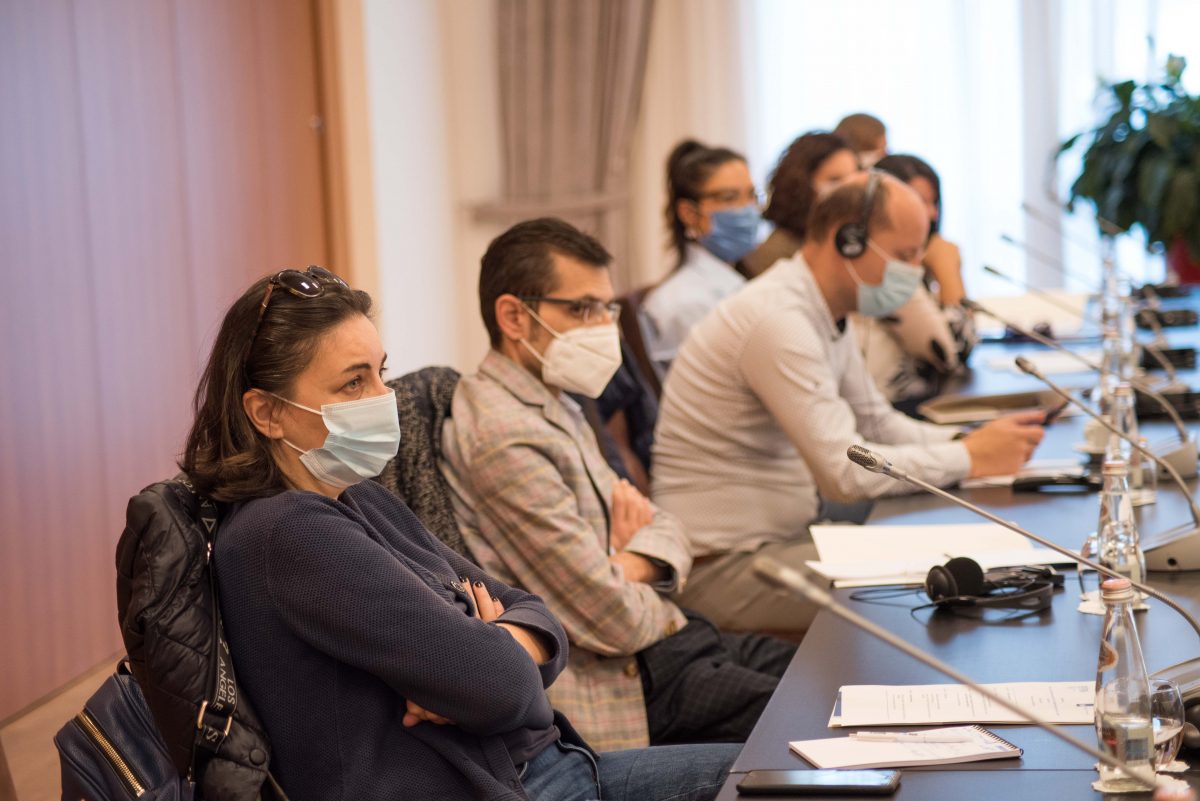
The discussion was moderated by Redion Qirjazi, the head of the security programme at the Institute for Democracy and Mediation in Tirana. The event produced lively debate about important topics that should be investigated in the field of organised crime and money-laundering as well as the need to build stronger bridges of communication and cooperation between civil society and journalists.

The main topics discussed included the proper implementation of Albania’s law for the integrity of public officials, the reach of organised crime in politics and its possible involvement in the 2021 parliamentary election campaign, the use by the community of confiscated assets of organised crime and efforts made by civil society to turn them into social businesses.

The journalists and civil society experts also discussed the illicit finances of organised crime, including contraband cigarettes, trafficking in narcotics and the laundering of these illicit gains in different sectors of the economy, ranging from tourism and media to the construction sector. Experts asked the journalists to pay more attention to the implementation of strategies against organised crime by the Albanian government and its law enforcement agencies.

The journalists underlined the wide reach of Albanian organised crime in Europe, including the narcotics trade in the Netherlands and other European countries, as well as the difficulties they face in covering this sensitive and dangerous topic, which requires editorial and financial support that their own media outlets do not provide.

The debate will inform BIRN Albania’s upcoming call for an investigation on the topic of organised crime.

BIRN Serbia Journalist Wins CEI SEEMO Investigative Award

Natalija Jovanovic wins top award for her groundbreaking story on the number of COVID-related deaths in Serbia, which President Vucic initally rubbished, only for it to be confirmed later on.

BIRN Serbia journalist Natalija Jovanovic is the winner of this year’s CEI SEEMO Award for Outstanding Merits in Investigative Journalism, promoted by the Central European Initiative CEI and the South East Europe Media Organisation SEEMO.

She is the  frontrunner for the “Young Journalist” award. Albanian journalist and BIRN contributor Esmeralda Keta won the jury’s special mention.

The awards ceremony was held on Thursday online in Belgrade.

Jovanovic is “a tenacious and brave reporter; the jury valued her story focusing on checking different COVID-19 data from different sources, carrying out her journalistic work through in-depth research,” the jury stated.

Her story “Serbia Under-Reported COVID-19 Deaths and Infections, Data Shows”, drew sharp reactions and comments from politicians, health experts, journalists, international organisations and others, and was quoted by influential media outlets across the world.

The subject of her article, published shortly after the June elections in Serbia, has become one of the main political and social issues in the country in recent months.

In July, after Serbian President President Aleksandar Vucic dismissed BIRN’s revelations, a government Crisis Staff member admitted in September that the COVID-19 death toll in June was far higher than was officially reported, blaming a new information system.

Investigations into health system failings won Albanian journalist Esmeralda Keta the jury’s special mention. Keta is an investigative journalist at Top Story show broadcasted by Top Channel and is a contributor to BIRN Albania’s Reporter.al and to BIRN’s regional publication Balkan Insight.

The jury highlighted the way “her model of journalism focuses on the injustices faced by vulnerable groups and the shortcomings in protecting citizens’ rights”

“I am very grateful for this prize and it means a lot to me. This pandemic placed a lot of challenges on all of us, but it has also encouraged us to be insistent and seek the truth, no matter what price is paid,” Keta said during her acceptance speech.“

Cecilia Anesi, investigative reporter at the online media of IRPI (Investigative Reporting Project Italy), was the winner in the “Professional Journalist” category.

This year’s edition of the CEI SEEMO Award gave priority to works covering issues related to the coronavirus crisis.

Before the awards ceremony, a conference, “(Re)Think the Digital – Reliability of the media, economic aspects of the pandemic, sustainable digital transitions in South East and Central Europe”, was organised simultaneously in Belgrade, Fažana, Podgorica, Sarajevo, Sofia, Tirana and Trieste.
EU Investigative Awards Presented in Albania

Presenting the annual awards, EU delegation commends authors of probing investigations into voting fraud, shoddy new builds and public officials’ extravagant travel expenses.

In a ceremony held in Tirana on Wednesday October 21, three journalists were awarded for their investigative reporting, exposing the involvement of organised crime in voter fraud, the shoddy construction of buildings that collapsed in the November 2019 earthquake and the lavish travel expenditures of public officials.

In his opening remarks, Sylvain Gambert, deputy head of the Political, Economic and Information Section in the EU Delegation in Albania, said the EU was a stanch supporter of media freedom and freedom of expression.

“This indeed is the fifth year that we are doing this award in Albania and it shows our commitment in supporting investigative journalism and freedom of expression,” Gambert said.

First place went to Klodiana Lala, journalist for Albania’s News 24 TV and a BIRN contributor, for the story titled “Wiretaps Reveal the Role of Organised Crime in Vote Buying”, which the jury called a fine example of careful investigation, proper fact-checking and the determination to shed light on a phenomenon that is present in Albanian society but has rarely been properly verified.

“I am happy this article was recognised because in the end it exposed a phenomenon that was often debated but never proved through documents,” Lala said in her acceptance speech.

“We as journalists are bound by duty to be every day in search of facts, proof and evidence of events that institutions are trying to hide,” she added.

Second place went to Merxhan Daci, a journalist for the Albanian fact-checking service Faktoje, for an article shedding light on the questionable use of public funds by officials and public institutions.

The third place went to the TV reporter Andi Malasi, from Top Channel TV, for his investigation into the abuses related to newly built apartments that collapsed in the November 26th earthquake in Albania.

The ceremony continued with a reception. Due to the COVID-19 pandemic, the events had to be held outdoors with limited attendance

BIRN Albania Publishes Report on Internet Governance

The Balkan Investigative Reporting Network in Albania has published a report entitled ‘Internet Governance in Albania and its Role in Media Freedom’.

This report was produced as part of the project ‘Towards Improved Labour Relations and Professionalism in the Albanian Media’, funded by the European Commission, represented by Delegation of the European Union to Albania and implemented by the partnership of the Albanian Media Institute (AMI) and the International Federation of Journalists (IFJ).

Through this study on internet governance, BIRN Albania aims to provide a realistic and easily-grasped review of the current legal landscape for online media and content providers, as well as explore the primary issues and processes that overlap between media development and internet governance, in order to inform stakeholders and the public debate.

The report explores a number of topics where internet governance and regulation intersect with online media, market conditions, financial regulations, ownership and competition, access to information and data protection, and copyright and cyber-security, while providing real-world examples of situations in which the abuse or poor definition of these regulations leads to restrictions on freedom of the media and freedom of expression in the country.

For an English-language copy of the report, click here.
For an Albanian-language copy of the report, click here.

BIRN Albania Publishes Report on Internet Governance

The Balkan Investigative Reporting Network in Albania has published a report entitled ‘Internet Governance in Albania and its Role in Media Freedom’.

This report was produced as part of the project ‘Towards Improved Labour Relations and Professionalism in the Albanian Media’, funded by the European Commission, represented by Delegation of the European Union to Albania and implemented by the partnership of the Albanian Media Institute (AMI) and the International Federation of Journalists (IFJ).

Through this study on internet governance, BIRN Albania aims to provide a realistic and easily-grasped review of the current legal landscape for online media and content providers, as well as explore the primary issues and processes that overlap between media development and internet governance, in order to inform stakeholders and the public debate.

The report explores a number of topics where internet governance and regulation intersect with online media, market conditions, financial regulations, ownership and competition, access to information and data protection, and copyright and cyber-security, while providing real-world examples of situations in which the abuse or poor definition of these regulations leads to restrictions on freedom of the media and freedom of expression in the country.

For an English-language copy of the report, click here.
For an Albanian-language copy of the report, click here.

BIRN Wins Reporters Without Borders Press Freedom Award

To mark World Press Freedom Day on Sunday, campaign group Reporters Without Borders Austria awarded the Balkan Investigative Reporting Network with its annual Press Freedom Award – A Signal for Europe.

The Vienna office of the Reporters Without Borders announced that the BIRN Network has been awarded for its courageous investigative journalism in Eastern and South-Eastern Europe, and for its dedication to the fight for human rights, democracy and justice for the victims of war crimes.

The award also honours BIRN’s founder, Gordana Igric, who served as the organisation’s regional director until May 2018, for her pioneering work in establishing the network.

“We are honoured by this acknowledgment from our Austrian colleagues. It comes at a critical time for our region, where media are often hampered by political or business influences and lack the resources to report beyond their own country’s borders,” said BIRN’s network director, Marija Ristic.

“The award gives us more motivation to continue with our uncompromising reporting despite continuous attacks on our journalists,” Ristic added.

“We are also thankful for the honour given to our founder, Gordana Igric, who had a vision of a free regional media network and paved the way for a new generation of journalists and editors who continue to champion the values of human rights and democracy,” she said.

The Balkan Investigative Reporting Network was established in 2004 as a network of organisations across the Balkans promoting freedom of speech, human rights and democratic values.

BIRN has country-based organisations in Albania, Bosnia and Herzegovina, Kosovo, North Macedonia, Romania and Serbia. It also works editorially in Bulgaria, Croatia, the Czech Republic, Greece, Hungary, Moldova, Montenegro, Poland, Slovakia and Ukraine.

BIRN’s structure has the advantage of combining local expertise with unique regional cooperation.

The Press Freedom Award – A Signal for Europe is given every year by the Austrian branch of Reporters Without Borders, a leading international non-profit and non-governmental organisation that safeguards the right to freedom of information. Its mandate is to promote free, independent and pluralistic journalism and to defend media workers.