SEE Digital Rights Network Established

Facing a rise in digital rights violations, more than a dozen rights organisations have agreed to work together to protect individuals and societies in Southeast Europe.

Nineteen organisations from Southeast Europe have joined forces in a newly-established network that aims to advance the protection of digital rights and address the growing challenges posed by the widespread use of advanced technologies in society.

Initiated by Balkan Investigative Reporting Network, BIRN, and SHARE Foundation, the SEE Digital Rights Network is the first network of its kind focused on the digital environment and challenges to digital rights in Southeast Europe.

The network brings together 19 member organisations – from Albania, Bosnia and Herzegovina, Croatia, Greece, Kosovo, Montenegro, North Macedonia and Serbia – dedicated to the protection and promotion of human rights, both online and offline.

Each is committed to advancing their work on issues of digital rights abuses, lack of transparency, expanded use of invasive tech solutions and breaches of privacy.

Since the onset of the COVID-19 pandemic, Central and Southeast Europe has seen a dramatic rise in the rate of digital rights violations, in countries where democratic values are already imperiled.

“This endeavour comes at a moment when we are seeing greater interference by state and commercial actors that contribute to the already shrinking space for debate while the exercise of basic human rights is continuously being limited,” said BIRN regional director Marija Ristic.

“The Internet has strong potential to serve the needs of the people and internet access has proved to be indispensable in times of crisis such as the COVID-19 pandemic. Our societies are becoming more digital, which presents a powerful incentive to increase the capacity of organisations dealing with digital developments and regulations in our region.”

During a first joint meeting, the members of the network agreed that the challenges posed by the fast-evolving tech solutions used by states have led to infringements of basic rights and freedoms, while false and unverified information is flourishing online and shaping the lives of people around the region. The online sphere has already become a hostile environment for outspoken individuals and especially marginalised groups such as minorities, LGBTIQ+ community, refugees and women.

“Digital technology is profoundly changing our societies as it becomes an important part of all spheres of our lives, so we see the diversity of organisations that joined this network as one of its biggest strengths,” said Danilo Krivokapic, director of the SHARE Foundation.

“We can learn so much from each other’s experience, as we have similar problems with governments using technology to exert control over society, especially in times of crisis such as the COVID-19 pandemic,” he said. “It is also important that we act together when we are trying to restore the balance between our citizens and big companies (Facebook, Google etc) that hold enormous amounts of our personal data and through this exert significant power over us.”

The network’s aim is to build on the skills, knowledge and experience of its members to achieve common goals such as strengthening democracy in the region and protecting individuals in the digital environment.

While cherishing the values of safety, equality and freedom, the work of the SEE Digital Rights Network will be directed at achieving the following goals: to protect digital rights and internet freedoms, enable people to access accurate information, make the internet a safer place, detect and report hate speech and verbal violence online, especially against women and other vulnerable groups, identify online recruitment, which can lead to exploitation, take control of  personal data, work to prevent the implementation of intrusive surveillance systems, hold governments accountable for the use and abuse of technology and improve digital literacy in order to prevent violence and exploitation.

The network will aim to increase the level of understanding of complex and worrying trends and practices, trying to bring them closer to the general public in a language it can understand. By creating a common space for discussion and exchange, organisations and the media will be able to increase the impact of their individual efforts directed towards legislative, political and social changes.

For more information about the network please contact: [email protected] or/and [email protected].

Here you can find the full text of the SEE Digital Right Network Declaration. The Declaration is also available in BCS, Macedonian and Albanian.

The organisations that have joined the network are as follows:

  1. A 11 – Initiative for Economic and Social Rights – Serbia
  2. Balkan Investigative Regional Reporting Network (BIRN) – Bosnia and Herzegovina
  3. Civic Alliance (CA) Montenegro
  4. Center for Internet, Development and Good Governance (IMPETUS) – North Macedonia
  5. BaBe.hr– Croatia
  6. Civil Rights Defenders (CRD)
  7. Da se zna – Serbia
  8. Gong – Croatia
  9. Homo Digitalis– Greece
  10. Open Data Kosovo (ODK) – Kosovo
  11. Media Development Centre (MDC) – North Macedonia
  12. Metamorphosis Foundation – North Macedonia
  13. Montenegro Media Institute (MMI) – Montenegro
  14. NGO Atina – Serbia
  15. Partners Serbia – Serbia
  16. Sarajevo Open Centre – Bosnia and Herzegovina
  17. Share Foundation – Serbia
  18. Vasa prava BiH – Bosnia and Herzegovina
  19. Zašto ne? – Bosnia and Herzegovina

Check our in-depth coverage on these topics on the new Digital Rights focus page. Find out more about the latest digital rights developments, the use of invasive tech solutions, privacy breaches and other online rights violations in the countries of Central and Southeast Europe.

BIRN Movie About Underground Hospital Premieres at Sarajevo Festival

A film about a remarkable hospital that functioned underground during the war in Bosnia – directed by BIRN BiH’s deputy editor – has its first showing at this year’s online Sarajevo Film Festival.

A documentary titled “Underground” directed by Dzana Brkanic, deputy editor of the Balkans Investigative Reporting Network in Bosnia and Herzegovina, BIRN BiH, will be premiered at this year’s Sarajevo Film Festival, taking place from August 14 to 21. The film about a wartime underground hospital will be screened as part of the BH Film programme. 

The film is about a hospital in the town of Olovo that was set up below ground during the 1992-5 war in Bosnia because the town’s old hospital had become exposed to everyday shelling during the war. 

The underground hospital handled more than 1,300 patients each month. Doctors saved hundreds of lives by surgeries and other interventions while midwives delivered around 500 babies. The film follows the young people who were born in the underground hospital during the war. 

“Some time ago I learnt about a hospital built below ground in a very short period of time during the war. Fascinated by the idea, I proposed making a screening of the story, so BIRN BiH produced the story about the superhuman efforts of doctors and other medical staff to save hundreds of lives in inhumane conditions,” Brkanic said.

“It is interesting to note that so many children from Olovo and its surroundings were born there without any complications, four meters below ground, with no electricity and sometimes with no necessary light. We found some of them proudly going through life, claiming that being born in such conditions actually sent a message that ‘they can do anything,’” Brkanic added.

Brkanic was the film director, Denis Dzidic was the producer and Semir Mujkic was the editor. Amel Djikoli, helped by cameramen Faris Dobraca, Jasmin Jatic and Mario Ilicic, was director of photography. Samir Hrkovic and Adis Bazdarevic handled sound while Adnan Musanovic and Elma Selimovic were in charge of music. The song used in the film was written by Mujo Hodzic.

“I am happy to have had the opportunity to be the author of this film and work with these great people, interlocutors and the crew, all of whom shared my enthusiasm for this story and the idea, and agreed that it should be shared with the world,” Brkanic said.

“It is an honour to see this film screened at the SFF alongside the great figures of domestic and world cinematography, and it is a stimulus to BIRN to continue making stories, because they kind of preserve history and the events that happened in this area,” Brkanic noted.

The Association of Filmmakers of Bosnia and Herzegovina organizes BH Film programme as part of the Sarajevo Film Festival, presenting films produced in Bosnia and Herzegovina as well as those made by domestic authors living abroad.

This year’s 15th BH FILM programme features 42 films, 31 of which will have their world premieres at the festival.

Due to the coronavirus pandemic, the 26th Sarajevo Film Festival will be screened online on ondemand.sff.ba. Through the platform the audience will have access to accompanying content, such as lectures and interviews with directors.

Serbian Authorities Seek Bank Data of Rights Groups, Investigative Media

A department of Serbia’s finance ministry tasked with tackling money laundering and terrorism financing has asked banks to hand over data about the transactions of dozens of individuals and NGOs known for their work on human rights, transparency and exposing corruption.

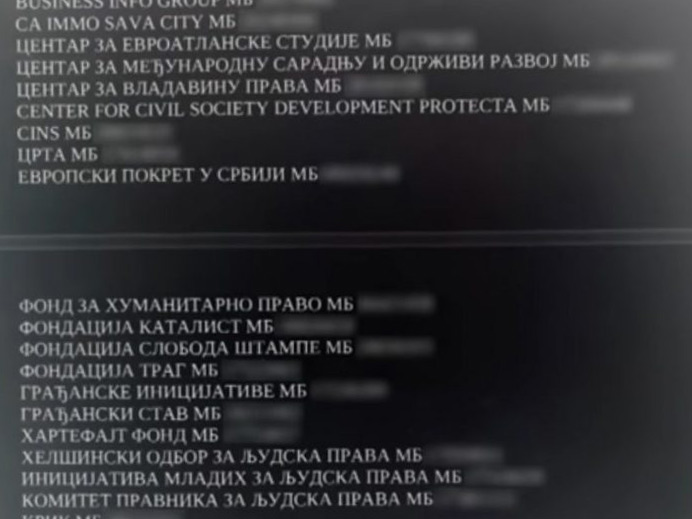
Journalists and civil society representatives in Serbia have accused the government of trying to silence its critics after it emerged that the finance ministry’s Administration for the Prevention of Money Laundering has sought access to bank data dating from January 1, 2019, for 20 individuals and 37 NGOs, including a number of investigative media outlets and high-profile human rights organisations.

The order was first published by TV Newsmax Adria Serbia. It cites the need “to determine whether the listed organisations and individuals have anything to do with terrorist financing or money laundering.”

The list includes Balkan Investigative Reporting Network, BIRN, the Centre for Investigative Journalism of Serbia, CINS, Crime and Corruption Reporting Network KRIK, the Novi Sad Journalism School, both of Serbia’s major journalism associations and a host of rights groups including Civic Initiatives, YUCOM, the Belgrade Centre for Security Policy, the Helsinki Committee for Human Right and the Humanitarian Law Centre.

The individuals include a number of BIRN employees, CINS director Branko Cecen, TV Newsmax Adria Serbia head and former BIRN editor Slobodan Georgiev and journalists Biljana Stepanovic and Vukasin Obradovic. Opposition politician Vuk Jeremic is also named.

Cecen told TV Newsmax Adria Serbia that the government, led by the Progressive Party of President Aleksandar Vucic, was “reckoning with its critics”. Zeljko Radovanovic, the head of the Administration for the Prevention of Money Laundering, said it was simply conducting “regular activities”.

‘Criminalising people’

Civic Initiatives, which was founded by anti-war activists in 1996 to promote democratic values and human rights, called on the government to “immediately stop the abuse of the mechanism for preventing money laundering and terrorist financing in order to intimidate organisations, media and individuals acting as controllers of the government”.

The law, it says, only allows authorities to seek bank data if it suspects an individual or organisation is involved in money laundering or financing of terrorism.

“The confrontation with organisations and critical media in this way is an abuse of the legal mechanism and state resources,” it said.

Milos Nikolic, head of Libertarian club – Libek, which is also on the list, expressed surprise, describing the non-governmental sector in Serbia as one of the most transparent in the country.

“Many of these organisations receive grants through competitions,” he told BIRN. “They cannot spend funds outside the described activities; there are contracts that regulate this relationship, often with very precise budget specifications of costs.”

“I really don’t see how an organisation like Libek or related organisations from the list that operate according to the law, keep proper financial books and have many years of achievements in the field of educational and research work behind them could raise suspicions about money laundering and terrorist financing.”

Georgiev, the head of TV Newsmax Adria Serbia, said the move was “a way of criminalising people”.

“People need to understand that this is what the Administration [for the Prevention of Money Laundering] does when investigating criminals, so now we are all placed in the same basket as criminals,” he told regional broadcaster N1 TV.

“That way you criminalise people when I try to detect crime with my work,” he said. “That Administration for the Prevention of Money Laundering has the same donor as BIRN – the European Commission. So I ask the public question: ‘Will the Administration for the Prevention of Money Laundering examine itself’? It’s horrible.”

BIRN Kosovo Participates in Environmental Journalism Awards

BIRN Kosovo was one of four organisations that implemented the ‘Europeanisation of Kosovo’s Environmental Agenda’ project, which has awarded journalists in Kosovo for the best stories about the environment, energy efficiency and climate change.

TV Mreza, ERA Group and Bankwatch were also involved in implementing the project, which is supported by the European Union Office in Kosovo.

The winning stories were chosen by Kreshnik Gashi, Dajana Berisha and Mustafa Skenderi from a total of 22 entries, all broadcast on TV or published in online media. See more details here.

First prize was given to a story by a journalist from Preport, Besnik Boletini, awarded for his documentary ‘Extraction Industry’.

The investigation revealed the damage caused to the environment by the extraction industry. Thousands of hectares of river bed have been damaged by operators extracting sand and gravel. Many hills, mountains and rivers have been affected by gravel exploiters, leaving the sites in total devastation. The story can be found here.

Sanie Jusufi from the Koha Group was awarded second prize for her investigation titled ‘Farewell River’.

The story addresses concerns over construction permits issued by the Ministry of Environment and Spatial Planning for hydropower plants, in violation of existing procedural rules and regulations.

The ministry, in violation of the criteria set out by these rules, permitted the construction of the plants, causing environmental degradation and leaving the many residents of Lower Bitija in the municipality of Sterpce without any water. The story can be found here.

Third prize was given to Katarina Marinkovic and Sanja Djokic from Media Centar for their TV report on environmental pollution in the municipality of Kllokot.

Their story addresses one of the most urgent environmental issues in Kllokot – the pollution of the river Morava of Binca, and the obstruction of its water flow as a result of waste being dumped in the river.

The story investigates the issues faced by residents of Kllokot, which are caused fellow locals who regard the river as a landfill, as well as municipal officials, who have failed to take adequate measures to protect it. The story can be found here.

Similar prizes will be awarded for stories published in 2020.


Ndahen çmimet gazetareske për hulumtimet më të mira në fushën e mjedisit

Juria profesionale i ka bërë publike vlerësimet për gazetarët në kuadër të thirrjes për tri hulumtimet më të mira në efiçiencë të energjisë, mjedis dhe ndryshime klimatike.

Për çmimin i cili ndahet në kuadër të projektit  “Europeanization of Kosovo’s Environmental Agenda”, në garë kanë qenë 22 storie të publikuara në televizione dhe media online gjatë vitit 2019.

Juria në përbërje Kreshnik Gashi, Dajana Berisha dhe Mustafa Skenderi kanë vlerësuar me çmimin e parë hulumtimin e gazetarit të Preport, Besnik Boletini. Çmimi I dytë është ndarë për hulumtimin e gazetares së grupit Koha, Sanie Jusufi, ndërsa çmimi i tretë është ndarë për gazetaret e Media Centar, Katarina Marinković dhe Sanja Đokić.

Hulumtimet e vlerësuara

Çmimi për gazetarin Besnik Boletini është ndarë për hulumtimin dokumentar  “Industrisë së Shkatërrimit”.

Hulumtimi paraqet dëmet që i janë bërë mjedisit nga industria nxjerrëse. Mijëra hektarë shtretër lumi janë dëmtuar nga operatorët ndërsa nxjerrin rërë dhe zhavorr. Shumë kodra, male dhe lumenj janë degraduar nga shfrytëzuesit e zhavorrit të cilët kanë lënë ato vende të shkatërruara më pas. Hulumtimi mund të lexohet në këtë link.

Çmimi për gazetaren Sanie Jusufi është ndarë për hulumtimet “Mirupafshim Lumë” që trajtojnë shqetësimin se si Ministria e Mjedisit dhe Planifikimit Hapësinor lëshoi leje për ndërtimin e hidrocentraleve duke shkelur rregullat dhe rregulloret. Duke u përplasur me kriteret, Ministria lejoi ndërtimin e hidrocentraleve që këtej, duke degraduar mjedisin dhe duke lënë pa ujë banorët e Bitisë së Poshtme – Komuna e Shterpcës. Hulumtimi mund të ndiqet në këtë link.

Çmimi për gazetaret Katarina Marinković dhe Sanja Đokić është ndarë për hulumtimet televizive për ndotjen e ambientit veçanërisht në komunën e Kllokotit. Hulumtimi trajton një nga çështjet më të ngutshme mjedisore të Kllokotit, ndotjen e lumit Morava e Binçës, bllokimin e tij për shkak të hedhjes së mbeturinave.  Hulumtimi trajton çështjet me të cilat merren banorët e Kllokotit duke pasur parasysh papërgjegjësinë e vendasve që trajtojnë lumin si deponi dhe përfaqësuesit e komunës që nuk marrin masa adekuate për ta mbrojtur atë. Hulumtimi mund të ndiqet në këtë link.

Çmimet janë ndarë në kuadër të projektit “Europeanization of Kosovo’s Environmental Agenda” i mbështetur nga Zyra e Bashkimit Evropian në Kosovë dhe i implementuar nga BIRN Kosova, TV Mreža, ERA Group dhe Bankwatch.

Çmime të ngjashme do të ndahen edhe për hulumtimet e publikuara gjatë vitit 2020.


Dodeljene novinarske nagrade za najbolje priče iz oblasti životne sredine

Stručni žiri objavio je imena nagrađenih u okviru poziva za tri najbolje novinarske priče o energetskoj efikasnosti, životnoj sredini i klimatskim promenama.

Za nagradu koja se dodeljuje u okviru projekta “Evropeizacija kosovske agende životne sredine,” koji podržava Kancelarija Evropske unije na Kosovu, u konkurenciji su bile 22 priče objavljene na televizijama i online.

Žiri u sastavu: Krešnik Gaši, Dajana Beriša i Mustafa Skenderija dodelio je prvu nagradu za priču novinara Preporta, Besnika Boljetina. Druga nagrada je dodeljena za priču novinara iz grupe Koha, Sanije Jusufi, dok je treća nagrada dodeljena novinarkama Medija centra, Katarini Marinković i Sanji Đokić.

Ocenjena istraživanja

Novinaru Besniku Boljetinu je nagrada dodeljena za dokumentarno istraživanje “Industrija uništenja”.

Istraživanje prikazuje štetu koju je industrija vađenja šljunka i peska nanela životnoj sredini. Radovima je oštećeno na hiljade hektara rečnih korita tokom vađenja peska i šljunka. Kopači šljunka su degradirali mnoga brda, šume i reke, a zatim ta mesta napustili i ostavili uništenim. Priča se može pročitati na ovom linku.

Novinarki Sanije Jusufi je nagrada dodeljena za istraživanje “Zbogom reko”. Priča govori o tome kako je Ministarstvo životne sredine i prostornog planiranja kršeći pravila i propise izdalo dozvole za izgradnju hidroelektrana. Protivno kriterijumima, Ministarstvo je dozvolilo gradnju hidroelektrana, degradirajući životnu sredinu i ostavivši bez vode stanovnike Donje Bitinje – opština Štrpce. Priča se može pročitati na ovom linku.

Novinarkama  Katarini Marinković  i Sanji Đokić je nagrada dodeljena za TV istraživanje u vezi zagađenja životne sredine, posebno u opštini Klokot. Priča se bavi jednim od najvažnijih problema životne sredine u Klokotu, zagađivanjem reke Binačke Morave i njenom blokadom zbog bacanja otpada.  Istraživanje obrađuje pitanja kojima se bave stanovnici Klokota uzimajući u obzir neodgovornost meštana koji tretiraju reku kao deponiju i opštinskih predstavnika koji ne preduzimaju adekvatne mere da bi je zaštitili. Priča se može odgledati na ovom linku.

Nagrade su uručene u okviru projekta „Evropeizacija kosovske agende životne sredine“ koji podržava Kancelarija Evropske unije na Kosovu, a realizuju BIRN Kosovo, TV Mreža, ERA Grupa i Bankvoč.

Slične nagrade će biti dodeljene i za priče objavljene tokom 2020.

BIRN’s Reporting Democracy Extends Cooperation with Independent Media

BIRN’s Reporting Democracy project is to cooperate with a newly-created network of independent media outlets that report on the Central and Eastern Europe region in English, with the aim of increasing global understanding of important events taking place in a region.

The initiative for building such a network came from the Notes from Poland organisation, as part of a project funded by the National Endowment for Democracy.

Notes from Poland brought together relevant media outlets in order to build links between the organisations, as well as supporting them with exchanges of content and reporting on issues relating to democracy, the rule of law, civil society, human rights and media freedom in the region.

More information about the project and the network can be found here.

Reporting Democracy is a cross-border journalistic platform dedicated to exploring where democracy is headed across the Central and Eastern Europe region.

In addition to generating a steady stream of features, interviews and analytical pieces by its own correspondents, it supports local journalists by commissioning stories and providing grants to report systemically on populist, authoritarian and other illiberal trends in Visegrad Four and Western Balkans countries, and thus to contribute to public understanding of these trends and their consequences.

Call for Applications for EU Award for Investigative Journalism in Albania 2020

Investigative stories published from January 1 to December 31, 2019, and related to freedom of expression, rule of law, transparency, abuse of power and fundamental rights, corruption and organised crime are welcome to apply.

The award fund in each country in 2020 (for achievements in 2019) is 10,000 EUR. The first prize will be 5,000 EUR, the second 3,000 EUR, and the third will be 2,000 EUR.

Individuals or groups of journalists are eligible to apply in all journalism forms (print, online, radio and TV) published or broadcast in the media in each country in official, minority or international languages.

Articles eligible for submission must appear in print, online, radio and TV media outlets during the 2019 calendar year.

EU Investigative Journalism Awards in the Western Balkans and Turkey aim to celebrate and promote the outstanding achievements of investigative journalists as well as improve the visibility of quality journalism in the Western Balkans and Turkey.

The awards are a continuation of the ongoing regional EU Investigative Journalism Award in the Western Balkans and Turkey and part of the ongoing project ‘Strengthening Quality News and Independent Journalism in the Western Balkans and Turkey’, funded by the European Union.

The project partners involved all have extensive expertise in the field of media freedom and have been recognised locally and internationally as strong independent media organisations.

The jury for the EU Award comprises media experts, some of them from the project consortia. Others are drawn from the extensive network projects that the consortium members have, such as editors, members of academia and journalists with merits.

The awards will be given annually in all six Western Balkan countries and Turkey.

For more information, please get in contact by email at [email protected]. All the details and guidelines for Albania can be found below this article.

The deadline for the applications is August 16, 2020 by 23:59


To download all necessary documents for Albania in Albanian click here

BIRN Bosnia and Herzegovina Director Given Srebrenica Reporting Award  

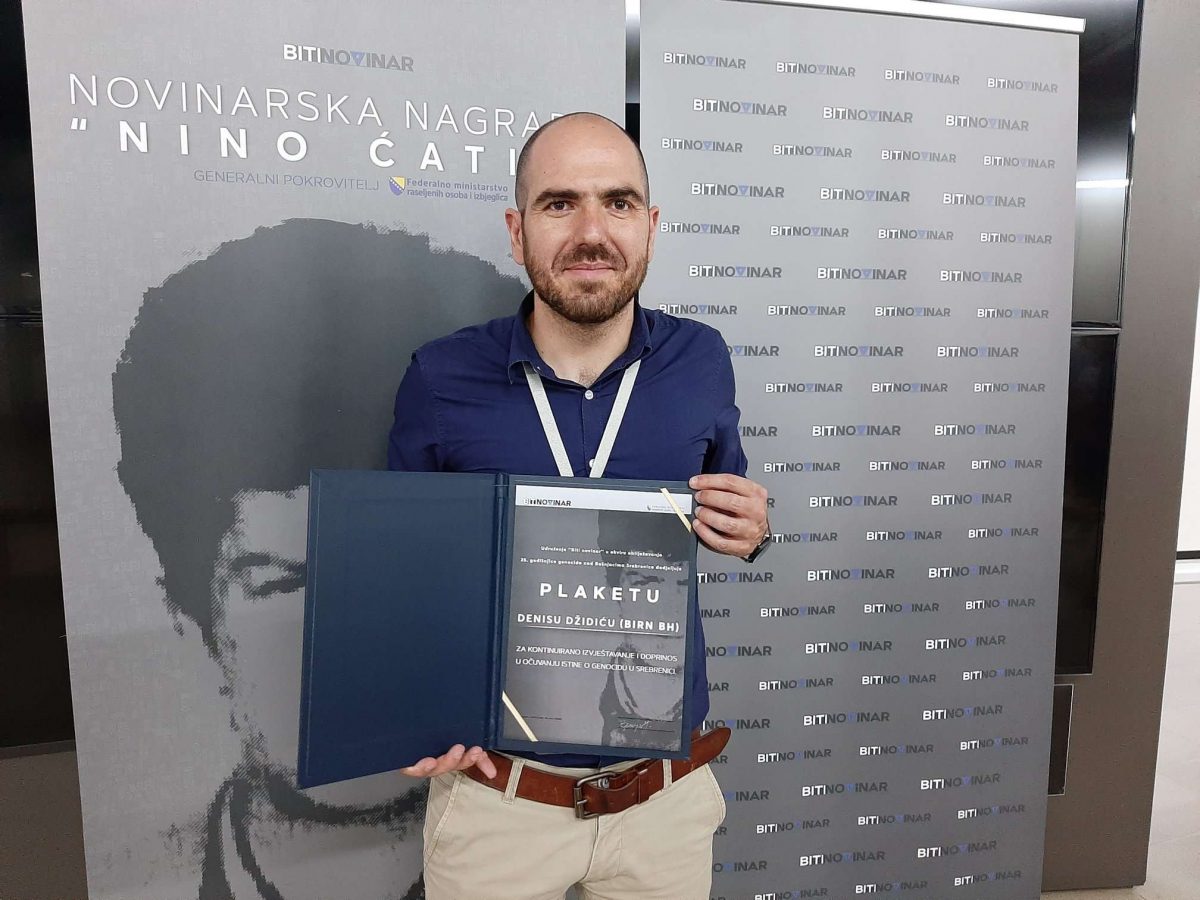
Denis Dzidic, director of the Balkan Investigative Reporting Network Bosnia and Herzegovina, was given a Nino Catic Journalism Award on Friday for long-term reporting about the Srebrenica genocide and for contributing to preserving the truth about the July 1995 mass killings.

Dzidic was presented with the award by the Biti Novinar Association from Tuzla at the Srebrenica Memorial Centre a day before the commemoration of the 25th anniversary of the genocide.

Other journalists who were given Nino Catic awards included Alema Kazazic for the best TV footage and Ismet Becar for a radio piece. The award was also given to Samir Karic in the ‘written text’ and ‘photography’ categories, while Edina Latif was given the award in the ‘blog’ category.

“I think that every journalist has a special relationship with the truth, as a goal and a challenge. When reporting on genocide and war crimes, the relationship becomes more complex and more important,” Dzidic said during the award ceremony.

“In that sense, the fact that I have been presented with a plaque of recognition, which was named after our colleague Nino Catic, for preserving the truth about Srebrenica over a long period, gives me a sense of honour, but also an obligation for us, at BIRN, to continue reporting on the truth and on Srebrenica,” he added.

Dzidic was appointed director of BIRN Bosnia and Herzegovina in October 2019 after working as an editor and journalist for BIRN. He has reported on war-crime trials at the Bosnian state court and the Hague Tribunal since 2008. He has written numerous pieces of analysis and created various TV programmes about the Srebrenica genocide.

Nihad ‘Nino’ Catic was a journalist from Srebrenica. During the war, he broadcast daily reports on the situation in the town. His last contribution to a live programme was on July 10, 1995, and he was last seen on July 11, 1995, when Bosnian Serb forces seized Srebrenica. He disappeared and his remains have never been found.

Biti Novinar also presented special recognition plaques to jury members Almasa Hadzic, Salih Brkic, Marko Divkovic and Marinko Sekulic.

Further plaques were presented to the Srebrenica Memorial Centre, Federal Television, Radio-Television of Tuzla Canton, Federal Journalistic Agency, Al Jazeera Balkans journalist Adnan Rondic, photographer Ahmet Bajric Blicko, RTV Srebrenica journalist Adem Mehmedovic, cameraman Ahmedin Djozic, Federalna.ba journalist Enes Hodzic, teacher Ehlimana Lukacevic-Grbo and humanitarian worker Huso Muratovic.

Nino Catic’s mother Hajra Catic was presented with a gold recognition plaque.

The Nino Catic award ceremony was organised under the patronage of the Federal Ministry of Displaced Persons and Refugees with support from the BH Journalists’ Association, the Organisational Board for Marking the 25th Anniversary of the Srebrenica Genocide, the Srebrenica-Potocari Memorial Centre, the Women of Srebrenica Association, the Tuzla Cantonal Government and the City of Tuzla.

Vucic Dismisses BIRN Report on COVID-19 Figures in Serbia

Aleksandar Vucic said BIRN report on the real number of COVID-19 victims in Serbia relies on data that are ‘not authentic’ – and again attacked the outlet over its 2015 investigation into the Tamnava mine clearance.

Serbian President Aleksandar Vucic on Thursday criticised the Balkan Investigative Reporting Network, BIRN, over its recent investigation into the number of COVID-19 victims in Serbia, saying the report, published on June 22, used data that was not authentic.

The report said the state COVID-19 database showed that more than twice as many infected patients had died than the authorities announced and that hundreds more people had tested positive for the virus in recent days than was admitted.

But in an interview for Radio Television of Serbia, RTS, on Thursday, Vucic said he was “completely sure that they [the data BIRN published] are not authentic”.

Questioned about the BIRN report, some members of the state Crisis Staff did not deny the information contained in it but said they had not seen the database itself and tried to blame the difference in numbers on methodology.

Vucic on Thursday also again attacked BIRN over an earlier report, from 2015, about clearing flood water from the Tamnava mine, saying it had been made up.

“They made up that story – some of those BIRNs, KRIKs [Crime and Corruption Reporting Network], CINSs [Center for Investigative Journalism of Serbia], I do not know exactly which ones – they made up the story that we stole some money from the water extraction in Tamnava,” Vucic said.

The January 2015 investigation showed how the state-owned power utility Elektroprivreda Srbije, EPS, awarded a contract to renovate the Tamnava mine, flooded in 2014, to a consortium that had no experience of such work, significantly increasing the cost.

Vucic, who was then Prime Minister, and pro-government-tabloids, attacked BIRN over the report. In another interview, in 2016, Vucic said he stood by his claim that BIRN had written lies in the investigation.

The Serbian President on Thursday became irritated over questions concerning a report carried by various media outlets that an entire family in southwest Serbia had died of COVID-19.

“You ask me quite seriously to comment on someone who said Refat Suljovic from Tutin lost his whole family to the corona [virus]. You ask me about them?” Vucic asked a journalist.

Local media reported that four members of the Suljovic family in Tutin had died in the pandemic. Vucic said the story was fabricated and that Suljovic’s parents had not died from COVID-19.

Kosovo Politician Threatens BIRN Country Director

Kosovo politician Gani Koci has threatened several public figures on Facebook, including BIRN Kosovo director Jeta Xharra, calling them malodorous ‘Serbian septic tanks’ that need to be ‘covered in concrete’.

A former deputy minister from the Democratic Party of Kosovo, PDK, Gani Koci, on Friday threatened several politicians and journalists on Facebook, including BIRN Kosovo director Jeta Xharra, saying they should be covered over with concrete because they are “Serbian septic tanks”.

“The time has come not to disinfect but to cover with concrete the Serbian septic tanks still left in Kosovo. They are releasing a lot of odour!” Koci wrote on Facebook, sharing photos of several public figures.

Koci deleted the initial post, only to share another one a couple of hours later containing the same expressions but without the photos. 

In the initial post, Koci shared photos of various politicians and public figures. They included former prime minister and Vetevendosje leader Albin Kurti; former deputy prime minister and Vetevendosje member Haki Abazi; parliamentary speaker and former deputy leader of the Democratic League of Kosovo, LDK, Vjosa Osmani; deputy parliament speaker from Vetevendosje Arberie Nagovci, former Kurti advisor Shkelzen Gashi – sacked by Kurti in April; Vetevendosje MPs Fatmire Kollcaku, Fitore Pacolli and Jusuf Buxhovi; and former MPs Drita Millaku and Ilir Deda.

He also included a photo of the activist Rron Gjinovci and BIRN Kosovo Director Jeta Xharra.

On June 26, Skender Musa, the legal representative of the PDK, announced a lawsuit against Xharra on behalf of the former PDK Minister of European Integration, Dhurata Hoxha. The lawsuit was also against BIRN’s local news outlet, done in collaboration with Internews KALLXO.com, and Prishtina Insight.

The lawsuit concerns BIRN’s investigation that showed a public relations company contracted by the ministry and Kosovo’s ambassador to France, Qendrim Gashi, lobbied for Kosovo and Serbia to swap land as a possible part a final agreement between the two countries.

Xharra said she had contacted the police and the prosecution regarding the threat.

Open Call for Applications for Engaged Citizens Reporting Grants in Serbia

Media for All Project (Supporting Greater Media Independence in the Western Balkans) invites local and regional media in Serbia to apply for Engaged Citizens Reporting grants.

This regional project implemented across Western Balkans is delivered by a consortium led by the British Council in partnership with the Balkan Investigative Reporting Network (BIRN), Thomson Foundation and INTRAC (The International NGO Training and Research Centre), and is funded by the UK Government through the British Embassy in Serbia.

Engaged Citizens Reporting Call aims to support local and regional independent media outlets in Serbia to become more audience oriented by strengthening their relationship with their audience using the platform for citizens reporting.

Grant recipients will be provided with a tool developed by the Project to engage with their audiences and enable citizens to suggest topics, provide testimonials, documents and evidence with the aim to help media outlets involve their audience in story production, long before it is published.

Grant recipients will be trained on how to use the platform and will be provided with editorial support and mentoring during project implementation on content production and promotion.

Grant funds for content production requested under this Call must fall between 7,500 GBP and 15,000 GBP.

Duration of the project is set to nine months in total, including the implementation of the ECR tool to the grantees’ websites and training on ECR.

The application forms and documents for the Engaged Citizen Reporting Call are available for download at the bottom of this page.

Eligibility: Only media outlets registered in Serbian Business Registers Agency (SBRA) are eligible to apply. Media outlet, or legal entity owning the media outlet, must be registered in Serbia before 1 January 2018.

Selection: In addition to quality of proposal and capacity of applicant to implement it, the selection process will take into consideration demonstrated commitment of the media outlet to adhere to the Law and uphold journalistic standards. Decisions of Regulatory Authority for Electronic Media (REM) Council and Press Council’s Complaints Commission, as well as adjudicated court cases – particularly in regard of hate speech, discrimination, rights of minors and minorities, invasion of privacy, and presumption of innocence – will be considered.

The Project encourages media operating in remote geographic areas, coming from underserved communities, and/or established or managed by underrepresented groups (minority, youth and other) to apply.

The project is also announcing another call for the Business Development (BD) Grants. Media outlets may apply to one or both of the Calls depending on their needs and level of capacity to implement the activities simultaneously.

Important information:

Applications must be completed in English language.
Deadline for applications is 19 July 2020 at 24.00.
Time and date of the online information sessions will be announced in due time.

UPDATE: Online information session is scheduled for Thursday, 9 July at 14:00. More information.


ECR Application Form

ECR Call for Applications

ECR Budget Form