BIRN Holds Training on Fact-checking Methodologies With Journalists in Prishtina

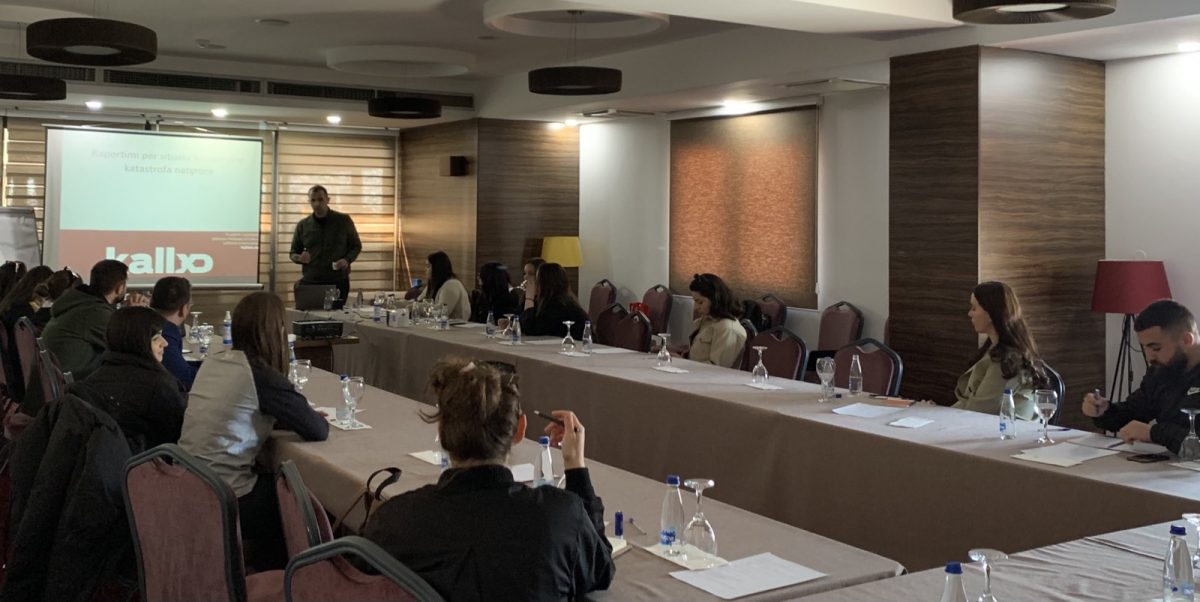
Balkan Investigative Reporting Network (BIRN) has trained 22 journalists and journalism students in Prishtina on fact-checking principles and methodologies.

The first part of the training covered the IFCN standards, the basics of fact-checking, and the differences between misinformation, fake news, deep fakes, and other fake news production formats.

The second part was dedicated to identifying fake news and harmful narratives in the media and building debunking mechanisms within newsrooms.

While the third part of the training gave participants the opportunity to practice together with the trainers to identify fake news.

Workshop trainers included Kreshnik Gashi, co-author of the investigative program/debate, “KallxoPernime”, Editor-in-chief of KALLXO.com, and KALLXO.com representative at the Press Council of Kosovo, and Visar Prebreza, Managing Editor of Research and Krypometer articles at KALLXO.com.

Following the completion of the training on fact-checking methodologies, BIRN will open a call for 10 Fellowships for local media and/or journalists to publish in-depth investigations and/or analyses based on fact-checking principles.

This training was held as part of the project “Promoting fact-checking to combat false news and misinformation in Kosovo” supported by the U.S. Embassy in Kosovo.

This project aims to combat fake news and misinformation, provide practical training for aspiring journalists, and raise public awareness about professional journalism through the creation of a platform that uses public data and fact-checking sources.


BIRN Albania Calls for Investigations on Organised Crime and Money-Laundering

BIRN Albania launched an open call for investigative stories on February 15, offering grants for three journalists to produce articles on the themes of organised crime and money laundering.

BIRN is offering grants for three journalists to work on organised crime and money-laundering stories, with mentoring by experienced editors.

The call is part of the project ‘Raising Awareness and Accountability on Money-Laundering in Albania’, which is supported by the Kingdom of the Netherlands.

The goal of this project is to strengthen the fight against organised crime and money-laundering by raising awareness and strengthening the accountability of the system for the seizure and confiscation of the illegal proceeds of crime.

Three journalists will be awarded grants to cover their expenses while conducting investigations and writing their stories.

The journalists will have around three months to dig deeper and research their ideas, and will also have the opportunity to work with experienced editors as mentors to guide them through the process of writing in accordance with BIRN’s standards.

The call only applies to journalists from Albania and closes on February 28.

Click here for more information (in Albanian) about the application procedure.

Click here to download the application (in Albanian).

Report Details Orban’s Expanding Influence on Balkan, European Media

A new report by the International Press Institute, IPI, offers insight into the ways Hungary’s Prime Minister Viktor Orban, has expanded his influence in the Balkan and European media.

The IPI report, titled “Hungarian Capital in Foreign Media. Three Strategic Models of Influencing the Neighbourhood”, includes articles examining how, where and why Hungary has invested in foreign media in recent years.

Part of the report focuses on how businessmen close to Prime Minister Viktor Orban and his ruling Fidesz party have purchased media outlets in Slovenia and North Macedonia since 2017.

“While Fidesz politicians insist such investments are purely commercial, heavy investments in these media have been used to support Janes Jansa’s SDS in Slovenia and the fugitive former North Macedonia’s Prime Minister Nikola Gruevski’s VMRO DPMNE” the IPI said. [Jansa is a close ally of the Hungarian Prime Minister.]

Another part casts more light on Fidesz’s influence on media in Hungarian-minority communities in Serbia, Romania, and Slovakia, which have all received financial support from Budapest, bringing their media into close alignment with Orban’s populist narrative.

The third part of the report pays attention to the establishment in 2019 of a new international news agency, V4NA, in London, which projects Fidesz’s narrative further, onto a pan-European media landscape.

IPI is an international association of media professionals representing leading digital, print and broadcast news outlets in nearly 100 countries, dedicated to defending media freedom and the free flow of news.

The articles in IPI’s latest report were produced by IPI in cooperation with BIRN, the Hungarian investigative reporting outlet Átlátszó and its Hungarian-language partner in Romania, Átlátszó Erdély, as well as the Center for Media, Data and Society at the Central European University’s Democracy Institute.

Call for Registration: Online Training on Gender-Sensitive Reporting

Belgrade-based NGO Atina, together with the Balkan Investigative Reporting Network, is organising an online training courses focusing on gender-sensitive reporting on human trafficking and violence against women.

Journalists and writers from the Balkans are invited to register for a two-day online training course on practicing gender-responsive reporting on human trafficking and violence against women.

The main idea behind the training is to examine and expose worrying and increasing trends in the incidence and prevalence of gender-based violence, both in the offline and online sphere in the Balkan region, particularly during the COVID-19 pandemic.

The training will be led by experienced activists from NGO ATINA, an organisation that has been running a direct support programme for trafficking and gender-based survivors in Serbia for 18 years now.

Designed to offer a deep insight into ways to avoid the most common mistakes in reporting on human trafficking and violence against women, the training will also offer participants a chance to practice methods of communication with survivors of violence. They should also encourage journalists and writers to apply the methods and lessons learned in their everyday work, raising the quality of their journalism.

The training will be held on March 2nd – 3rd, 2022.

Applicants must register for the training by filling out the form located below. The number of participants is limited, so please register no later than February 28th. Scroll down for registration.

The training will be held in English language, from 10am to 2pm. Each training day will consist of two 1.5-hour-long sessions that will encompass interactive exercises, facilitated discussions, with an evidence-based approach to group work in practicing gender-responsive reporting on human trafficking and violence against women. At the beginning and at the end of the training course, there will be a questionnaire, and participants will be invited to keep a journalistic diary.

Agenda

Day I

10:00 – 10:30  Introduction of participants, topic and activities

10:30 – 12:00  Not victimhood reporting, but promotion of the agency of women

  • Proactive role of journalists in understanding the context of human trafficking and violence against women (meaning of the phenomenon, why it happens, who are the perpetrators and who are the victims, what are the main trends and statistics, involvement of journalists in the process of identification, referral, assistance and court proceedings)

12:00 – 12:30  Break

12:30 – 14:00  How to avoid the most common mistakes while reporting on human trafficking and violence against women

  • Deconstruction of stereotypes and prejudices

Day II

10:00 – 10:30  Warm-up and recapitulation of the previous day

10:30 – 12:00 Why wording matters

  • Communication with survivors and practicing preferred terminology for reporting

12:00 – 12:30  Break

12:30 – 14:00  Reporting on specific types of violence against women

  • Understanding of violence and abuse in the digital sphere

For more information, contact: Jelena Hrnjak ([email protected]).

Please register here and select a preferred slot. Upon registration, you will receive an email confirmation, and a Zoom link will be sent to all participants a few days before the training course.

The training is being organised with support from the Balkan Trust for Democracy, a project of the German Marshall Fund of the United States and the Royal Norwegian Embassy in Belgrade.

BIRN Journalist Wins Fetisov International Award

BIRN’s Haris Rovcanin has won the Fetisov international award in the ‘Outstanding Contribution to Peace’ category for a series of four articles.

A series of four articles by Haria Rovcanin was awarded for their outstanding contribution to peace on February 10, when the Fetisov award organisers announced 13 winners in four categories. The awards ceremony takes place in Switzerland on April 22.

The winners were announced by Aidan White, Honorary Advisor to the Fetisov Journalism Award and President of the Ethical Journalism Network, in a video published on the Award’s social media.

White said the international jury had a record number of entries this year, and “has come up with a terrific selection of world-beating stories”.

“They provide us with a masterclass in stylish, fact-based, and courageous reporting,” White added, noting that the winners come from different backgrounds and different cultures, but all share a passion for truth-telling.

“Every story here is remarkable, and valuable in its own right. They are a shining example of committed and fearless journalism. Together these stories are a priceless body of evidence that journalism, despite all the pressures and threats that are facing news media, continues to make a difference in a global struggle for transparency, humanity and democracy,” White continued.

He said the organizers would announce the final line-up of first, second and third winners at the awards ceremony in April.

Four articles written by Rovcanin, two of which were co-written by Albina Sorguc, a member of BIRN BiH team at the time of publication, were selected as one of the three winners in the “Outstanding Contribution to Peace” category.

The series includes two investigative pieces, about individuals  not prosecuted for the 1995 Srebrenica genocide, “Bosnian Serb Military Police Chiefs Never Charged with Srebrenica Killings, and “Serb Chetniks’ Links to War Criminals and Extremists Uncovered, as well as a feature, “28 Years on, Families still Searching for Missing Bosnian Soldiers and an analysis piece, “BIRN Fact Check: Is the Bosnian Serb Report on the Sarajevo Siege Accurate?

The Fetisov international award promotes universal human values through the example of outstanding journalists from all over the world, as “their service and commitment contribute to changing the world for the better”.

Other winners in the same category include Syrian-Swedish duo Ali Al Ibrahim and Khalifa Al Khuder’s story “Syria’s Sinister Yet Lucrative Trade in Dead Bodies” and Olatunji Ololade from Nigeria for ‘The Boys Who Swapped Football for Bullets”.

The “Outstanding Contribution to Peace” category recognises articles on anti-war topics that have made an important contribution to peace-making and to spreading the concept of human life as the highest value.

Nominated works focus on issues of international disarmament, reduction or ending of national or international conflicts, support for national and international peacekeeping communities.

The three other categories are “Contribution to Civil Rights”, “Outstanding Investigative Reporting” and “Excellence in Environmental Journalism”.  Three winners are announced in each of the categories.

This year, just under 400 entries from 80 countries around the globe were submitted and 13 winners were selected in the four categories. The Fetisov Journalism Award Expert Council selected 37 best stories from 34 countries for the shortlist, which included 17 collaborative works and 11 cross-border investigations.

As described on the award website, the annual contest aims to highlight the works of those journalists who bring up hot-button issues and have widespread impact, reward outstanding journalists with major money prizes for their dedicated work and help nominees and winners to achieve greater visibility by publishing their works on the website of the contest and in print media.

This year, the jury consisted of Ann Cooper and Bruce Shapiro from the US, Barbara Trifonfi from Austria, Christophe Deloire from France, Christopher Warren and Julianne Schultz from Australia, Eva Markaceva from Russia, Kaarle Nordenstreng from Finland, Mariana Santos from Portugal/Brazil, Nikos Panagiotou from Greece and Ricardo Gutierrez from Belgium.

Former BIRN Bosnia and Herzegovina journalist Sorguc was also shortlisted alongside Emina Dizdarevic for the Fetisov Award in 2019 in the “Outstanding Contribution to Peace” category with a series of articles on war crimes and transitional justice.

BIRN Albania Holds Roundtable on the Fight Against Organized Crime

The Balkan Investigative Reporting Network in Albania held on Wednesday February 9th a roundtable in Tirana on the topic of organized crime and money laundering.

The event, which was attended by 23 journalists and representatives of civil society organisations and international institutions working in the field of organised crime, money-laundering and illicit asset recovery, is part of the Kingdom of the Netherlands-supported project ‘Raising Awareness and Accountability on Money Laundering in Albania’.

The goal of the project is to strengthen the fight against organised crime and money-laundering by raising awareness and strengthening accountability on the system for the seizure and confiscation of the illegal proceeds of crime.

The discussion was moderated by Fabian Zhilla, an Associate Professor at the Canadian Institute of Technology and expert with the Global Initiative Against Transnational and Organized Crime.

The roundtable produced lively debate about important topics that should be investigated in the field of organised crime and money-laundering as well as the need to build stronger bridges of communication and cooperation between civil society and journalists.

The main topics discussed included the sectors of Albania’s economy more affected by money laundering, access to documents and sources and methodologies used by investigative journalist to uncover wrongdoing and hold institutions to account for their fight against the illicit proceeds of crime.

The roundtable will inform BIRN Albania’s upcoming call for an investigation on the topic of organised crime and money laundering.

BIRN Macedonia Publishes ‘Media Uncovered’ Database

New database will give the public essential information about the media on which they rely for current events and developments in the country and worldwide.

BIRN Macedonia has published a new database focusing on media. About 30 media were selected in the first stage – those seen as the most popular according to rankings and public perception. They are divided into categories, TV, radio, print or websites.

Each media outlet has its own character and identity, determined by their ownership structure, editorial policy, the team working in it and its history. These were the criteria the database was built on, in order to become a source of information and a place for preserving the testimonies of and on key players in this industry.

Media Uncovered is a hybrid between a classic database and journalistic investigations, and is designed to help compensate for the lack of transparency and accuracy in data on the media.

The database will expand with new media outlets (local and regional) and with new information. With the first group of around 30 outlets, BIRN laid the foundations to which new profiles and new journalistic investigations will be added on hidden ownerships and undetected influences.

The database will give the public essential information about the media on which they rely for current events and developments in the country and worldwide. The quality of information directly influences citizens’ democratic decisions, their acceptance or disapproval of the public policies, as well as their contribution to achieving the common good.

Media Uncovered is a long-term endeavor aiming to collect, filter and present data on the media scene, which is publicly available, but rarely gets in the spotlight and is therefore often forgotten or ignored. Link: mediumi.prizma.mk

Bosnia Prosecution Publishes Confirmed Indictments, Acting on BIRN Petition

Following a request by BIRN BiH for more transparency in the justice system, the State Prosecution has started publishing redacted factual descriptions from confirmed indictments on its website.

Bosnia’s state Prosecution late last year announced it would start publishing indictments after BIRN handed 5,000 signatures to the High Judicial and Prosecutorial Council, HJPC, demanding more transparency in the judiciary.

Acting chief prosecutor Milanko Kajganic rendered and signed a binding instruction ensuring the publication from the start of this year of redacted factual descriptions from indictments it had issued.

At the time, he said that indictments, or their factual descriptions, would be published on confirmation of the indictments.

The Binding Instruction provided a detailed description of how the necessary anonymization and preparation for publication, as well as record-keeping of issued indictments, should be performed.

In mid-2021 BIRN began a campaign to collect signatures drawing attention to the issue of the unavailability of indictments and corruption verdicts, calling for better transparency in the work of Bosnia’s judicial institutions.

Through its project, Transparency against Corruption in Judiciary, BIRN encouraged citizens to become more involved and demand changes to the judicial system, as well as to develop awareness of the need to standardize document publication practices.

The focus was put on indictments for corruption and bad practices in the Bosnian judiciary in terms of transparency.

The project was implemented with financial support from the US Agency for International Development, USAID, and was part of a broader project, Assistance to Citizens in the Fight against Corruption, implemented by the Center of Civic Initiatives as the leading partner.


BIRN Holds Training on Fact-checking Methodologies with Journalists in Prizren

Balkan Investigative Reporting Network (BIRN) has trained 16 journalists and journalism students from Prizren on fact-checking principles and methodologies.

The first part of the training covered the IFCN standards, the basics of fact-checking, and the differences between misinformation, fake news, deep fakes, and other fake news production formats.

The second part was dedicated to identifying fake news and harmful narratives in the media and building debunking mechanisms within newsrooms.

While the third part of the training gave participants the opportunity to practice together with the trainers to identify fake news.

Workshop trainers included Kreshnik Gashi, co-author of the show, “KallxoPernime”, Editor-in-chief of KALLXO.com, and KALLXO.com representative at the Press Council of Kosovo, and Visar Prebreza, Managing Editor of Research and Krypometer articles at KALLXO.com.

In the upcoming weeks, BIRN will organize the third training session in Pristina. Following the completion of the training on fact-checking methodologies, BIRN will open a call for 10 Fellowships for local media and/or journalists to publish in-depth investigations and/or analyses based on fact-checking principles.

This training was held as part of the project “Promoting fact-checking to combat false news and misinformation in Kosovo” supported by the U.S. Embassy in Kosovo.

This project aims to combat fake news and misinformation, provide practical training for aspiring journalists, and raise public awareness about professional journalism through the creation of a platform that uses public data and fact-checking sources.


BIRN Presents Interactive Publication Within Local Journalism – European Perspectives Project

Learning and incorporating experiences from journalists from the region and beyond will help local media overcome difficulties they face that would otherwise be insurmountable, panelists told a BIRN debate.

At one of the series of Platform B events, on Friday, BIRN presented its interactive publication produced within the project Local Journalism – European Perspectives.

The publication was created in collaboration with nine local media outlets from Bosnia and Herzegovina, Montenegro and Serbia.

Among other things, the publication aims to help journalists learn about alternative financing models and the opportunities that online fundraising and crowdfunding provide – and learn how to recognize fake news and limit its distribution.

It also explains the importance of local media collaboration and cross-border stories in giving stories wider coverage and impact and so becoming societal gamechangers.

While local media face similar struggles everywhere, panelists discussed their resilience and how we can learn from colleagues from the region and beyond.

The focus of the first part of the event was on an exchange between media representatives and journalists from EU countries who face the same or similar problems in their work in the region.

Anna Petersen, editor at Landeszeitung Lüneburg from Germany, spoke about the struggles of local newspapers to satisfy the need for information in smaller communities and the effect of the transformation created by technological upheaval and digitalization.

But Petersen stated: “This should not be a burden. We should discover new possibilities there.”

She added that digitalization and platform development have their advantages because media can reach a broader audience more easily. She also undermined that she believes that print format has not reached the end of its existence. “I don’t like to say that paper format is out, that it is over. Maybe the paper format will be viewed as a medium of deceleration,” she suggested.

“It is important that people are interested in new formats and that they experience them as an additional value because they are an additional content to print edition,” she added.

Márton Kárpáti, founder and CEO of Telex.hu in Hungary, shared his experience of starting a new media outlet, and how he was able to finance and create an independent voice for open debate and democratic discussion.

Kárpáti stated that all Telex’s employees, around 70 of them, worked previously for Index.hu, Hungary’s biggest online news site.  After their independence and belief in what journalism should be were compromised, they had decided to start their own website Telex.hu.

“We had no money. We had nothing. We didn’t know what would happen. But we believed in our staff and believed in readers. Some days after we quit, we asked the readers and possible supporters to help us out, and support us with money,” he said.

In just a few days, they received around one million euros that gave them a safe start. “We were the first crowdfunded news site starting from zero,” Kárpáti added. Now they are the third or fourth biggest news site in Hungary.

Speaking of the importance of cooperation and cross border journalism, Brigitte Alfter, director of Arena for Journalism in Europe, said cross-border journalism should be utilized when it can bring something beneficial but should be used only when there is a shared interest of all participants.

“If there is not a shared interest, don’t use it,” she said, adding: “Use it as much as it helps you. Be sure that it will help you at some point, but don’t use it all the time. Use it when it is necessary.”

In the second part of the event, Amer Bahtijar, president of Tačno.net from Bosnia and Herzegovina, Darija Ranković, editor of Kolubarske from Serbia and Ivana Petrović, editor of City Smart Radio from Serbia, talked about issues they shared as independent local media outlets.

“We are all facing similar problems and issues but they have different phenomena,” said Petrović, adding that “political influence is also accompanied by a huge inflow of money into the pockets of the regime’s loyal media, which has made the marketing opportunities for independent media almost non-existent.”

This is still a lasting problem for local media outlets in the region, but by networking and through collaboration with other local media and beyond the region, some changes and positive results can be made, she said.