Kosovo Albanian, Serb Journalists Trained in Fact-Checking, Media Literacy

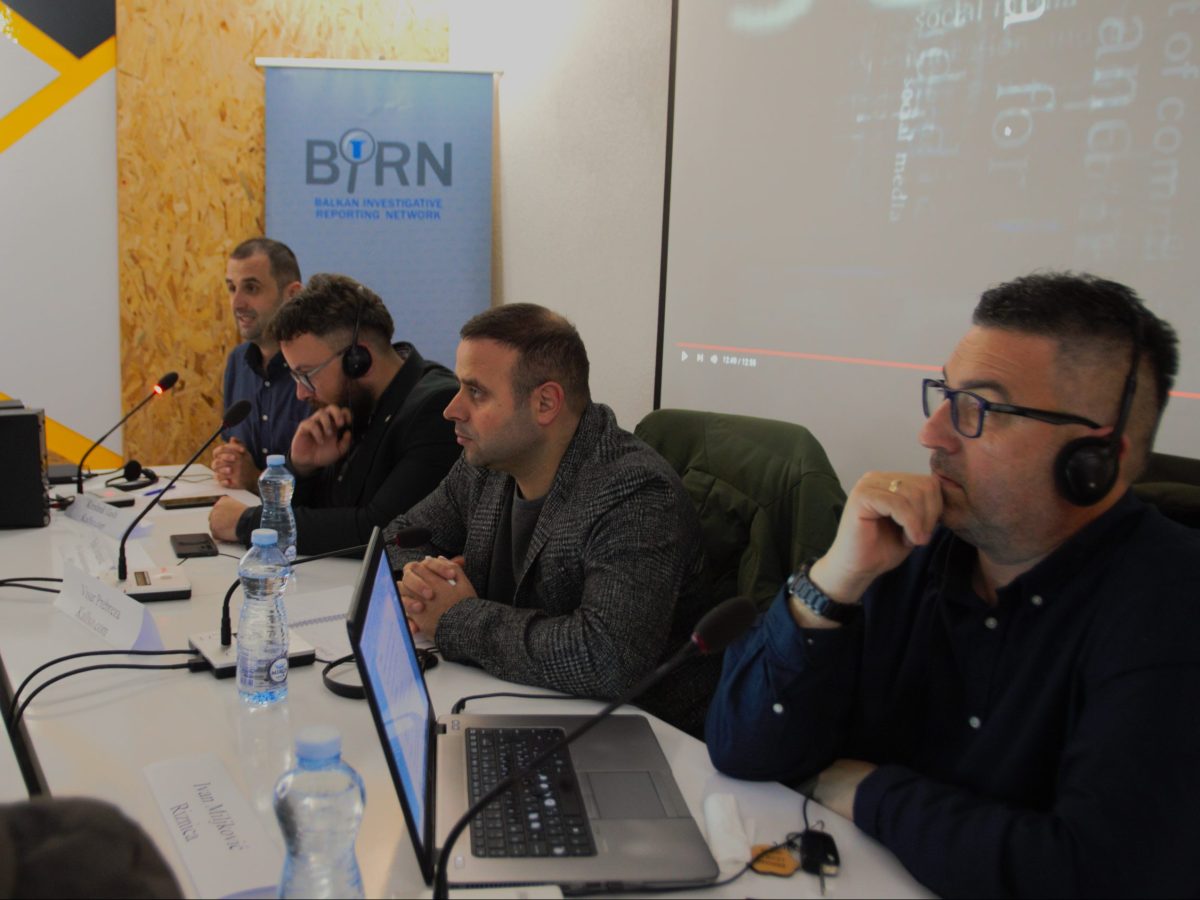
BIRN Kosovo held a training course on November 12 entitled ‘Fact-Based Journalism and Media Literacy’, organised in cooperation with Gracanica Online.

The training brought together 15 Albanian and Serb journalists representing media such as Radio Television of Mitrovica, Gracanica Online, Kossev, Veriu Info and Radio Gorazdevac, and students from the Isa Boletini University of Mitrovica’s Faculty of Law and from North Mitrovica.

Participants had the opportunity to learn about topics such as advanced international fact-checking standards, techniques for fact-checking current affairs, reporting discrimination and promoting media literacy through traditional and online media.

The training was delivered by BIRN editors Kreshnik Gashi and Visar Prebreza, who have extensive experience in carrying out investigations and reporting, as well as providing training for media and relevant stakeholders.

Professor Islam Qerimi, acting dean of the Isa Boletini University of Mitrovica’s Faculty of Law, was a guest speaker.

In his presentation, Qerimi said that such training sessions are an important tool for law students to gain practical experience in researching current affairs from a legal perspective.

The training was organised as part of the ‘Addressing Misinformation Through Fact-Based Journalism’ project, which is implemented by BIRN Kosovo and supported by UNMIK.

The aim of the project is to contribute to combating the spread of fake news and disinformation in Kosovo by raising the general public’s awareness of these phenomena, while promoting and supporting fact-checking journalism.


EU Investigative Journalism Award Winners for 2022 announced during EU Western Balkans Media Conference in Tirana

Established in 2015, the EU Investigative Journalism Awards in the Western Balkans and Turkey, continues to celebrate and promote the outstanding achievements of investigative journalists as well as the visibility of quality journalism in the Western Balkans and Turkey.

The call was opened during mid-April to mid-March 2022 for awards for investigative stories published during 2021 related to freedom of expression, rule of law, transparency, abuse of power and fundamental rights, corruption and organised crime.

Individuals or groups of journalists were invited to apply with their stories, eligible in any journalism forms (print, online, radio and TV), published or broadcast in the media in each country in official, minority or international languages.

The award fund in each of the six Western Balkans countries and Turkey amounted to €5,000 for the first prize, €3,000 for the second and €2,000 for the third prize.

On Thursday, 10 November, during the EU Western Balkans Media Conference in Tirana, award winners were announced. The jury comprised media experts, some of them from the project consortia and others from the extensive network that the project consortium members have, such as editors, members of academia and journalists with merits.

The following individuals and groups of journalists were awarded:

Albania

  • 1st prize, Klodiana Lala, “Albanian Crime Story: Hostage to the Cocaine Supply Chain”.
  • 2nd prize, Dorian Kodra, How is Rilindja Monitoring Phone and ID Numbers, Workplaces and Other Confidential Data of 910,000 Voters of Tirana”.
  • 3rd prize, Ola Mitre, “Chromium in Bulqiza is Extracted Without an Environmental Permit”.

Bosnia and Herzegovina

  • 1st prize, Mubarek Asani and Jelena Jevtić, “The Boss and Her ‘Black Shirt’ Mob”.
  • 2nd prize, Amarildo Gutić, “Battle for the Political Commissioner”.
  • 3rd prize, Adna Zilić, “Police Uniform Requirements Tailored For Private Businessmen”.

Kosovo

  • 1st prize, Kreshnik Gashi, Visar Prebreza and Bahar Mustafa with a series of stories: ”The Justice on the Market”, “‘The North File”, The Link Between the Company Which is on US Blacklist and the Investments in Ulcinj” and “Racketeers File: The Judge Negotiates the Case”.
  • 2nd prize, Besnik Krasniqi with a series of stories: “Let’s ‘Clean’ the Budget”, “’Cleaning’ of Hundreds and Thousands of Euros With Gloves and Masks”, and “Garbage in Kosovo, Wages in Pockets”.
  • 3rd prize, Besnik Boletini and Xhavit Drenori, with “Daily Contamination”.

Montenegro

  • 1st prize, Mihailo Jovović, “A Series of Stories on Secret Flights of the President of Montenegro, Milo Đukanović”.
  • 2nd prize, Đurđa Radulović, “A Series of Stories on Wildfire Season in Montenegro”.
  • 3rd prize, Vladimir Otašević and Marko Vešović, “Secrets of Crime – The Murder of Duško Jovanović”.

North Macedonia

  • 1st prize, Irena Karevska, “Raškovski Bought Software for Traffic Fines, Which the Ministry of Interior Does not Know About and Certainly Does not Plan to Use”.
  • 2nd prize, Miroslava Byrns, “Case of Jaldz Veaposka, Woman in Labour Who Lost Her Uterus, Ovary and Kidney in Struga Hospital”.
  • 3rd prize, Snežana Lupevska Sozen, Miomir Serafinović, Biljana Nikolovska and Emilija Misirljevski, “Penalties for Traffic Accidents With Fatal Consequences by Necessity, Not by Law”.

Serbia

  • 1st prize, Stevan Dojčinović, Milica Vojinović, Bojana Pavlović, and Bojana Jovanović, “Series of Articles on Serbian Gang Led by Veljko Belivuk”.
  • 2nd prize, Jovana Gligorijević, “Conspiracy of Silence Lasted for a Long Time – Sexual Harassment at the Petnica Science Centre”.
  • 3rd prize, Saša Dragojlo, “People Smuggling: Money, Violence, and Ties to the Security Services”, and Aleksandar Đorđević and Miodrag Marković, “A Series of Stories on Corrupt Mechanism in the Electric Power Industry of Serbia”.

The awards are a continuation of the ongoing regional EU Investigative Journalism Awards in the Western Balkans and Turkey and part of the ongoing project, “Strengthening Quality News and Independent Journalism in the Western Balkans and Turkey“, funded by the European Union and administered by BIRN Hub and its partners: Independent Trade Union of Journalists and Media Workers in the North Macedonia, Center for Investigative Journalism in Montenegro, MASE, BIRN Albania, BIRN Serbia and the Association of Journalists from Ankara, Turkey.

Since its launch, including this year, a total of 147 prizes were awarded to outstanding journalistic efforts in six Western Balkan countries and Turkey, promoting media freedom and importance of investigative work and exposing wrongdoings in countries where independent media is more important than ever.


EXTENSION: Open Call for Audience-Engaged Journalism Grants

Media outlets from Albania, Bosnia and Herzegovina, the Czech Republic, Hungary, Kosovo, Montenegro, North Macedonia, Poland, Serbia and Slovakia that want to engage the public in their investigative reporting are invited to apply for Audience-Engaged Journalism Grants.

Balkan Investigative Network (BIRN) is extending a call for applications. BIRN is inviting media outlets interested in connecting with their audiences and reporting on original stories that will make an impact to apply for Audience-Engaged Journalism Grants.

Individual grants will be awarded to selected media outlets that wish to cover national/regional/local topics on their own. Collaborative grants will be awarded to selected media outlets that want to investigate cross-border issues with a media partner.

Audience-engaged reporting, in which ordinary people’s voices are heard and unresolved issues are tackled, has proven a game-changer. Using it helps media outlets to listen to these voices and report on essential topics for their communities while bringing innovation to their investigative reporting and newsrooms.

Audience-Engaged Journalism Grants support media outlets that want to engage their audiences in reporting by providing them with training and mentorship in engagement journalism and usage of the B-Engaged tool, developed by BIRN.

Audience-Engaged Journalism Grants are part of the Media Innovation Europe project managed by a consortium led by the Vienna-based International Press Institute. The consortium includes the Kyiv-based Media Development Foundation, the Berlin-based Thomson Foundation and BIRN.

Ten (10) successful applicants will receive grants based on this call.

BIRN will grant €4,000 to five (5) successful applicants interested in making an individual audience-engaged story.

BIRN will grant €5,000 to five (5) successful applicants interested in making a cross-border collaborative story.

If you already know a media partner with whom you want to work on a cross-border story, you will receive €10,000 to cover expenses for both partners involved. If you are interested in investigating a cross-border story but don’t have a partner, BIRN can find you a matching media outlet.

Content may include news, analysis, investigations etc, and can be in any form – text, audio, video. The content must be promoted through the outlets’ social media channels.

The selected grantees will undergo a four-day training programme that will be offered online, as well as on-the-job mentoring by BIRN editors on how to use and implement innovative, effective audience-engagement tools for investigative community-based reporting.

The participating media will receive training in the use of the B-Engaged tool, an online tool developed by BIRN that enables the direct engagement of members of the public who are interested in sharing information and evidence related to issues they are facing.

Through training and mentoring, media outlets will also learn:

how to select engaging topics;

what is important to the audience;

how to develop a callout;

how to analyse crowdsourced data;

how to incorporate data in stories,

and how to shape a story according to engagement journalism standards.

The call is open until November 4, 2022, midnight CET.

To read the full call for application click here.

To apply for a grant, use the online application form and send us a proposal for a story and the required documents.

Follow BIRN on Facebook, Instagram and Twitter to get more notifications.

Co-funded by the European Union. Views and opinions expressed are however those of the author(s) only and do not necessarily reflect those of the European Union or European Commision. Neither the European Union nor the granting authority can be held responsible for them.


Meet the People Behind BIRN: Sinisa-Jakov Marusic

Each month, BIRN introduces you to a different member of its team. For October, meet Sinisa-Jakov Marusic Editor and North Macedonia Correspondent at BIRN’s flagship English-language website Balkan Insight.

Sinisa, 42, is half Croat and half Macedonian. He studied literature and anthropology but finished journalism. He has worked as a journalist for 17 years and this year celebrates his 15 years’ anniversary in BIRN.

Sinisa told us about his work and Balkan Insight’s virtual newsroom where differences become familiar commonalities, his favorite BIRN’s “Happy Friday” mantra, his noisy keyboard and BIRN’s new endeavor “European Focus” – a weekly newsletter published by Balkan Insight and nine European Media such as Domani, Delfi, Tagesspiegel, Hvg.hu, El Confidential, Gazeta Wyborcza, Liberation, and N-ost.

Let’s meet him:

  1. What do you like most in your job, and what is the most challenging thing?

Coming from a small country, born before the internet was a thing, who experienced first-hand as a teenager the breakup of former Yugoslavia and the isolation of the country that followed during the 1990s, not only from Europe, but from the immediate neighbors as well, to this day I consider it as my biggest achievement that through my work I have expanded my horizons and managed to keep the door with the outside world open.

Nothing makes me happier than the notion that I get to share and communicate daily with a group of talented people from so many different countries who work at BIRN, and realizing how many commonalities we actually share, both personal and societal. And whenever we  meet in person, it’s a joy. It is a great asset to have in my career, sure, but it also makes me genuinely grateful.

As for the most challenging aspect, it is connected to the most joyous one. It is hat I work from home, or from a corner at my home that I’ve transformed into an office.

It is a blessing for some and a curse for others. For me it is a bit of both. Any journalist would tell you that it could be very challenging at times not sharing an actual physical space with your colleagues.

It helps a lot when you share your worries, laughs and “buying” or “selling” ideas with people in person. It eases up the day, nudges you in the right direction and motivates you to be better than yesterday. It is a base where you go to and you return to after each battle, to replenish your energy and motivation. If nothing else, it helps a person writing for a living, not getting stuck too much in his or her own head. Sadly, that natural human interaction that we all crave for is a little bit lost on the internet.

  1. Can you share a good memory of when you were on duty?

Being a duty editor in Balkan Insight sometimes resembles being a flight controller at the airport. You have to sort each article that flies your way, find its angle and place on the website and make it land well with the readers, while always multitasking and having the bigger picture in mind.

Having said that, I am happy to say that I have one good memory that reoccurrs each week. It is the “Happy Friday” exclamation each Friday at the morning editorial meeting that our Editor-in –Chief, Dusica Tomovic makes. I am fully aware that to an outsider this may sound totally lame. That’s OK. But for me it is a stress relief pill, acknowledgement that we are still here, we have almost made it through the stresses of the working week and a reminder to look forward to turning the “autopilot” at least for a while during the weekend.

  1. Besides your work, you are mostly known among people in BIRN as the editor with the noisy keyboard. Are you planning to change your keyboard?

I recently decided to look for a better keyboard. I figured out that for a person that spends so much time in front of the PC, a nicer keyboarded experience may be worth it. But to my horror, after paying an arm and a leg for a very expensive mechanical keyboard, I found out that the same soothing clicky sounds that my keyboard makes are the very sounds that annoy my colleagues when on a call.

I have to be honest. I have already spent my allowance for keyboards for the foreseeable future, and going back to the generic membrane keys of the old one is out of the question. So, sorry guys but no. I am not planning to change it.

I hope, though, that an ambient noise canceling software may help, and I pledge to look into it.

  1. Balkan Insight together with nine European media outlets publish together a weekly newsletter called “European Focus”. Tell us more about this cross-border initiative and its main scope

We started with the premise that Europe is not just Brussels, and surely not just the European Union nations, and that through cooperation with some of the best informative outlets across the continent, we can try to understand our common home a bit better.

We felt that while our nations share common challenges, national media alone are often not enough to offer European audiences the bigger European picture and often not able to connect the topics and discussions that are moving Europeans.

So we set up to try and offer this wider perspective that we feel our readers deserve. Thus, together with Tagesspiegel, El Confidencial, Liberation, Domani, Delfi, HVG.hu, Gazeta Wyborcza and N-OST we launched our joint weekly free of charge newsletter to cover topics that connect or affect us all and to exchange our different perspectives on them.

Our newsletter has five brief original pieces, which we also republish in the local languages of our different print and online publications to bring a variety of perspectives to our readers. And our hope is that this will enrich the essential debate in our joint European space.

  1. Each week journalists from nine different European newsrooms meet and decide European Focus’s context; how easy or difficult is this?

In professional terms, it is never easy to produce a good, well thought of, digestible yet informative and helpful newsletter. But we are not short of professional and enthusiastic colleagues from all corners of Europe, and not just from the aforementioned media outlets and organizations. So this enthusiasm and will to collaborate showed right from the start at our editorial meetings.

We are never short of ideas either. One colleague inspires another to try to look for similarities or differences in his or her own country, different angles, positive or negative examples. And just as we are thrilled, finding out new things and connecting the dots, we are sure that our readers will find the product of our work equally interesting and informative.

At the end of the entire process, of course, we have to decide on the topic of the week so we simply vote. It is plain and simple and as democratic as can be. Then we produce each newsletter jointly with a weekly rotating a team of five journalists and editors-in-chief.

  1. What kind of stories do you choose to present to the readers? How can you make multicultural readers be interested in these stories?

I must say, at the beginning of our cooperation, when we were still at the planning stage, we never imagined that the launch of our newsletter would coincide with the serious effects of the Russia aggression of Ukraine that has affected us all, from concerns about our security, to soaring fuel, electricity and food prices, all the way to how all these things fuel social and political movements in our countries.

And while at the beginning we felt, and still feel, compelled to tackle some of these issues that are undoubtedly shared among us all, causing great headaches but also inspiring great feats, we never feared that a European-focused newsletter could run out of topics, crisis or no crisis.

Be it the debate on EU enlargement, or the climate challenges or the worrying spread of wildfires this summer that showed that even countries like the UK are not unfazed by it, our Europe is simply too interesting to ignore, for good or for ill.

So we see the multiculturalism, multi-ethnicity and multi-confessionalism of our readers not as an obstacle but as our advantage. That is the whole point and our distinct European advantage, being able to compare, pinpoint the similarities, acknowledge the differences and simply try to learn from each other.

That was the thing that made us launch this newsletter and I believe that will be the thing that will keep our readers interested.


Bellingcat and BIRN Albania Hold Training on Far Right and OSINT

Two dozen journalists from national media in Albania participated on October 19 and 20 in a two-day training course on investigating far-right extremism and open search research methods.

The training was organized by the Bellingcat international collective of researchers, investigators and citizen journalists and the Balkan Investigative Reporting Network BIRN in Albania.

The training in Tirana was delivered by Bellingcat journalist Michael Colborne and investigator and researcher Foeke Pastma.

Colborne leads Belllingcat’s project to research and monitor the far-right in Central and Eastern Europe. He shared with local journalists in Albania his experience on how to understand the far right in international and different domestic contexts and how to apply open source intelligence OSINT techniques in researching extremist groups.

Meanwhile, researcher Foeke Postma spoke on geolocation and open search techniques in the internet and how to set up passive research accounts on social networks.

Among the topics covered were also facial recognition and social media networks research, as well as archiving and digital footprint tracing.

BIRN Holds Visual Storytelling Workshop for Youngsters Interested in Transitional Justice

Eleven youngsters from Bosnia and Herzegovina, Croatia, Montenegro, Kosovo, and Serbia met in Sarajevo to learn about using war crimes archives in visual storytelling.

From 20-21 October, 11 youngsters from all over the Balkans met in the Bosnian capital Sarajevo for the “Visual Storytelling Using War Crime Archives” workshop organised by Balkan Insight’s Transitional Justice program.

With the help of Denis Dzidic, director of BIRN BiH and Lamija Grebo, journalist for BIRN BiH, and Nejra Mulaomerovic, programme associate for BIRN BTJ, they learned how to use war crimes archives and how to conduct interviews. Azem Kurtic, journalist for BIRN Hub, held a full-day workshop covering visual storytelling and video-making principles.

With the help of the trainers, the participants watched and analysed previous work that BIRN published on this topic, like “44 Months Under Siege” and “Lives Behind the Fields of Death”.

“These stories are a way to heal together beyond borders and nationalities. It’s nice to see people doing these kinds of projects, and putting in the effort, it’s inspiring. But it makes you wonder why nobody else is doing this,” reflected a participant. 

All these tools and knowledge will come in handy for the second part of the workshop, which starts when they travel back home. Each of them will produce two short video interviews with people who survived the wars in the former Yugoslavia.

The best five applicants will be selected for a one-month exchange programme in 2023 in Sarajevo. This will enable the participants to foster closer networks, learn more about different facets of the war, gain skills and do more research into court archives.

In the previous edition of this project, held last year in Tuzla from July 25-29, 2021, ten young people from Albania, Bosnia and Herzegovina, Montenegro, North Macedonia, and Serbia also produced interviews with war crime survivors. The whole playlist can be found here.


BIRN Grantee Trains Kosovo Journalists to Research War Crime Archives

A BIRN grant recipient trained journalists in Kosovo how to explore the archives of the International Criminal Tribunal for the Former Yugoslavia and domestic courts in ex-Yugoslav countries that deal with war crimes cases.

Amer Alija, one of 13 recipients of grants from the Balkan Investigative Reporting Network to create small projects based on the archives of the UN war crimes tribunal, held a workshop for young journalists in Pristina on Thursday about how to research Kosovo war crimes in court archives.

“Documents administered by courts provide many details and insights into historical events that researchers and journalists can use to tell the truth, using official documents and sources,” Alija, a legal analyst at the Humanitarian Law Centre Kosovo, told the journalists.

His workshop was divided into two sections: lectures on the history of trials for crimes committed during the 1998-99 Kosovo war, and training on using the International Criminal Tribunal for the Former Yugoslavia, ICTY’s database and the databases of Kosovo and Serbian courts dealing with war crimes cases from the Kosovo war.

Alija talked through the events of the Kosovo war, the forces involved and the difference between war crimes and crimes against humanity.

He explained that crimes related to the Kosovo war have been tried in five different types of courts including the ICTY, Kosovo’s domestic courts, Serbian courts, Montenegrin courts and the Kosovo Specialist Chambers, a hybrid court that exists within Kosovo legal system but is located in The Hague and is trying former KLA members.

He said that there are 11 cases currently ongoing in Kosovo’s domestic courts and three at the Specialist Chambers.

He also said that contrary to common belief and reporting in Kosovo’s media that such cases are unpunished, five people have been convicted of bearing responsibility for sexual violence during the Kosovo war.

In the second part of the workshop, Alija showed the journalists how to do research in the ICTY’s database of court documents that include indictments, testimonies, official state documents, photographs and other documents admitted in court.

He also provided documents and step-by-step guides for using the ICTY database and domestic courts’ and non-governmental organisations’ databases in former Yugoslavi countries.

Alija showed the journalists how, by opening an account for the ICTY database, they can find more information about specific massacres during the war or particular war crimes by reading the indictments of individuals who have been tried already and the evidence from their trials.

Nejra Mulaomerovic, programme associate at BIRN’s Balkan Transitional Justice programme, said that archives play an important role in ensuring that the past is properly documented.

“The archives themselves are not a guarantee of the non-recurrence of conflicts, but if they are used by various actors from different research and academic backgrounds, they can contribute to raising awareness and can be used as tools to spark dialogue and inspire others to continue their efforts to seek justice and truth,” Mulaomerovic said.

BIRN’s other grantees have been exploring topics such as gender-based violence, Roma war victims, wartime sexual violence, the experience of women in conflict and the role of photography in prosecuting war crimes.


Freedom of Information in the Balkans: No Access and no Progress

Regional public institutions still need to improve their records on freedom of information and their transparency and accountability. Institutional silence remains a widespread problem, a BIRN panel discussion heard.

Even though almost all Western Balkan countries have excellent written Freedom of Information laws, they are mostly on paper. State institutions still need to improve regarding Freedom of Information (FOI) requests, speakers from the region told BIRN’s panel discussion, “Freedom of Information in the Balkans: No political will, no access, no progress”, held on Wednesday.

Political will is as important as laws, and public authorities need to make more progress with FOI requests, agreed speakers at the event, at which BIRN’s annual freedom of information report was officially launched.

 Saša Dragojlo, a BIRN journalist from Serbia, told the panel discussion that the laws are good only in theory. „The key word is political will. In our societies, it is much more important than laws”, Dragoljo said. Although the new law Serbia implemented last year is an improvement, if public institutions do not answer FOI requests, journalists will submit fewer of them. They will try to gather information unofficially, and that is a danger, he told the panel.

Helen Darbishire, executive director for Access Info Europe, said political will is often an individual decision, which leads to different reactions from even the same institutions. „In some countries, we have seen progress. Journalists tend to ask for more controversial pieces of information, therefore, have different impressions than the rest of the public. That’s not the way it should be,” Darbishire said.

Elona Hoxhaj, General Director of the Right to Information in Albania, told the panel that, „although much progress has been made towards transparency, civil servants are still unaware of their obligation towards the press and the public, so they question the requests”. The Information and Data Protection Commissioner’s Office is actively working with the Albanian school of public administration.

The Agency for Personal Data Protection and Free Access to Information in Montenegro also helps public servants and journalists. But it is struggling to deal with more than 6,100 appeals, the Head of the Department for Free Access to Information said. „Some first-instance bodies don’t have enough money to have websites, so despite their goodwill, they are unable to publish public information”, Biljana Božić described the situation.

All Western Balkan countries have problems, the panel heard. In Bosnia and Herzegovina, there is a need for a strong, independent body monitoring the implementation of a new law submitted last year. In Kosovo, the local agency aims to raise awareness of public institutions that providing access to public information is obligatory.

In Serbia, one of the most significant problems is the so-called „silence of the administration”. „The common goal for all of us, both in the region and in Serbia, should be zero tolerance”, Serbia’s Commissioner for Information of Public Importance and Personal Data Protection, Milan Marinović, wrote in a statement sent to the panel.

According to BIRN’s annual Freedom of Information report, this institutional silence is one of the most critical problems in the region. Monitored institutions from Albania, Bosnia and Herzegovina, Kosovo, Montenegro, North Macedonia and Serbia continue to struggle with implementing their own Freedom of Information laws. They are failing to become more transparent and accountable to their citizens.

BIRN’s annual FOI report is part of the „Paper Trail to Better Governance” project, funded by the Austrian Development Agency.


Freedom of Information in the Balkans: No access and no progress

Balkan Investigative Reporting Network, BIRN, will present its annual Freedom of Information Report in an online event on Wednesday, October 19.

The panel, including representatives from the Freedom of Information commissioner’s offices from several countries in the region, will discuss main findings of the report: that politics in the Balkans has a significant influence on access to information.

The report is part of BIRN’s ongoing project, A Paper Trail to Better Governance, whose main aim is monitoring access to information and exposing wrongdoing through country-based and cross-border investigations.

Speakers:

Krenare S. Dermaku, Commissioner of the Information and Privacy Agency, Kosovo

Besnik Dervishi, Commissioner for the Right to Information and Personal Data Protection, Albania

Irma Hadžiavdić, Deputy Ombudsperson, Bosnia and Herzegovina

Biljana Božić, Head of Department for Free Access of Information, Montenegro

Cvetan Stanoeski and Makfirete Morina Sulejmani, lawyers, Agency for Protection of the Right to Free Access to Public Information, North Macedonia

Helen Darbishire, Executive Director, Access Info Europe

Shengyl Osmani, author of BIRN’s Freedom of Information in the Western Balkans report in 2021: “No political will, no access, no progress”.

Moderator of the event: Ivan Angelovski, BIRN Investigations Editor

Date and time: Wednesday, October 19., 1400 CET

Zoom link: https://us06web.zoom.us/j/82662905904?pwd=Z2dKZTJoeGo4RjB0Rytwck11VlUwdz09

The report will be available on https://bird.tools/publications/ after the official launch event.


Open Call: Third Cycle of the Digital Rights Programme for Journalists

Journalists from Bosnia and Herzegovina, Montenegro, North Macedonia, Serbia, and Kosovo are invited to apply for the third edition of BIRN’s Digital Rights Programme, which seeks to analyse threats to digital rights and freedoms and to document, explore and communicate to the wider public the abuses of digital tools to undermine democracy and human rights.

BIRN is looking for people who want to create engaging and informative content focusing on technology and the opportunities and challenges it poses to democracy and human rights, in particular:

  • Freedom of expression,
  • COVID-related tech regulations,
  • Content blocking and removal,
  • Artificial intelligence, machine-learning and algorithmic decision-making processes,
  • Transparency of processes of digital transformation in the region,
  • Hate speech and discrimination in the digital environment,
  • Gender issues,
  • LGBTI+ issues,
  • Digital security and phishing campaigns,
  • Privacy and data protection,
  • Surveillance practices,
  • Accountability of the major internet platforms and online safety of users,
  • Information security,
  • Disinformation and misinformation,
  • 5G technology in the region,
  • Cryptocurrencies/blockchain,
  • Social media bots and troll farms.

BIRN offers a comprehensive six-month programme for all accepted applications, which includes:

  • Financial support ($1,325 gross),
  • Regular networking opportunities,
  • Meetings with relevant stakeholders dealing with digital transformation challenges and freedom of expression,
  • On-the-job mentoring and editorial sessions to produce high-quality journalism and educational sessions focused on digital security for media.

Support is available for professional freelance or staff journalists to cover local, national and cross-border topics. The stories produced under the programme will be published by Balkan Insight and by prominent European, regional and international media outlets.

Click here to apply for the programme.

The call is open until October 31, 2022.

Who can apply?

The programme is open to all journalists who believe they have a good story concerning the health of the digital ecosystem in the Bosnia and Herzegovina, Montenegro, North Macedonia, Serbia, and Kosovo . We also welcome applications from staff reporters from local and national media who wish to co-publish the story with us.

Formal applicants can be:

  • Individual journalists (working as part of newsroom structures or as freelancers),
  • Teams (eg. reporter, producer, photographer, video editor) with a designated team leader as the contract signatory.

BIRN is committed to gender diversity and freedom from prejudice on any grounds.

Story requirements

  • The story must focus on at least one of the topics listed above,
  • It must be relevant and current to Bosnia and Herzegovina, Montenegro, North Macedonia, Serbia, and Kosovo ,
  • Stories that cover more than one country will be given an advantage,
  • Only in-depth, investigative stories will be taken into account,
  • Each story should be around 2,000 words long,
  • Each selected story must be published within six months of receipt of the first instalment.

How to apply?

Fill out the application form and follow the instructions.

Attach the signed declaration document.

Evaluation and selection:

Step I: Technical evaluation will be carried out by BIRN staff to ensure the applicants have followed application procedures and submitted all the required documents.

Step II: Evaluation will be carried out by the editorial board to select applicants based on the evaluation criteria, including:

  • Quality of the proposed idea,
  • Feasibility of the proposed plan,
  • Ability to reach the general public,
  • Relevance of the proposed idea.

Step III: Notification of applicants.

For additional information, please contact [email protected]

The Digital Rights Programme for Journalists is made possible through support from the UN Democracy Fund, Internews and Swedish International Development Cooperation Agency.